Nikko Toshogu Shrine in Nikko City, Tochigi Prefecture, is home to carvings that many Japanese people know from their school textbooks, such as Yomeimon Gate, the Sleeping Cat, and the Three Wise Monkeys. In this article, I introduce the highlights with photos in the order I walked them in autumn 2023: from Shinkyo Bridge up the main approach to the Five-Story Pagoda, Yomeimon Gate, Karamon Gate, the Sleeping Cat, and the Okumiya.
The opening hours, admission fees, and parking information were checked on the official Nikko Toshogu website (checked on October 27, 2026). I aimed to write an article that shows first-time visitors where to go and what to see at Nikko Toshogu.
- Nikko Toshogu Basics (Opening Hours, Admission, Access)
- Shinkyo Bridge: The Vermilion Bridge at the Entrance to the Shrines and Temples of Nikko
- The Main Approach, the Stone Torii, and the Five-Story Pagoda
- The Nio Statues of the Omotemon Gate and the “Imaginary Elephants”
- Yomeimon Gate: The “Higurashi-no-mon” with More Than 500 Carvings
- Karamon Gate and the Shin’yosha
- The Sleeping Cat and the Okumiya
- A Short History of Nikko Toshogu
- Summary: The Order for Touring Nikko Toshogu
Nikko Toshogu Basics (Opening Hours, Admission, Access)
First, here is what you should know before you go. Opening hours change with the season, and in winter the shrine closes one hour earlier, so please be careful.
| Opening hours | April 1 – October 31: 9:00–17:00 November 1 – March 31: 9:00–16:00 Admission until 30 minutes before closing |
| Admission (individuals) | Adults and high school students 1,600 yen Elementary and junior high school students 550 yen |
| Treasure Museum | Separate from the shrine admission (adults and high school students 1,000 yen). A combined ticket with Toshogu is 2,400 yen for adults and high school students |
| By train | About 1 hour 50 minutes from Asakusa to Tobu-Nikko Station on the limited express “Kegon” About 2 hours from Shinjuku to Tobu-Nikko Station on the JR limited express “Nikko” |
| From the station | About 10 minutes by bus from Tobu-Nikko Station; get off at “Omotesando” |
| By car | About 2 km from Nikko IC on the Nikko-Utsunomiya Road Toshogu Large Parking Lot (200 regular cars; 600 yen for regular cars) |
*Checked on October 27, 2026 on the official Nikko Toshogu website (Access) and the Tobu Railway Nikko Area Map. Some areas may be closed to visitors because of festivals or repairs, so please check the official website before you go.
The admission ticket covers the Omotemon Gate, Yomeimon Gate, the Worship Hall (Haiden), the East Corridor with the Sleeping Cat, the Okumiya, the Honjido Hall with the Crying Dragon (Nakiryu), and more. The Treasure Museum and the Art Museum charge separate fees.
Shinkyo Bridge: The Vermilion Bridge at the Entrance to the Shrines and Temples of Nikko
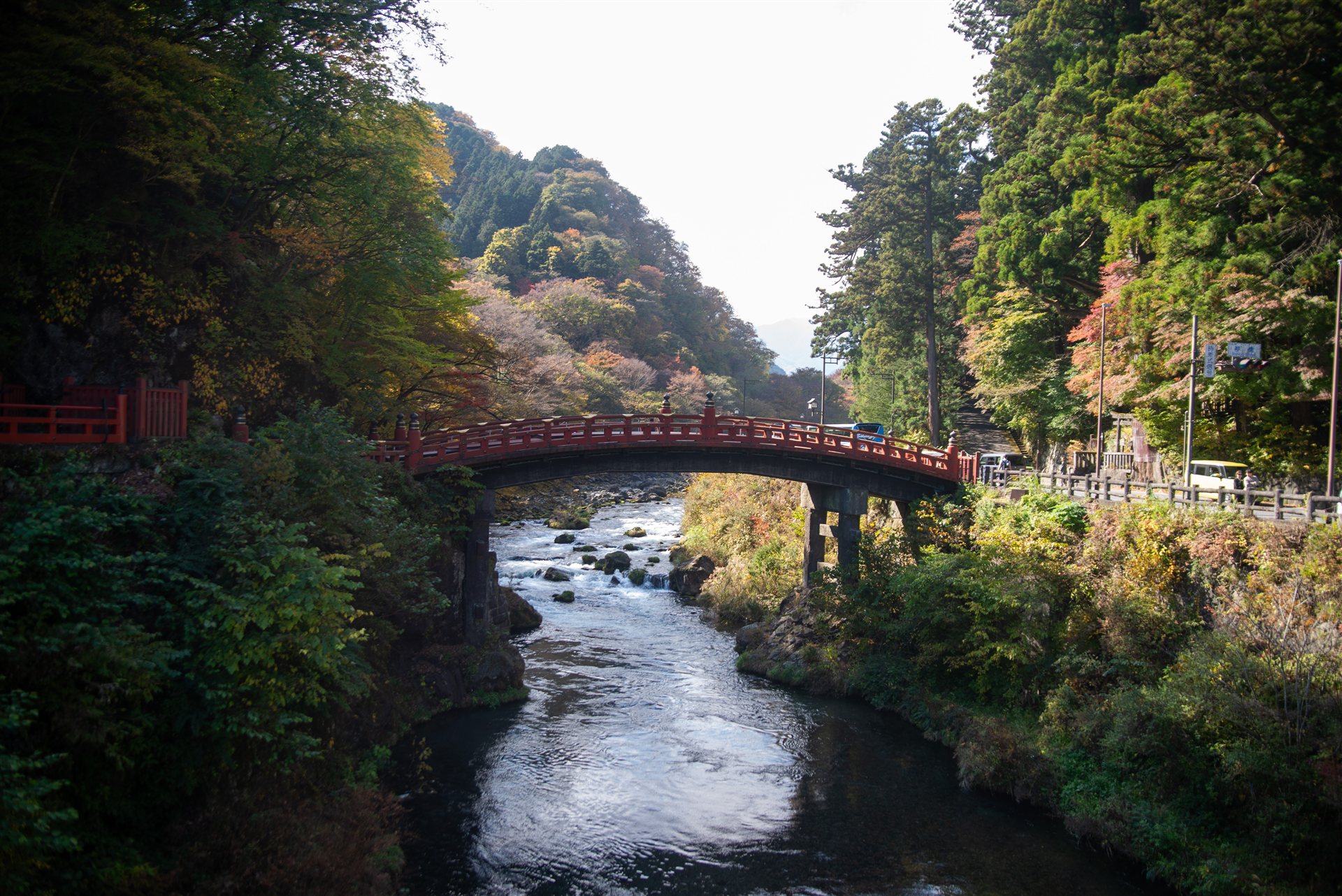
The vermilion Shinkyo Bridge over the Daiya River. The mountains behind it were starting to change color.
As you walk up the slope from Tobu-Nikko Station, the first thing you see is the vermilion Shinkyo Bridge. Nikko City’s World Heritage guide describes it as an arched wooden bridge at the entrance to the sacred area called Nikko Sannai. Shinkyo Bridge belongs to Futarasan Shrine and, together with Toshogu and Rinnoji Temple, is part of the World Heritage Site “Shrines and Temples of Nikko.”
It is about 5 minutes by bus from Tobu-Nikko Station, right next to the “Shinkyo” bus stop. There is a fee to walk across the bridge.
Adults 300 yen / High school students 200 yen / Elementary and junior high school students 100 yen
April–October: 8:30–16:30 (last entry around 16:00)
November–March: 9:30–15:30 (last entry around 15:00)
Shinkyo Bridge can also be seen from the roadside, so many people just take photos without crossing it. In autumn, the trees on both banks of the river turn color and go beautifully with the vermilion bridge.
I went during the autumn foliage season, and it was very beautiful. It is a spot I really want you to see.
The Main Approach, the Stone Torii, and the Five-Story Pagoda
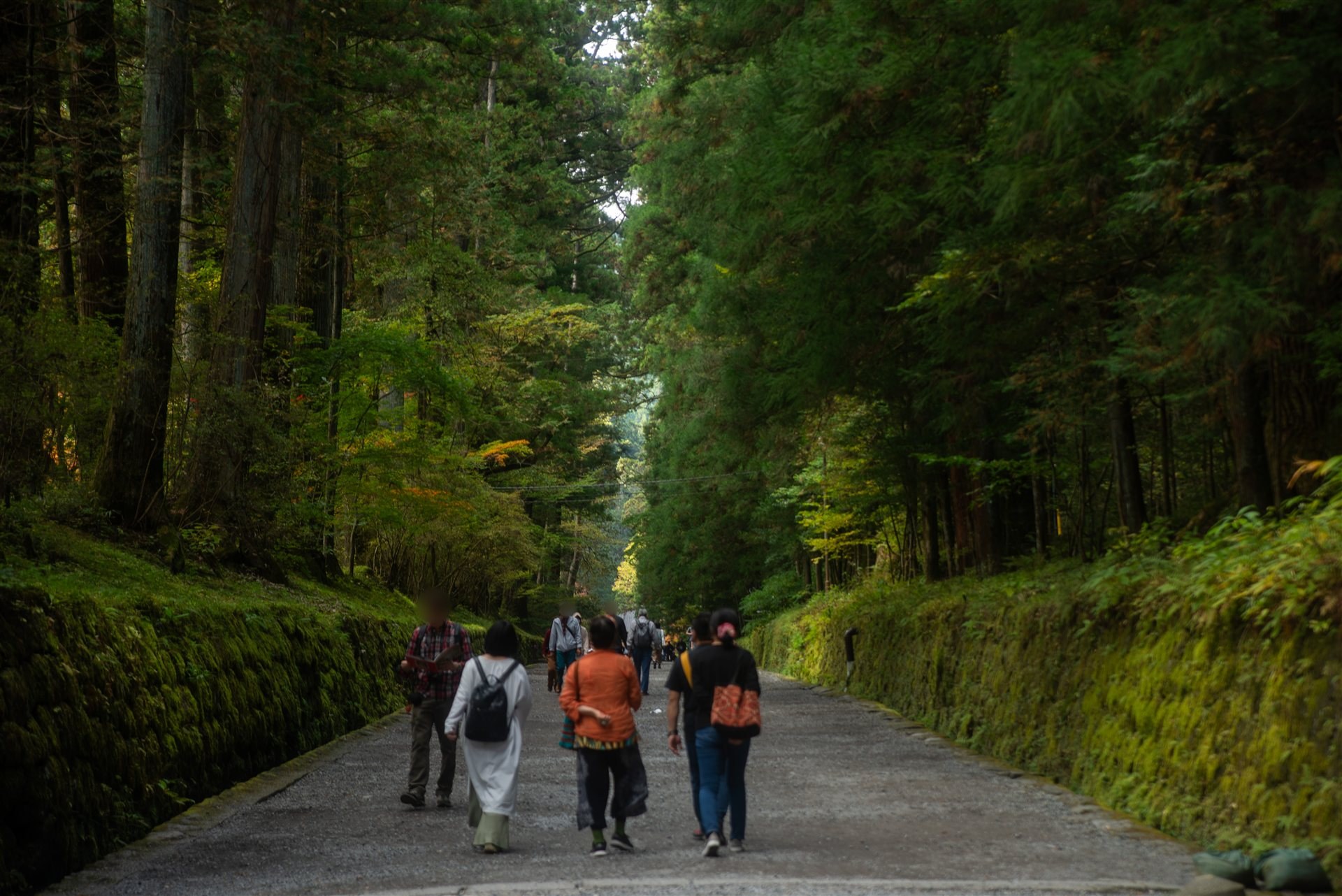
The approach to Toshogu, lined on both sides with tall cedar trees.
From Shinkyo Bridge, you climb toward Toshogu along an approach surrounded by huge cedar trees. The stone walls are thickly covered with moss, a scene that feels very much like Nikko.
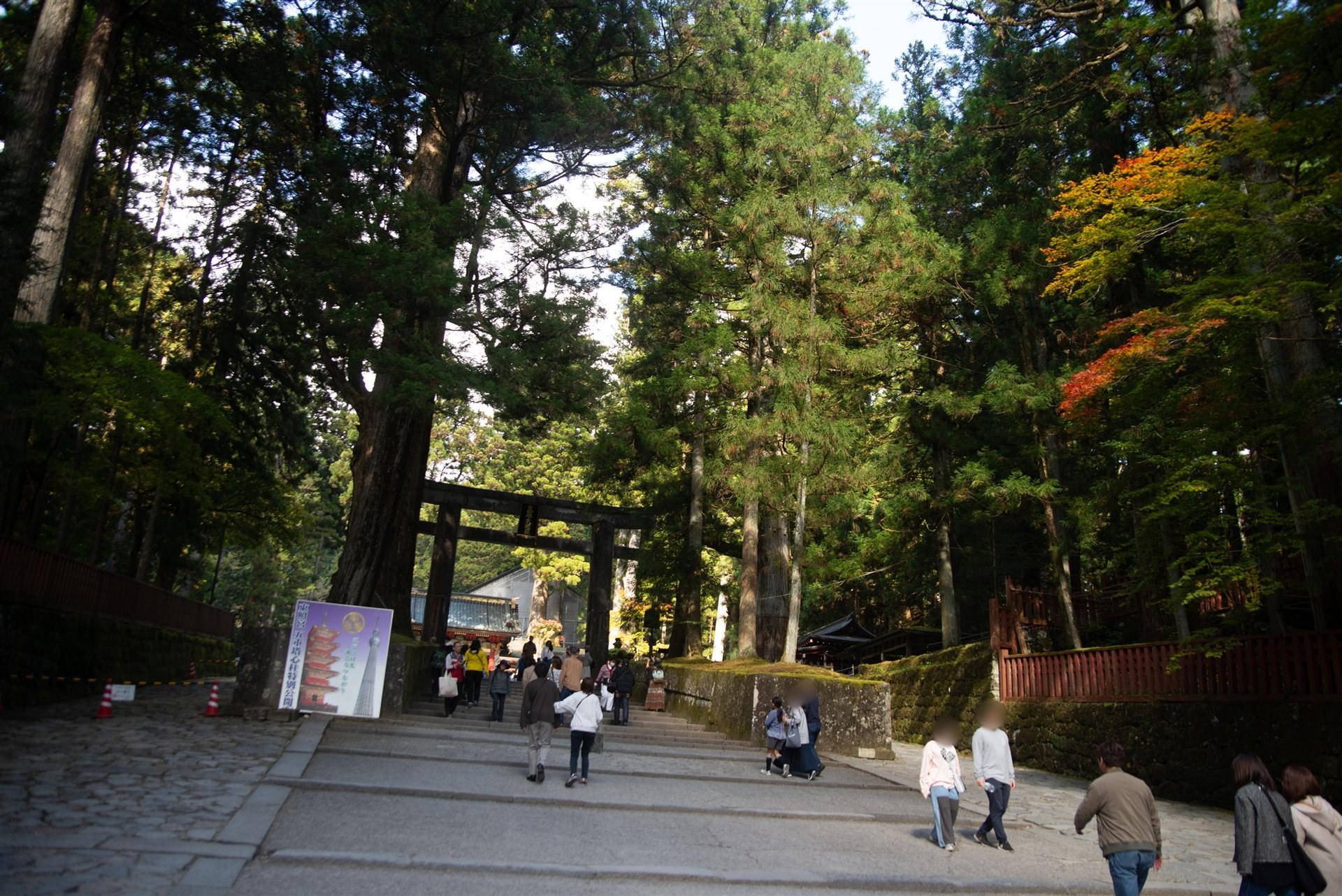
The Stone Torii seen at the top of the steps. The sign on the left announced a special viewing of the central pillar of the Five-Story Pagoda.
At the top of the stone steps stands the Stone Torii. According to the official website, it was donated in 1618 (Genna 4), the year after the deity was enshrined, by Kuroda Nagamasa, lord of Chikuzen (present-day Fukuoka Prefecture). The stones are said to have been carried by ship from Kyushu to Oyama, and from there to Nikko by human strength.
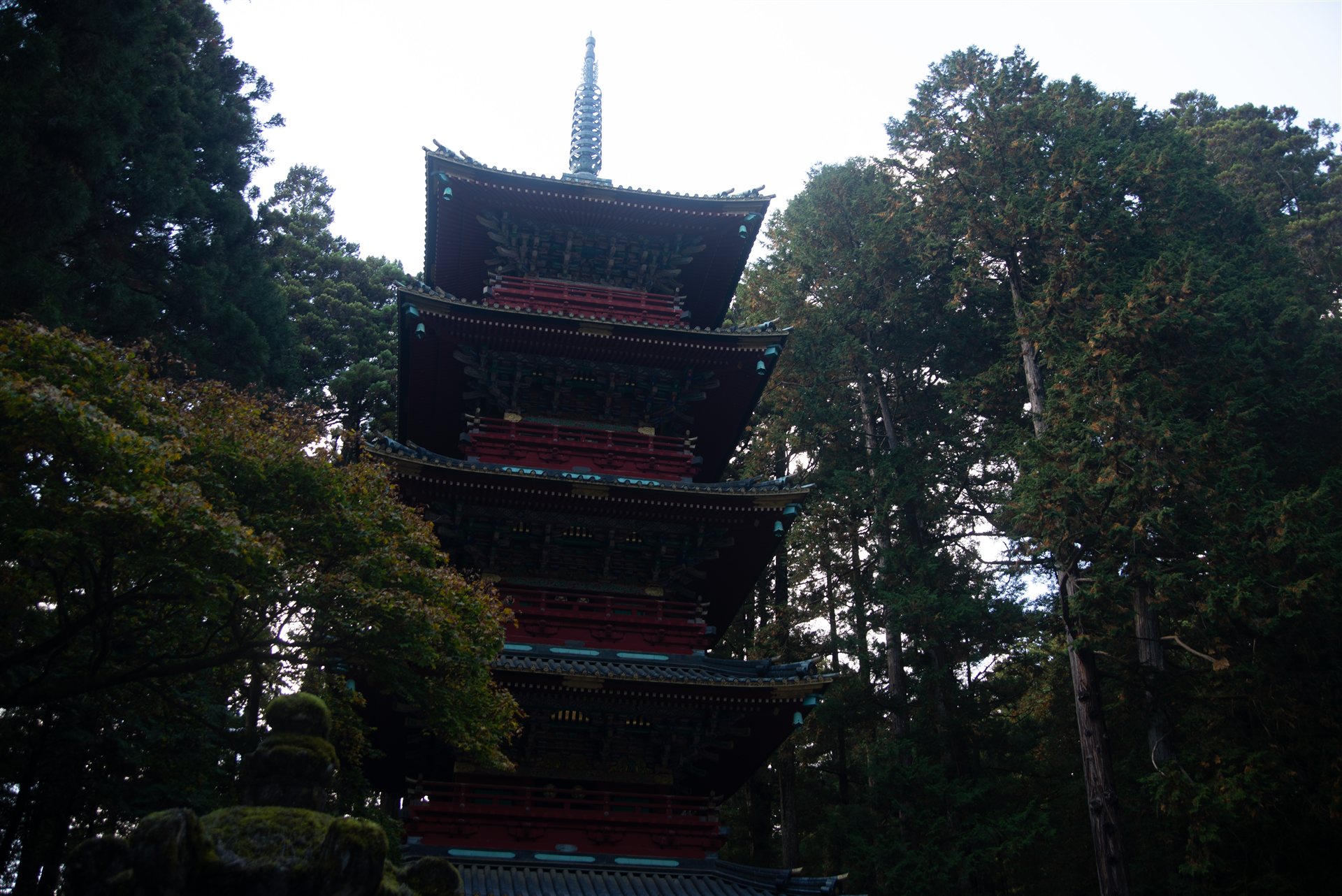
The Five-Story Pagoda to the left of the Stone Torii. It is tall enough to hold its own against the cedars.
To the left of the Stone Torii stands the Five-Story Pagoda. It was donated in 1650 (Keian 3) by Sakai Tadakatsu, lord of the Obama Domain in Wakasa. After it burned down in a fire, it was rebuilt in 1818 (Bunsei 1) by a later lord of the same Sakai family.
The Nio Statues of the Omotemon Gate and the “Imaginary Elephants”
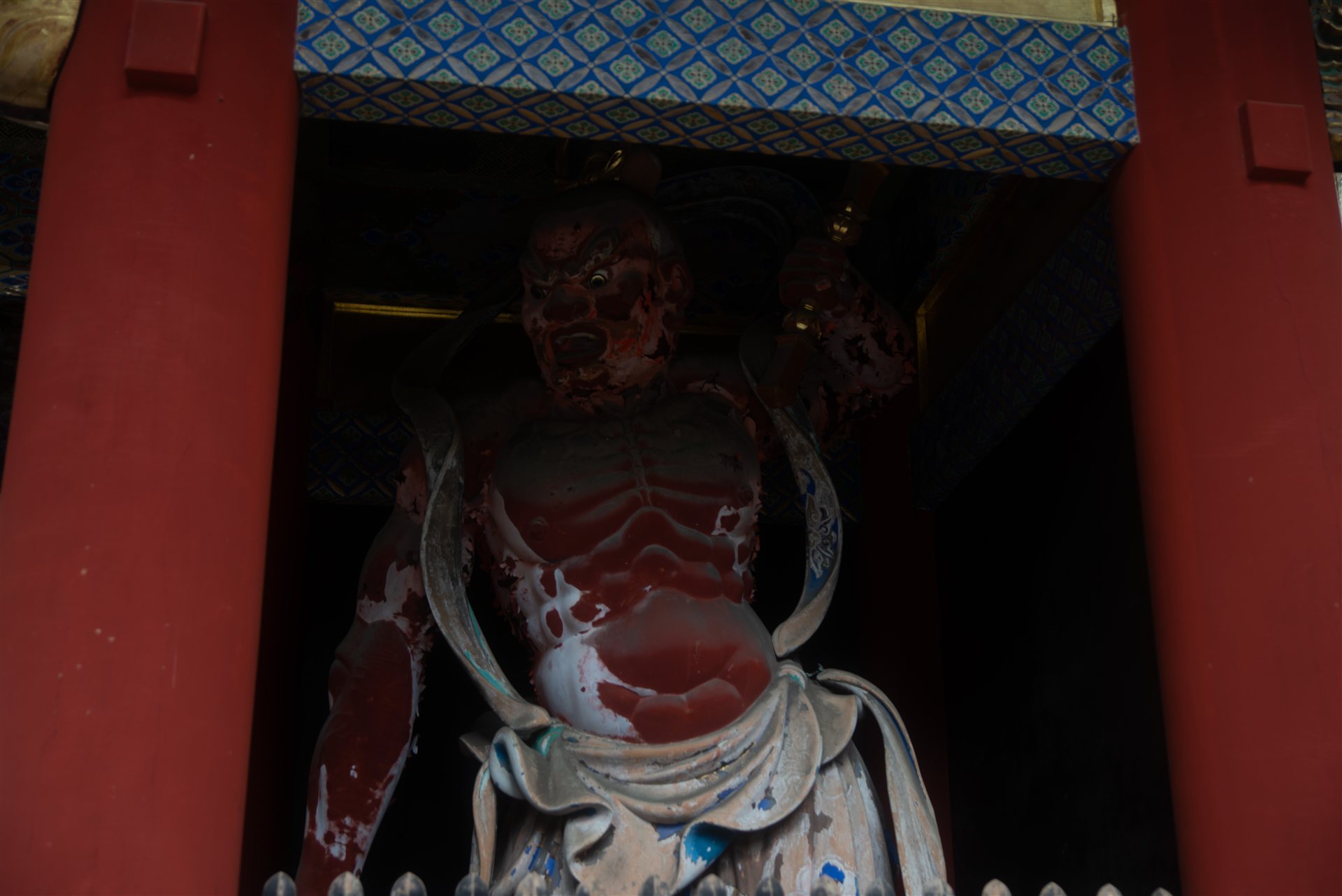
A Nio statue at the Omotemon Gate. The fading paint shows the long years it has stood here.
The first gate you pass through after showing your ticket is the Omotemon Gate. It is the first gate of Toshogu, and because Nio guardian statues stand on its left and right, it is also called the “Niomon Gate.”
At the Sacred Stable (Shinkyusha) beyond the Omotemon Gate are the famous carvings of the Three Wise Monkeys (see no evil, speak no evil, hear no evil). According to the official website, monkeys were believed to protect horses, so eight panels of monkey carvings are set above the beams (nageshi), depicting the course of a human life.
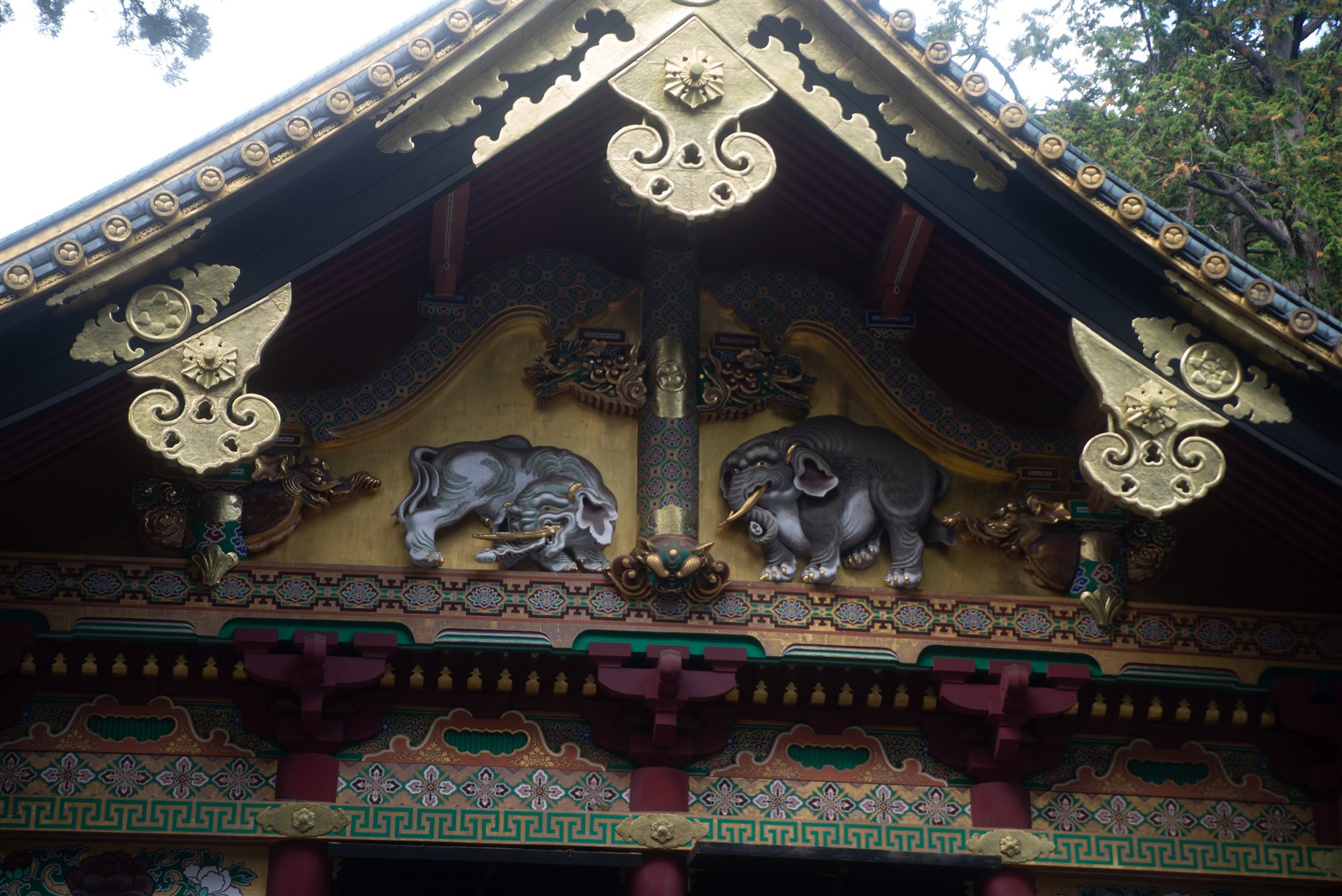
The “Imaginary Elephants” under the roof of the Kami-jinko. They look a little different from real elephants.
Of the three sacred storehouses (Sanjinko), the Kami-jinko has large carvings of the “Imaginary Elephants” under its roof. The original sketches were drawn by Kano Tan’yu, a painter of the Edo period. As you can see in the photo, the shapes of the tusks, ears, and tail look a little different from the elephants we know.
Yomeimon Gate: The “Higurashi-no-mon” with More Than 500 Carvings
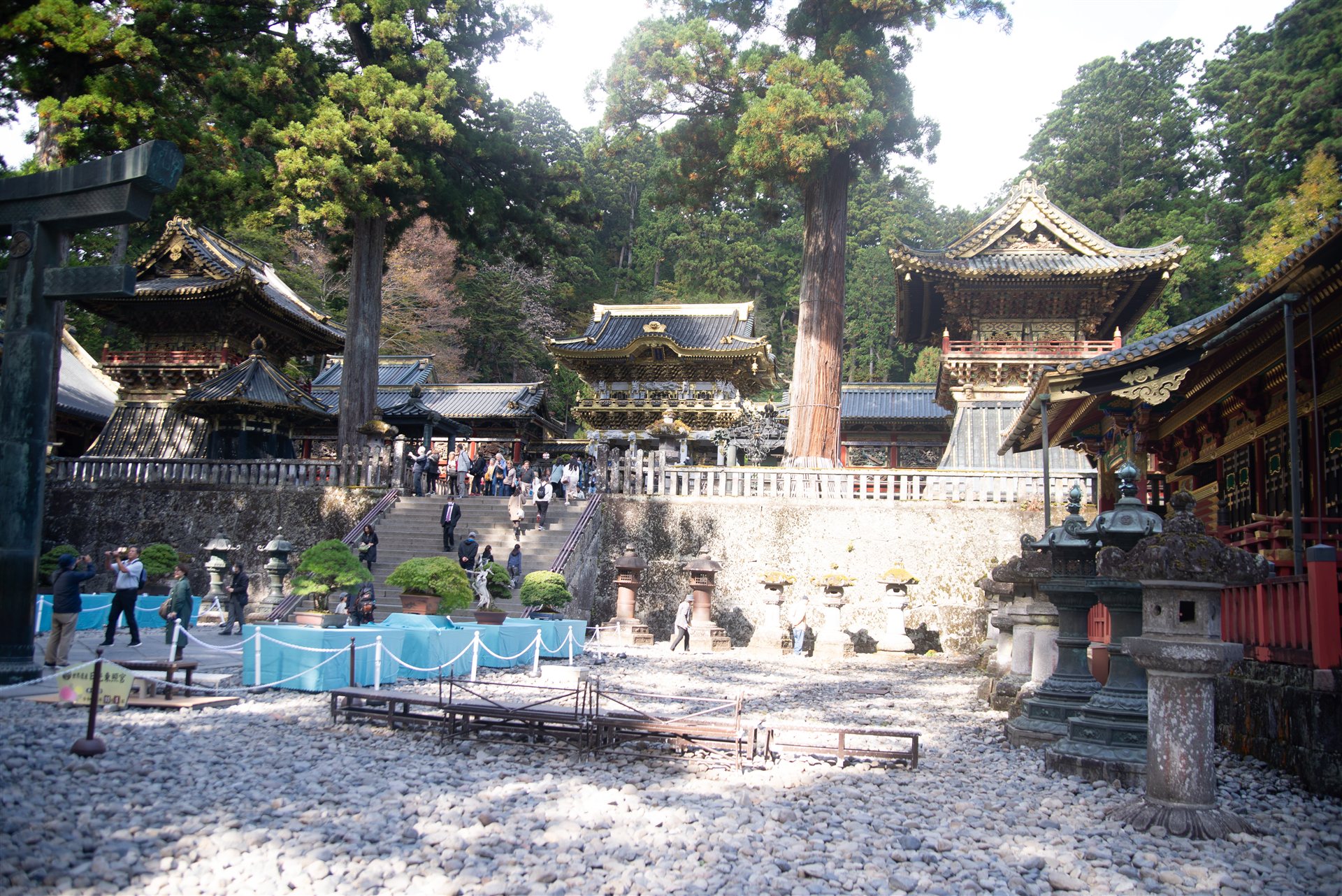
Yomeimon Gate in the center at the top of the steps. On the day I took this photo, bonsai were on display in the grounds in front.
Towering at the top of the stone steps, straight ahead on the approach, is Yomeimon Gate. It is a National Treasure, and the official website introduces it as “the most beautiful gate representing Japan.” Because you could look at it until the sun goes down without growing tired of it, it is also called the “Higurashi-no-mon” (Twilight Gate).
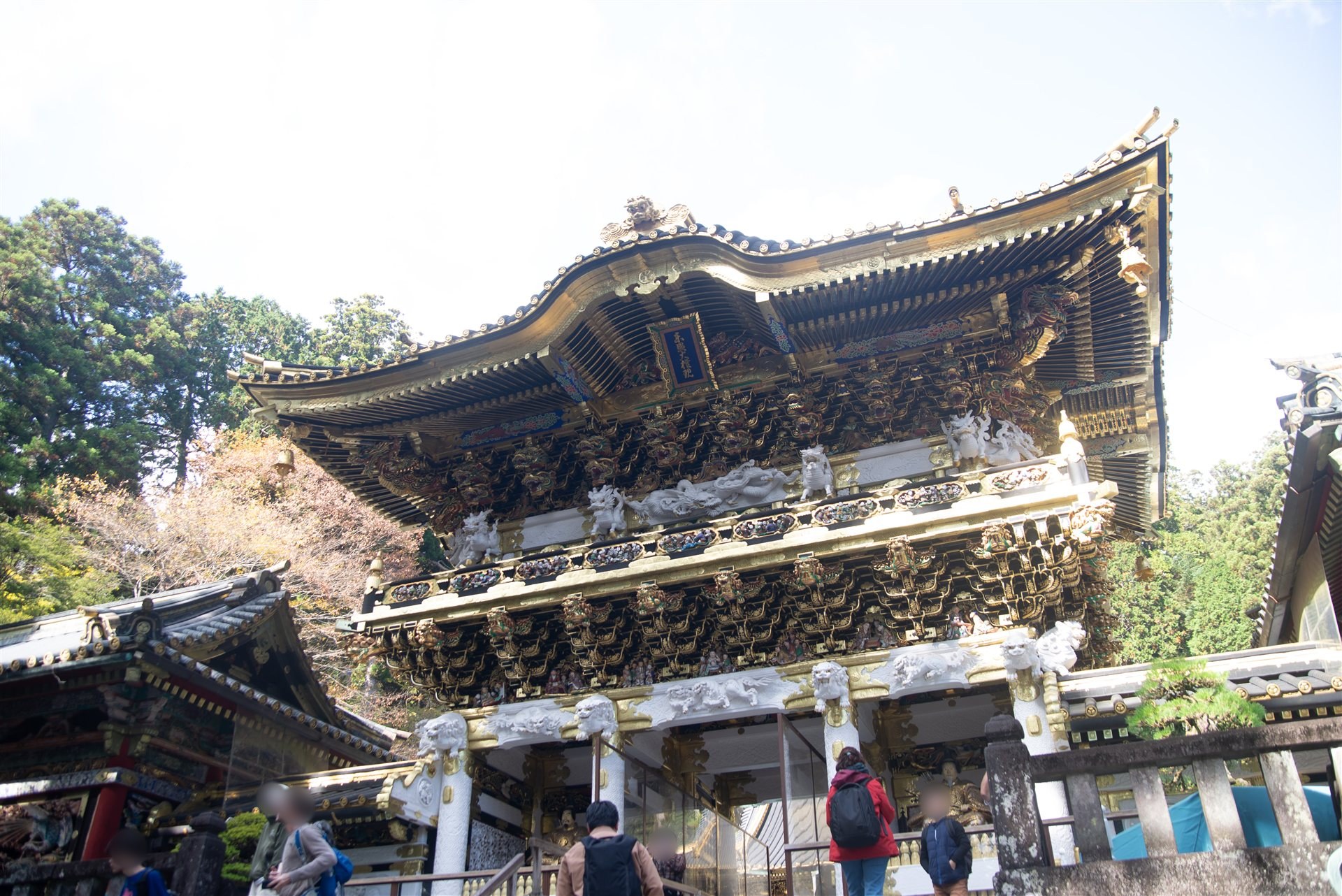
Looking up at Yomeimon Gate, you can see white dragons, Chinese lions (karajishi), and human figures packed tightly together.
The gate is decorated with more than 500 carvings of old tales and anecdotes, children at play, saints and sages, and more. White pillars, golden metal fittings, and colorful carvings are layered together, and the closer you look, the more you notice the fine detail.
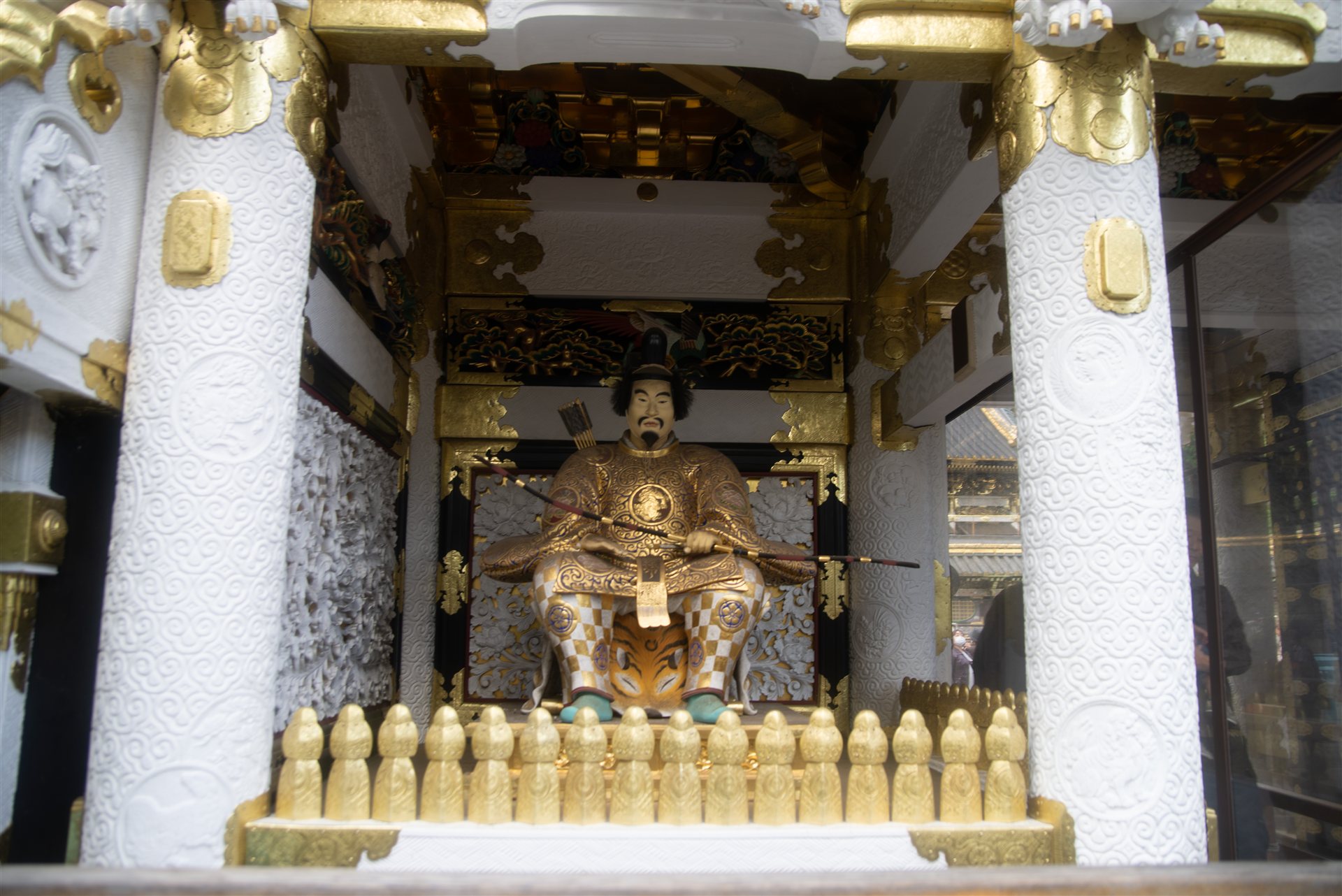
A statue in the dress of a military official, holding a bow and arrows, placed inside Yomeimon Gate.
Inside the gate sits a statue in the dress of a military official, holding a bow and arrows. The patterns on the white pillars and the carvings near the ceiling are also worth a look.
It was extremely crowded, and honestly, in some places it was hard even to move forward.
Karamon Gate and the Shin’yosha
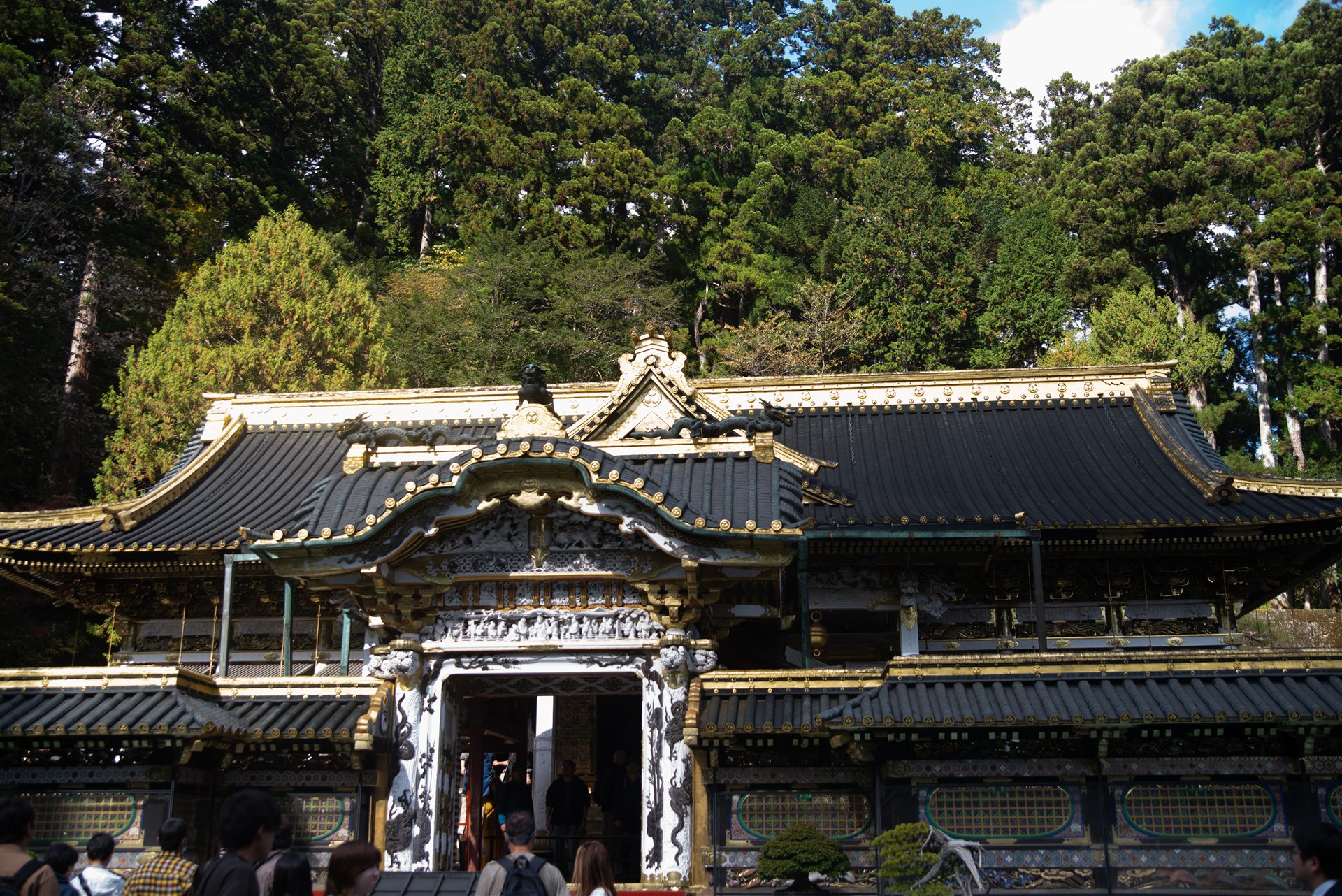
The white Karamon Gate and the roof of the Worship Hall visible behind it.
Beyond Yomeimon Gate is Karamon Gate, a National Treasure. It is painted entirely white with gofun (a white pigment made from seashells) and decorated with detailed carvings such as “Xu You and Chao Fu” and “Emperor Shun’s Audience Ceremony.” Behind Karamon Gate is the Main Shrine (Gohonsha), made up of the Worship Hall (Haiden) and the Main Hall (Honden).
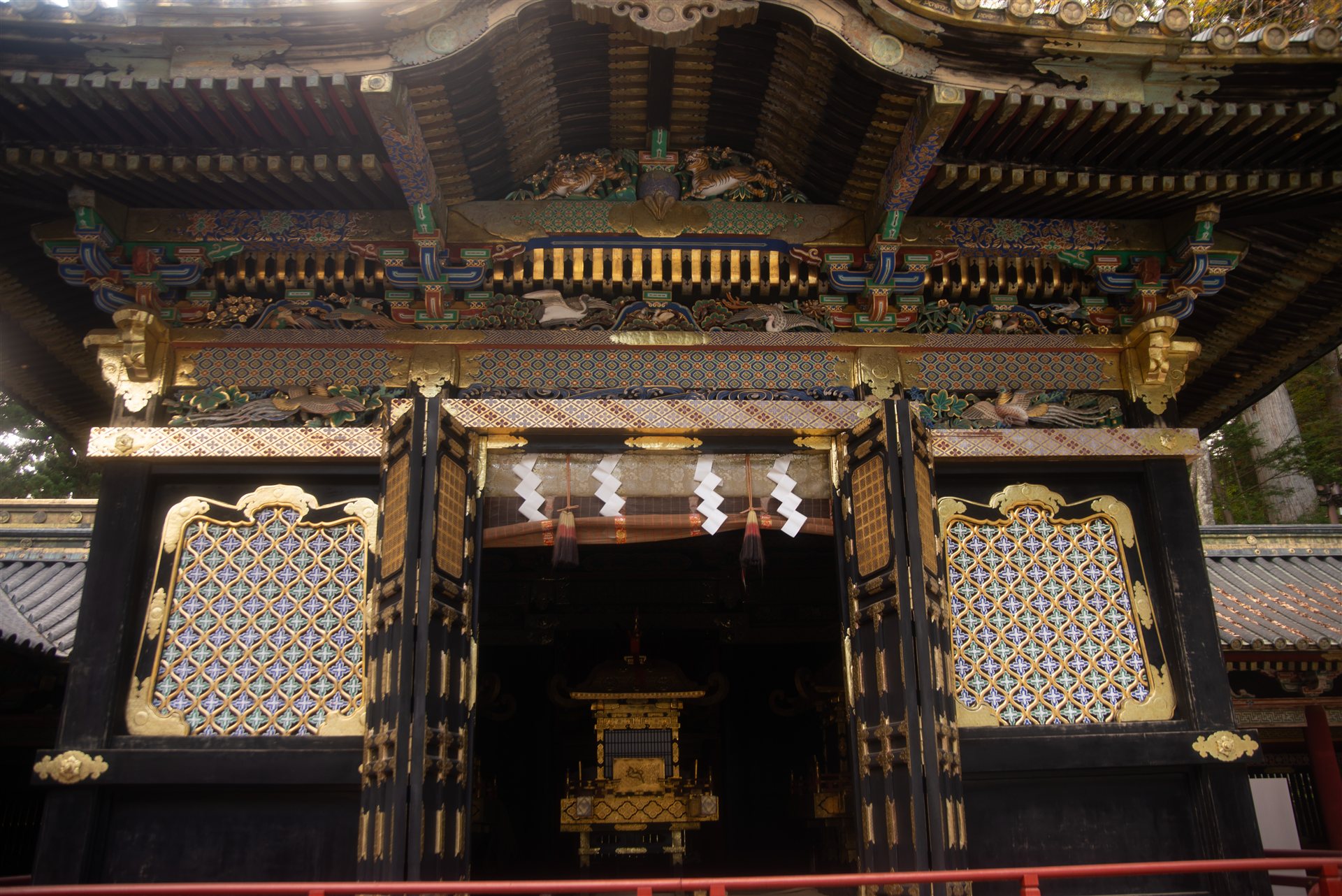
The golden portable shrines (mikoshi) seen inside the Shin’yosha. Above them is a carving of tigers.
Near Yomeimon Gate is the Shin’yosha (Sacred Palanquin House). It houses the three portable shrines (mikoshi) used in the spring and autumn Togyo-sai processions (May 18 and October 17). If the doors are open, you can see the golden mikoshi from outside.
The Sleeping Cat and the Okumiya
In the East Corridor (Higashi-kairo) is the Sleeping Cat (Nemuri-neko), a National Treasure. According to the official website, it is a carving attributed to Hidari Jingoro. The cat dozes in the sunlight surrounded by peony flowers, and it is also said to have been carved as a nod to the name “Nikko,” which means “sunlight.”
The official website also says, “From here, the way leads to the Okumiya.” The path to the Okumiya begins at the Sleeping Cat.
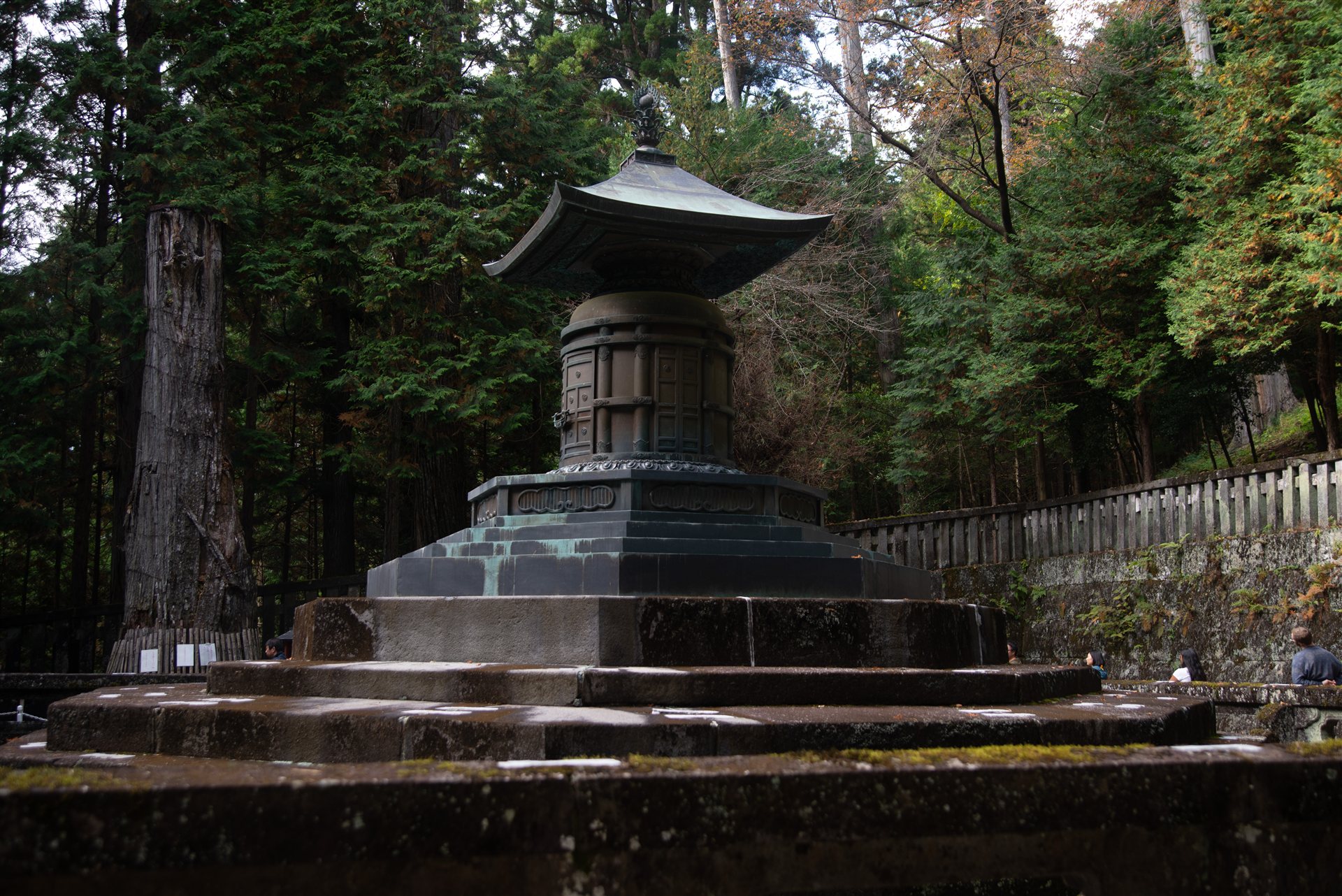
The Hoto of the Okumiya, standing in the cedar forest.
Past the Sleeping Cat, up the stone steps through the cedar trees, is the Okumiya. Made up of a worship hall, the Inukimon Gate, and the Hoto (treasure tower), it is the tomb of the enshrined deity, Tokugawa Ieyasu. Unlike the bustle around Yomeimon Gate, it is a quiet place surrounded by cedar forest. The stone steps go on for a while, so comfortable walking shoes are recommended.
A Short History of Nikko Toshogu
Nikko Toshogu is a shrine dedicated to Tokugawa Ieyasu. Since the Stone Torii was donated in 1618 (Genna 4), “the year after the enshrinement,” the enshrinement took place the year before, in 1617 (Genna 3).
Most of the shrine buildings you can see today were rebuilt in 1636 (Kan’ei 13), about 20 years after the enshrinement, in the “Great Rebuilding of the Kan’ei Era.” According to the official website, the work took about one year and five months.
Yomeimon Gate, Karamon Gate, the Sleeping Cat, and others are designated National Treasures, and the Five-Story Pagoda, Omotemon Gate, the three sacred storehouses, the Sacred Stable (Three Wise Monkeys), the Shin’yosha, the Okumiya, and others are designated Important Cultural Properties. In December 1999 (Heisei 11), together with Futarasan Shrine and Rinnoji Temple, it was registered as the World Heritage Site “Shrines and Temples of Nikko.”
Summary: The Order for Touring Nikko Toshogu
Here are the highlights of Nikko Toshogu in walking order.
- Shinkyo Bridge: The entrance to the Shrines and Temples of Nikko. A vermilion bridge over the Daiya River (about 5 minutes by bus from Tobu-Nikko Station)
- Approach, Stone Torii, and Five-Story Pagoda: Climb the cedar-lined approach to the Stone Torii donated by Kuroda Nagamasa
- Omotemon Gate, Three Wise Monkeys, and Imaginary Elephants: The gate with the Nio statues, and the carvings beyond it
- Yomeimon Gate: The “Higurashi-no-mon,” with more than 500 carvings
- Karamon Gate and Shin’yosha: The white Karamon Gate and the three portable shrines
- Sleeping Cat and Okumiya: From the Sleeping Cat in the East Corridor up the stone steps to the Hoto
In winter (November 1 – March 31), the shrine closes at 16:00 and admission ends at 15:30. If you want to see the Okumiya too, it is best to enter with plenty of time to spare. In the autumn foliage season, visiting Shinkyo Bridge as well lets you enjoy scenery that is truly Nikko.
References (checked on October 27, 2026)
- Nikko Toshogu: Opening Hours and Fees (official website, Japanese)
- Nikko Toshogu: Overview of the Shrine Buildings (official website, Japanese)
- Nikko Toshogu: Access and Parking (official website, Japanese)
- Tobu Railway: Nikko Area Map (Japanese)
- Nikko City: “World Heritage Shrines and Temples of Nikko” Futarasan Shrine (Japanese)
コメント