The Hachiōji Castle ruins in Hachiōji City, Tokyo, are the remains of a mountain castle built by Hōjō Ujiteru, a member of the Odawara Hōjō clan. The site is a National Historic Site and has been selected as one of Japan’s 100 Fine Castles.
This article focuses on the restored Hikihashi bridge, the stone walls of the koguchi (castle gate), and the Goshuden site, and sums up the history of Hachiōji Castle and what to know before your visit. The photos were taken on November 1, 2023, so some things may look different today. Fees, hours, and other details were checked on November 3, 2026, on the official Hachiōji City website and other sources.
If you would like an overview of the sights in Hachiōji City, please also see our Hachiōji overview article (Japanese).
- What Is Hachiōji Castle? | A Branch Castle of the Odawara Hōjō Clan Built by Hōjō Ujiteru
- The Fall of the Castle in 1590 | A Battle Said to Have Ended in a Single Day
- Crossing the Hikihashi Bridge to the Gate | Seeing the Restored Stone Walls
- The Goshuden Site and the Goshuden Falls | Where Ujiteru’s Residence Stood
- The Mountain Trail to the Main Enclosure | Walking the Yōgai Area
- The View from the Mountain
- Access and Basic Visitor Information for the Hachiōji Castle Ruins
- Frequently Asked Questions
- Summary
What Is Hachiōji Castle? | A Branch Castle of the Odawara Hōjō Clan Built by Hōjō Ujiteru
Hachiōji Castle was a branch castle of the Hōjō clan, whose home base was Odawara Castle. The Japan Heritage page of the Agency for Cultural Affairs describes it as the largest branch castle of the Odawara Hōjō clan.
The lord of the castle, Hōjō Ujiteru, was one of the central figures of the Hōjō clan. According to the database of the Agency for Cultural Affairs, Ujiteru moved here from Takiyama Castle and made this castle his residence.
When the castle was built is not clear. According to Hachiōji City, construction is thought to have begun in the Tenshō era, although this has not been confirmed. The Japan Heritage page says the castle was built from 1582 to around 1587.
The Castle Is Divided into Three Areas
The Hachiōji Castle ruins are broadly divided into three areas.
- Negoya area: the area that served as the castle town
- Ikan (residence) area: where the lord’s residence stood. The Goshuden site is also here
- Yōgai (stronghold) area: the fortress used in times of war. The main enclosure (honmaru) is at the top of Mt. Fukasawa (Shiroyama)
The Goshuden site is at the foot of the mountain, and the main enclosure is on top. If you plan to go up to the main enclosure, you will walk a mountain trail, so deciding beforehand how much you want to see makes it easier to prepare.
The Fall of the Castle in 1590 | A Battle Said to Have Ended in a Single Day
No account of the history of Hachiōji Castle is complete without the battle of 1590 (Tenshō 18).
When Toyotomi Hideyoshi attacked the Hōjō clan in the Kantō region, Hachiōji Castle also became a target. According to Hachiōji City, the castle was attacked by the armies of Maeda Toshiie and Uesugi Kagekatsu on the 23rd day of the 6th month of Tenshō 18 and fell.
At that time, the lord, Ujiteru, was not at the castle. He had joined the defense of Odawara Castle under siege. Many of those left in the castle were farmers and women, and it is said the castle fell just one day after the attack began.
It Led to the Surrender of Odawara Castle
The news of the fall of Hachiōji Castle is said to have been one of the reasons Odawara Castle decided to surrender. After Odawara Castle was handed over, Ujiteru committed ritual suicide (seppuku).
The city’s kids’ website also explains that Hachiōji Castle is thought to have been unfinished when it fell. We also introduce Odawara in our Odawara travel diary (Japanese).
What It Means That the Castle Fell Less Than 10 Years After It Was Built
According to the Japan Heritage page, Hachiōji Castle fell less than 10 years after it was built. For this reason, it is considered a valuable site where the period of the excavated remains and artifacts can be pinned down.
In addition, the land was under the direct control of the shogunate in the Edo period and became a national forest from the Meiji era onward, so it was left largely untouched. This is why the remains around the Goshuden are so well preserved.
Crossing the Hikihashi Bridge to the Gate | Seeing the Restored Stone Walls
The first things to see at the Hachiōji Castle ruins are the Hikihashi bridge and the gate leading to the Goshuden.
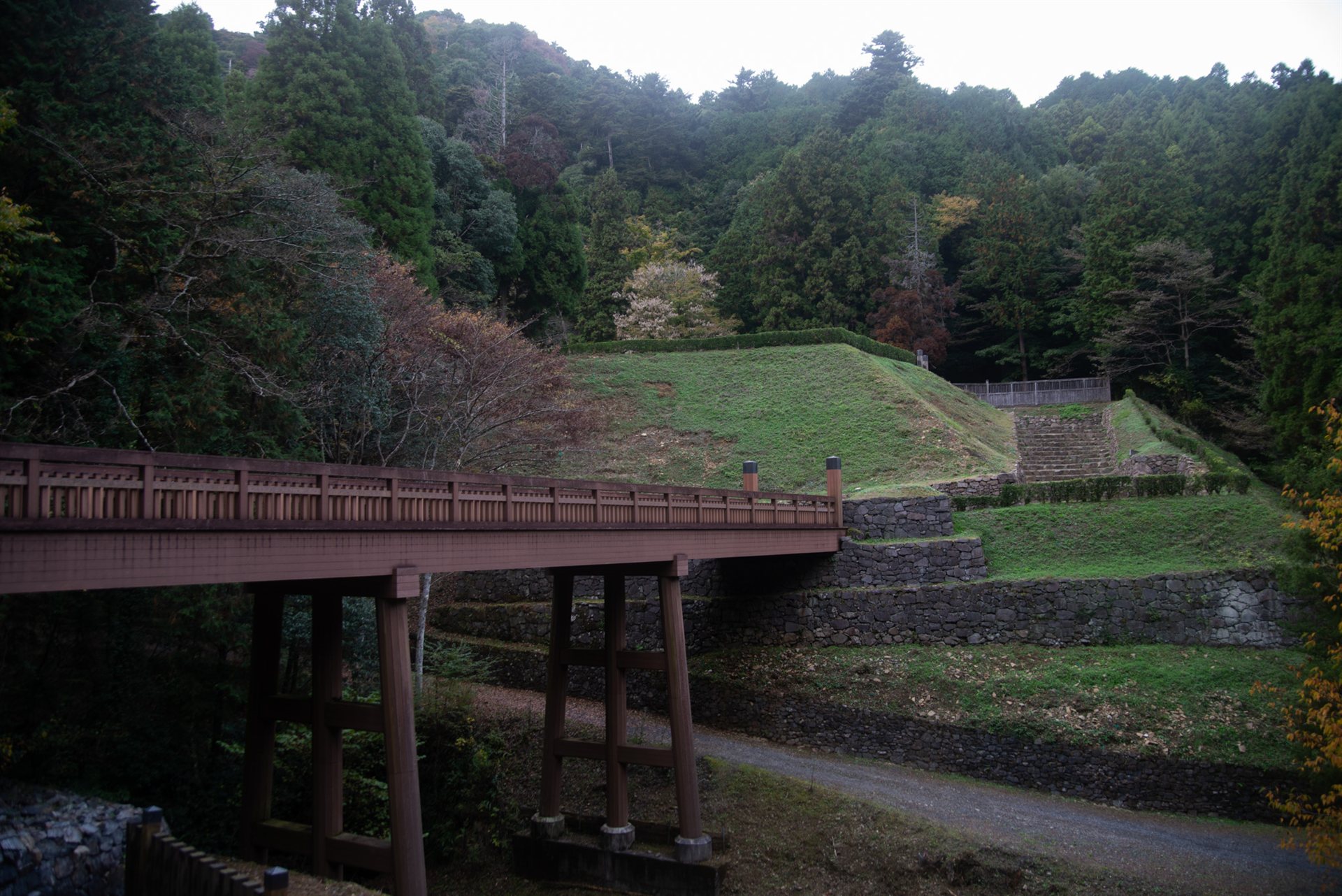
The Hikihashi bridge over the Shiroyama River. Beyond it you can see terraced stone walls and the stone steps of the gate.
The Hikihashi is a bridge that crosses the Shiroyama River to the Goshuden enclosure, and the bridge you see today is a reconstruction. As the photo shows, layer upon layer of stone walls continue beyond the bridge.
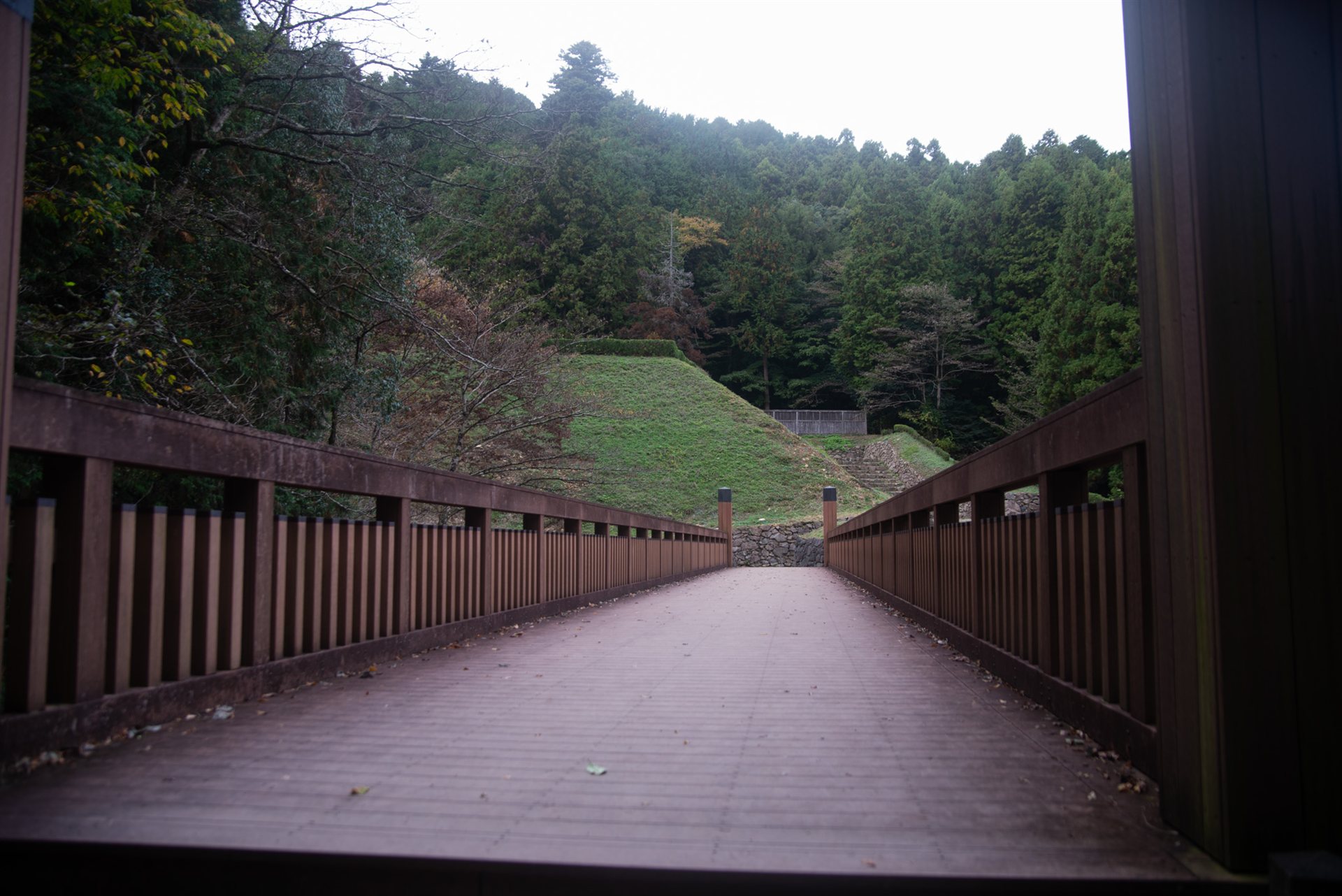
The view toward the Goshuden from the Hikihashi bridge.
The Gate (Koguchi) and the Kabukimon
A koguchi is an entrance to a castle. At the koguchi leading to the Goshuden, the stone walls, the stone steps, and a kabukimon (a gate with a crossbeam on top) have been reconstructed.
According to nippon.com, the Goshuden site and the gate were restored using the original stones. At the top of the stone steps stands the gate in the next photo.
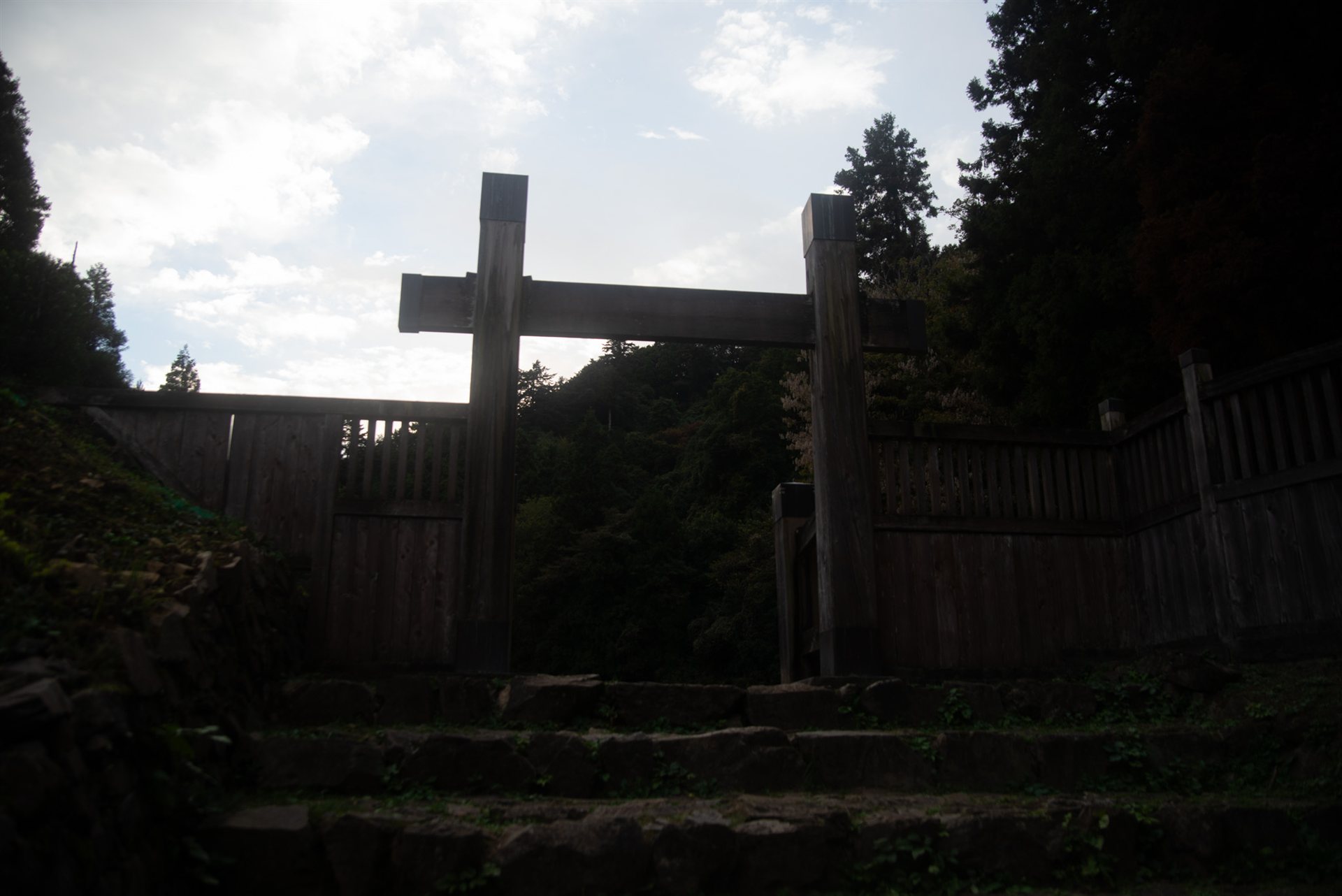
Looking up at the kabukimon from the bottom of the stone steps. A wooden plank fence runs to its left and right.
The stones used in the walls are said to be a hard sandstone found on Shiroyama. It is the same rock as the bedrock of the Goshuden Falls, introduced later.
The Goshuden Site and the Goshuden Falls | Where Ujiteru’s Residence Stood
Past the gate is the Goshuden site. It gets this name because the residence of the lord, Hōjō Ujiteru, stood here.
The Goshuden enclosure is a terrace made by artificially leveling land along the Shiroyama River, and it is said to be the largest enclosure spreading out at the southern foot of Hachiōji Castle.
What Excavations Revealed About the Residence
Excavations carried out in fiscal 1992 and 1993 (Heisei 4 and 5) found building foundation stones, a stone-paved path, the remains of a garden, and more.
The remains that were found have been covered back over to protect them. Today, replicas of the foundation stones and other features are placed directly above them. The original buildings no longer exist, but you can trace the layout of the residence on the ground.
The Legends of the Goshuden Falls
On the Shiroyama River next to the Goshuden is the Goshuden Falls. The upper tier is about 3 m high and the lower tier about 2 m.
It is said that on the day the castle fell, the women, children, and warriors at the Goshuden took their own lives upstream of the falls and threw themselves into the water one after another. In the villages at the foot of the mountain, there is also a story that rice cooked with water from the Shiroyama River turned red. Even today, some people reportedly make akamamma, rice cooked with adzuki bean broth, as a memorial to their ancestors.
These are all legends, but they are essential stories for understanding the history of this castle.
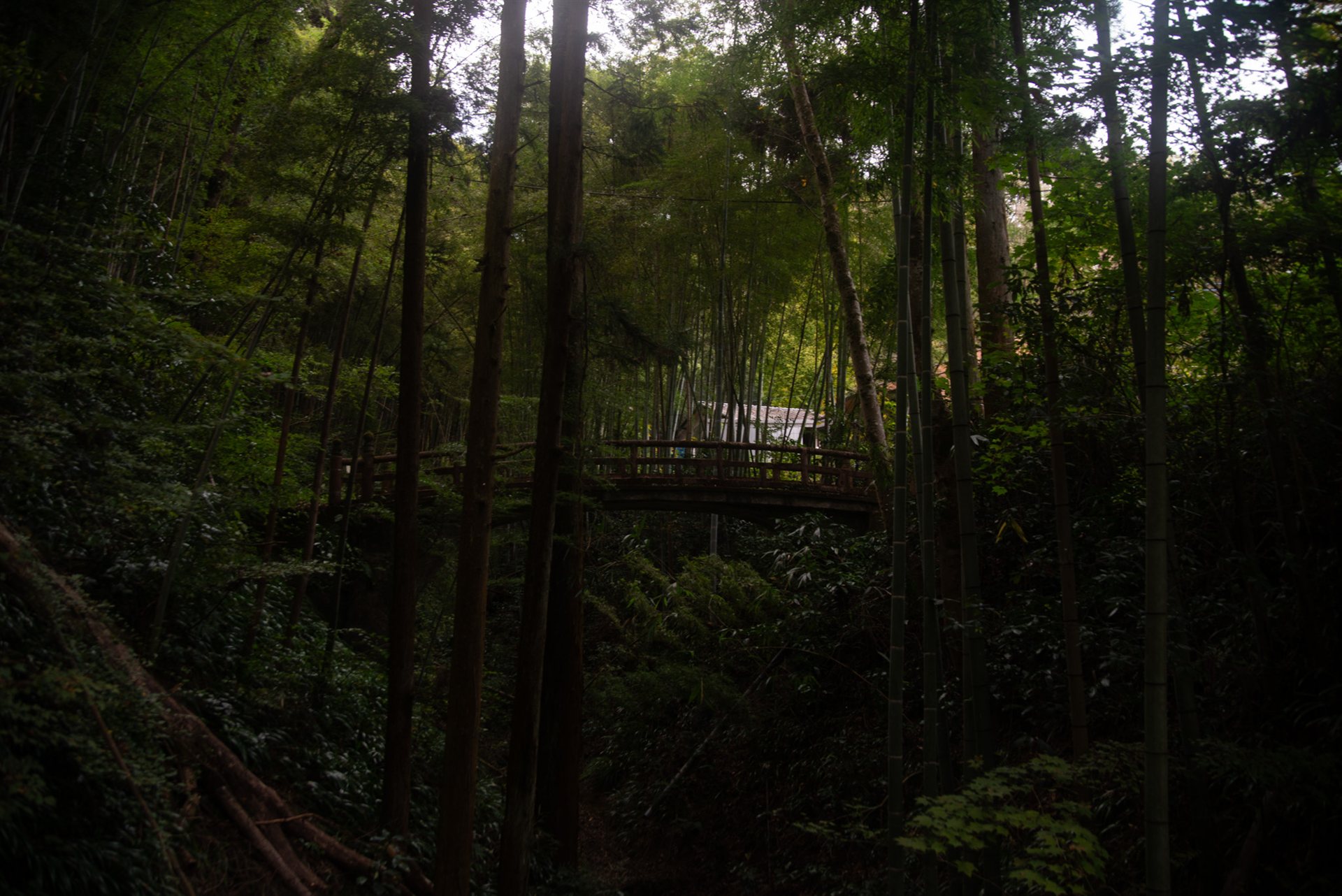
A bridge among bamboo and cedar trees that I came across at the Hachiōji Castle ruins.
The Mountain Trail to the Main Enclosure | Walking the Yōgai Area
To reach the main enclosure, you climb a mountain trail on foot.
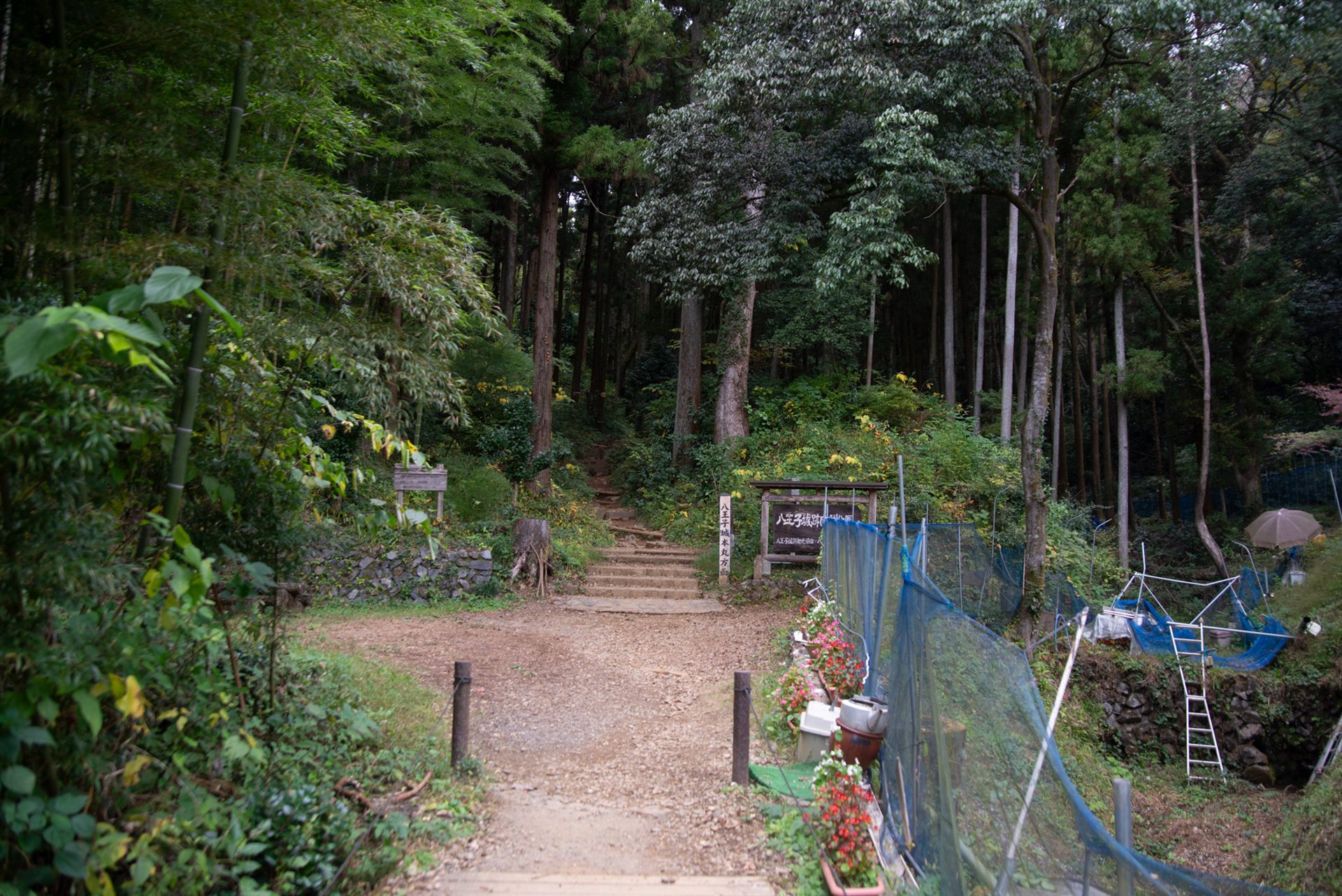
A post reading “To the Main Enclosure of Hachiōji Castle” and steps leading up the mountain.
The main enclosure is at the summit of Mt. Fukasawa (Shiroyama), 446 m above sea level. When I actually climbed it, it took about an hour to reach the main enclosure.
nippon.com also notes that hiking gear is needed to reach the main enclosure site near the summit. It is best to go in shoes that are easy to walk in.
I actually climbed it, and it was a proper mountain hike. I recommend sports shoes; you should definitely not climb it in casual sneakers or heels.
Hachiōji Shrine and the Name of the Castle
In the days of Hachiōji Castle, the deity Hachiōji Gongen was enshrined on the mountain as the guardian of the castle. It is said to have been enshrined in 916 (Engi 16), and it is also said to be the origin of the castle’s name. It corresponds to today’s Hachiōji Shrine.
Stonework Remaining in the Mountains
In the Yōgai area, stone walls from the late Sengoku (Warring States) period remain. Unlike the well-maintained area around the Goshuden, the stonework in the mountains peeks out among tree roots and fallen leaves.
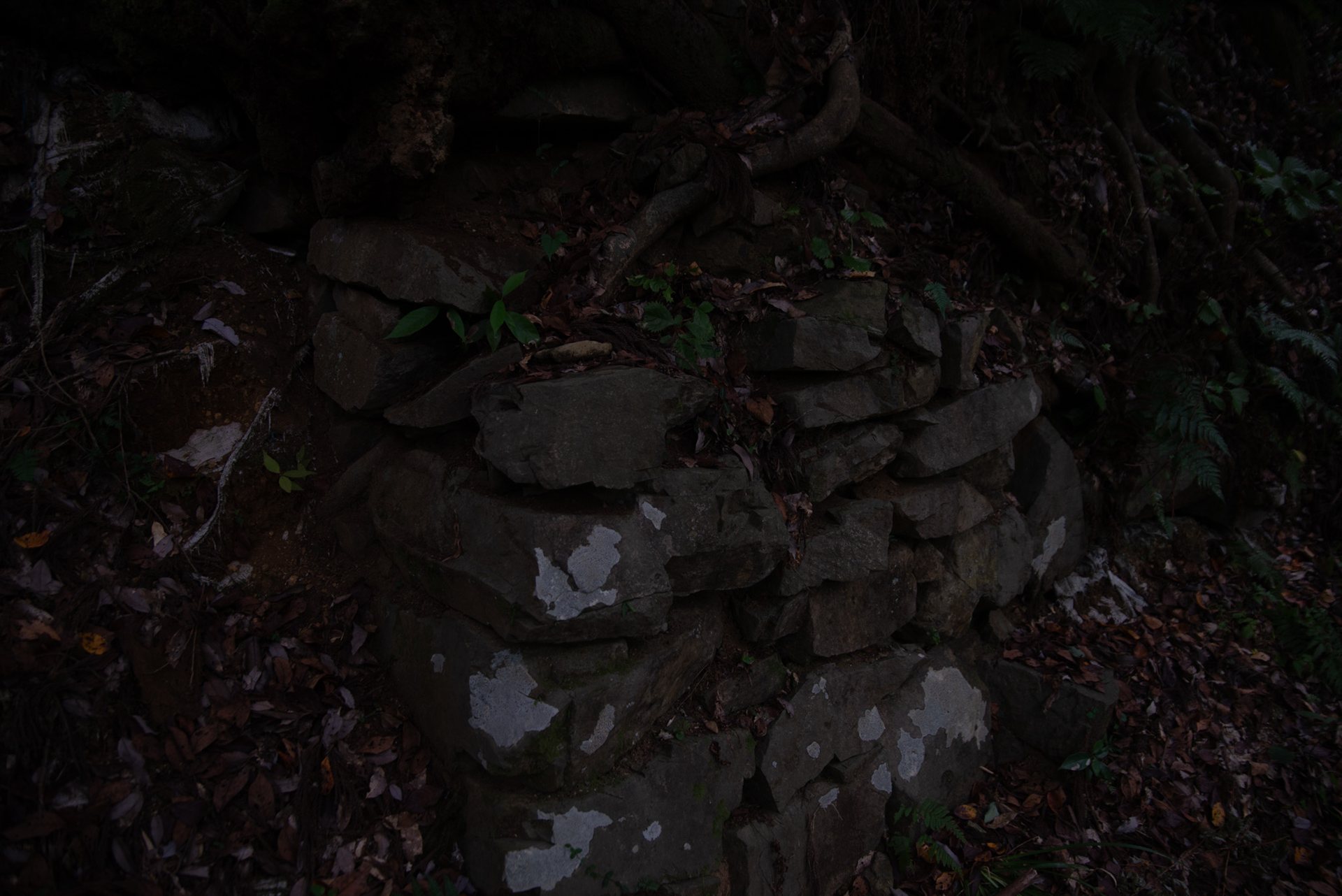
Stonework surrounded by fallen leaves and tree roots that I came across at the Hachiōji Castle ruins.
At the main enclosure site there is a stone monument reading “Site of the Main Enclosure of Hachiōji Castle,” said to have been erected in 1957 (Shōwa 32). As a medieval mountain castle, it never had a building like a castle keep.
The View from the Mountain
From the mountain, you can look out over the cityscape of Hachiōji.
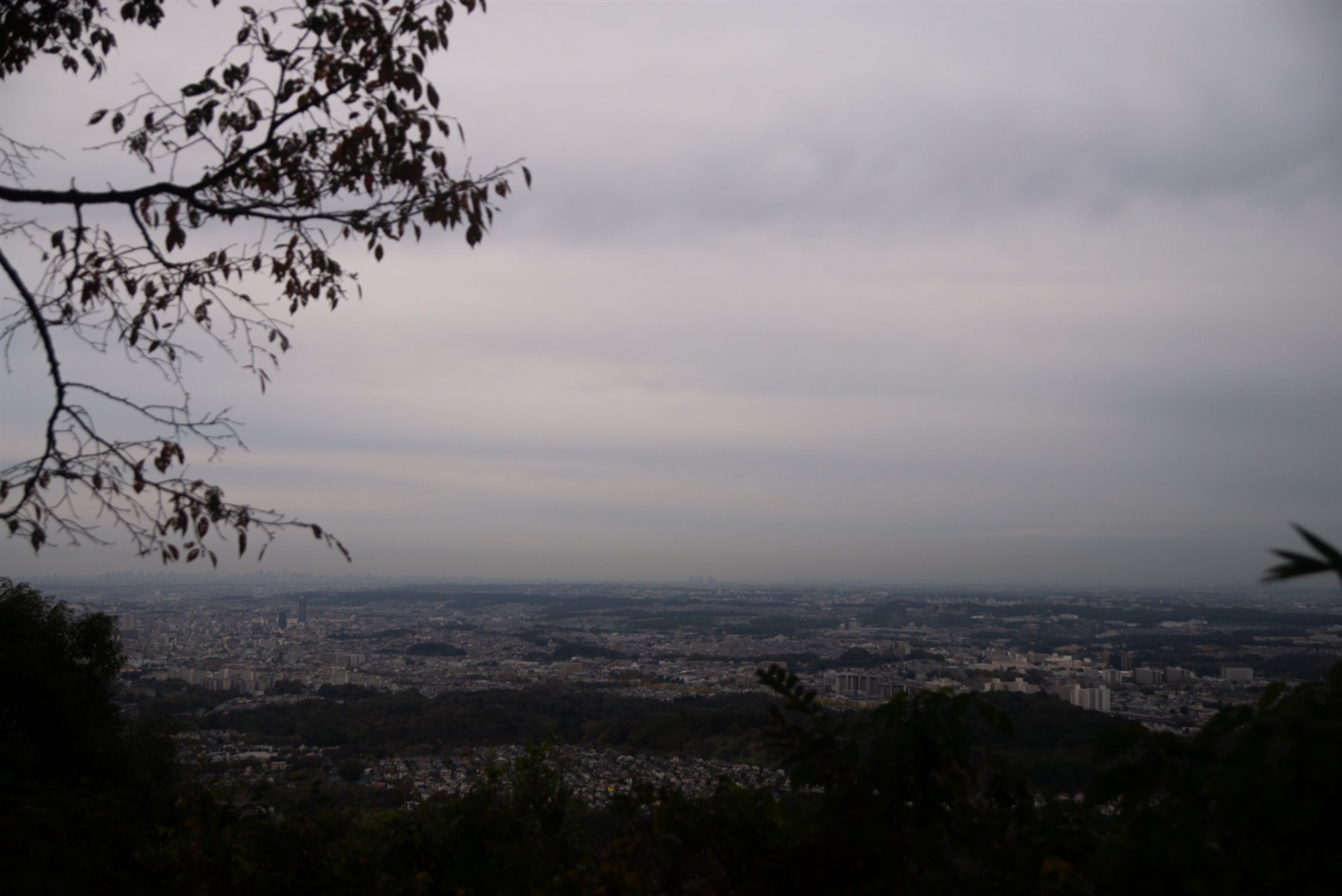
The city spreading out beyond the tree branches. The sky was cloudy that day.
You can see across Hachiōji City, so the view was excellent. However, the path where you take in this view is narrow, so you need to be careful.
Access and Basic Visitor Information for the Hachiōji Castle Ruins
This information was checked on November 3, 2026. Before you go, it is a good idea to check the latest information on the official Hachiōji City page (Japanese).
| Location | Motohachiōji-machi 3-chōme and surrounding area, Hachiōji City, Tokyo (東京都八王子市元八王子町3丁目ほか) |
| Admission | Free |
| Parking | Free. 9:00 a.m.–5:00 p.m. 50 standard cars |
| Restrooms | Use those at the management building or the guidance facility (9:00 a.m.–5:00 p.m.) |
| Contact | Cultural Properties Division, Hachiōji City Board of Education (042-620-7265) |
Getting There by Bus
From the North Exit of JR Takao Station, take a Nishi Tokyo Bus and get off at “Reien-mae / Hachiōji-jōseki Iriguchi” (霊園前・八王子城跡入口). From there it is about a 20-minute walk. On Saturdays, Sundays, and national holidays, there are also buses that go all the way to the Hachiōji Castle ruins.
Hachiōji Castle Ruins Guidance Facility
At the Hachiōji Castle Ruins Guidance Facility (Japanese) at the foot of the mountain, videos and panels introduce the history of Hachiōji Castle and Hōjō Ujiteru.
- Opening hours: 9:00 a.m.–5:00 p.m.
- Closed: December 29–January 3 (may also close temporarily)
- Admission: Free
Getting an overall picture of the castle here first will help when you look at the remains on site.
Guided Tours
The city’s page introduces free official guided tours by volunteers. They run from 10:00 a.m. to 3:00 p.m., with the last reception at 2:00 p.m. Reservations are accepted by phone. Please check the city’s page before you go.
There is also a free smartphone app, “Pocket Gakugeiin” (ポケット学芸員, “Pocket Curator”), that explains the Goshuden route. The signal on site is weak, so visitors are advised to download it in advance.
Things to Keep in Mind When Visiting
- Night visits are not allowed. Because of complaints from people living nearby, visits at night and late at night are refused.
- Stay on the maintained paths. Visitors are asked not to leave the paths.
- The restroom near the summit has been closed. The restroom set up by the Tokyo Metropolitan Government was closed on September 9, 2026 (Reiwa 8). Use the restroom at the management building or the guidance facility before you climb.
- Watch out for bears. Asian black bears have been sighted in the area. Visitors are advised to check the latest information and bring a bear bell.
- Do not park anywhere other than the designated areas.
Frequently Asked Questions
Does it cost anything to visit the Hachiōji Castle ruins?
Admission is free. Entry to the guidance facility and parking are also free.
Can I enjoy the Hachiōji Castle ruins without climbing the mountain?
In the Ikan area at the foot of the mountain, you can see the Hikihashi bridge, the stone walls of the gate, the kabukimon, and the Goshuden site. If you go up to the main enclosure, you will walk a mountain trail, so come properly equipped.
How do I get to the Hachiōji Castle ruins by train?
From the North Exit of JR Takao Station, take a Nishi Tokyo Bus and get off at “Reien-mae / Hachiōji-jōseki Iriguchi.” From there it is about a 20-minute walk. On Saturdays, Sundays, and national holidays, there are also buses that go all the way to the Hachiōji Castle ruins.
Who was the lord of Hachiōji Castle?
Hōjō Ujiteru, a member of the Odawara Hōjō clan. When the castle fell in 1590 (Tenshō 18), he was away, defending Odawara Castle under siege.
Summary
The Hachiōji Castle ruins are a Sengoku-period mountain castle built by Hōjō Ujiteru that fell in 1590 (Tenshō 18). At the foot of the mountain you can see the Hikihashi bridge, the stone walls of the gate, and the Goshuden site, and if you climb the mountain trail you can walk all the way to the main enclosure site.
Because the land was left largely untouched from the Edo period through the Meiji era and beyond, the remains are well preserved. If you walk the site after learning its history, the stone walls and the Goshuden site should look different to you.
What I felt when I actually visited was that it is a place preserved in nature you cannot experience elsewhere in Tokyo, and I found it very interesting. I had not expected an actual mountain climb, so I was lightly equipped, and that partly made it tiring.
Other sights in Hachiōji City are introduced in our Hachiōji overview article (Japanese).
References (checked on November 3, 2026)
- Hachiōji Castle Ruins | Hachiōji City (Japanese)
- Hachiōji Castle Ruins Guidance Facility | Hachiōji City (Japanese)
- Hachiōji Castle Ruins | Database of National Cultural Properties (Agency for Cultural Affairs) (Japanese)
- Hachiōji Castle Ruins | Japan Heritage Portal Site (Agency for Cultural Affairs) (Japanese)
- Hachiōji Castle | nippon.com (Japanese)
コメント