On top of Mount Aoba, overlooking the city of Sendai, are the Sendai Castle Ruins (Aoba Castle Site). This is the site of the main enclosure of the castle built by Date Masamune, and today the Equestrian Statue of Date Masamune, wearing his crescent-moon helmet, watches over the city.
In this article, I introduce the view from the main enclosure site, the Equestrian Statue of Date Masamune, the Shōchūhi Monument, and Miyagi-ken Gokoku Shrine, with photos from my walk around the Sendai Castle Ruins in August 2024.
Note: Information on parking, access, and so on was checked on October 26, 2026. The photos were taken on August 24, 2024.
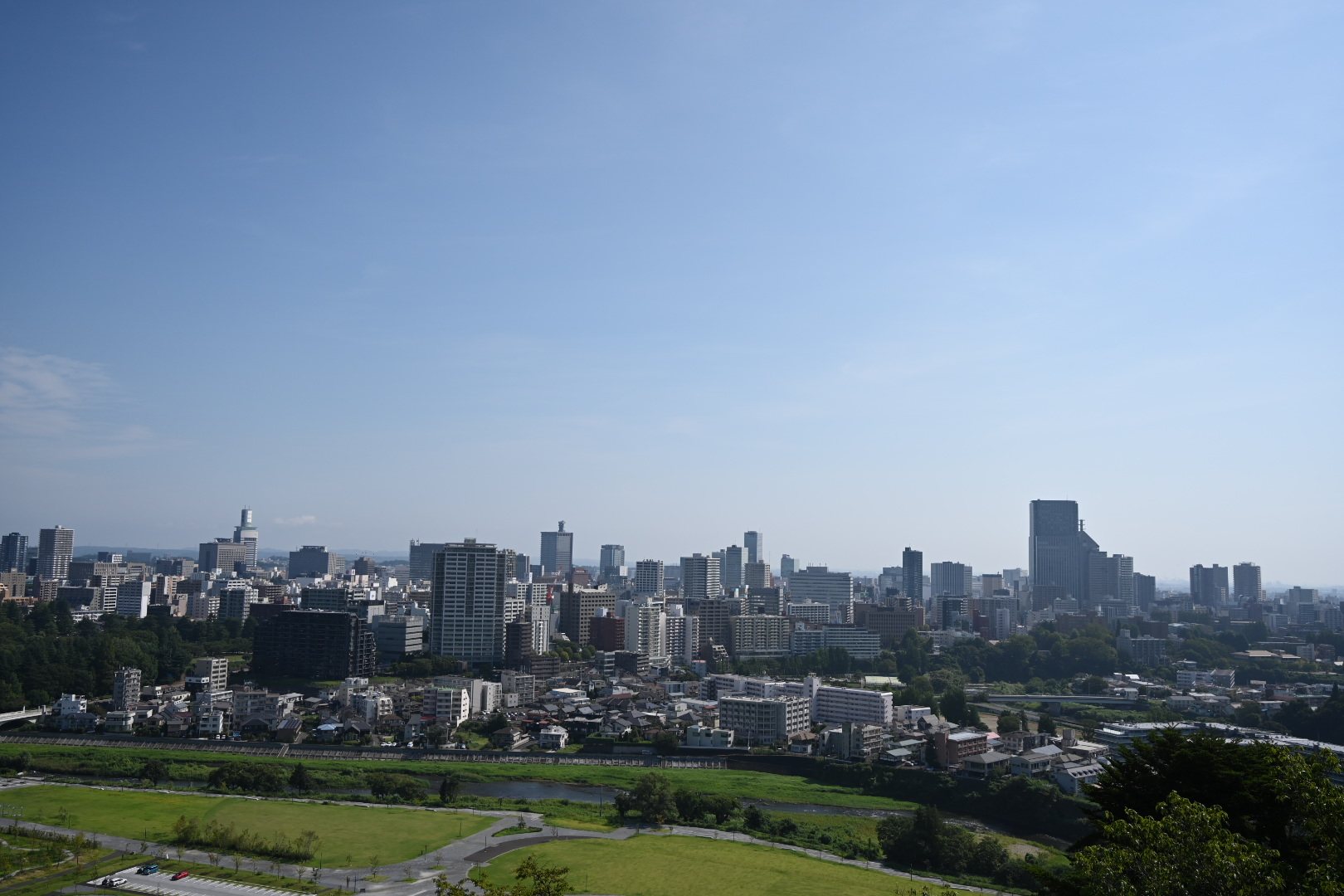
The city of Sendai seen from the main enclosure site, with the Hirose River flowing in the foreground (taken in August 2024).
- What Are the Sendai Castle Ruins (Aoba Castle)?
- A Panoramic View of Sendai from the Main Enclosure Site
- The Equestrian Statue of Date Masamune
- The Shōchūhi Monument, Topped by a Kite (Tobi) Statue
- The Great Torii of Miyagi-ken Gokoku Shrine
- Access to the Sendai Castle Ruins
- Frequently Asked Questions
- Summary: The Sendai Castle Ruins, Where You Can Enjoy Masamune’s Equestrian Statue and the View over Sendai
What Are the Sendai Castle Ruins (Aoba Castle)?
Sendai Castle is a castle that Date Masamune began building on Mount Aoba after the Battle of Sekigahara. It is also called “Aoba Castle” (Aoba-jō).
Sendai Castle had no keep (tenshu); instead, a large palace is said to have been built there. The castle buildings were burned in air raids during the war, but you can still see the stone walls and the rebuilt side turret (wakiyagura) today (from the City of Sendai’s page “About the Sendai Castle Ruins Historic Site”). The Sendai Castle Ruins were designated a National Historic Site in 2003.
At the main enclosure site stands the Equestrian Statue of Date Masamune, and you can look out over the whole city of Sendai.
A Panoramic View of Sendai from the Main Enclosure Site
Standing at the edge of the main enclosure site, you see the Hirose River flowing right below, with the buildings of central Sendai lined up beyond it. Because the site is on top of Mount Aoba, you can take in the whole city.
The view was truly wonderful. You can see the whole townscape of Sendai at once, and it was a perfect photo spot.
Looking in another direction, residential areas stretched out beyond the green forest, and a large white Kannon statue could be seen on a hill far in the distance.
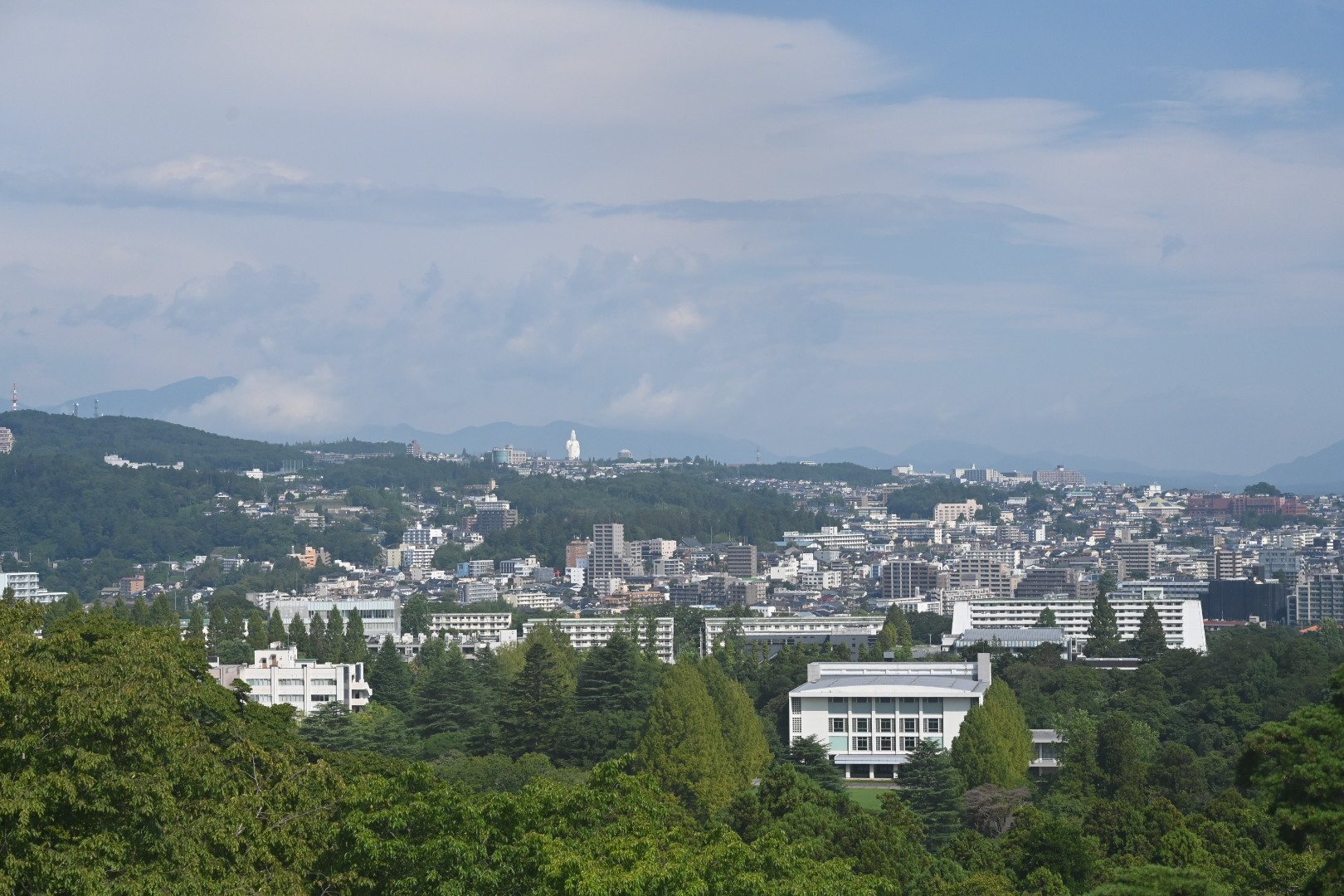
The city of Sendai spreading out beyond the forest. A white Kannon statue can be seen in the distance.
The Equestrian Statue of Date Masamune
Standing in the middle of the plaza at the main enclosure site is the Equestrian Statue of Date Masamune. The pedestal bears the words “Date Masamune-kyō” (Lord Date Masamune) and two relief panels, and guardian lion-dogs (komainu) are placed on both sides.
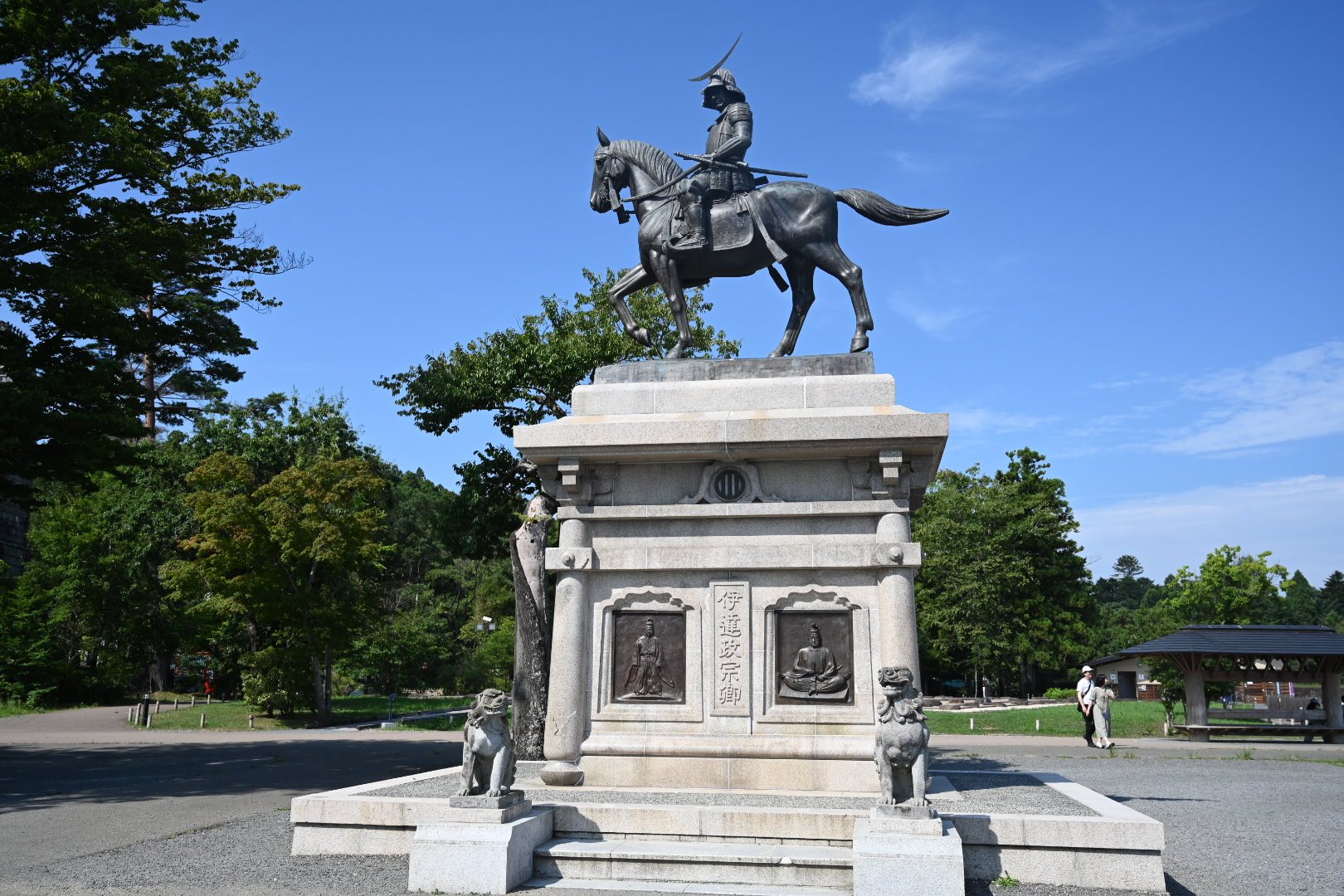
The pedestal bears the words “Date Masamune-kyō” and reliefs.
The statue shows Masamune wearing a helmet with a large crescent-moon crest (maedate), sitting astride his horse and facing forward.
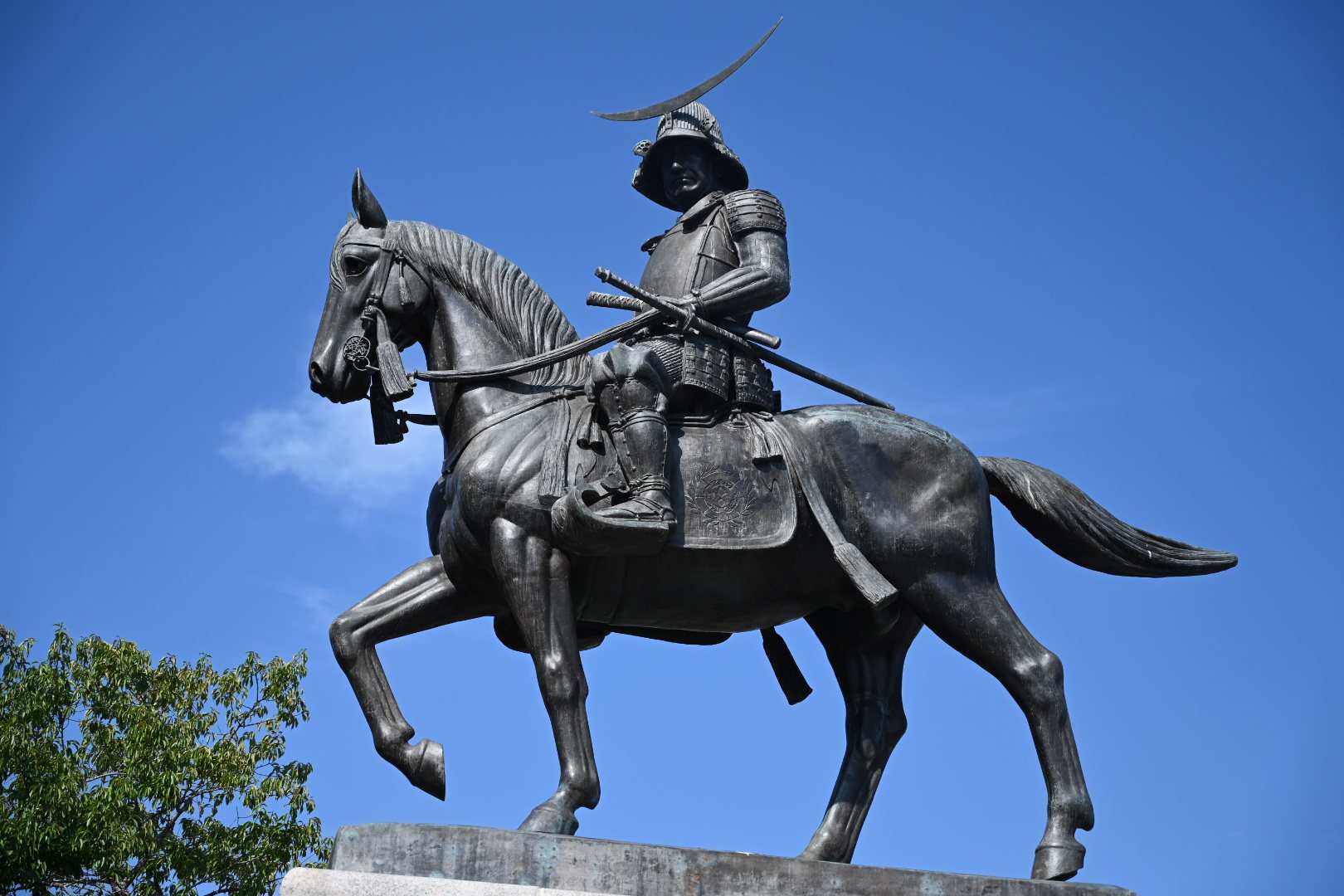
The Equestrian Statue of Date Masamune, easy to recognize by its crescent-moon helmet.
The Shōchūhi Monument, Topped by a Kite (Tobi) Statue
In the forest at the main enclosure site stands the Shōchūhi Monument, where a large bird statue spreads its wings in front of a stone tower. According to a report by the Tokyo National Research Institute for Cultural Properties, the monument was built in 1902 (Meiji 35) to honor the soldiers of the Second Division, then based in Sendai, who died in the First Sino-Japanese War. A bronze kite (tobi) with both wings spread was placed on a stone tower more than 20 m tall.
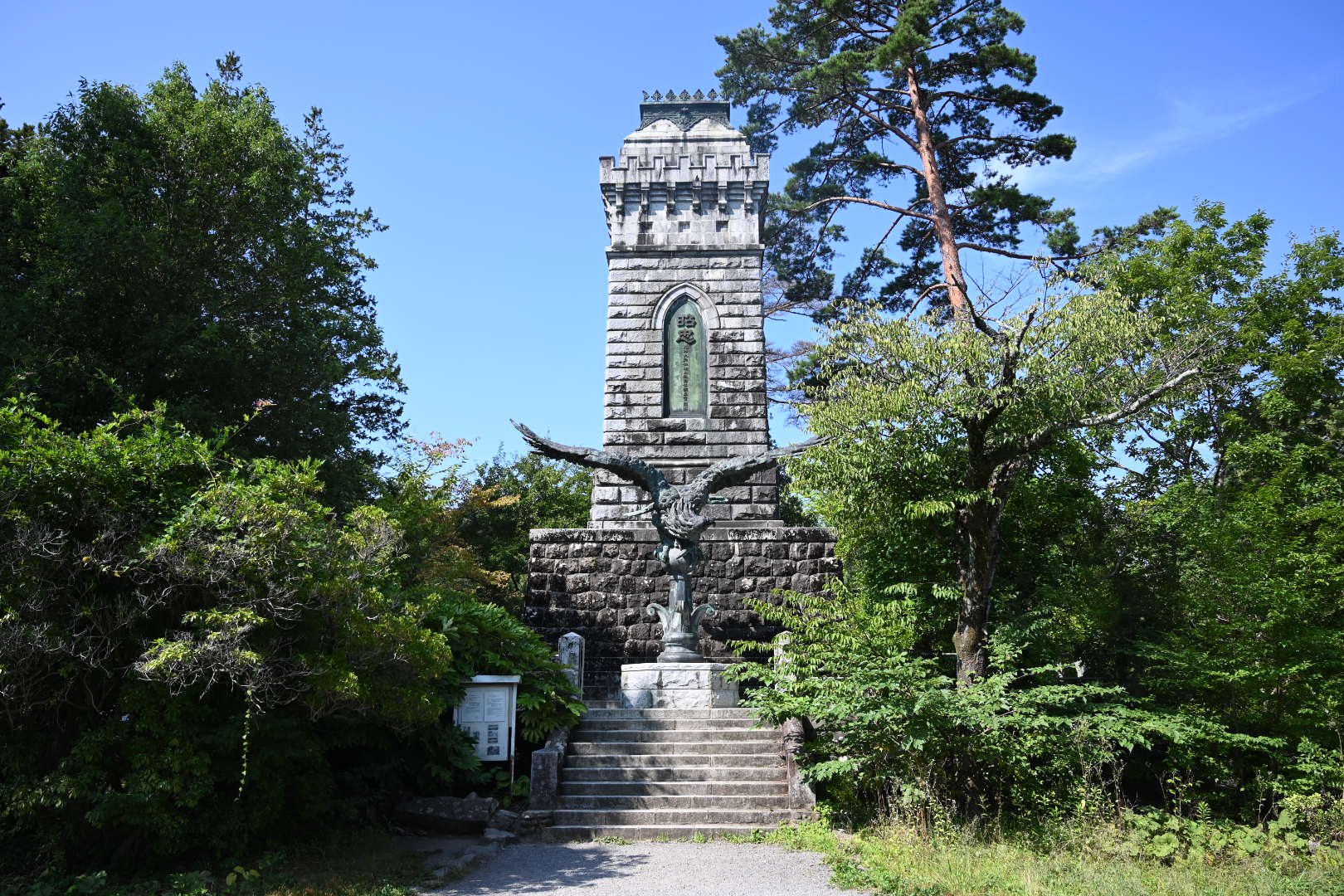
The kite statue spreading its wings in front of the stone tower.
Today the monument is managed by Miyagi-ken Gokoku Shrine. In the Great East Japan Earthquake, its bronze parts were damaged, and it became a subject of the Cultural Properties Rescue Program. When I visited in August 2024, the kite statue was spreading its wings in front of the tower, as in the photo.
The Great Torii of Miyagi-ken Gokoku Shrine
The main enclosure site is also home to Miyagi-ken Gokoku Shrine. It is a shrine dedicated to people who have died for the nation since the Meiji era, and it is said to have begun as a Shōkonsha shrine in 1904 (Meiji 37).
After passing through the large torii gate, you can see the vermilion shrine building at the end of the stone-paved approach.
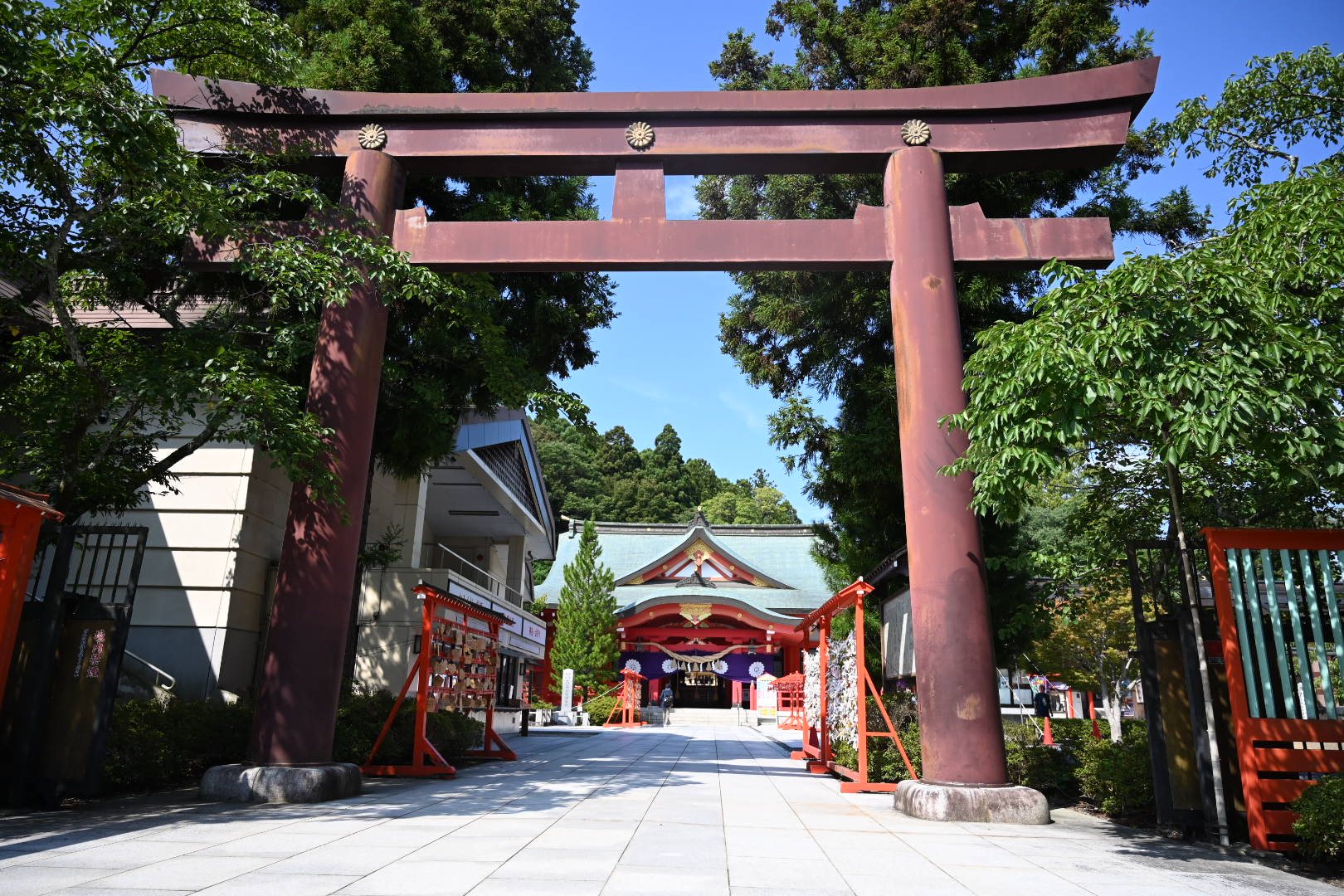
The shrine building beyond the great torii. Many ema votive plaques were also hanging in the grounds.
Note that the parking lot at the main enclosure site is a paid lot managed by Miyagi-ken Gokoku Shrine. The City of Sendai’s website says to contact Aobajō Honmaru Kaikan (022-222-0218) for parking fees.
Access to the Sendai Castle Ruins
From Sendai Station, you can reach the Sendai Castle Ruins on Loople Sendai (Rūpuru Sendai), a loop bus that goes around the sightseeing spots of the city. Get off at the “Sendai Castle Ruins” (Sendaijō-ato) stop. According to the City of Sendai, there may be extra services or route changes during long holiday periods. Please check the fares and timetable on the official information before you go.
If you go by car, you can use the paid parking lot at the main enclosure site.
Zuihoden, where Date Masamune is buried, can also be visited on Loople Sendai. I introduce Zuihoden in “Zuihoden Mausoleum: Complete History & Access Guide (Sendai, Japan)” and “Why Is Zuihoden So Lavishly Decorated? The Story Behind the Stairs and Hidden Highlights.” For a place that passes on the memory of the earthquake disaster, see also “[Sendai, Miyagi] Earthquake Disaster Remains: Sendai Arahama Elementary School | A Visitor’s Guide to the Memory of 3.11” (Japanese).
Frequently Asked Questions
Does Sendai Castle have a keep?
No. Sendai Castle never had a keep, and the castle buildings were burned in air raids during the war. Today you can see the stone walls, the rebuilt side turret, the Equestrian Statue of Date Masamune at the main enclosure site, and more.
Where is the Equestrian Statue of Date Masamune?
It stands in the plaza of the main enclosure site of the Sendai Castle Ruins. From beside the statue, you can look out over the whole city of Sendai.
Is there parking at the Sendai Castle Ruins?
Yes. There is a paid parking lot at the main enclosure site, managed by Miyagi-ken Gokoku Shrine (City of Sendai website, checked on October 26, 2026).
Summary: The Sendai Castle Ruins, Where You Can Enjoy Masamune’s Equestrian Statue and the View over Sendai
- The Sendai Castle Ruins are the remains of the castle Date Masamune built on Mount Aoba. There is no keep, but the stone walls and a side turret remain
- From the main enclosure site, you can look out over the Hirose River and the whole city of Sendai
- The Equestrian Statue of Date Masamune with his crescent-moon helmet, the Shōchūhi Monument topped by a kite statue, and Miyagi-ken Gokoku Shrine are all here
- From Sendai Station, you can get there on Loople Sendai
References (checked on October 26, 2026)
- City of Sendai: About the Sendai Castle Ruins Historic Site (FAQ) (Japanese)
- City of Sendai: Shuttle Bus Service on the Sendai Castle Ruins Road and Extra Loople Sendai Services (Japanese)
- Miyagi Prefecture: Sendai Castle Ruins (National Historic Site) (Japanese)
- Tokyo National Research Institute for Cultural Properties: Cultural Properties Rescue Report (Shōchūhi Monument) (Japanese)
- Sendai Castle | nippon.com (Japanese)
コメント