In the middle of Shimabara City, Nagasaki Prefecture, rises the white five-story keep of Shimabara Castle. Built at the start of the Edo period, the castle has seen many events over 400 years: the Shimabara Rebellion, changes of lords, its dismantling in the Meiji era, and the rebuilding of its keep in the Shōwa era.
This article follows the history of Shimabara Castle in order and introduces the exhibits inside the keep, the view from the top, and the streets of samurai residences that remain on the west side of the castle, together with photos from my walk in September 2023. Admission fees, opening hours and other details were checked on the official website on October 25, 2026.
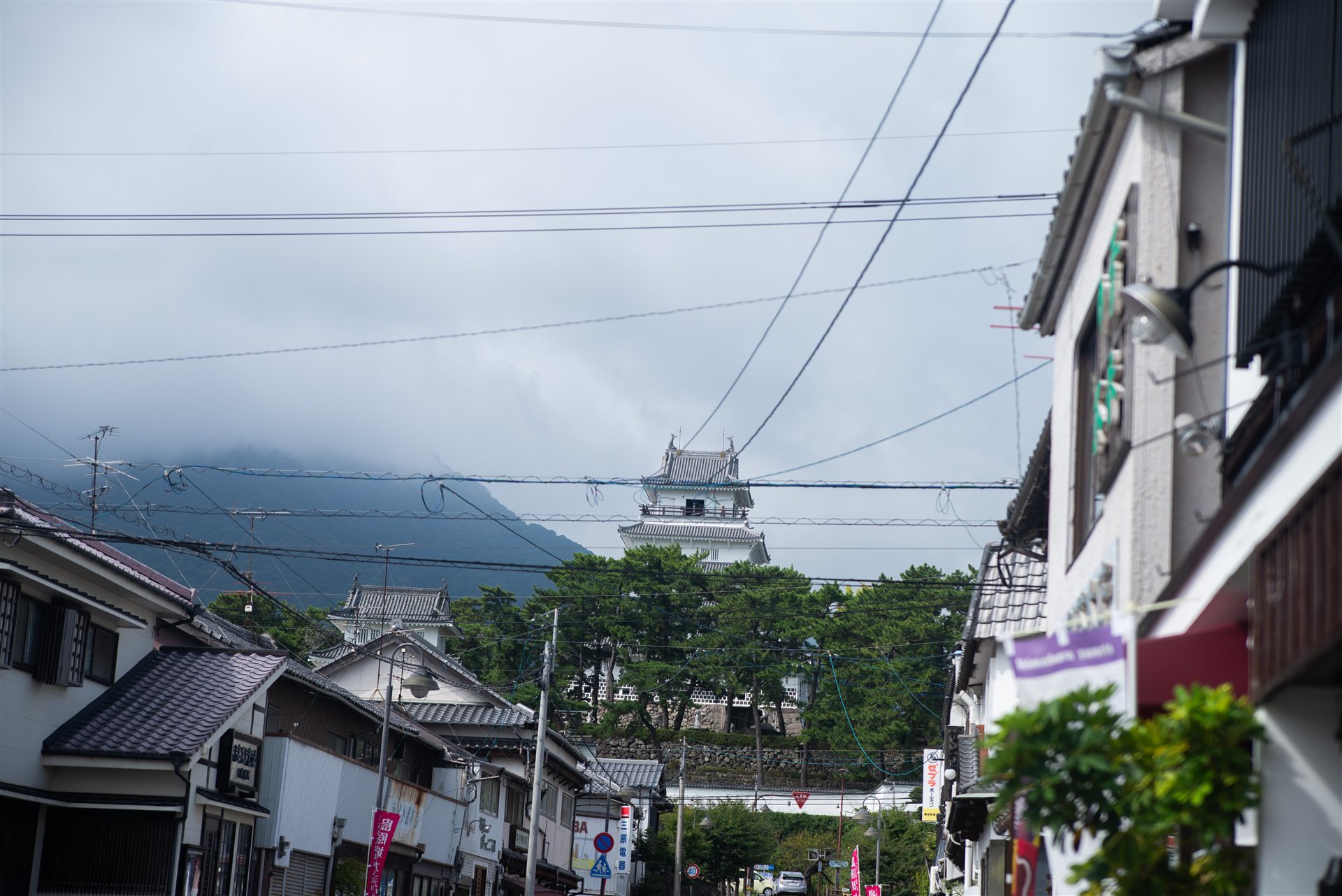
The keep of Shimabara Castle appears at the end of a town street. The mountain behind it is Mt. Mayuyama.
- What Is Shimabara Castle? Basic Information
- Shimabara Castle History ①: Built by Matsukura Shigemasa (from 1618)
- Shimabara Castle History ②: The Shimabara Rebellion (1637–1638)
- Shimabara Castle History ③: Changes of Lords and the Shimabara Taihen Disaster
- Shimabara Castle History ④: Dismantled in the Meiji Era, Keep Rebuilt in the Shōwa Era
- Exhibits Inside the Keep and the View from the Top Floor
- Highlights on the Castle Grounds: The Statue of Amakusa Shirō and the Seibō Memorial Museum
- The Samurai Residence District on the West Side of Shimabara Castle
- Shimabara Castle Admission, Opening Hours and Access
- Frequently Asked Questions
- Summary: At Shimabara Castle, You Can Trace 400 Years of History in the Keep and the Streets
What Is Shimabara Castle? Basic Information
Shimabara Castle stands on a plateau called Moritake in the center of Shimabara City. According to the official website, it was a flatland castle of the renkaku-shiki type, with the main enclosure (honmaru), the second enclosure (ninomaru) and the third enclosure (sannomaru) lined up in a row.
| Item | Details |
|---|---|
| Built by | Matsukura Bungo-no-kami Shigemasa |
| Construction | Begun in 1618 (Genna 4). Completed 4 to 7 years later |
| Keep | About 33 m tall, a five-story, five-floor tower-style (sōtō-gata) keep with no gables (hafu) |
| Lords | 19 generations of 4 clans (the Matsukura, Kōriki, Matsudaira and Toda clans, then the Matsudaira clan again) |
| Abandoned | 1873 (Meiji 6) |
| Current keep | Rebuilt in 1964 (Shōwa 39) |
(From “History of Shimabara Castle” and “400th Anniversary of the Castle” on the Shimabara Castle official website. Checked on October 25, 2026)
The “400th Anniversary” page of the official website counts the 400 years from 1624 to 2024. When I took these photos in September 2023, a banner reading “2024: 400th Anniversary of Shimabara Castle” hung in front of the keep.
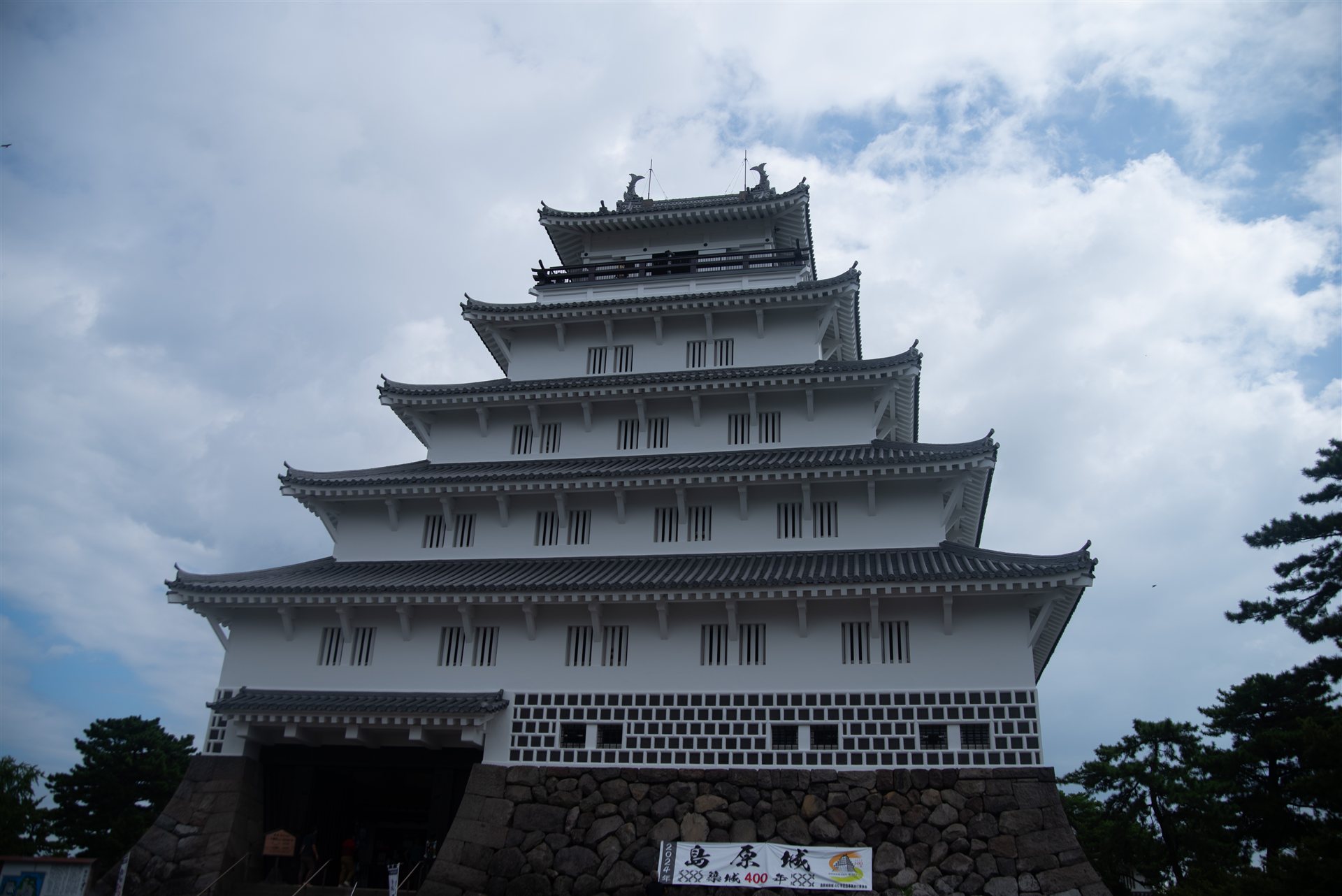
The clean shape with no gables is a feature of the Shimabara Castle keep (photo taken in September 2023).
Shimabara Castle History ①: Built by Matsukura Shigemasa (from 1618)
Shimabara Castle was built by Matsukura Shigemasa. Work began in 1618 (Genna 4), and it became a large castle with, besides the keep, 3 three-story turrets, 7 two-story turrets and 39 single-story turrets. According to the official website, the outer enclosure covers 460,100 m².
A castle town was laid out around the castle, divided into three towns: Furumachi, Shinmachi and Miemachi.
The stone walls and moats of the main and second enclosures still remain today. Walking around the outside of the castle, you can look up at the tall, grass-covered stone walls and the turrets on top of them.
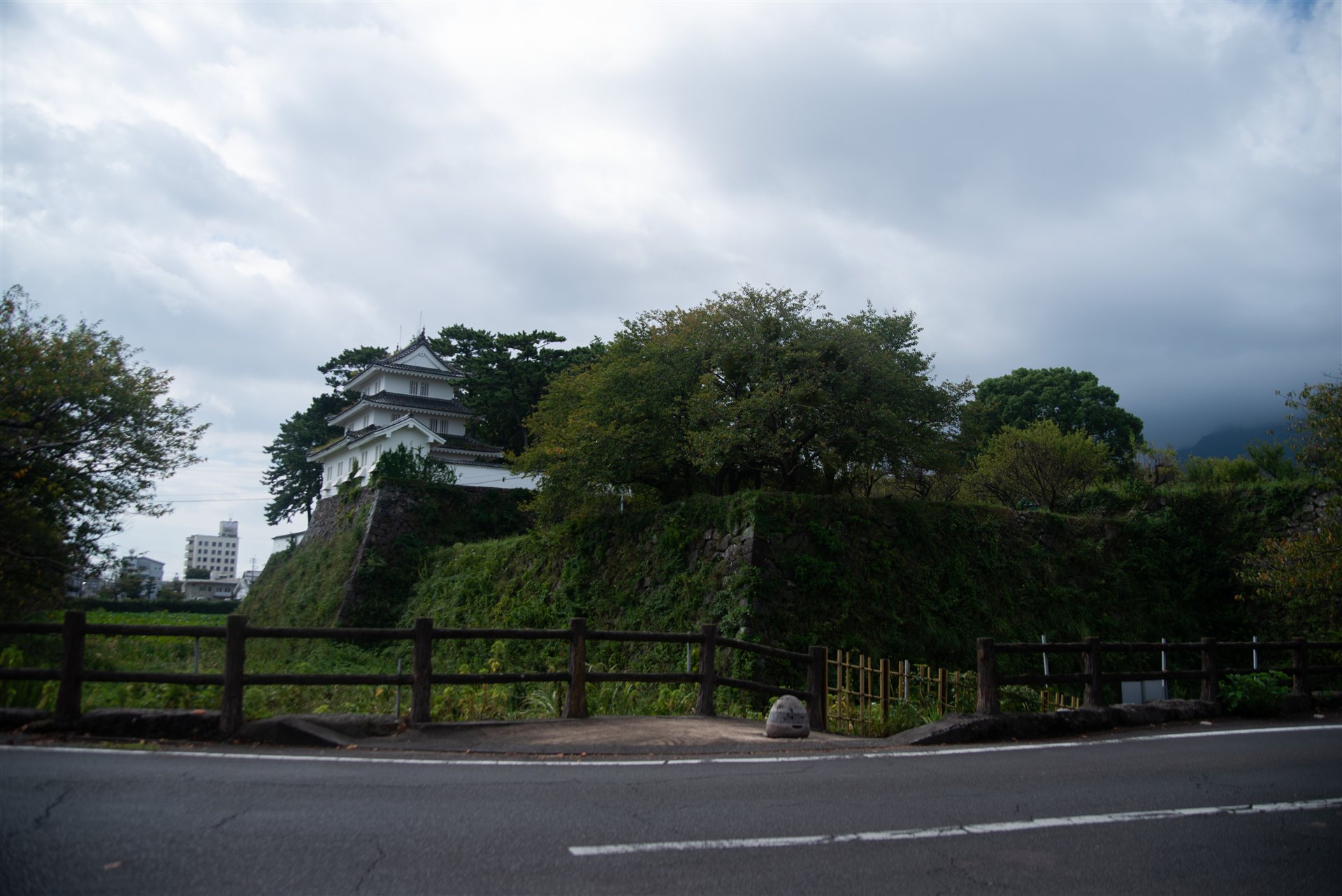
The stone wall and turret of Shimabara Castle seen from outside the moat. The stone walls and moats date back to the Edo period.
Shimabara Castle History ②: The Shimabara Rebellion (1637–1638)
No account of the history of Shimabara Castle is complete without the Shimabara Rebellion.
According to the official website, the rebellion broke out in a village in Arima on October 25, 1637. It is said to have been driven by a combination of grievances: heavy taxes, poor harvests and the suppression of Christianity. The rebels attacked Shimabara Castle, but the castle did not fall.
People in Amakusa then rose up as well, and in December the people of Shimabara and Amakusa gathered at the ruins of Hara Castle. About 30,000 people held out there for about three months, until February 28 of the following year. Their leader was Amakusa Shirō, who is said to have been 16 years old at the time. The shogunate and domain forces numbered about 120,000.
After the rebellion, the Matsukura clan, the lords of the castle, were held responsible. Shimabara Castle went down in history as the castle of the side that had caused the rebellion.
Shimabara Castle History ③: Changes of Lords and the Shimabara Taihen Disaster
The Kōriki clan came after the Matsukura clan, but the official website describes them as having “failed in governing.” In 1669 (Kanbun 9), Matsudaira Tadafusa arrived from Fukuchiyama in Tanba Province. The houses of the retainers who followed this Matsudaira family to Shimabara are the samurai residences introduced later in this article.
In 1749 (Kan’en 2), the Toda clan came from Utsunomiya, trading places with the young domain lord. Later the Matsudaira clan returned and ruled until the Meiji era.
In 1792 (Kansei 4), a great disaster known as the “Shimabara Taihen” (“the Shimabara catastrophe”) caused heavy damage to the castle town. According to the official website, the town later recovered and prospered as a center of transport on the Ariake Sea.
Shimabara Castle History ④: Dismantled in the Meiji Era, Keep Rebuilt in the Shōwa Era
Under the castle abolition order of 1873 (Meiji 6), Shimabara Castle was abandoned, and by 1876 (Meiji 9) its keep and turrets had been torn down. Only the stone walls and moats remained.
The keep rose again in 1964 (Shōwa 39). Like the Edo-period keep, the current keep was built as a five-story tower with no gables.
From the alleys around the castle, the keep sometimes comes into view unexpectedly. The sight of the white keep at the top of a stone-paved slope is something only a castle town can offer.
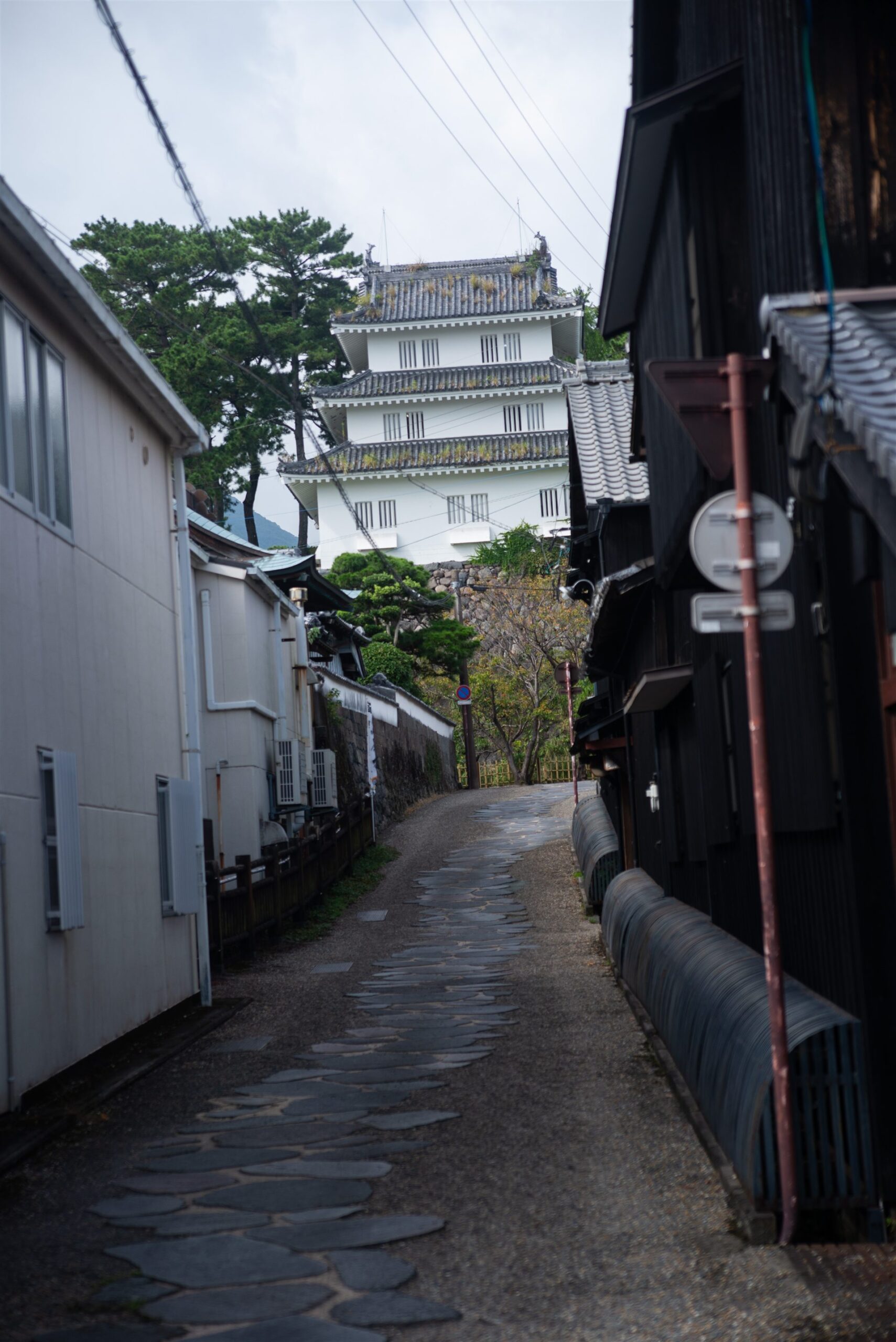
The keep of Shimabara Castle seen from an alley near the castle.
Exhibits Inside the Keep and the View from the Top Floor
The current keep houses a museum. According to “Castle Grounds Walk” on the official website, the exhibits on each floor are as follows.
- 1st floor: Christian history materials: three sections on the age of trade and missionary work, the age of the ban on Christianity, and the Shimabara Rebellion
- 2nd floor: Local history materials: items related to the successive domain lords and Shimabara Castle
- 3rd floor: Folk materials: pottery, weapons of the domain’s soldiers, and tools from the daily lives of ordinary people
- 5th floor: Observation deck: a 360-degree view of the town of Shimabara, Mt. Mayuyama and the mountains of Kumamoto
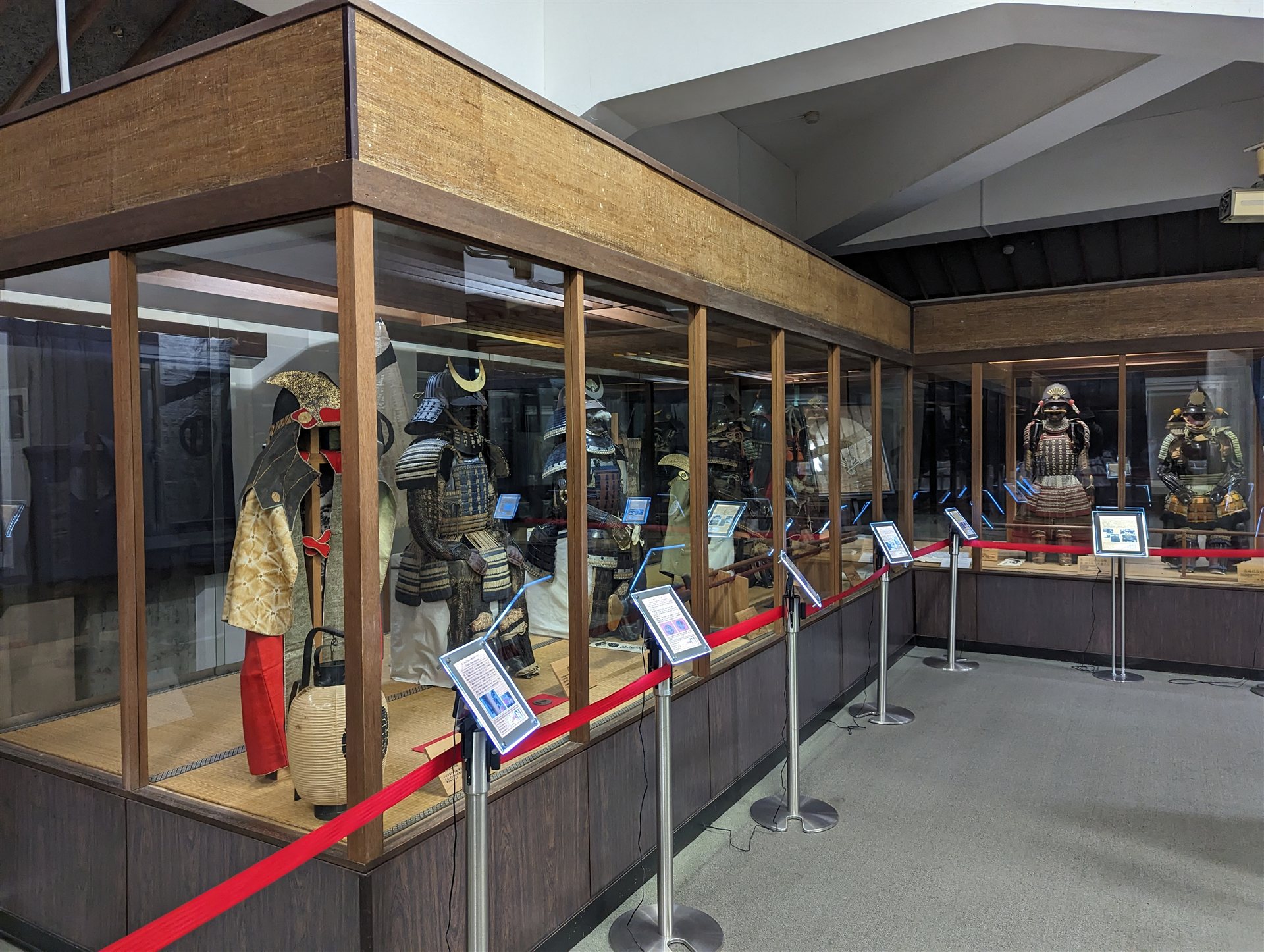
Rows of armor and helmets line the inside of the keep.
From the observation deck on the top floor, Mt. Mayuyama looms right in front of you, with the town of Shimabara spreading out below it.
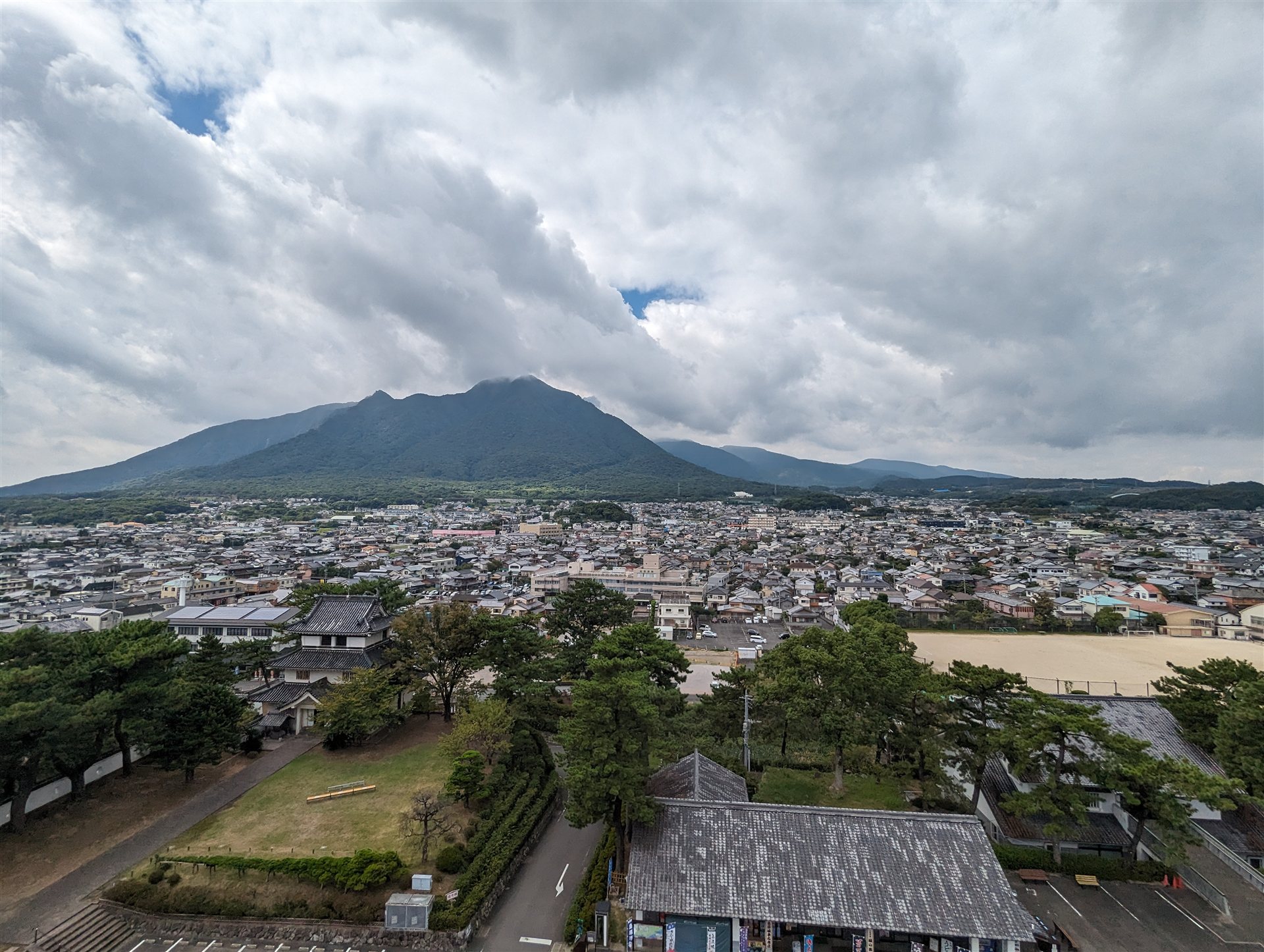
Mt. Mayuyama and the town of Shimabara seen from the top floor of the keep.
Highlights on the Castle Grounds: The Statue of Amakusa Shirō and the Seibō Memorial Museum
The open grounds around the keep also have things worth seeing.
The first thing that catches your eye is the statue of Amakusa Shirō, standing with his hands pressed together in prayer. The statue of Amakusa Shirō, who led the rebels in the Shimabara Rebellion, stands in the main enclosure of Shimabara Castle, the very castle the rebels attacked.
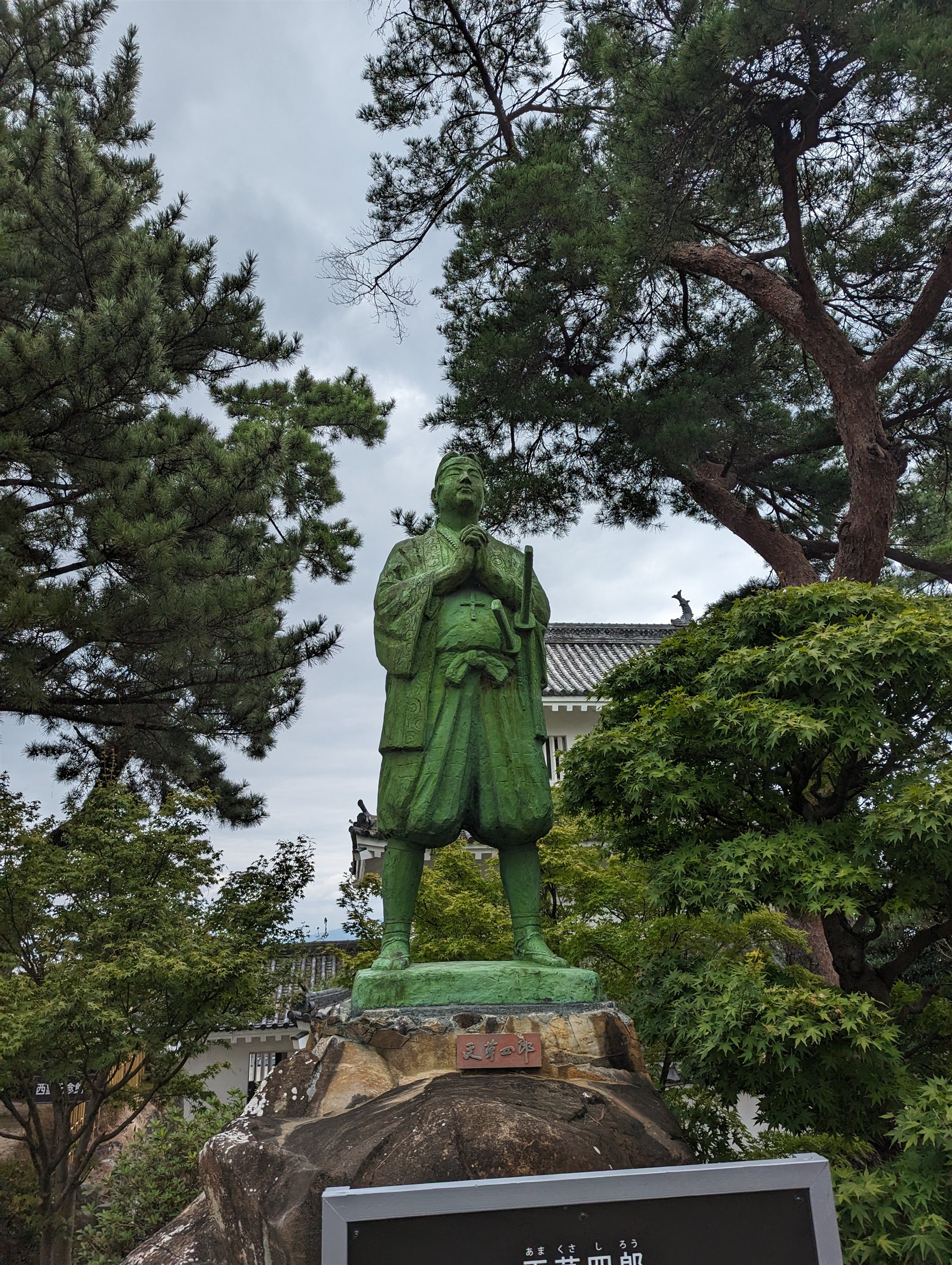
The statue of Amakusa Shirō in the main enclosure.
The castle grounds are also home to the Seibō Memorial Museum. It opened in 1972 to celebrate the 88th birthday of Kitamura Seibō, a sculptor from the area, and displays about 70 of his major works (according to the official website). Large works are also placed outdoors, including the statue “Oda Nobunaga in His Youth” (Wakaki Hi no Oda Nobunaga), which shows Nobunaga drawing a bow on horseback.
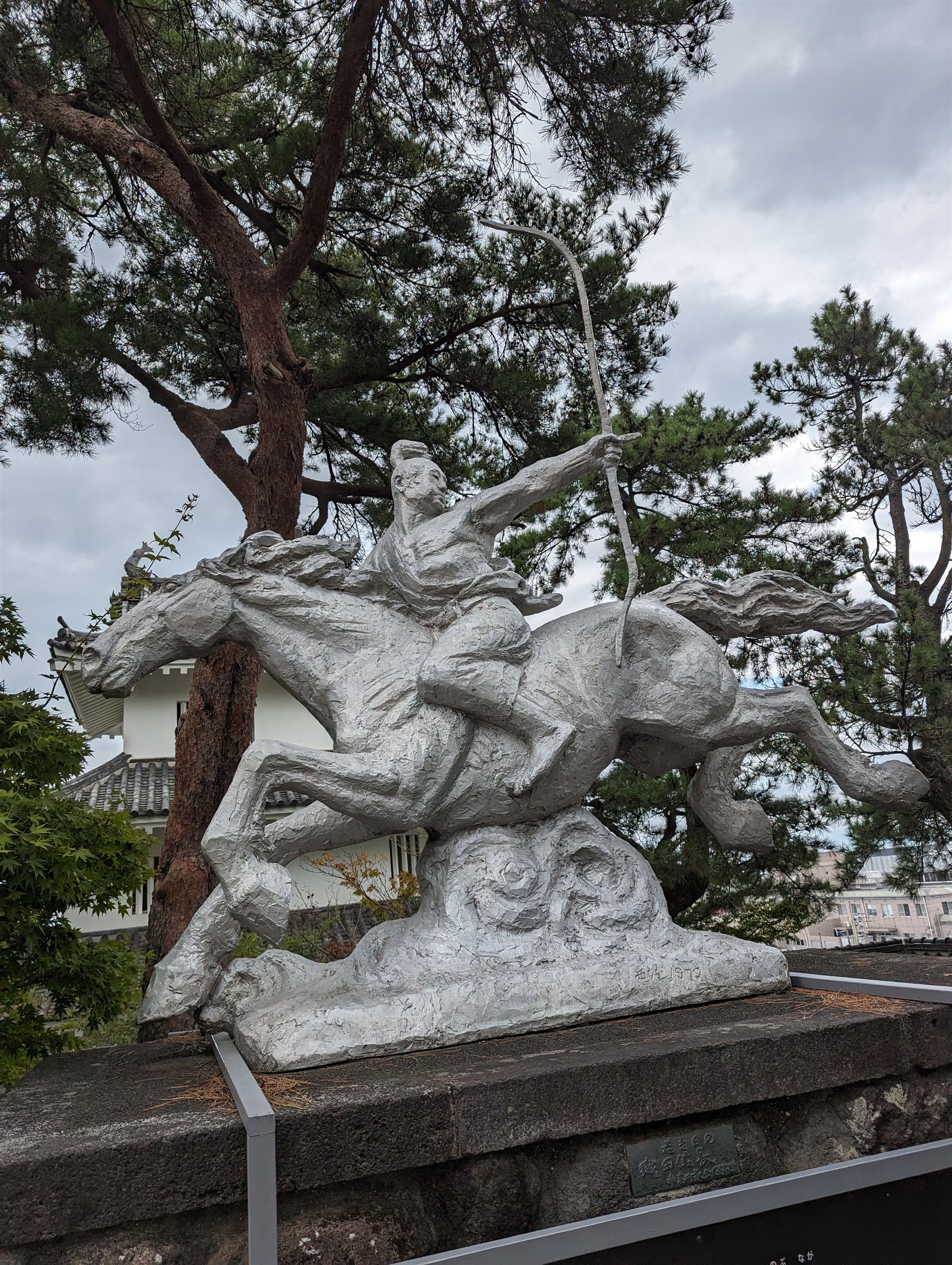
“Oda Nobunaga in His Youth,” a work by Kitamura Seibō placed outdoors.
At the Tourism Revival Memorial Museum, a film of about 15 minutes on a large screen shows how the 1991 (Heisei 3) eruption of Mt. Unzen-Fugendake unfolded. The keep, the Seibō Memorial Museum and the Tourism Revival Memorial Museum can all be visited with a single combined admission ticket.
The Samurai Residence District on the West Side of Shimabara Castle
After seeing Shimabara Castle, be sure to walk on to the samurai residences (buke yashiki) on the west side.
According to the information board on site, this area was lined with the houses of middle- and lower-ranking samurai, and each plot was divided into 3 se (90 tsubo). Each household is said to have planted fruit trees such as loquat, persimmon and citrus.
The most distinctive feature is the water channel running down the middle of the street. The information board says, “The clear stream flowing down the center of the road is the water channel used for daily life in those days.”
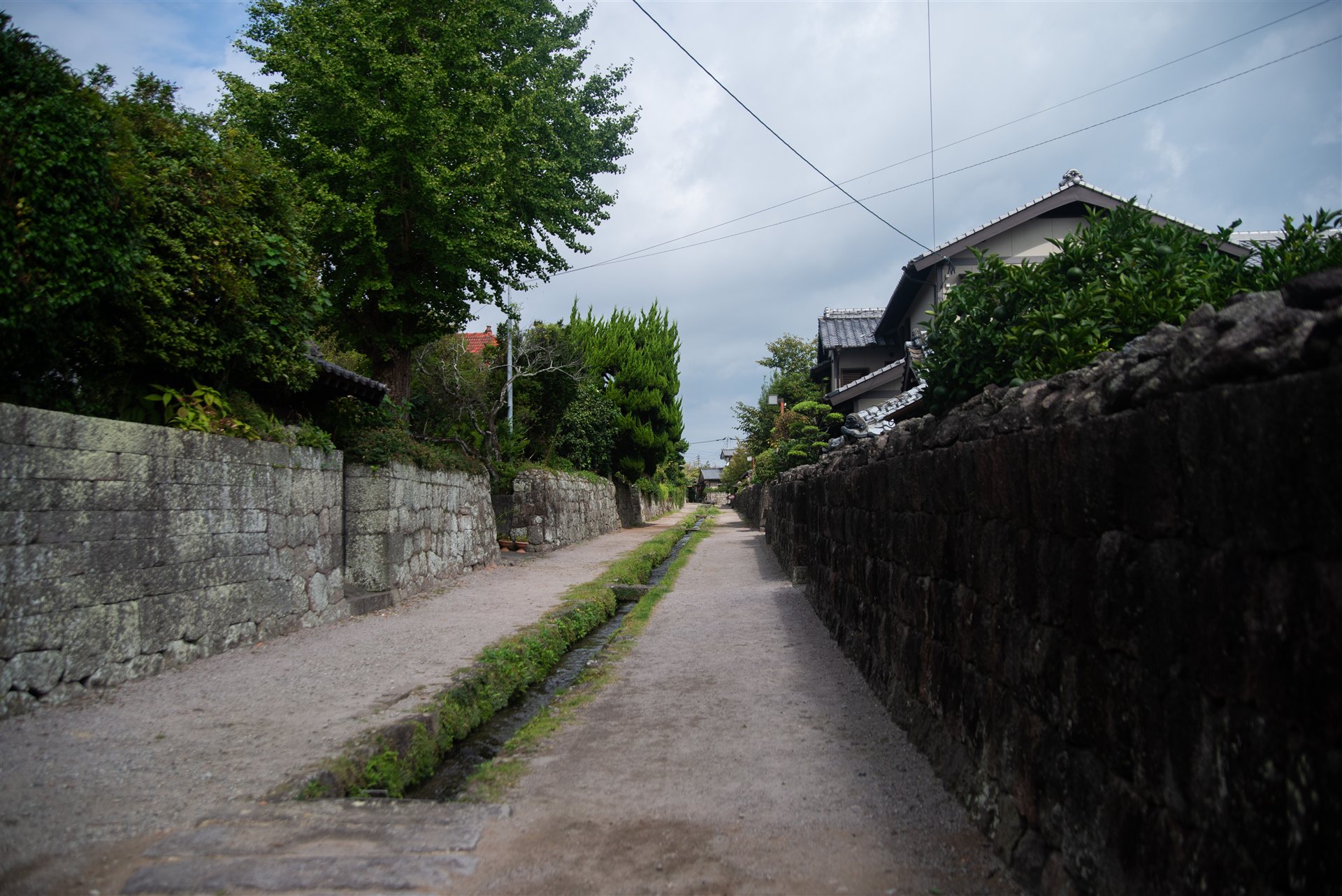
A water channel runs down the middle of the street, flanked by stone walls.
According to materials from Nagasaki Prefecture, three houses are open to the public free of charge: the Yamamoto, Shinozuka and Torita residences.
According to the information board, the Shinozuka family followed Matsudaira Tadafusa when he moved from Fukuchiyama to Shimabara in 1669 (Kanbun 9). The family continued for 11 generations until the early Meiji era, serving as district scribes (kōrikata yūhitsu) and magistrates (daikan). The Torita family also came to Shimabara in the same year, and at the end of the Edo period its members served in posts such as timber magistrate (zaimoku bugyō).
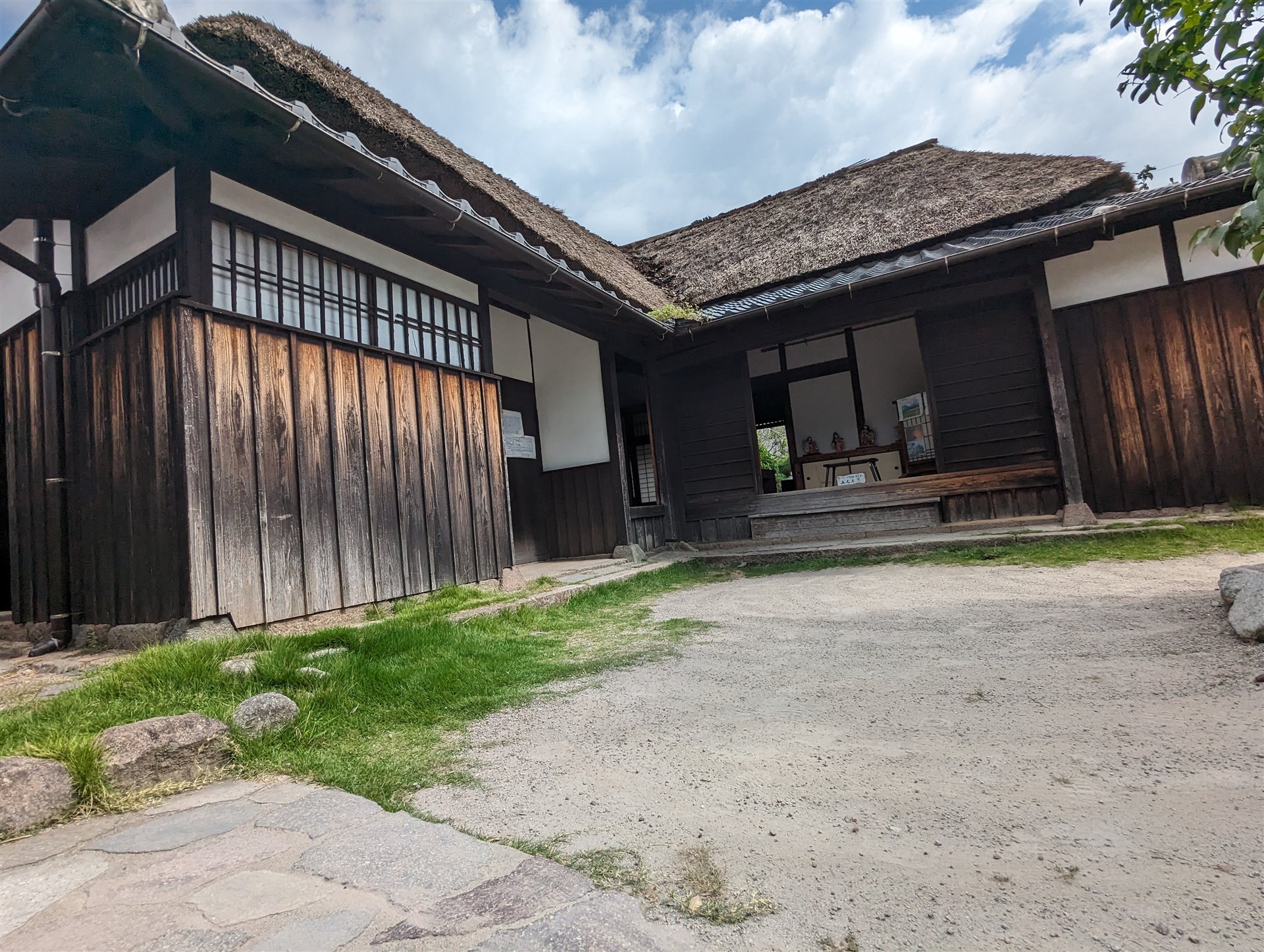
A thatched-roof samurai residence. You can also look inside the tatami rooms.
Shimabara Castle Admission, Opening Hours and Access
(Checked on the Shimabara Castle official website on October 25, 2026)
| Item | Details |
|---|---|
| Address | 長崎県島原市城内1丁目1183-1 (1183-1 Jōnai 1-chōme, Shimabara City, Nagasaki Prefecture) |
| Opening hours | 9:00–17:30 (last entry 17:00) |
| Closed | Open every day |
| Admission | Adults 700 yen, elementary, junior high and high school students 350 yen (combined ticket for the keep, the Tourism Revival Memorial Museum and the Seibō Memorial Museum) |
| Groups (15 or more) | Adults 560 yen, elementary, junior high and high school students 280 yen |
| Parking | About 90 spaces. 500 yen for regular vehicles |
| Phone | 0957-62-4766 |
| Official website | Shimabara Castle official website (Japanese) |
Prices may change. Please check the latest information on the official website before you go.
Access: The castle is within walking distance of Shimabara Station on the Shimabara Railway.
If you are coming from Kumamoto, the ferry from Kumamoto Port to Shimabara Port is convenient. I have put together the ferry timetables, fares and the differences of the two companies in “Kumamoto–Shimabara Ferry Guide: Timetable, Fares & Terminals.”
If you plan to visit Kumamoto Castle as well, see “Kumamoto Castle History: From Kato Kiyomasa to the Earthquakes and Stone Wall Restoration.” For the history of another castle, see “The History of Hiroshima Castle | From Mori Terumoto’s Construction to the Atomic Bomb, the Rebuilt Keep and Its 2026 Closing.”
Frequently Asked Questions
Who built Shimabara Castle?
Matsukura Shigemasa. Work began in 1618 (Genna 4), and the castle took 4 to 7 years to complete.
Is the keep of Shimabara Castle from the Edo period?
No. The Edo-period keep was torn down when the castle was abandoned in the Meiji era, and the current keep was rebuilt in 1964 (Shōwa 39). The stone walls and moats remain from the Edo period.
How is Shimabara Castle connected with the Shimabara Rebellion?
During the Shimabara Rebellion, the rebels attacked Shimabara Castle but could not take it. After the rebellion, the Matsukura clan, the lords of the castle, were held responsible.
How much is admission to Shimabara Castle?
Adults 700 yen, elementary, junior high and high school students 350 yen (checked on October 25, 2026). The ticket covers three facilities: the keep, the Tourism Revival Memorial Museum and the Seibō Memorial Museum.
Summary: At Shimabara Castle, You Can Trace 400 Years of History in the Keep and the Streets
- Shimabara Castle, begun by Matsukura Shigemasa in 1618 (Genna 4), is known for its five-story keep with no gables
- After the Shimabara Rebellion, changes of lords, the Shimabara Taihen disaster and dismantling in the Meiji era, its keep was rebuilt in 1964 (Shōwa 39)
- Inside the keep are Christian history materials and displays of armor, and the top floor looks out over Mt. Mayuyama and the town of Shimabara
- On the west side of the castle, a district of samurai residences remains, with a water channel running down the middle of the street
References (checked on October 25, 2026)
- Shimabara Castle official website (Japanese)
- History of Shimabara Castle | Shimabara Castle official website (Japanese)
- 400th Anniversary of the Castle | Shimabara Castle official website (Japanese)
- Castle Grounds Walk | Shimabara Castle official website (Japanese)
- Admission and Access | Shimabara Castle official website (Japanese)
- Nagasaki Prefecture materials (free admission to the samurai residences, 2019) (Japanese)
- On-site information boards at the samurai residences (Shinozuka and Torita residences)
コメント