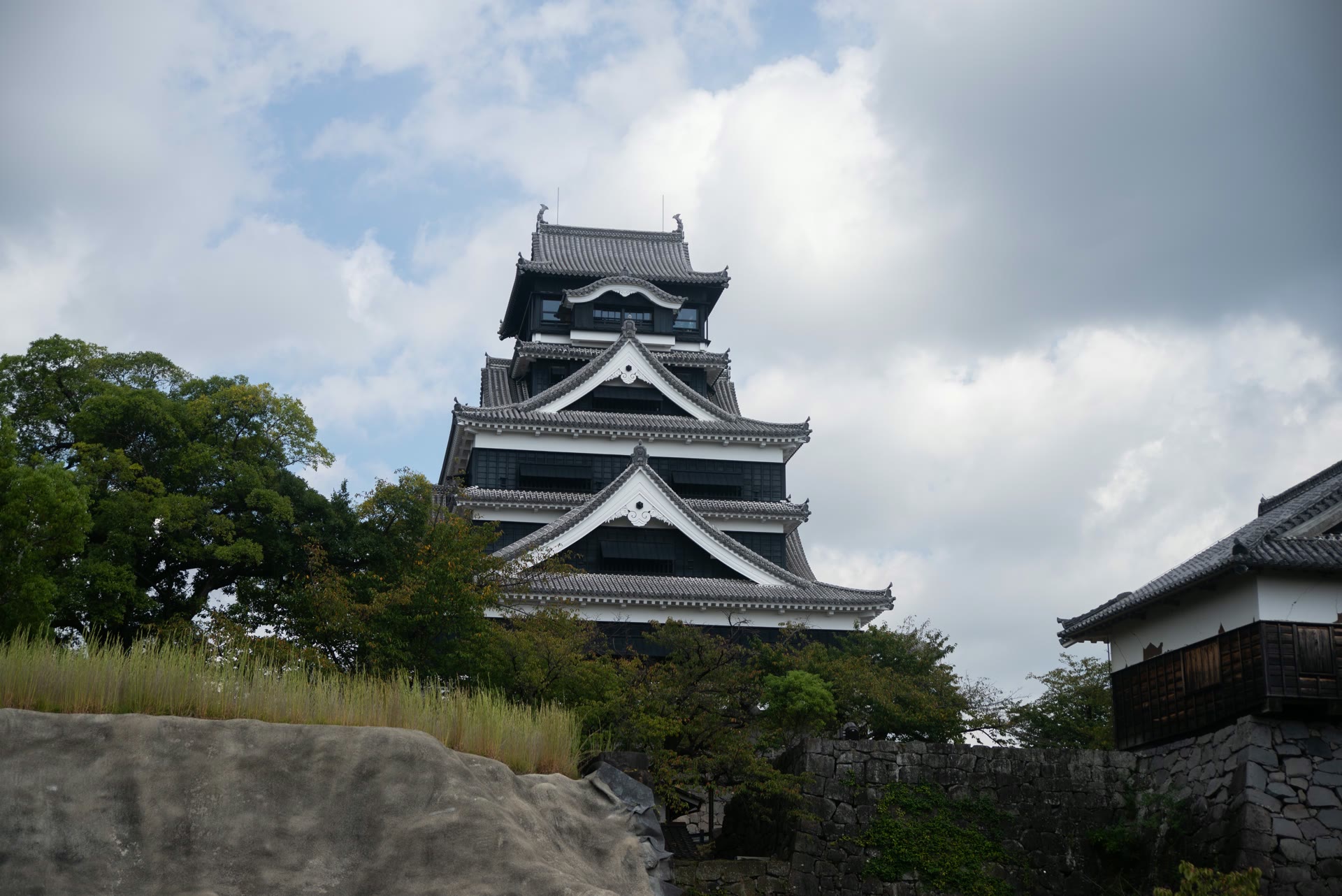
Kumamoto Castle was built by Kato Kiyomasa. Over a little more than 400 years, it has come through the fire of the Satsuma Rebellion and two major earthquakes, in 2016 and 2026.
This article explains the history of Kumamoto Castle in order, from its construction to the stone wall restoration going on today. It also shows photos of collapsed stone walls and of stones laid out on the ground. At the end, you will find opening hours, admission fees and how to get there from Kumamoto Station.
I walked around Kumamoto Castle on September 27, 2023. All the photos were taken on that day. They show the castle before the July 2026 earthquake, so some places look different now.
About the information in this article
- Opening hours, fees and opening status were checked on October 11, 2026 (on the official Kumamoto Castle website).
- Kumamoto Castle was damaged in the earthquake of July 28, 2026 (the Reiwa 8 Kumamoto Earthquake), including collapsed stone walls. It reopened on August 13, and the official website says it is “open as usual” (notice as of September 18, 2026).
- What is open may change because of aftershocks or inspections. Please check the news on the official website before you go.
- Kumamoto Castle History at a Glance: Timeline
- Kato Kiyomasa Builds the Castle
- The Hosokawa Era: Lords of the Castle for Almost 240 Years
- The Satsuma Rebellion: The Keep Burned, the Stone Walls Remained
- The 2016 Kumamoto Earthquake: About 30% of the Stone Walls Damaged
- Stones Laid Out in Rows: Rebuilding the Walls Exactly as They Were
- The July 2026 Earthquake: The Stone Walls Collapsed Again
- Historical Sights You Can Walk to for Free
- Kumamoto Castle Opening Hours and Admission Fees
- How to Get to Kumamoto Castle
- Frequently Asked Questions (FAQ)
- Summary
Kumamoto Castle History at a Glance: Timeline
First, here are the main events in the history of Kumamoto Castle.
| Year | Event |
|---|---|
| 1588 (Tensho 16) | Kato Kiyomasa becomes lord of the northern half of Higo Province and enters Kumamoto Castle (the old castle, “Furushiro”) |
| 1599 (Keicho 4) | Construction of a new castle (today’s Kumamoto Castle) is thought to have begun on Chausuyama hill |
| 1600 (Keicho 5) | Battle of Sekigahara. The main keep is completed around this time |
| 1607 (Keicho 12) | The new castle is completed. The characters used to write “Kumamoto” are changed from 隈本 to 熊本 |
| 1611 (Keicho 16) | Kiyomasa dies at the age of 50. His son Tadahiro succeeds him |
| 1632 (Kan’ei 9) | The Kato family has its fief confiscated. Hosokawa Tadatoshi enters Higo |
| 1871 (Meiji 4) | Abolition of the feudal domains |
| 1877 (Meiji 10) | Satsuma Rebellion. The keep, the Honmaru Goten Palace and other buildings burn down in a fire |
| 1889 (Meiji 22) | Damaged by the Kumamoto Earthquake (Kinpozan Earthquake) |
| 1933 (Showa 8) | Twelve buildings including Uto Yagura Turret are designated National Treasures; the stone walls and moats are designated a Historic Site |
| 1955 (Showa 30) | Designated a Special Historic Site |
| 1960 (Showa 35) | The main keep and small keep are rebuilt in steel-reinforced concrete |
| 2016 (Heisei 28) | Damaged by the Kumamoto Earthquake |
| 2021 (Reiwa 3) | Restoration of the castle keep is completed |
| 2026 (Reiwa 8) | Stone walls collapse again in the earthquake of July 28 |
Note: Events up to 2021 are based on the timeline on the official Kumamoto Castle website. The 2026 entry is based on announcements by Kumamoto City.
Official: History of Kumamoto Castle | Kumamoto Castle Official Website (in Japanese)
Kato Kiyomasa Builds the Castle
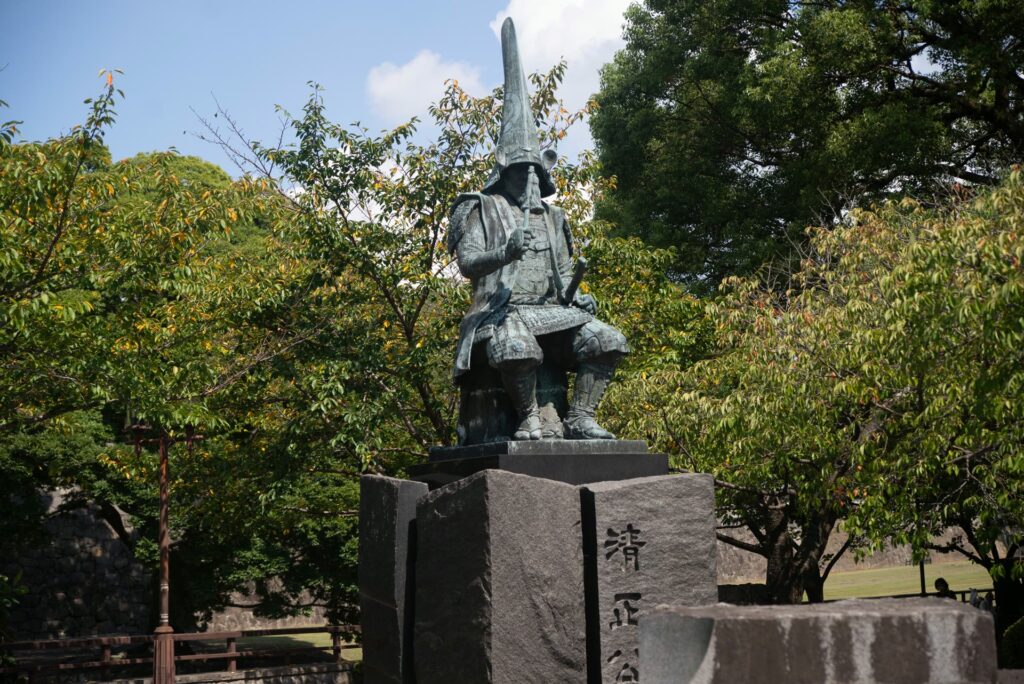
Kumamoto Castle was built by the samurai warlord Kato Kiyomasa.
In 1588 (Tensho 16), Kiyomasa entered the old Kumamoto Castle (Furushiro) as lord of the northern half of Higo Province. He later began building a new castle on a hill called Chausuyama. According to the timeline on the official website, construction is thought to have begun in 1599 (Keicho 4).
The main keep was finished around 1600 (Keicho 5). The whole castle was completed in 1607 (Keicho 12). At that time, the characters for the place name were also changed from 隈本 to 熊本. Both are read “Kumamoto”.
Kiyomasa put his efforts not only into the castle but also into river works and the development of rice fields. In Kumamoto, people still call him “Seishoko-san” with affection.
Kiyomasa’s Stone Walls: “Musha-gaeshi”
Kumamoto Castle is famous for its stone walls. They are known as “musha-gaeshi”, which means “walls that turn warriors back”.
The lower part has a gentle slope and looks easy to climb. But the higher you go, the steeper the curve becomes, until you cannot climb any further. The name comes from the idea that neither samurai nor ninja could climb them.
The Hosokawa Era: Lords of the Castle for Almost 240 Years
Kiyomasa died in 1611 (Keicho 16) at the age of 50, and his son Tadahiro succeeded him. In 1632 (Kan’ei 9), however, the Kato family had its fief confiscated.
Hosokawa Tadatoshi entered Higo in their place. From then until the abolition of the feudal domains in 1871 (Meiji 4), the Hosokawa family were the lords of Kumamoto Castle.
In 1640 (Kan’ei 17), Tadatoshi invited the swordsman Miyamoto Musashi to Kumamoto and gave him a residence in Chibajo-machi, near the castle. In 1755 (Horeki 5), the domain school “Jishukan” was opened in the Ninomaru area.
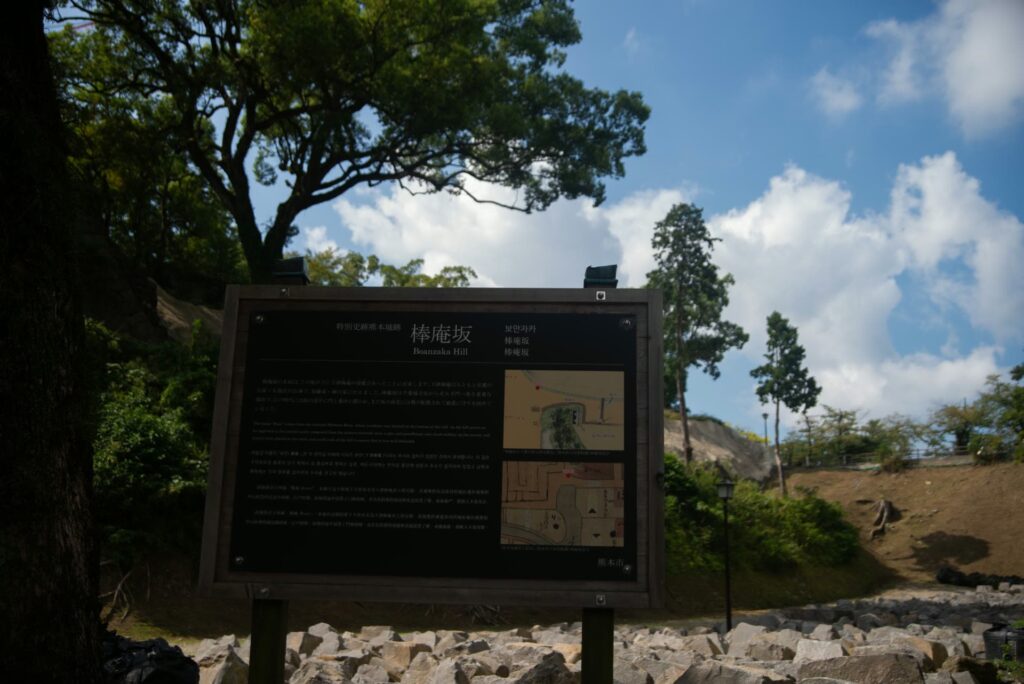
“Boan-zaka”, a slope on the east side of the castle, carries the name of a man who served both the Kato and the Hosokawa families. According to the information board on site, the name comes from the residence of Shimotsu Boan, which stood at the bottom of the slope. In the Edo period, a gate and a guardhouse stood partway up the slope, and it was heavily guarded.
The Satsuma Rebellion: The Keep Burned, the Stone Walls Remained
In the Meiji era, the castle grounds became army land. In 1874 (Meiji 7), the headquarters of the Kumamoto Garrison moved into the Honmaru area.
In 1877 (Meiji 10), the Satsuma Rebellion broke out. Just before the fighting, a fire in the castle burned down the keep, the Honmaru Goten Palace and other buildings. There are several theories about the cause, such as arson or a fire set by the garrison itself, but it is not known for certain.
Most of the buildings were lost, but almost all the stone walls remained as they were. Today’s main keep and small keep were rebuilt in steel-reinforced concrete in 1960 (Showa 35).
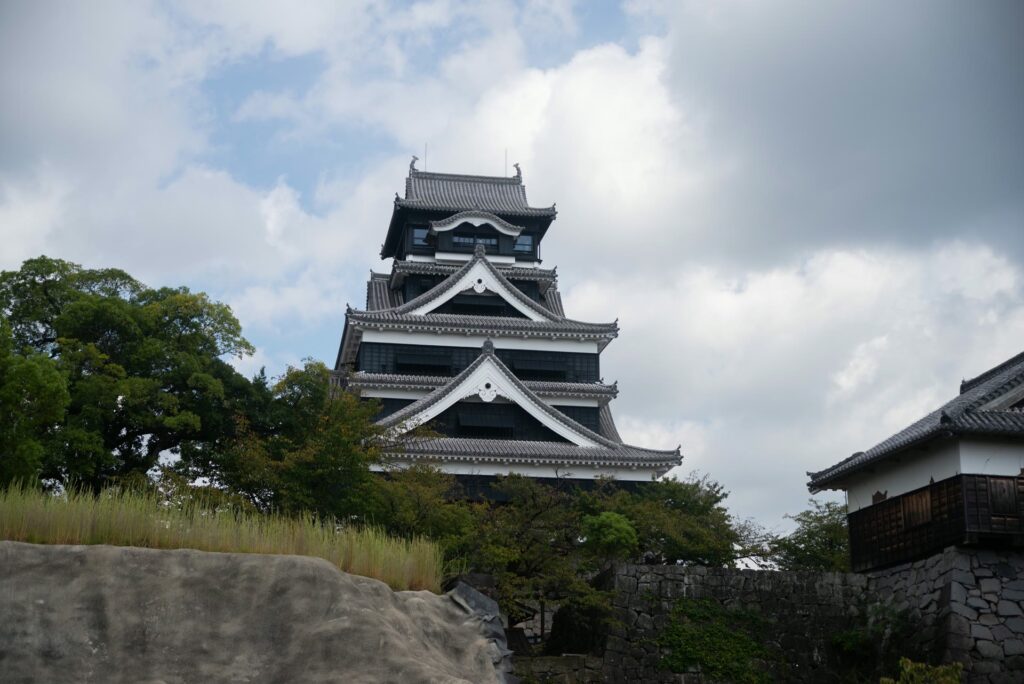
Inside the Castle Keep
I also entered the paid area and went up the castle keep.
Inside the keep, the history of Kumamoto Castle was explained in a way that was easy to understand. Until then, I had not known what kind of history the castle had been through. This was where I first got a grasp of the whole story.
The view from the keep was also very good. You can look out over the whole city of Kumamoto.
The 2016 Kumamoto Earthquake: About 30% of the Stone Walls Damaged
In the Kumamoto Earthquake of April 2016 (Heisei 28), Kumamoto Castle was badly damaged.
According to Kumamoto City’s “Basic Policy for the Restoration of Kumamoto Castle”, the damage was as follows.
| Item | Damage |
|---|---|
| Stone walls (area needing repair) | About 23,600 m², roughly 30% of the total (collapse, bulging, loosening) |
| Stone walls (area that collapsed) | About 8,200 m² (roughly 10% of the total) |
| Important Cultural Property buildings | All 13 buildings were damaged |
Collapsed Stone Walls Still Remain Around the Castle
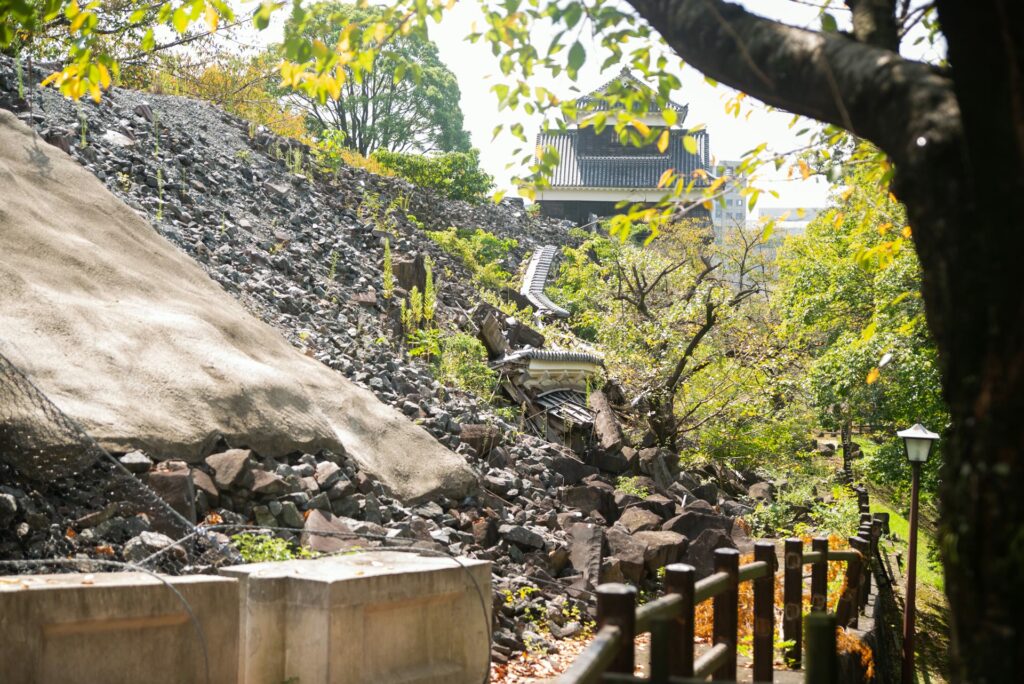
When I walked around in 2023, there were still collapsed stone walls here and there. I took the photo above near Kato Shrine. The roof of a fallen wall lies on the slope together with stones from the stone wall.
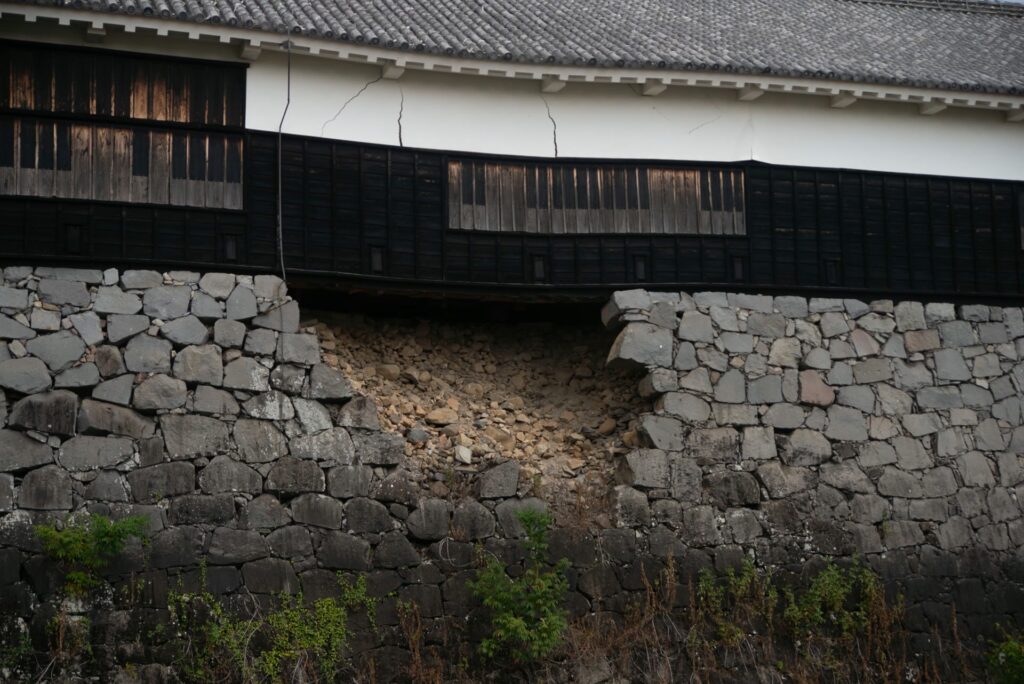
This is a place where the stone wall right below a turret collapsed. The large stones on the surface fell away, leaving the small stones packed inside exposed. You can also see cracks in the white wall above.
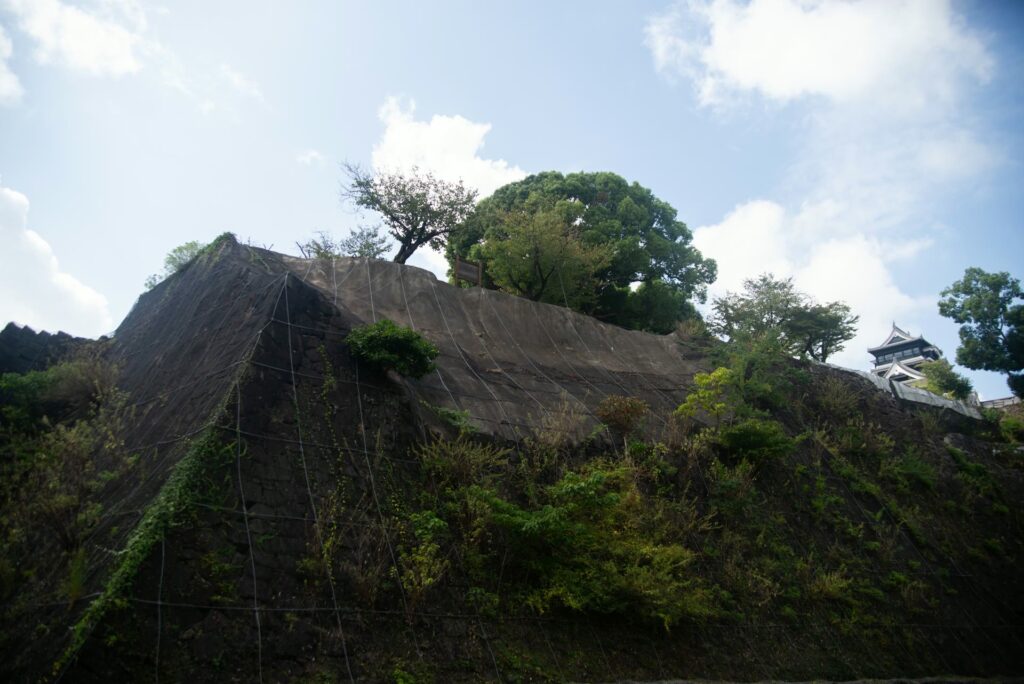
Stone walls that looked likely to collapse were covered with nets.
Stones Laid Out in Rows: Rebuilding the Walls Exactly as They Were
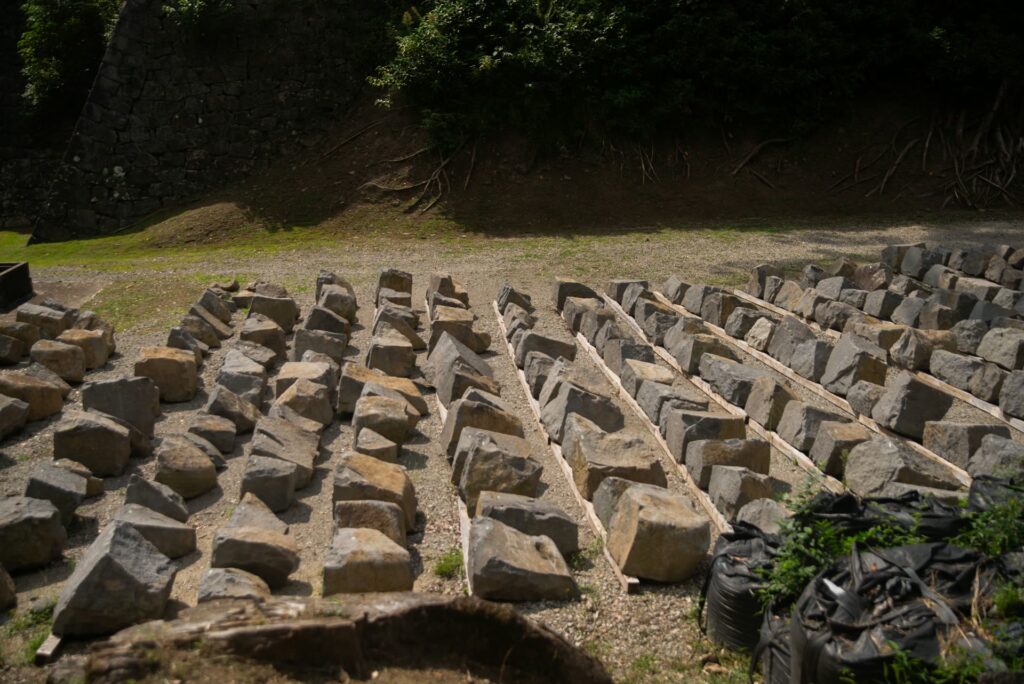
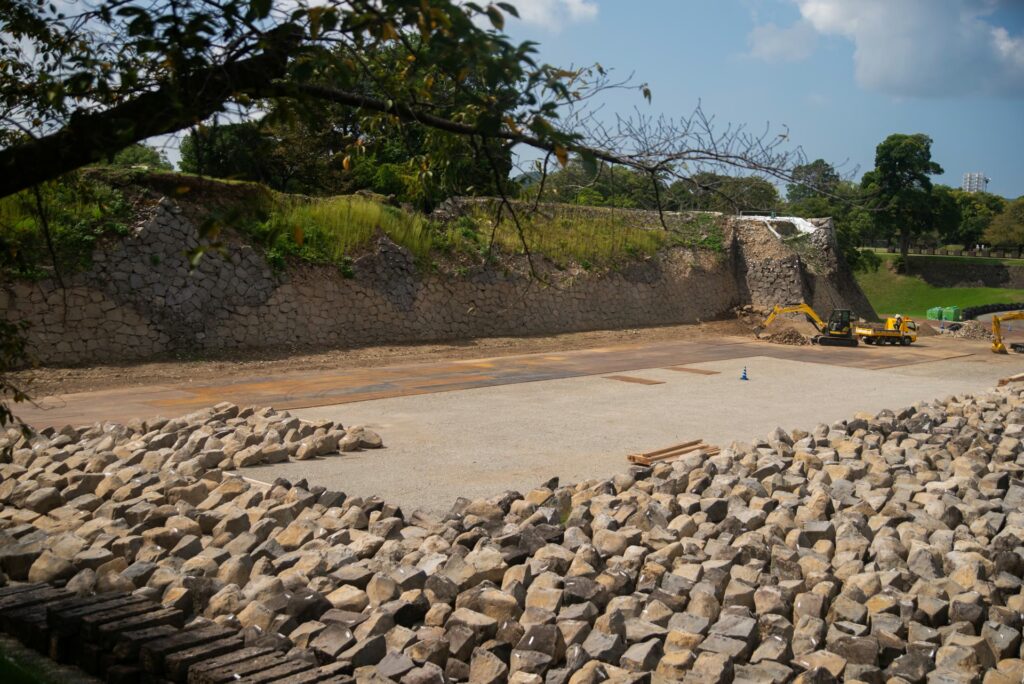
Near Boan-zaka, stones from the stone walls were laid out in long rows on the ground. They were collected from the collapsed walls.
The stone walls of Kumamoto Castle are cultural properties, so the fallen stones are put back in their original positions when the walls are rebuilt. For this reason, each stone is managed one by one.
- When the stones are collected, the place where each one fell is recorded (according to materials from the Kumamoto Castle Research Center, Kumamoto City)
- Each stone is marked with characters showing the rough location of its wall, a number for the original wall, and a number showing the order in which it was collected (according to explanatory materials from the Ministry of Land, Infrastructure, Transport and Tourism)
- Kumamoto University and others have developed a system that compares photos taken before the collapse with photos of the stones to find their original positions
The stones are not just lying there. They are waiting for their turn to go back to where they came from. When you walk around Kumamoto Castle, take a look at these stones as well as the stone walls.
Restoration Is Scheduled to Finish in Fiscal 2052
Restoration of the castle keep was completed in 2021 (Reiwa 3). The Nagabei wall was restored in 2021, and Kenmotsu Yagura Turret in 2023.
On the other hand, work and design are still going on for Uto Yagura Turret, Iidamaru Five-Story Turret and stone walls in many places. In March 2023, Kumamoto City revised its “Basic Plan for the Restoration of Kumamoto Castle” and extended the plan period by 15 years, to fiscal 2052.
Official: Restoration Status | Kumamoto Castle Official Website (in Japanese)
The July 2026 Earthquake: The Stone Walls Collapsed Again
At about 4:27 p.m. on July 28, 2026, an earthquake struck with its epicenter in the Kumamoto region of Kumamoto Prefecture. According to the Japan Meteorological Agency, the magnitude was 7.1 (preliminary), and a seismic intensity of 7 on the Japanese scale was recorded in Uki City and Hikawa Town. The agency named it the “Reiwa 8 Kumamoto Earthquake”.
Kumamoto Castle was damaged again. Materials from Kumamoto City’s disaster response headquarters (as of 4:00 p.m. on July 29) report the following.
| Item | Damage |
|---|---|
| Stone walls | Collapse and other damage at 40 locations, including the stone wall on the west side of Nishidemaru |
| Buildings | Cracked earthen walls and other damage at 8 locations, including the castle keep |
Kumamoto Castle was closed after the earthquake, but Kumamoto City confirmed that it was safe and reopened it on August 13. The official website says that Kumamoto Castle is “open as usual” (as of September 18, 2026).
However, “Kumamoto Castle Museum Wakuwakuza” near the castle remains temporarily closed (also as of September 18).
According to news reports, work began in September to move stones that were blocking a path near Kita-Otemon Gate. It is also reported that the completion of the restoration, planned for fiscal 2052, may be delayed.
The photos in this article are from 2023. The stone walls and the stone storage yard in the photos may also look different now.
Historical Sights You Can Walk to for Free
Around Kumamoto Castle, there are also places where you can feel the history without paying an admission fee. Here they are in the order I walked.
Tsuboi River and the Stone Walls
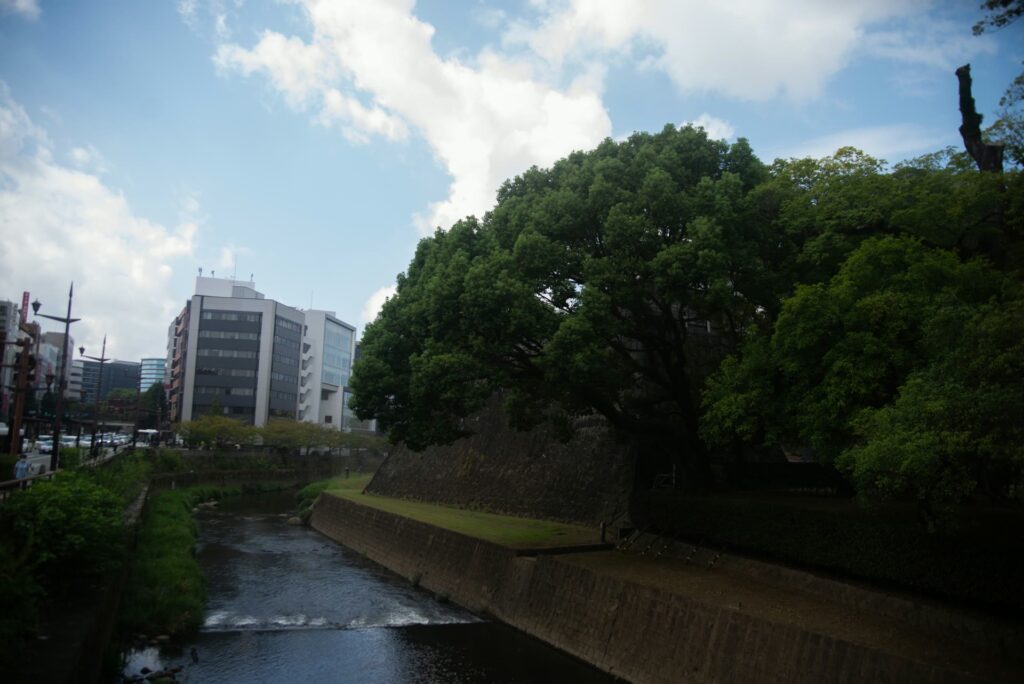
This is the Tsuboi River, which flows beside the castle. Across the river, stone walls covered with trees stretch into the distance.
Kumamotojo Inari Shrine
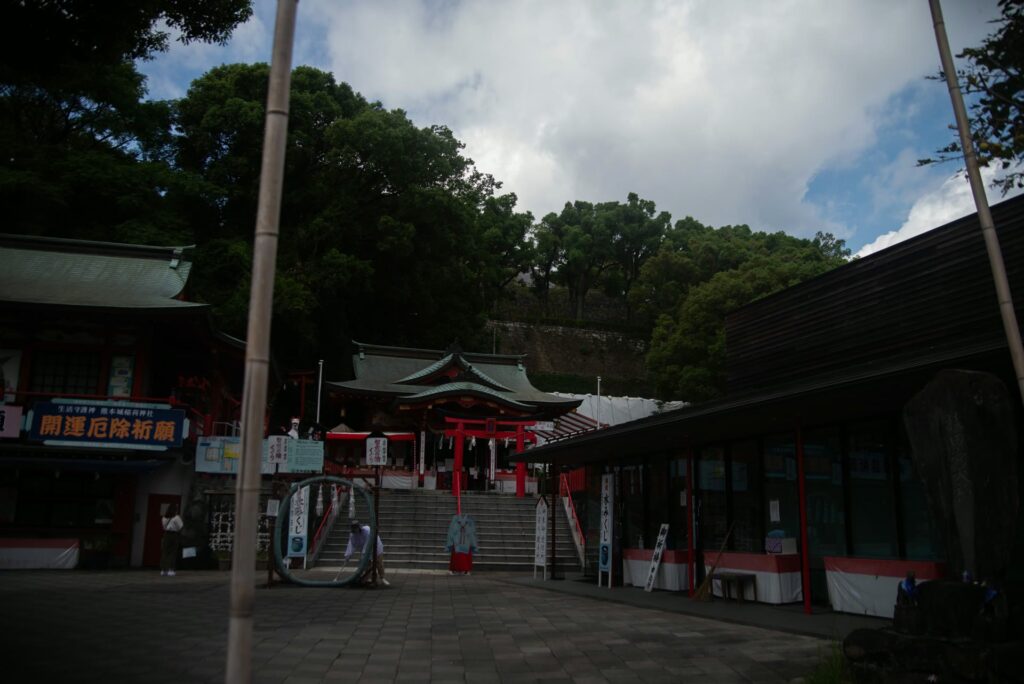
This shrine is on the east side of the castle. From here, you can go up Boan-zaka slope and come out near Kato Shrine.
Kato Shrine: A Good View of the Keep
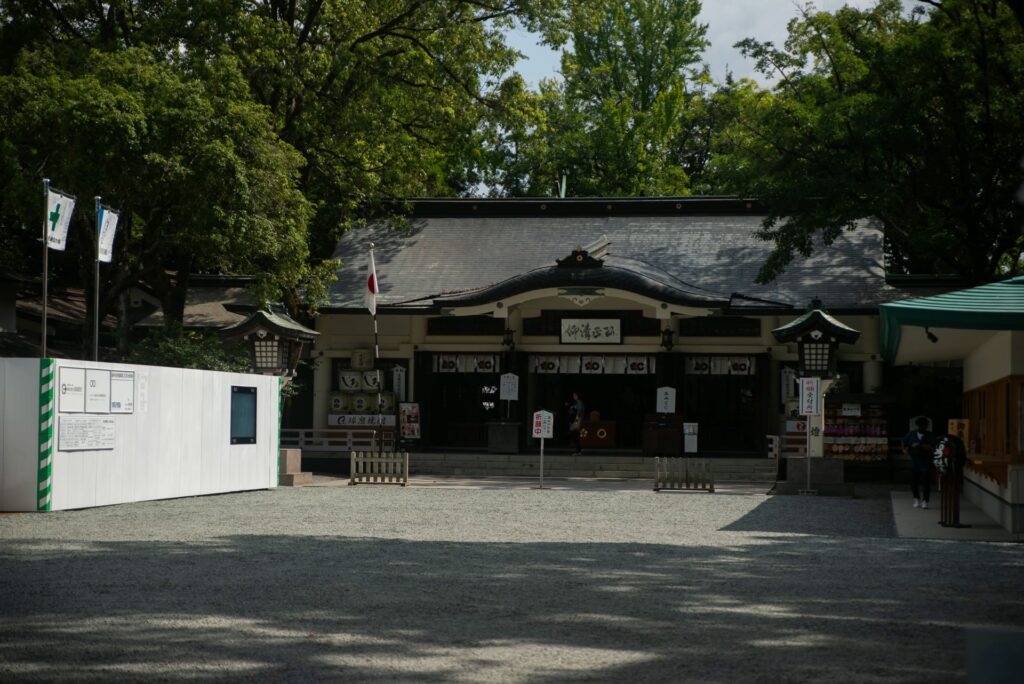
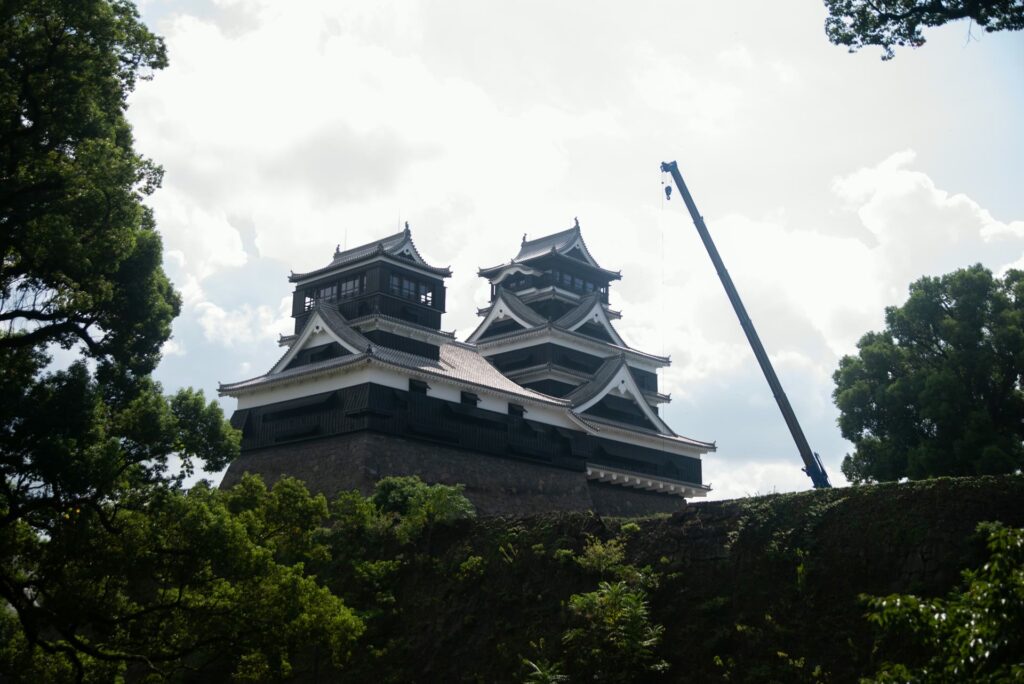
This shrine is dedicated to Kato Kiyomasa. From the grounds, you can see the main keep and the small keep side by side. When I visited, a construction crane stood next to the keep.
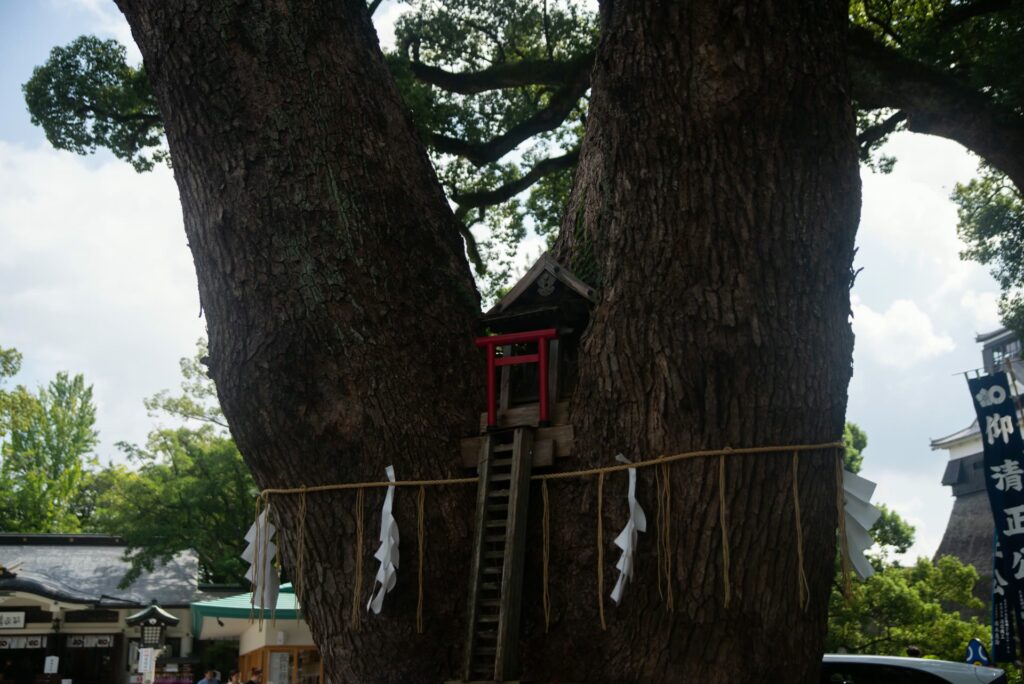
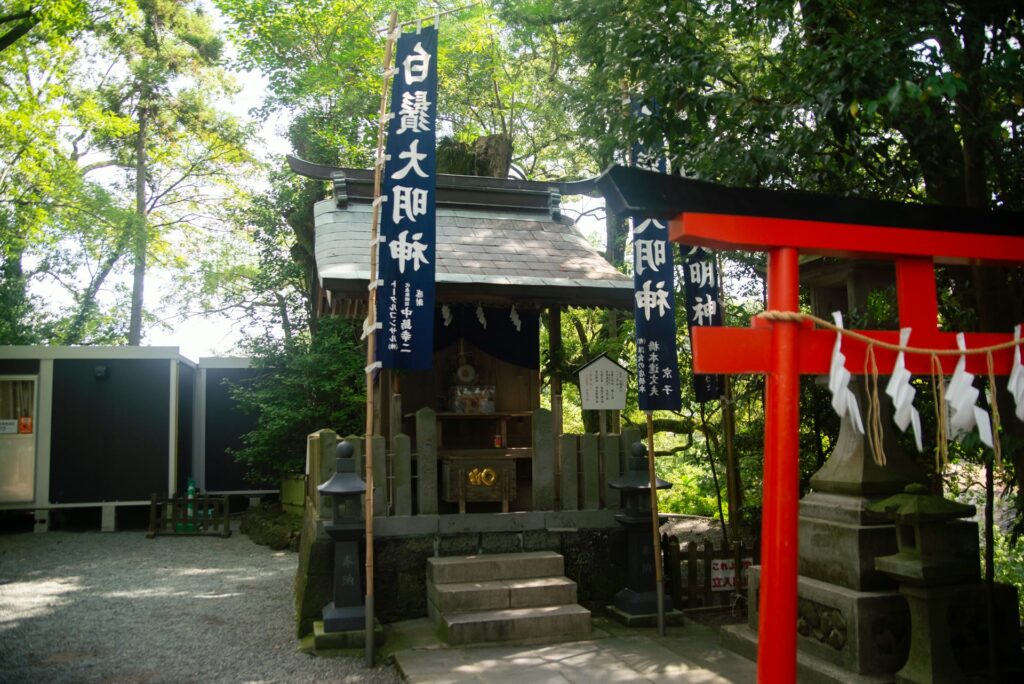
In the grounds, there is also a large tree with a sacred rope (shimenawa) around it, and “Shirahige Daimyojin” with its red torii gate.
Official: Kato Shrine (in Japanese)
Kumamoto Castle Opening Hours and Admission Fees
| Item | Details |
|---|---|
| Opening hours (September to June) | 9:00–17:00 (last entry 16:00; last entry to the castle keep 16:30) |
| Opening hours (July and August) | 9:00–19:00 (last entry 18:00; last entry to the castle keep 18:30) |
| Closed | December 29 (may also close in bad weather, etc.) |
| Admission | High school students and older 800 yen; elementary and junior high school students 300 yen; preschool children free |
| Entrances | South Gate only on weekdays. South Gate and North Gate on Saturdays, Sundays and public holidays |
| Inquiries | Kumamoto Castle Management Center 096-223-5011 (9:00–17:00) |
Note: Checked on the official website on October 11, 2026.
- The castle stays open into the evening during the “Autumn Kumamoto Castle Festival”. From Friday, October 2 to Sunday, November 1, 2026, the opening hours are 9:00–21:00 (last entry 20:00)
- The North Gate may be unavailable depending on construction work. Please check the news on the official website
- You cannot eat inside the paid area. Only drinks with a lid may be brought in
- Tripods and selfie sticks cannot be used inside the castle keep. Luggage with wheels cannot be brought in either
Official: Visitor Information | Kumamoto Castle Official Website (in Japanese)
How to Get to Kumamoto Castle
By Tram from Kumamoto Station
From the tram stop in front of Kumamoto Station, take Line A (bound for Kengunmachi). Get off at “Kumamoto Castle / City Hall” (Kumamotojo-Shiyakusho-mae) and walk from there. It takes about 10 minutes from Kumamoto Station to Kumamoto Castle / City Hall (according to the official Kumamoto City website).
By the “Shiromegurin” Loop Bus
The “Shiromegurin” loop bus, which goes around Kumamoto Castle, also runs from Kumamoto Station. The one-day pass comes with discount coupons for nearby facilities.
By Car
| Parking | Hours | Fee (standard car) |
|---|---|---|
| Ninomaru Parking (210 spaces) | September to June 8:00–18:30 / July and August 8:00–20:30 | 400 yen for up to 2 hours, then 200 yen per additional hour |
Note: Checked on the official website on October 11, 2026. There are also Sannomaru Parking No. 1 and No. 2, Miyauchi Parking and others.
A free shuttle bus also runs inside the castle grounds. It connects “Sakura-no-baba Josaien”, “South Gate” and “Ninomaru Parking”, and runs every 10 to 15 minutes from 9:00 to 17:00.
Official: Access and Parking | Kumamoto Castle Official Website (in Japanese)
Frequently Asked Questions (FAQ)
Q. Who built Kumamoto Castle, and when?
A. Kato Kiyomasa built it. Construction is thought to have begun in 1599 (Keicho 4), and the castle was completed in 1607 (Keicho 12).
Q. Is the keep of Kumamoto Castle the original building?
A. No. The original keep burned down in a fire just before the Satsuma Rebellion in 1877 (Meiji 10). Today’s main keep and small keep were rebuilt in steel-reinforced concrete in 1960 (Showa 35).
Q. Can I visit Kumamoto Castle now?
A. Yes. It was closed after the earthquake of July 28, 2026, but reopened on August 13. The official website says it is “open as usual” (as of September 18, 2026). Please check the official website for the latest information.
Q. When will the stone walls of Kumamoto Castle be fully restored?
A. Under Kumamoto City’s plan, the restoration is scheduled to finish in fiscal 2052. However, because stone walls collapsed again in the July 2026 earthquake, news reports say it may be delayed.
Q. What are the stones laid out inside the castle grounds?
A. They are stones collected from collapsed stone walls. Each one is recorded, marked and stored so that it can be put back in its original position.
Q. How much is admission?
A. 800 yen for high school students and older, and 300 yen for elementary and junior high school students. Preschool children are free (checked on the official website on October 11, 2026).
Summary
Kumamoto Castle was built by Kato Kiyomasa and kept by the Hosokawa family for almost 240 years.
- It was completed in 1607 (Keicho 12), when the characters for “Kumamoto” were changed from 隈本 to 熊本
- Just before the Satsuma Rebellion in 1877 (Meiji 10), the keep and the Honmaru Goten Palace burned down in a fire. The stone walls remained
- In the 2016 Kumamoto Earthquake, about 30% of the stone walls came to need repair
- Fallen stones are recorded, laid out, and put back in their original positions
- The castle keep was restored in 2021. The whole restoration is scheduled to finish in fiscal 2052
- In the earthquake of July 28, 2026, stone walls collapsed or were damaged at 40 locations. The castle reopened on August 13
Every time the stone walls of Kumamoto Castle have collapsed, they have been rebuilt with the same stones. When you visit, take your time to look not only at the keep but also at the stone walls and the stones laid out on the ground.
If you like castle history, please also read my article on the history of Tsurugajo Castle in Aizuwakamatsu.
References and official information checked (October 11, 2026; all in Japanese)
- Kumamoto Castle Official Website
- History of Kumamoto Castle | Kumamoto Castle Official Website
- Visitor Information | Kumamoto Castle Official Website
- Restoration Status | Kumamoto Castle Official Website
- Access and Parking | Kumamoto Castle Official Website
- Opening information for facilities around Kumamoto Castle after the Reiwa 8 Kumamoto Earthquake | Kumamoto Castle Official Website
- Opening hours during the Autumn Kumamoto Castle Festival | Kumamoto Castle Official Website
- On the earthquake in the Kumamoto region of Kumamoto Prefecture at about 16:27 on July 28, 2026 | Japan Meteorological Agency
- Kumamoto City, materials for the 5th Disaster Response Headquarters meeting (July 29, 2026)
- Basic Policy for the Restoration of Kumamoto Castle | Kumamoto City
- Access to Kumamoto City Hall | Kumamoto City
- Explanatory material on the stone walls of Kumamoto Castle | MLIT multilingual tourism database
News reports used as references
- Kumamoto Castle reopens to the public; visitors line up from the morning after closure due to collapsed stone walls | Kumamoto Nichinichi Shimbun
- Repair work begins on Kumamoto Castle stone walls that collapsed in the July earthquake | Kumamoto Nichinichi Shimbun (September 30, 2026)
コメント