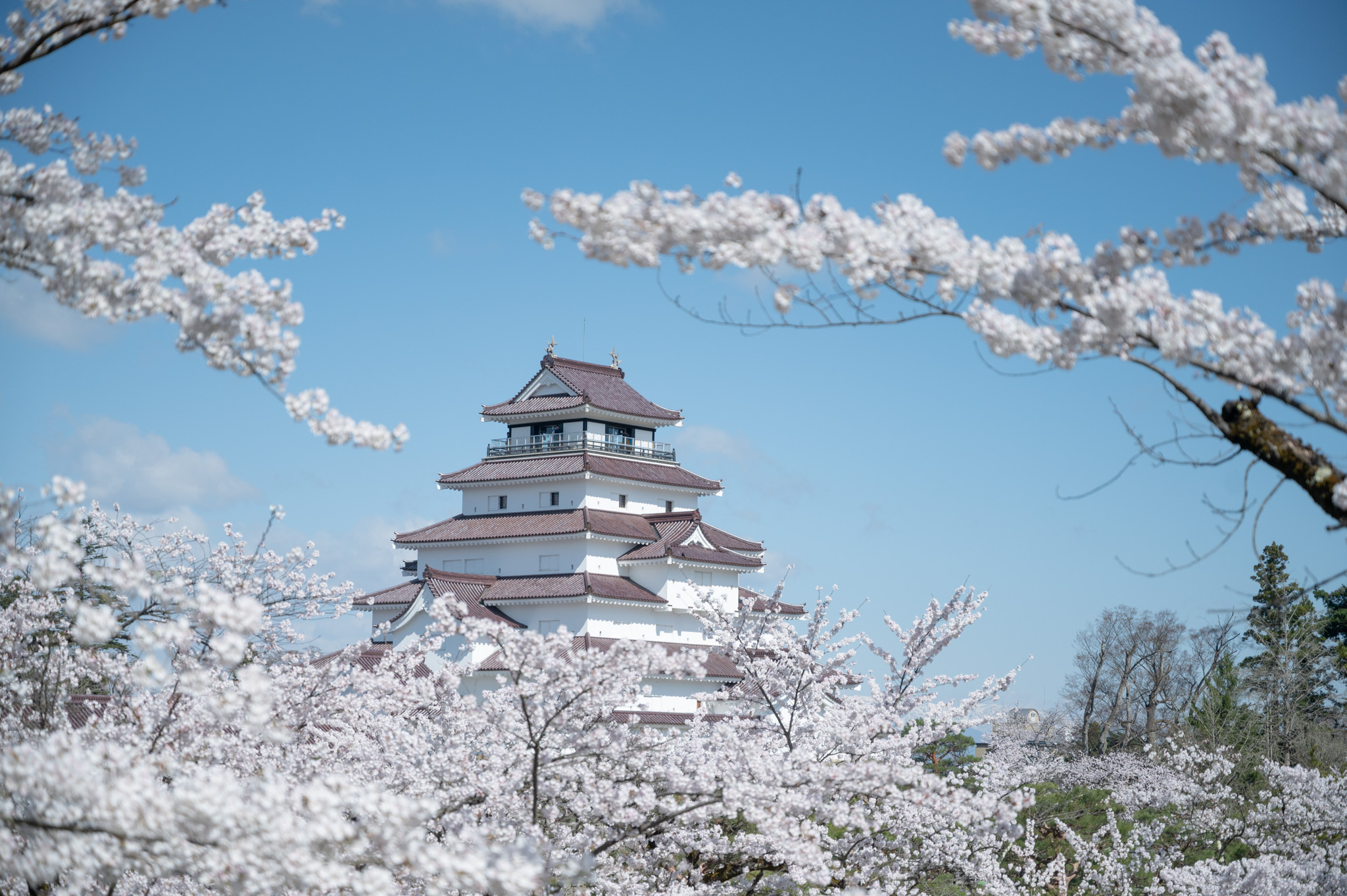
Tsurugajo Castle in Aizuwakamatsu, Fukushima Prefecture, is best known as the stronghold that endured a month-long siege during the Boshin War, and as the castle of the Aizu Domain, home of the tragic Byakkotai (White Tiger Force). But the story of Tsurugajo Castle begins centuries earlier than the Aizu Domain itself — all the way back to 1384, in the Nanboku-cho period.
From its founding by the Ashina clan, through a fierce power struggle with Date Masamune, a dramatic modernization under Gamo Ujisato, and the eventual rise of the Aizu Domain under the Tokugawa shogunate’s own bloodline, Tsurugajo Castle changed hands again and again on its way to becoming the symbol we know today.
This guide traces that full history — with a particular focus on the centuries before the Aizu Domain even existed — and explains exactly how a code of loyalty written 200 years earlier ended up dragging the Aizu Domain into the most tragic battle of the Boshin War.
- The Origins of Tsurugajo Castle: The Ashina Clan
- The Golden Age of the Ashina Clan at Kurokawa Castle
- Date Masamune Conquers Aizu
- Gamo Ujisato and the Birth of “Tsurugajo Castle”
- The Great Aizu Earthquake and the Kato Family’s Reconstruction
- Hoshina Masayuki and the Founding of the Aizu Domain
- The Fifteen Family Precepts: The Roots of Aizu’s Loyalty to the Tokugawa
- Matsudaira Katamori, the Kyoto Shugoshoku, and the Road to the Boshin War
- Conclusion
The Origins of Tsurugajo Castle: The Ashina Clan
The story of Tsurugajo Castle begins in 1384 (Shitoku 1), during the Nanboku-cho period.
Ashina Naomori, the 7th head of the Ashina clan that ruled the Aizu region, built a residence known as “Higashi-Kurokawa-date” (the Eastern Kurokawa Residence) at the center of the Aizu Basin. According to local legend, Naomori prayed at Tanaka Inari Shrine to ask the gods where he should build his castle, and the next morning he followed a trail of fox footprints in the snow to this very spot — a story still honored today by an Inari shrine kept within the castle grounds.
This residence was later expanded into a full base of regional rule known as Kurokawa Castle, named after the old Kurokawa River (today’s Yugawa River), which still lends its name to the area’s history.
The Golden Age of the Ashina Clan at Kurokawa Castle
The Ashina clan went on to rule the Aizu region for roughly 170 years. In 1553 (Tenbun 22), Ashina Moriuji, the clan’s 16th head, succeeded his father Morikiyo and became lord of Kurokawa Castle.
Under Moriuji, the Ashina clan reached its peak, extending its influence beyond Aizu into the Sendo region (present-day central Fukushima) and earning Moriuji a reputation as one of the great lords of the Tohoku region. Kurokawa Castle’s surrounding castle town flourished under his rule. However, after Moriuji’s death, a succession dispute split the clan from within, and Ashina power began to fade.
Date Masamune Conquers Aizu
The Ashina clan’s decline created an opening for Date Masamune, the ambitious warlord seeking to unify the Tohoku region. In 1589 (Tensho 17), Masamune defeated the Ashina at the Battle of Suriagehara and seized Kurokawa Castle, bringing roughly 200 years of Ashina rule in Aizu to an end.
Masamune’s own control of Aizu, however, was short-lived. In 1590 (Tensho 18), following Toyotomi Hideyoshi’s Siege of Odawara and the subsequent Oshu Shioki (the reorganization of Tohoku’s fiefs), Masamune was stripped of his newly won Aizu territory after holding it for barely a year. In his place, Hideyoshi installed his trusted retainer Gamo Ujisato as the new lord of Aizu.
Gamo Ujisato and the Birth of “Tsurugajo Castle”
Gamo Ujisato entered Kurokawa Castle in 1590 and began a major reconstruction in 1592 (Bunroku 1). He transformed what had largely been a wartime lord’s residence into a full-fledged early-modern castle, complete with stone walls and a tiled-roof keep — reportedly a magnificent seven-story tenshu.
As part of this renovation, Ujisato also renamed the castle town from “Kurokawa” to “Wakamatsu.” When the new keep was completed the following year, in 1593 (Bunroku 2), the castle itself was given a new name: Tsurugajo Castle, said to draw on auspicious characters tied to Ujisato’s home region of Omi Hino and to the pine (“matsu”) motif. The name “Tsurugajo” that visitors use today dates back to this very moment under Gamo Ujisato.
The Great Aizu Earthquake and the Kato Family’s Reconstruction
Even Gamo Ujisato’s magnificent keep couldn’t withstand the forces of nature. In 1611 (Keicho 16), a massive earthquake struck the Aizu region and left Tsurugajo Castle’s tenshu badly tilted and severely damaged.
Reconstruction fell to Kato Yoshiaki and his son Kato Akinari, who took over Aizu in 1627 (Kan’ei 4) after transferring from Iyo-Matsuyama. Akinari inherited the reconstruction project from his father and finally completed it in 1639 (Kan’ei 16), rebuilding the keep as an earthquake-resistant five-story structure — replacing Ujisato’s original seven stories. This is essentially the tenshu design still seen at Tsurugajo Castle today. Akinari also expanded the western and northern baileys (Nishidemaru and Kitademaru), turning the castle into the formidable, near-impregnable fortress it would become known as.
Hoshina Masayuki and the Founding of the Aizu Domain
Kato Akinari’s rule was troubled by conflict with his own retainers (the Aizu Disturbance), and he was eventually stripped of his domain.
In his place, in 1643 (Kan’ei 20), Hoshina Masayuki arrived from Yamagata in Dewa Province to take up the 230,000-koku Aizu Domain as its first daimyo. Masayuki was the half-brother of the third Tokugawa shogun, Iemitsu — and it’s with his arrival that the “Aizu Domain,” ruling from Tsurugajo Castle, truly came into being.
Iemitsu trusted Masayuki deeply, and after Iemitsu’s death, Masayuki served as regent and guardian for the young fourth shogun, Tokugawa Ietsuna. This close, almost fraternal bond with the shogunate would go on to define the character of the entire Aizu Domain for generations.
The Fifteen Family Precepts: The Roots of Aizu’s Loyalty to the Tokugawa
Late in his life, in 1668 (Kanbun 8), Hoshina Masayuki drew up the “Fifteen Family Precepts” (Aizu Kakun Jugo-ka-jo), a code of conduct that would become the moral backbone of the entire Aizu Domain.
Article 1 famously declares that the domain must devote itself, heart and soul, to loyal service to the shogun — and that it must never take its cue from how other domains behave. Any lord who broke this rule, the precepts warned, would no longer be considered a true descendant of Masayuki. It was an extraordinarily strict standard to set for two centuries of successors.
These precepts governed the conduct of Aizu’s lords and retainers for more than 200 years. Even the well-known children’s code of the han school, with its famous line “What must not be done, must not be done” (“Naranu koto wa naranu mono desu”), carries the same spirit of unbending discipline first laid down in Masayuki’s precepts.
Matsudaira Katamori, the Kyoto Shugoshoku, and the Road to the Boshin War
By the closing years of the Edo period, it was the ninth lord of Aizu, Matsudaira Katamori, whose fate would be shaped most decisively by these precepts. Adopted into the Aizu Matsudaira family from the Takasu Domain — a branch of the Owari Tokugawa — Katamori took the family’s founding code especially seriously.
In 1862 (Bunkyu 2), as pro-imperial, anti-foreign sentiment boiled over in Kyoto, Katamori was pressed by figures such as Matsudaira Shungaku and Hitotsubashi Yoshinobu to accept the post of Kyoto Shugoshoku — the shogunate’s military commissioner responsible for keeping order in the capital. Despite fierce opposition from his own retainers, Katamori accepted, in direct fulfillment of Article 1’s demand for absolute loyalty to the Tokugawa. But his subsequent crackdown on anti-shogunate activists in Kyoto — carried out partly through the Shinsengumi and the Kyoto Mimawarigumi — earned Aizu the lasting enmity of powerful domains like Satsuma and Choshu.
When the Boshin War broke out in 1868 (Keio 4) with the Battle of Toba-Fushimi, Aizu was branded an enemy of the newly formed imperial court and became a prime target of the new government’s forces. Starting in August of that year, Tsurugajo Castle endured roughly a month of siege in the Battle of Aizu — the very conflict that produced the tragic story of the Byakkotai. Nearly 500 years after Ashina Naomori first built his modest residence on this spot, the very code of loyalty that Hoshina Masayuki had written to bind the domain to the Tokugawa house instead led Tsurugajo Castle into one of the final, most tragic battles of the shogunate’s fall.
Conclusion
The history of Tsurugajo Castle begins with Ashina Naomori’s residence in 1384, runs through roughly 170 years of Ashina rule, a brief takeover by Date Masamune, Gamo Ujisato’s transformation of the castle and the naming of “Tsurugajo,” the Great Aizu Earthquake and the Kato family’s reconstruction, and finally the founding of the Aizu Domain under Hoshina Masayuki.
The Fifteen Family Precepts that Masayuki left behind — with their uncompromising demand for loyalty to the Tokugawa — shaped the domain for more than two centuries, ultimately pushing the ninth lord, Matsudaira Katamori, into accepting the Kyoto Shugoshoku post that would set Aizu on a collision course with the Boshin War.
The next time you visit Tsurugajo Castle, look past the story of the Byakkotai and the Boshin War for a moment, and consider the nearly 500 years of history — the Ashina clan, Date Masamune, Gamo Ujisato, and Hoshina Masayuki — that brought the castle to that fateful moment.
コメント