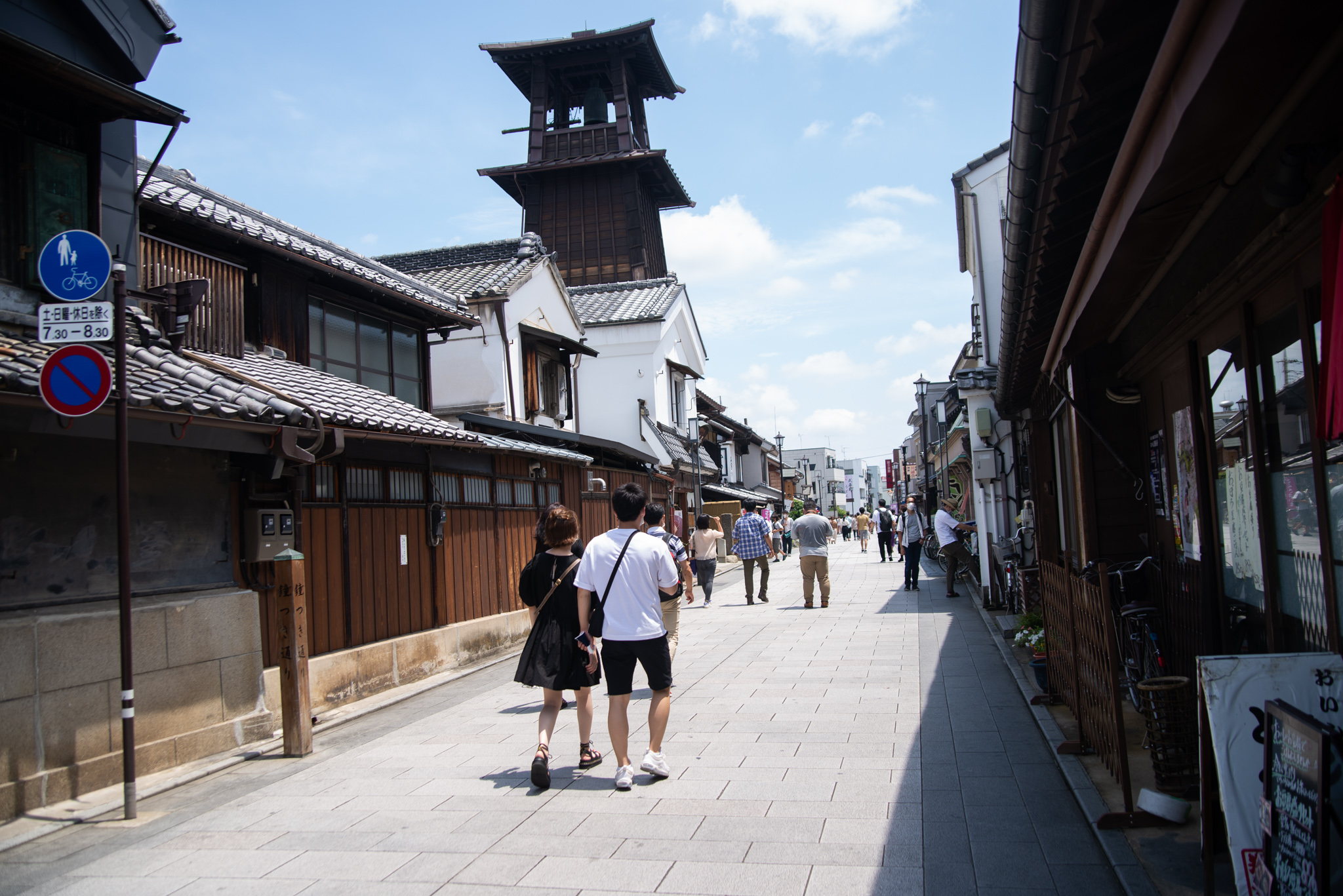
As you stroll through Koedo Kawagoe, a wooden bell tower peeks out above the roofs of the old storehouse-style buildings. This is Toki no Kane (the “Bell of Time”), the symbol of Kawagoe. For about 400 years, since the early Edo period, this bell has told the time to the castle town — and it still rings out over the streets four times a day.
This guide walks you through how Toki no Kane was built and rebuilt, with a history timeline, and covers when the bell rings, why it was chosen as one of the “100 Soundscapes of Japan,” the best photo spots, and a walk through the surrounding kurazukuri (clay-walled storehouse) streets.
What Is Toki no Kane?
Toki no Kane is a three-tiered wooden bell tower about 16 meters tall, located in Saiwaicho, Kawagoe City, Saitama Prefecture. Locals also call it the “Kanetsukido” (bell-ringing hall). It stands on Kanetsuki-dori, a small street that branches east off Ichibangai, the main street lined with kurazukuri buildings, and it is a must-see on any Kawagoe itinerary.
- Founded: Said to have been built in the early Edo period, during the rule of Kawagoe domain lord Sakai Tadakatsu (between 1627 and 1634)
- Current tower: The fourth tower, rebuilt in the year after the Great Kawagoe Fire of 1893
- Cultural property: Designated a Tangible Cultural Property of Kawagoe City
- Recognition: Selected in 1996 by the Environment Agency (now the Ministry of the Environment) as one of the “100 Soundscapes of Japan”
Originally built to tell the townspeople the time, the tower has burned down and been rebuilt several times over the centuries, and has been passed down to the present day.
History of Toki no Kane [Timeline]
The history of Toki no Kane is closely tied to the fires and recoveries that Kawagoe has gone through. Between the Edo period and the Meiji era it burned down three times, and each time it was rebuilt. Here are the main events.
| Year | Event |
|---|---|
| 1627–1634 | Toki no Kane is said to have been founded during the rule of Kawagoe domain lord Sakai Tadakatsu (originally in Tagamachi, today’s Saiwaicho) |
| 1653 | After Matsudaira Nobutsuna becomes lord of Kawagoe, Shiina Hyogo casts a new bell |
| 1774 and 1856 | Destroyed by major fires each time, and rebuilt in 1776 and 1857 |
| 1893 | The Great Kawagoe Fire destroys about one-third of the town, including Toki no Kane |
| 1894 | The current (fourth) tower is rebuilt. Yakushi Shrine is rebuilt around the same time |
| 1958 | Designated a Tangible Cultural Property of Kawagoe City |
| 1996 | Selected as one of the Environment Agency’s “100 Soundscapes of Japan” |
| 1999 | The surrounding Kawagoe historic district is designated a national Important Preservation District for Groups of Traditional Buildings |
| Fiscal years 2015–2016 (2015–2017) | Earthquake-resistance work is carried out |
The Great Kawagoe Fire and the Rebuilding
The Great Kawagoe Fire of 1893 was a major disaster that burned down one-third of the town of Kawagoe at the time. Toki no Kane was lost as well, but it was rebuilt just one year later — a sign of how eager the people were to restore the symbol of their town as quickly as possible.
After the fire, Kawagoe’s merchants began building their shops in the fire-resistant kurazukuri storehouse style one after another. Today’s kurazukuri streetscape and Toki no Kane were both born from the recovery after the same fire — you could call them “siblings.”
Highlights of Toki no Kane
The Bell Rings Four Times a Day (6:00, 12:00, 15:00, 18:00)
Today the bell is struck automatically by a mechanical device and rings four times a day: at 6 a.m., noon, 3 p.m. and 6 p.m.
If you are sightseeing, aim for 12:00 or 15:00, when you can hear it during the day. You will often see people waiting on Kanetsuki-dori a little before the hour to hear the bell.
A Sound Chosen as One of the “100 Soundscapes of Japan”
The sound of Toki no Kane is one of the “100 Soundscapes of Japan” selected in 1996 by the Environment Agency (now the Ministry of the Environment). It was recognized for its “history in sound”: a bell that has told the time to the castle town for about 400 years and still echoes through the kurazukuri streets today.
Yakushi Shrine Beyond the Tower
The base of Toki no Kane forms a kind of tunnel. Walk through under the tower and you will come out into the grounds of Yakushi Shrine. The shrine was originally a Buddhist temple called Zuikozan Iouin Jorenji, and its principal image is a standing statue of Yakushi Nyorai, the Buddha of healing. It is said to bring recovery from illness, and is especially known for blessings for eye ailments.
Many visitors just look up at the bell tower and leave, so be sure to walk under it and pay a visit to the shrine.
Photo Spots
Because Toki no Kane stands right on Kanetsuki-dori, the classic shot is taken from the street, looking up at the tower.
- From the Ichibangai end of Kanetsuki-dori: The classic composition, framing the tower straight ahead between the buildings on both sides of the street
- Looking up from directly below: An angle that captures the impressive scale of the three-tiered wooden tower
- Early morning or evening: The street is busy with visitors during the day, so come early if you want photos with fewer people
The street is busy with people coming and going, so please be careful not to block traffic while taking photos.
My personal recommendation is to photograph Toki no Kane together with the streetscape of Kanetsuki-dori. Rather than shooting the tower on its own, including the kurazukuri buildings along the street in the foreground gives you a photo that truly conveys “a bell tower in the little Edo town.”
Exploring the Kurazukuri Streets Nearby
Toki no Kane is just off Ichibangai, a street lined with imposing kurazukuri shops with black plaster walls. In 1999 this area was designated a national Important Preservation District for Groups of Traditional Buildings.
- Osawa Residence: A storehouse-style shop built in 1792 for a kimono and textile merchant. It survived the Great Fire of 1893 and is one of the buildings that inspired the spread of the kurazukuri style
- Kurazukuri streets of Ichibangai: Merchant houses in the kurazukuri style, developed as fire-resistant architecture, stand side by side and preserve the look of an Edo-period town
- Kashiya Yokocho (Candy Alley): A popular lane of old-fashioned sweet shops within walking distance of Ichibangai
For an overview of Kawagoe’s sights, see our guide 13 Must-See Spots in Koedo Kawagoe. If you plan to continue on to Kawagoe Castle (Honmaru Goten), our Kawagoe Castle access guide will help.
In October, the Kawagoe Festival is also held, when floats parade through the kurazukuri streets.
Toki no Kane Basic Information
| Item | Details |
|---|---|
| Name | Toki no Kane (Kanetsukido) |
| Address | 15-7 Saiwaicho, Kawagoe City, Saitama 350-0063 |
| Bell times | 6:00 / 12:00 / 15:00 / 18:00 (four times a day) |
| Viewing hours | The exterior can be viewed freely at any time (no set hours or closing days) |
| Admission | Free |
| Time needed | About 5–10 minutes |
| Parking | None (use nearby coin parking lots) |
| Cultural property | Tangible Cultural Property of Kawagoe City |
| Official information | Kawagoe City official website “Toki no Kane” (Japanese) |
*The author visited around July 2021. Bell times, admission, access and other information were checked on the Kawagoe City official website on October 7, 2026. Details may change, so please check the latest information before you go.
How to Get to Toki no Kane
By Train + On Foot
| Nearest station | Walking time |
|---|---|
| Hon-Kawagoe Station (Seibu Shinjuku Line) | About 15 minutes |
| Kawagoeshi Station (Tobu Tojo Line) | About 18 minutes |
| Kawagoe Station, East Exit (JR Kawagoe Line / Tobu Tojo Line) | About 24 minutes |
By Train + Bus
- Tobu Bus: From Kawagoe Station, take a bus bound for the “Kura no Machi” (storehouse town) area and get off at the “Ichibangai” bus stop. About 2 minutes on foot from there
Walking while taking in the streetscape is fun, but the bus is handy if you are short on time or tired on the way back.
By Car
About 11 minutes from Kawagoe IC on the Kan-Etsu Expressway. There is no dedicated parking for Toki no Kane, so use one of the nearby coin parking lots. Roads in the area tend to get congested on weekends and during the tourist season, so public transportation is recommended.
Frequently Asked Questions
Q. What time does Toki no Kane ring?
It rings four times a day: at 6 a.m., noon, 3 p.m. and 6 p.m. Today it is struck automatically by a mechanical device.
Q. Is there an admission fee?
No, it is free. You can view the exterior freely at any time, and you can also walk under the tower to visit Yakushi Shrine.
Q. When was Toki no Kane built?
It is said to have been built in the early Edo period, during the rule of Kawagoe domain lord Sakai Tadakatsu (between 1627 and 1634). The current tower is the fourth one, rebuilt in the year after the Great Kawagoe Fire of 1893.
Q. How much time should I allow?
Toki no Kane itself takes about 5–10 minutes. If you include a visit to Yakushi Shrine and a stroll along Ichibangai, allow 1–2 hours to enjoy it at a relaxed pace.
Q. Is there parking near Toki no Kane?
There is no dedicated parking. We recommend using nearby coin parking lots, or coming by train and bus.
Q. Can I enjoy street food near Toki no Kane?
Yes. The Ichibangai area around Toki no Kane has many Japanese sweet shops and street-food stalls, and Kashiya Yokocho (Candy Alley) is also within walking distance.
Summary
Kawagoe’s Toki no Kane is the symbol of Koedo Kawagoe, a bell that has told the time to the castle town for about 400 years since the early Edo period.
- Founded between 1627 and 1634; the current tower is the fourth, rebuilt the year after the Great Fire of 1893
- The bell rings four times a day (6:00, 12:00, 15:00, 18:00) — for sightseeing, aim for 12:00 or 15:00
- Its sound was chosen as one of the “100 Soundscapes of Japan”
- Walk under the tower to Yakushi Shrine, known for blessings for eye ailments
- Free to visit, and best enjoyed together with a walk through the kurazukuri streets
Time your visit to the hour, and listen to the bell echoing through the old storehouse streets of Kawagoe.
コメント