Arima Onsen is a hot spring town on the north side of Mount Rokkō, in Kita Ward, Kobe. The website of the Arima Onsen Tourism Association introduces it as “one of Japan’s three oldest hot springs,” and it is also known as a place Toyotomi Hideyoshi came to many times to bathe and rest.
In this article, I introduce Arima Onsen, where I stopped by during a trip in May 2023, with photos in the order I walked: from Arima-Onsen Station on the Kobe Electric Railway to Yukemuri Plaza, Taiko Bridge, Nene Bridge and the path along the Arima River. I have also put together the prices of the public bathhouses “Kin no Yu” and “Gin no Yu,” and how to get there from Sannomiya and Osaka.
* Prices, opening hours and other details were checked on the official website of the Arima Onsen Tourism Association on November 9, 2026. The photos were taken in May 2023, so some places may look different today.
- Start Your Arima Onsen Town Walk at Arima-Onsen Station
- Yukemuri Plaza and the Statue of Taikō Hideyoshi (Taiko Bridge)
- The Red-Railed Nene Bridge and the Riverside Plaza
- Walking Up the Arima River
- A Street of Ryokan Inns and Hotels, and a Round Postbox
- Kin no Yu and Gin no Yu (Public Bathhouses): Kinsen and Ginsen Waters
- How to Get to Arima Onsen
- Frequently Asked Questions
- Summary
Start Your Arima Onsen Town Walk at Arima-Onsen Station
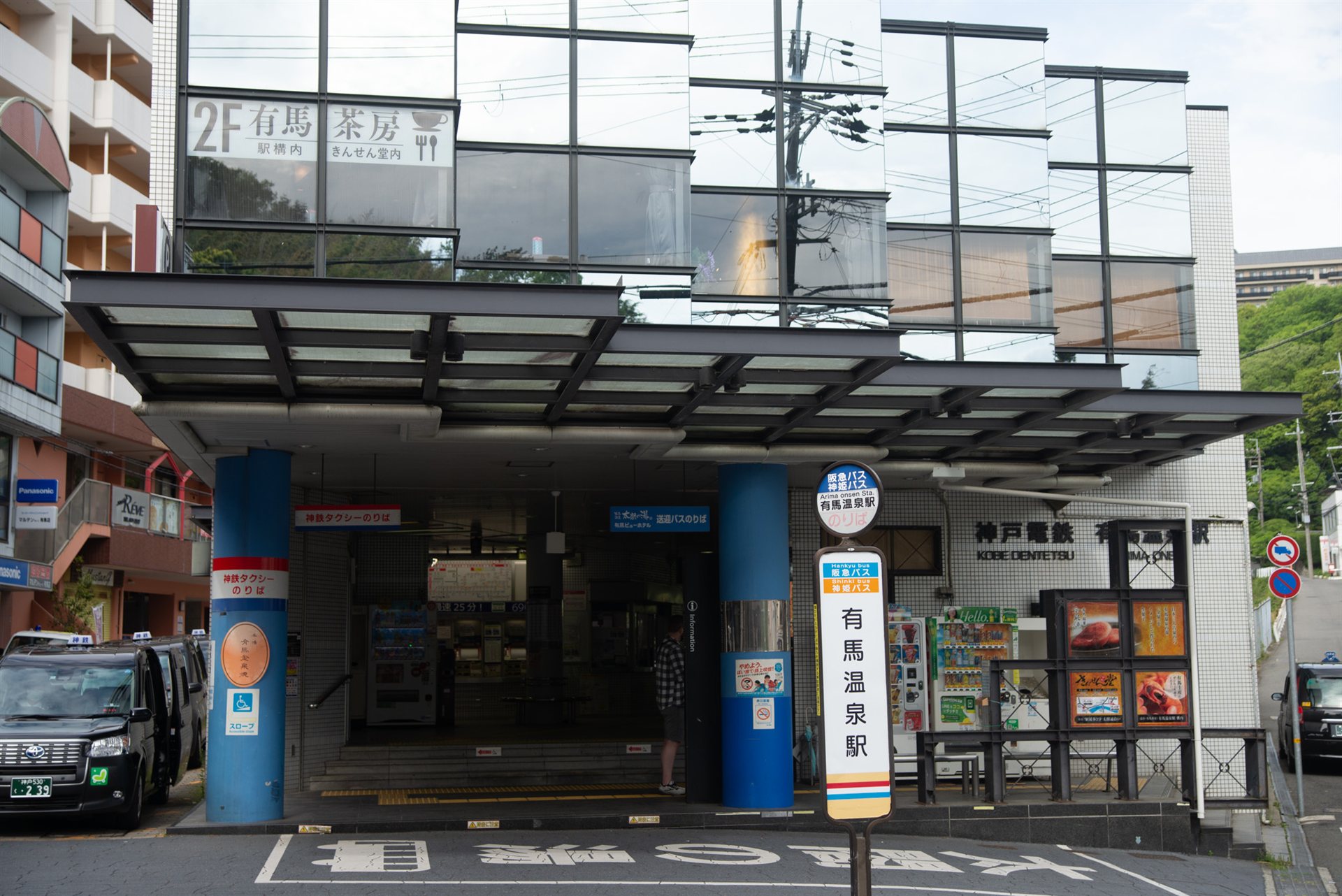
Arima-Onsen Station on the Kobe Electric Railway. In front of the station there is the “Arima-Onsen Station” stop for Hankyu Bus and Shinki Bus, as well as a taxi stand.
If you come by train, your gateway is Arima-Onsen Station on the Kobe Electric Railway. There are bus stops and a taxi stand in front of the station, and the center of the hot spring town is within walking distance. The official website says the public bathhouse Kin no Yu is “a 5-minute walk from Arima-Onsen Station.”
The town of Arima Onsen lies in a valley along the Arima River. Ryokan inns and hotels stand on both sides of the river, with narrow sloping lanes climbing up among them. If you leave the station and head along the river, you soon come to the intersection with Yukemuri Plaza and Taiko Bridge.
Yukemuri Plaza and the Statue of Taikō Hideyoshi (Taiko Bridge)
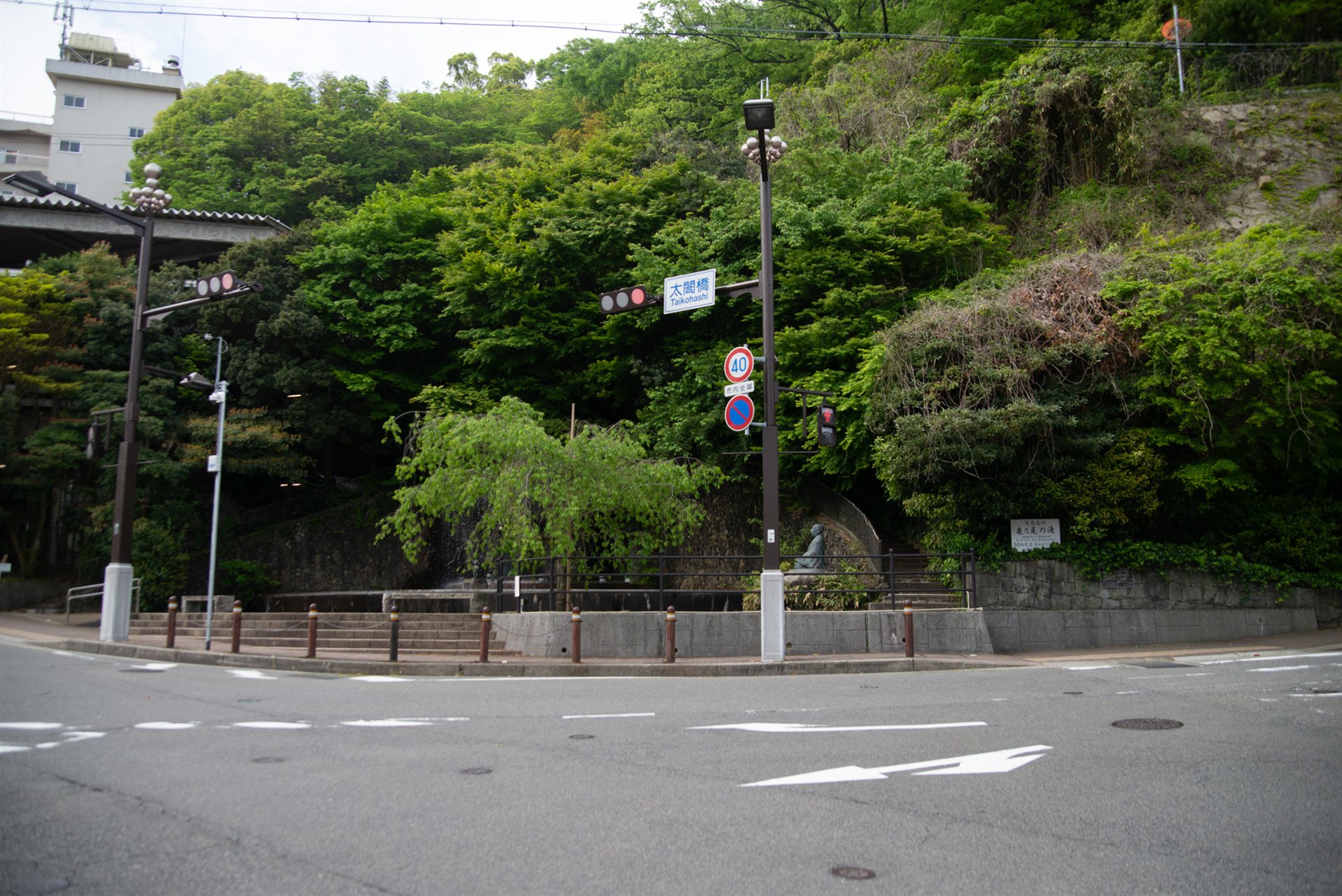
The intersection with the “Taikōbashi” traffic light. Below the green slope is Yukemuri Plaza. On the right stands a sign for “Kamenoo Falls.”
According to the official website, Yukemuri Plaza is the plaza you “see right away when you leave Arima-Onsen Station and turn right.” In the center of the plaza is a waterfall made to look like rising hot spring steam, and to its right is the statue of Taikō Hideyoshi. The Hideyoshi statue is placed so that it faces the statue of Nene on the opposite bank of the Arima River (both are works by the artist Shintani Hideko).
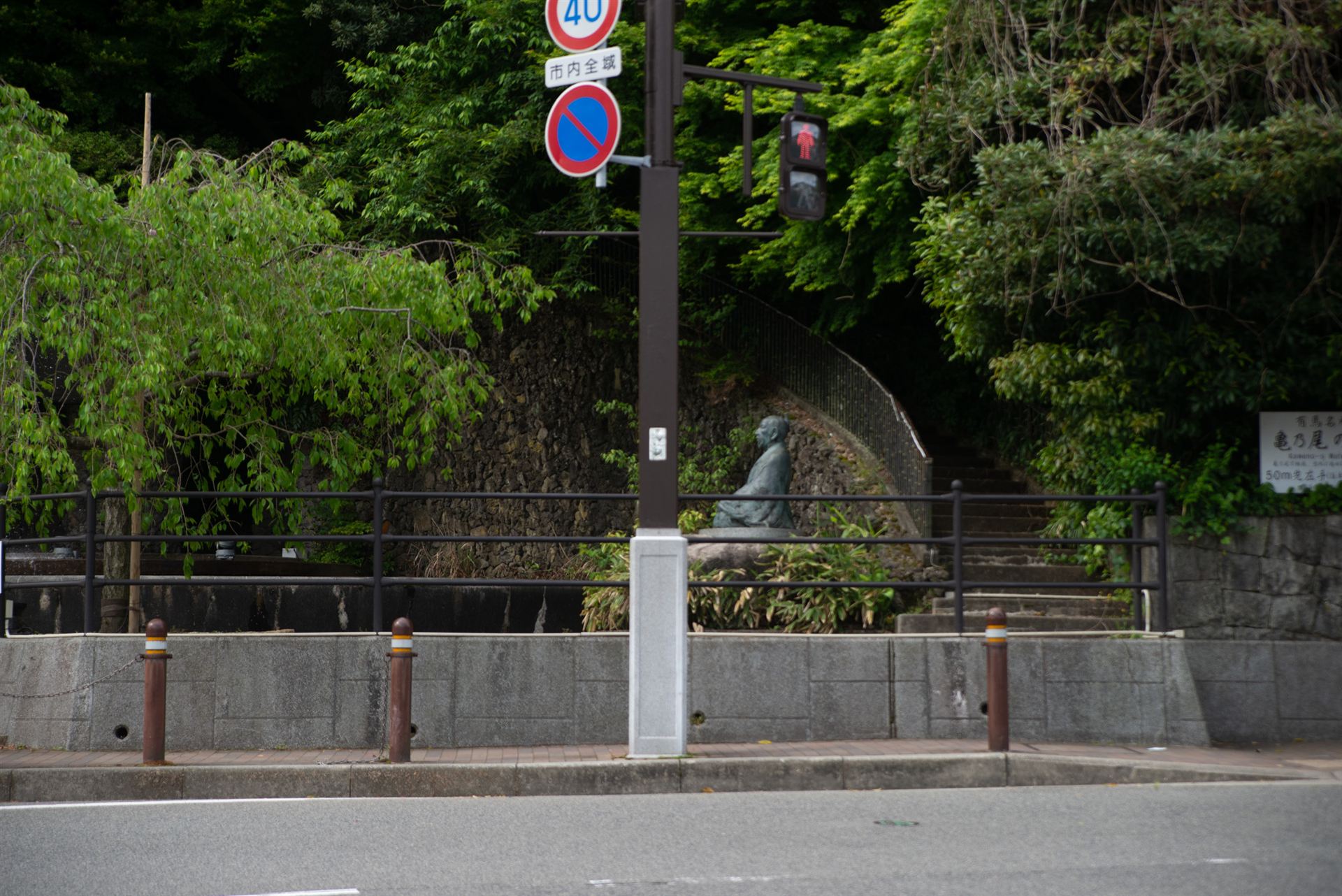
The statue of Taikō Hideyoshi. Hideyoshi sits among the trees. The stone steps beside him lead up to the road above.
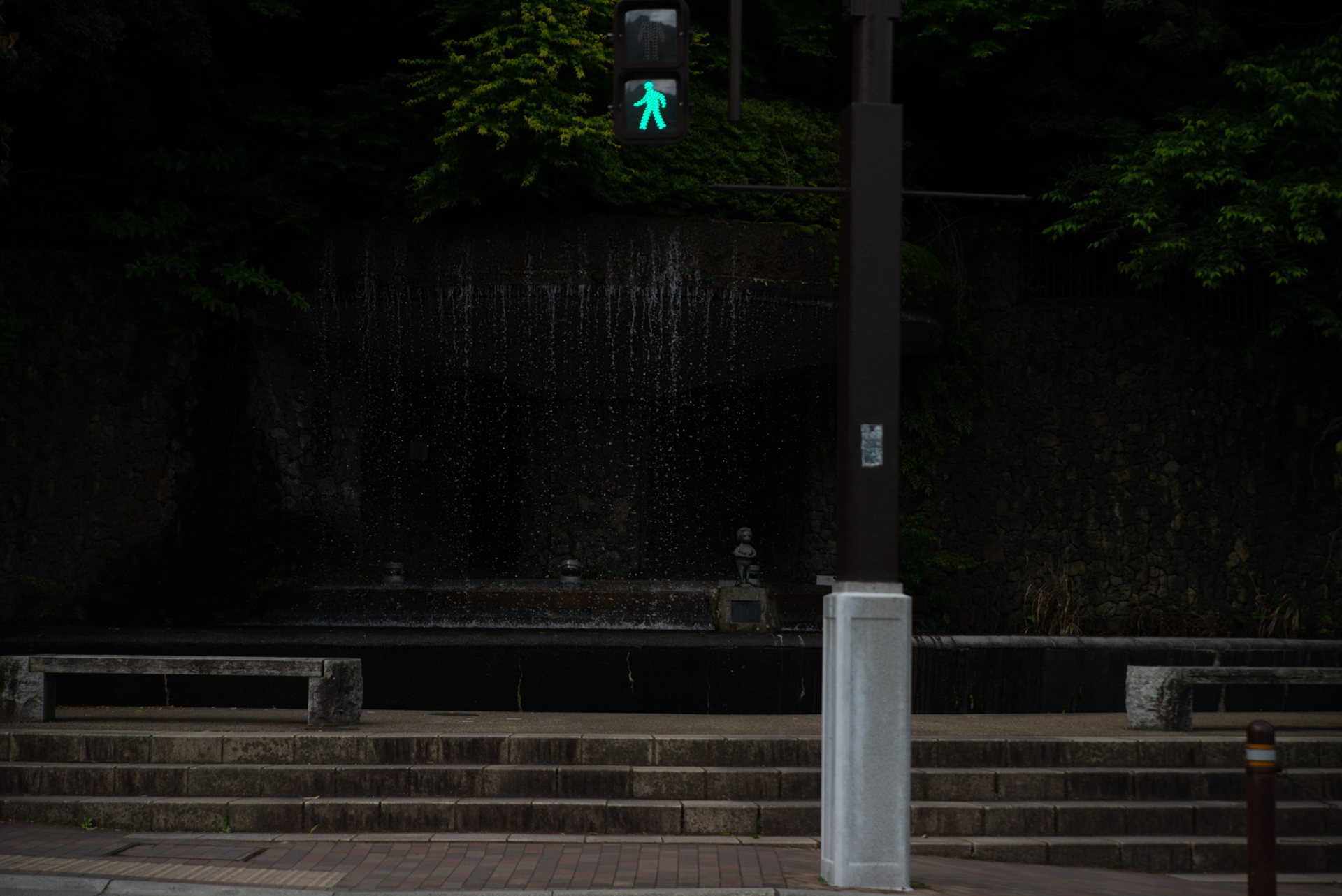
The waterfall flowing down the stone wall, made to look like hot spring steam. There is a small statue in front of it.
The plaza also has a kappa statue called “Yūjō” (Friendship). The official website explains that it was a gift from Jōzankei Onsen in Sapporo in 1993 (Heisei 5), marking 20 years of partnership.
The sign near the intersection reads “Kamenoo Falls.” According to the official website, Kamenoo Falls is “a thin waterfall like a turtle’s tail, beside the shrine of Fudō Myōō on the left, a little way up Yukemuri-zaka slope.” The rock next to it is carved with the characters “Akatsuki-zakura” (Dawn Cherry Blossoms), and is said to bear the seal of Kameda Kyūraku, a Kyoto calligrapher of the Edo period. Also, next to Taiko Bridge is the “Tamoto-ishi,” a stone about 3 meters square decorated with a sacred straw rope (shimenawa).
Hideyoshi and the History of Arima Onsen
Arima Onsen is a hot spring with very old records. The “History” page of the tourism association says that Emperor Jomei bathed at Arima for 86 days in 631 (Jomei 3), and Emperor Kōtoku for 82 days in 647 (Taika 3). Gyōki, a famous monk of the Nara period, is regarded as the person who laid the foundations of Arima Onsen.
The first record of Toyotomi Hideyoshi bathing at Arima is said to date from 1583 (Tenshō 11). After that, Hideyoshi visited Arima again and again, and in 1597 (Keichō 2) a large-scale renovation project began. The page on Nene Bridge says that his wife, Nene, also built a villa in Arima. The Hideyoshi statue at Yukemuri Plaza and the Nene statue across the river face each other because of this history.
If you want to learn more about Hideyoshi and Arima, the “Taikō no Yudonokan” museum introduced on feel KOBE (the official Kobe tourism website) is also worth a visit. According to the site, a bathtub believed to be part of the “Yuyama Goten” palace built by Hideyoshi was found beneath the priests’ quarters of Gokurakuji Temple, which were destroyed in the great earthquake of January 1995.
The Red-Railed Nene Bridge and the Riverside Plaza
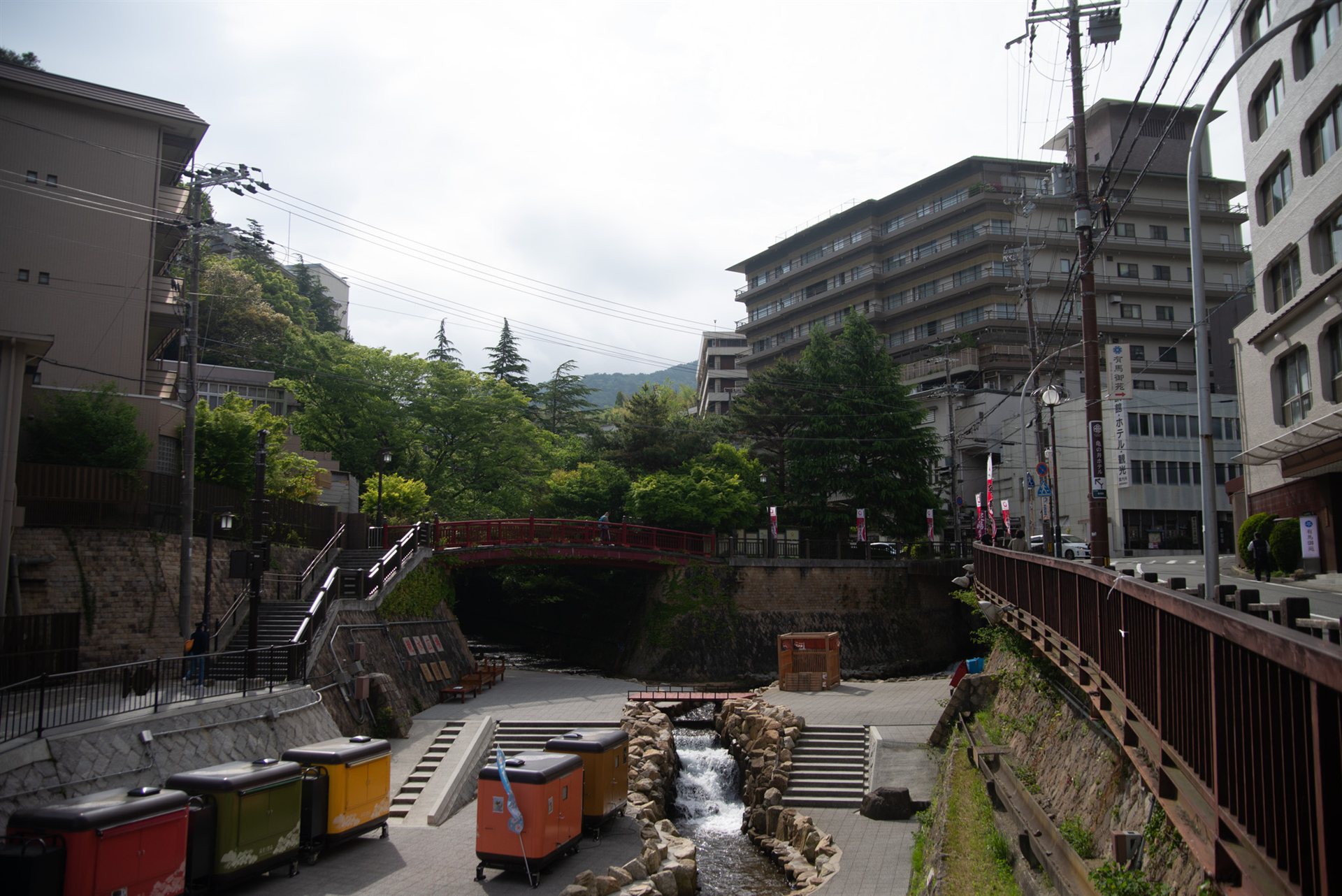
The plaza where you can walk down to the bank of the Arima River. The bridge with red railings in the back is Nene Bridge. Large ryokan inns and hotels surround the area.
Looking down at the river from Taiko Bridge, you can see a plaza that lets you go down to the water’s edge. There are stepped waterfalls built of stones and small streams, with stairs and walking paths on both sides of the river.
Beyond it is the red-railed Nene Bridge. The official website describes it as “Nene Bridge, with its strikingly red railings in the center of town,” and the statue of Nene stands at the foot of the bridge.
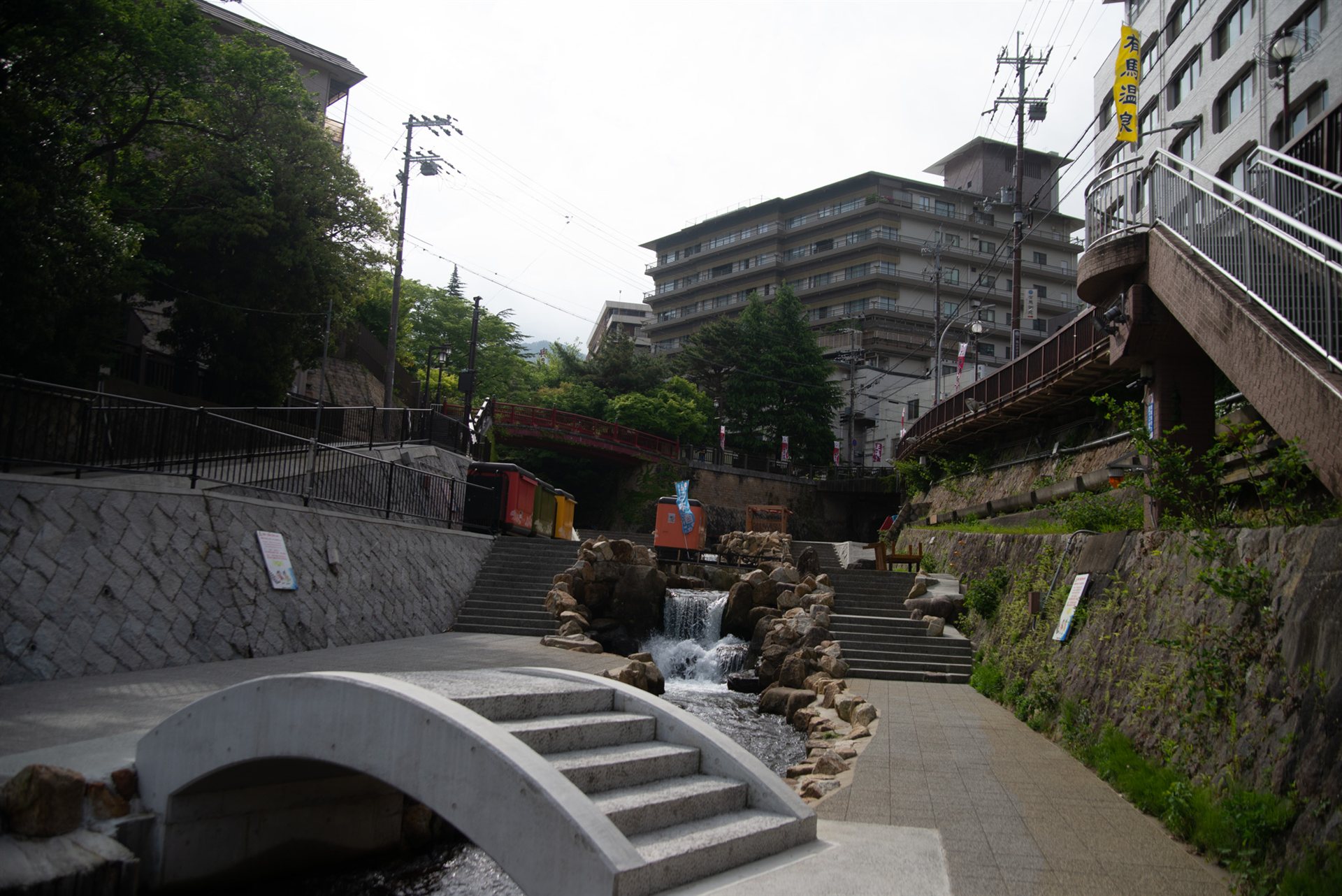
The plaza seen from the riverbank. A small white arched bridge and stone waterfalls continue along the river.
Walking Up the Arima River
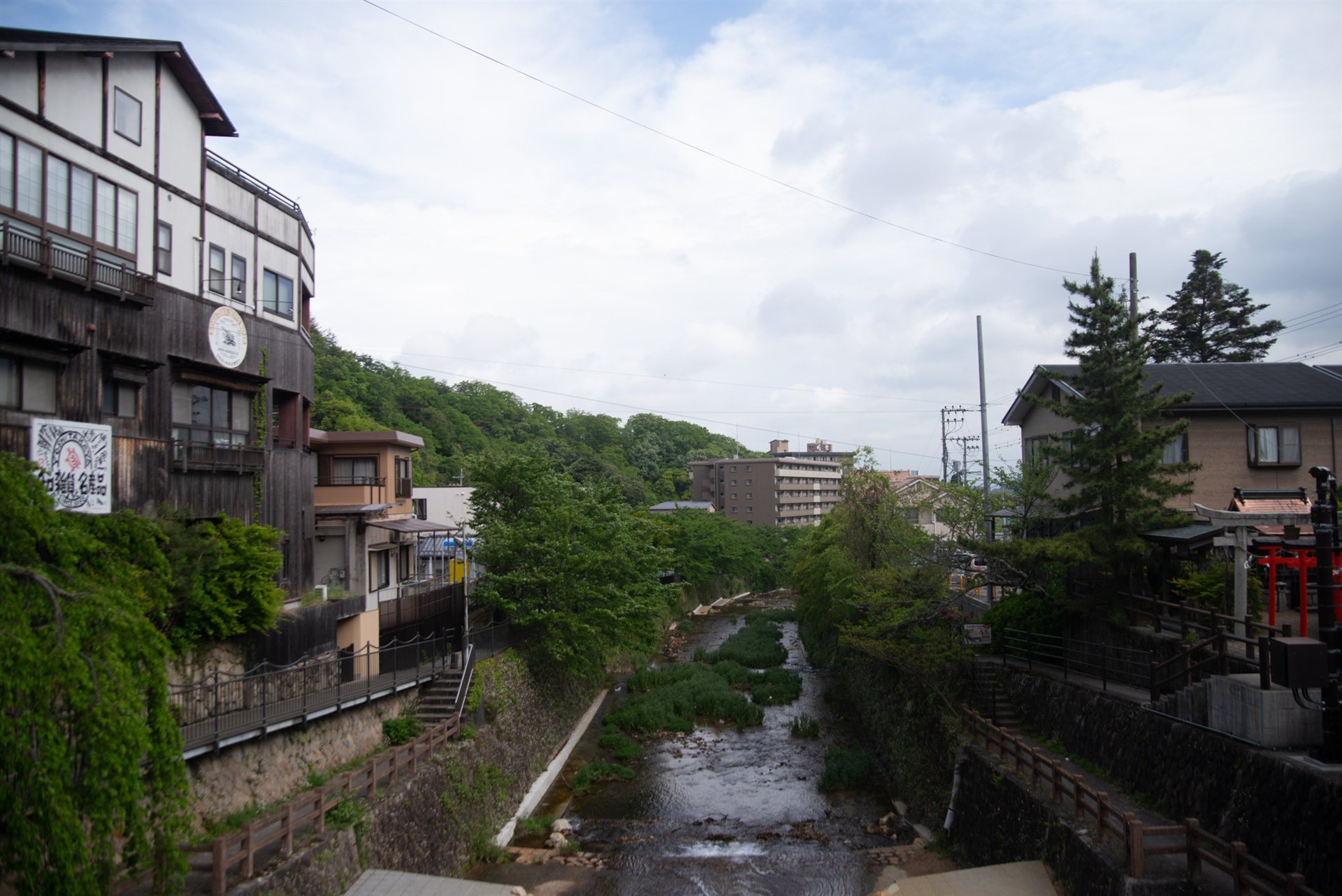
The Arima River seen from a bridge. On the left is a large wooden building, and in the back on the right you can see a red torii gate. The green of the mountains comes close.
Around here, the Arima River flows gently. On both sides of the river are walking paths with stone walls and fences, and the green mountains are very close. It is a different view from the town center, where large hotels line the streets.
A Street of Ryokan Inns and Hotels, and a Round Postbox
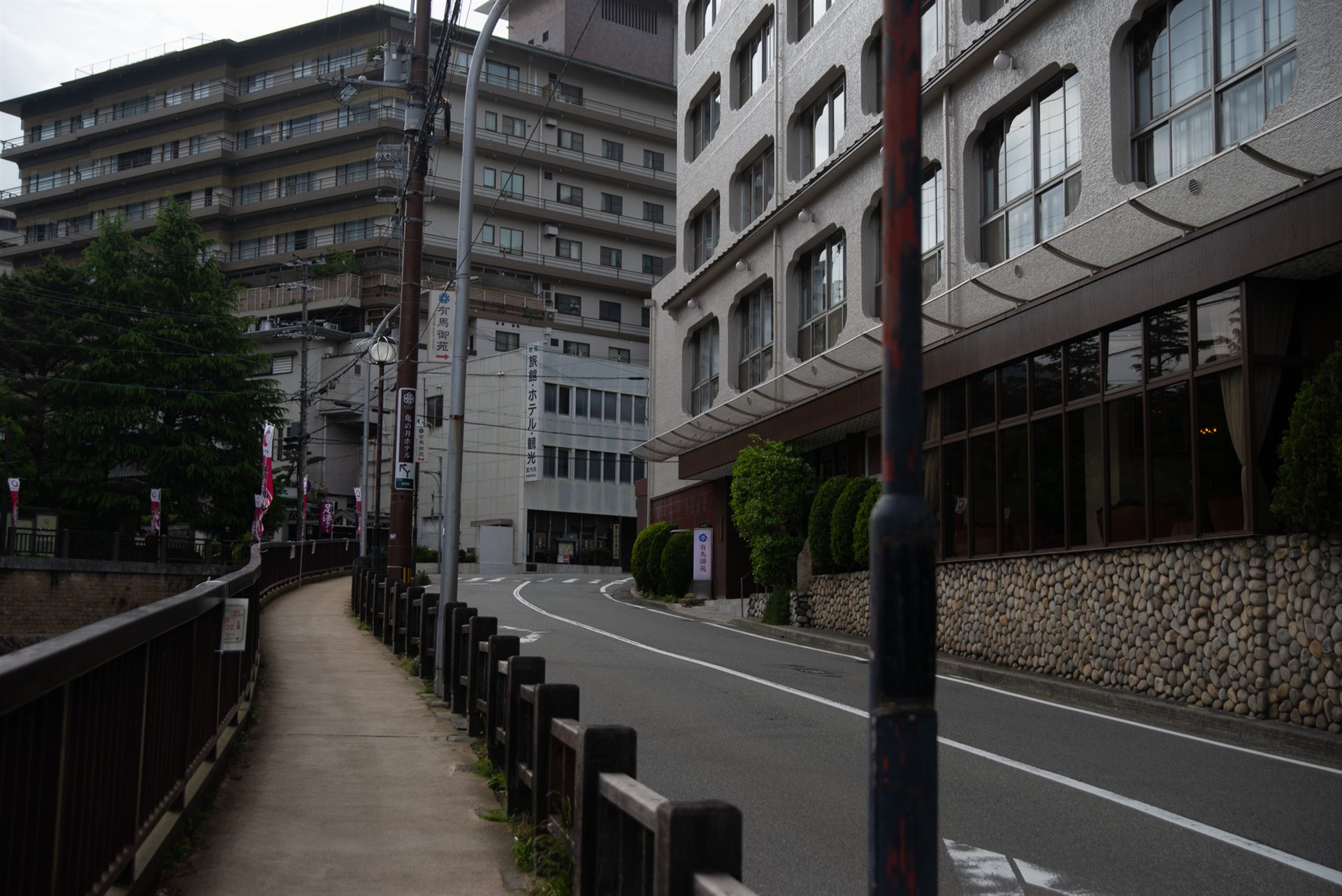
The street along the river. Large ryokan inns and hotels line the street, and utility poles and buildings carry signs for the inns and for the “Ryokan, Hotel and Tourist Information Center.”
Large ryokan inns and hotels continue along the riverside road. The utility poles and buildings have the names of the inns and arrows showing the way, so you can follow these signs to reach the place you are staying.
If you get lost or want a map of the town, the Arima Onsen Tourist Information Center is useful. According to the official website, it is open 9:30–17:00 and is open every day of the year (with shorter hours over the New Year holidays). It has a full range of brochures and can also help you book hotels and ryokan inns.
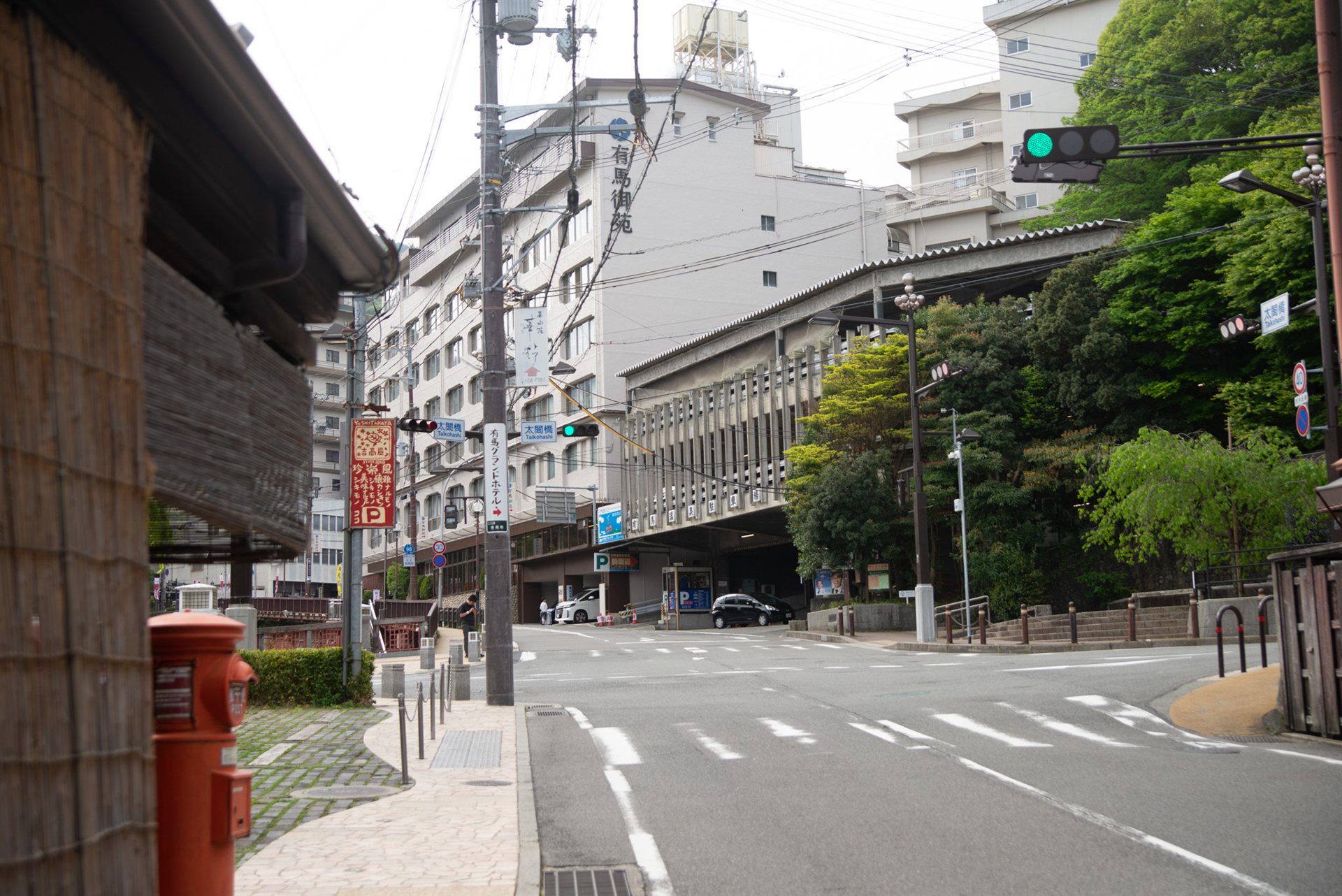
On the corner of the Taiko Bridge intersection stands an old-fashioned round postbox.
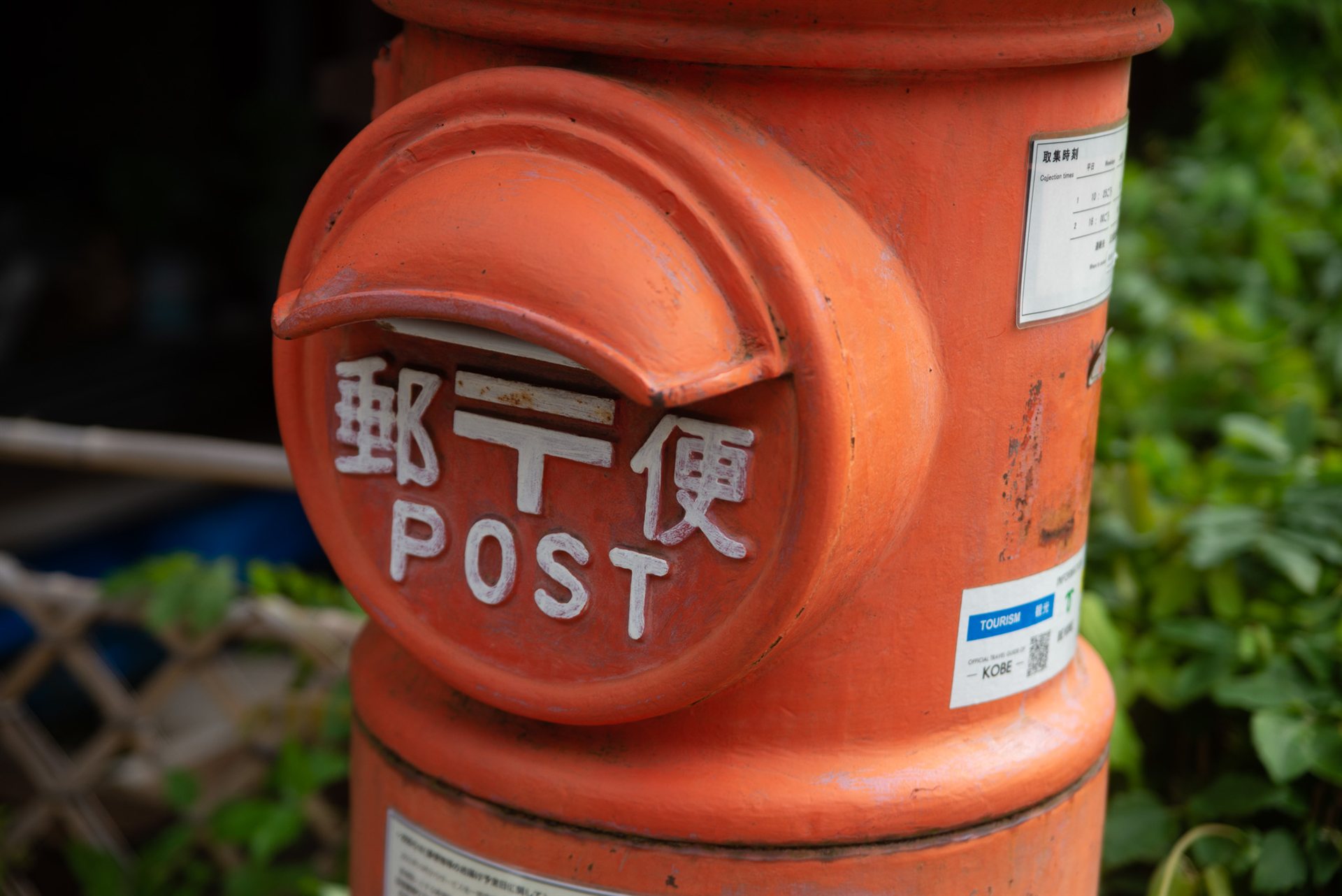
A closer look at the round postbox. The mail slot above the “〒” mark has a small roof over it.
A red round postbox stands on the corner of the Taiko Bridge intersection. When I took the photo, a notice of the collection times was posted on it, and it was still in use as a postbox. It stands in front of an old building hung with bamboo blinds.
Kin no Yu and Gin no Yu (Public Bathhouses): Kinsen and Ginsen Waters
They are not in this article’s photos, but the public bathhouses “Kin no Yu” (Gold Spring) and “Gin no Yu” (Silver Spring), which you can enter as a day visitor, are worth stopping by on your Arima Onsen town walk.
The hot spring water of Arima Onsen comes in two main types. The official website describes Kinsen (gold spring) as “Arima Onsen’s original hot spring water containing iron and salt,” and Ginsen (silver spring) as water containing carbonic acid and radon. Kin no Yu uses Kinsen water, and Gin no Yu uses Ginsen water.
| Item | Kin no Yu | Gin no Yu |
|---|---|---|
| Opening hours | 8:00–22:00 (last entry 21:30) | 9:00–21:00 (last entry 20:30) |
| Closed | 2nd and 4th Tuesdays (open on national holidays and closed the next day), January 1 | 1st and 3rd Tuesdays (open on national holidays and closed the next day), January 1 |
| Adult admission | 800 yen (650 yen on weekdays) | 700 yen (550 yen on weekdays) |
| Location | 5-minute walk from Arima-Onsen Station | About a 5-minute walk from Kin no Yu |
* Checked on November 9, 2026, on the Arima Onsen Tourism Association page (posted September 2, 2026). A combined ticket for Kin no Yu and Gin no Yu costs 1,200 yen (with a towel on weekdays). Before you go, please check the latest information on the official website of Kin no Yu and Gin no Yu.
Next to Kin no Yu there is also a free footbath. Even if you don’t have time for a full bath, you can stop by during your town walk.
How to Get to Arima Onsen
These are the routes described on the “Access” page of the Arima Onsen Tourism Association.
By Train
- From Sannomiya: Take the Kobe Municipal Subway from Sannomiya Station to Tanigami Station. Change to the Kobe Electric Railway, go to Arimaguchi Station, and continue to Arima-Onsen Station (about 30 minutes)
- From Osaka (Umeda): From Hankyu or Hanshin Umeda Station, travel via Shinkaichi Station and take the Kobe Electric Railway to Arima-Onsen Station (about 1 hour 20 minutes). In the morning and evening, there are also direct trains from Shinkaichi bound for Arima-Onsen
- From JR Osaka Station: About 1 hour
By Bus
- The Shinki Bus express bus runs from Kobe Sannomiya (Shinki Bus Kobe Sannomiya Bus Terminal) via Shin-Kobe Station and arrives at “Arima Onsen” (Taiko Bridge). The bus drops you in front of Taiko Bridge, where Yukemuri Plaza is, so it is an easy place to start your town walk
- The highway bus “Arima Express” has services from Shin-Kobe Station, Sannomiya Bus Terminal and Osaka Station
- From Osaka International Airport (Itami Airport), it takes about 30 minutes by Hankyu Bus
Please check train and bus timetables and fares on each company’s official website.
Frequently Asked Questions
Where should I start my Arima Onsen town walk?
If you come by train, start at Arima-Onsen Station on the Kobe Electric Railway. If you take the Shinki Bus from Sannomiya, start at the “Arima Onsen” (Taiko Bridge) stop. When you leave the station and turn right, the intersection with Yukemuri Plaza and Taiko Bridge is right there.
Where are the statues of Hideyoshi and Nene near Taiko Bridge?
The statue of Taikō Hideyoshi is in Yukemuri Plaza at the foot of Taiko Bridge. The statue of Nene is on the opposite bank of the Arima River, at the foot of Nene Bridge. The two statues are placed so that they face each other.
How are Kin no Yu and Gin no Yu different?
Kin no Yu uses “Kinsen” water, which contains iron and salt, and Gin no Yu uses “Ginsen” water, which contains carbonic acid and radon. Their closing days also differ: Kin no Yu is closed on the 2nd and 4th Tuesdays, and Gin no Yu on the 1st and 3rd Tuesdays (checked on November 9, 2026).
Summary
On an Arima Onsen town walk, if you go from Arima-Onsen Station to Yukemuri Plaza and Taiko Bridge, then around the riverside plaza, Nene Bridge and the street along the river, you can see the whole center of the hot spring town. It is a town with many things to discover on foot, such as the statues of Hideyoshi and Nene, Kamenoo Falls, the Tamoto-ishi stone and the round postbox.
After your walk, I also recommend comparing the Kinsen and Ginsen waters at Kin no Yu and Gin no Yu.
For Hyogo Prefecture, we also have an article on Himeji Castle. Take a look at my Chūgoku region road trip visiting Okayama Castle and Himeji Castle (Japanese) as well. For walks through other hot spring towns, see the articles on the Atagawa Onsen town walk and the Gero Onsen Kua Garden open-air bath.
References (checked on November 9, 2026)
- Arima Onsen Tourism Association official website (Japanese)
- Kin no Yu | Arima Onsen Tourism Association (Japanese)
- Gin no Yu | Arima Onsen Tourism Association (Japanese)
- History of Arima Onsen | Arima Onsen Tourism Association (Japanese)
- Access | Arima Onsen Tourism Association (Japanese)
- Arima Onsen Area Guide | feel KOBE (Japanese)
コメント