Enoshima is an island you can reach on foot by crossing a bridge. At the far end of the island are the Enoshima Iwaya Caves, sea caves carved by the waves, and Chigogafuchi, a rocky shore known as a famous sunset spot.
This article explains, step by step, how to walk from Katase-Enoshima Station to the very far end of the island. It also covers the walking time for each section, the fees for the Escar and the Iwaya Caves, and ways to get back. The photos were taken on November 8, 2023, and the fees and hours were checked with official information on November 2, 2026.
- How to Walk Enoshima: The Overall Route and Walking Times
- From Katase-Enoshima Station Across Benten Bridge to the Island
- The Bronze Torii and Benzaiten Nakamise Street
- To the Top: Take the Stairs or Use the Escar
- To the Far End of the Island: Oiwayamichi-dori and the Cliff Views
- Enoshima Iwaya Caves: Cross Iwaya Bridge to the Entrance
- Chigogafuchi: The Rocky Shore Right Next to the Iwaya Caves
- Visiting Chigogafuchi at Sunset
- For the Way Back, You Can Also Take the Bentenmaru
- Frequently Asked Questions
- Summary
How to Walk Enoshima: The Overall Route and Walking Times
On Enoshima, you can go from the entrance to the far end almost as if following a single road. The table below shows walking times based on the model course on the official Fujisawa City tourism website.
| Section | Approximate walking time |
|---|---|
| Nearest stations such as Katase-Enoshima Station → Enoshima Shrine (Hetsunomiya) | About 15–23 minutes |
| Benzaiten Nakamise Street → Enoshima Shrine | About 8 minutes |
| Enoshima Shrine → Enoshima Samuel Cocking Garden | About 5 minutes |
| Enoshima Sea Candle → Ryuren Bell | About 10 minutes |
| Ryuren Bell → Enoshima Iwaya Caves | About 7 minutes |
| Enoshima Iwaya Caves → Chigogafuchi | About 2 minutes |
The island has many stairs and slopes, so comfortable walking shoes are recommended. For going up, you can also use the Escar. For the return trip from the far end of the island, the Bentenmaru sightseeing boat is another option.
From Katase-Enoshima Station Across Benten Bridge to the Island
On the way to the island, there is an underground passage at the Enoshima Entrance intersection. Inside the passage, signs show the directions to Enoshima, Higashihama (East Beach), and Nishihama (West Beach).
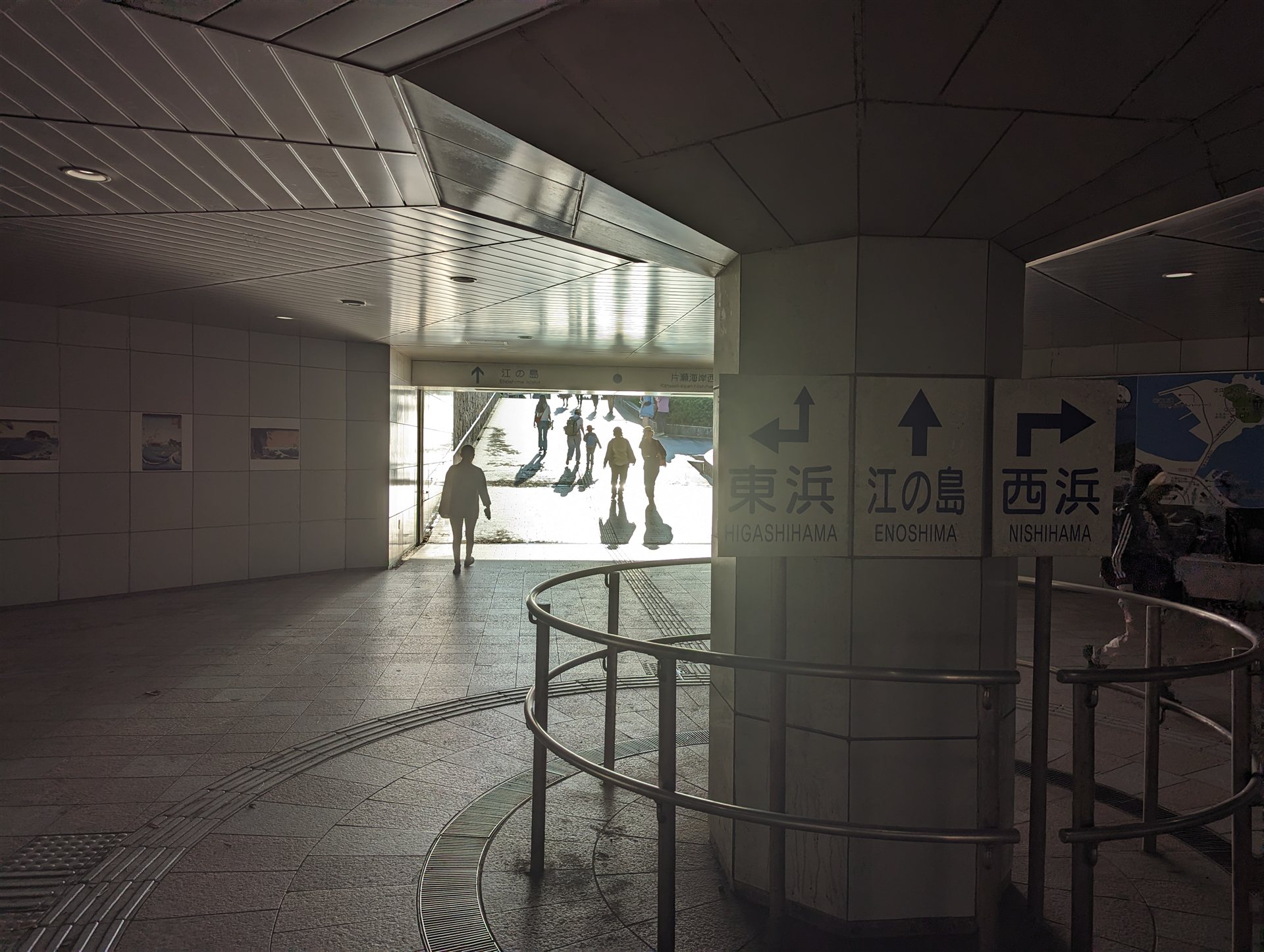
The sign in the underground passage. Follow the arrow for Enoshima.
Coming out of the passage, you reach the Enoshima Benten Bridge, which leads to the island. According to materials from the Fujisawa City Archives, the permanent Benten Bridge opened in 1949. Later, the Enoshima Ohashi Bridge for cars was built alongside it. People on foot cross Benten Bridge.
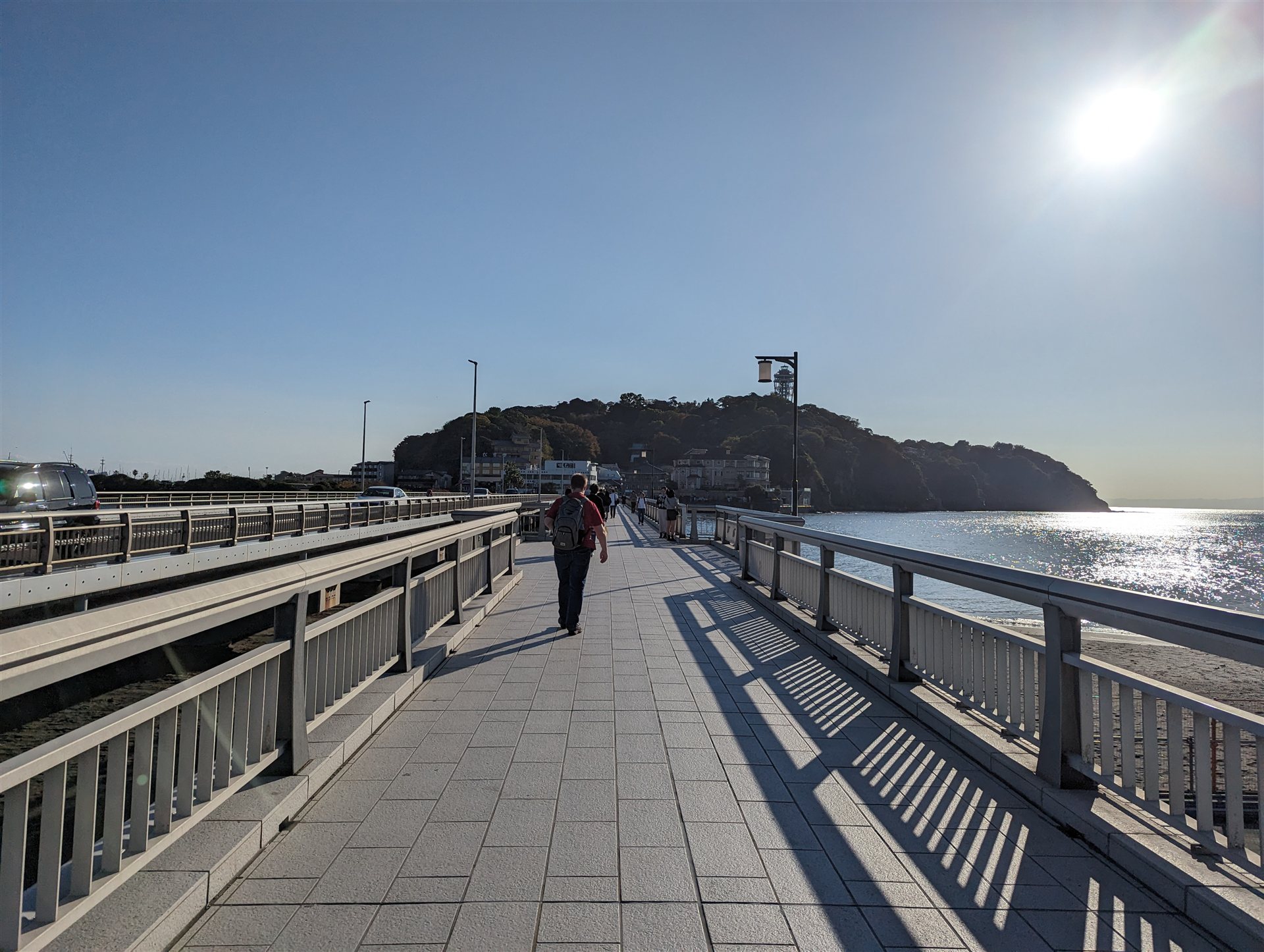
The walkway of Benten Bridge. You can see the Sea Candle on top of the island ahead.
The Bronze Torii and Benzaiten Nakamise Street
After crossing the bridge, you will find the Bronze Torii standing at the entrance to the approach to the shrine. It was first built in 1747, and the present torii was rebuilt in 1821. It is designated an Important Cultural Property of Fujisawa City.
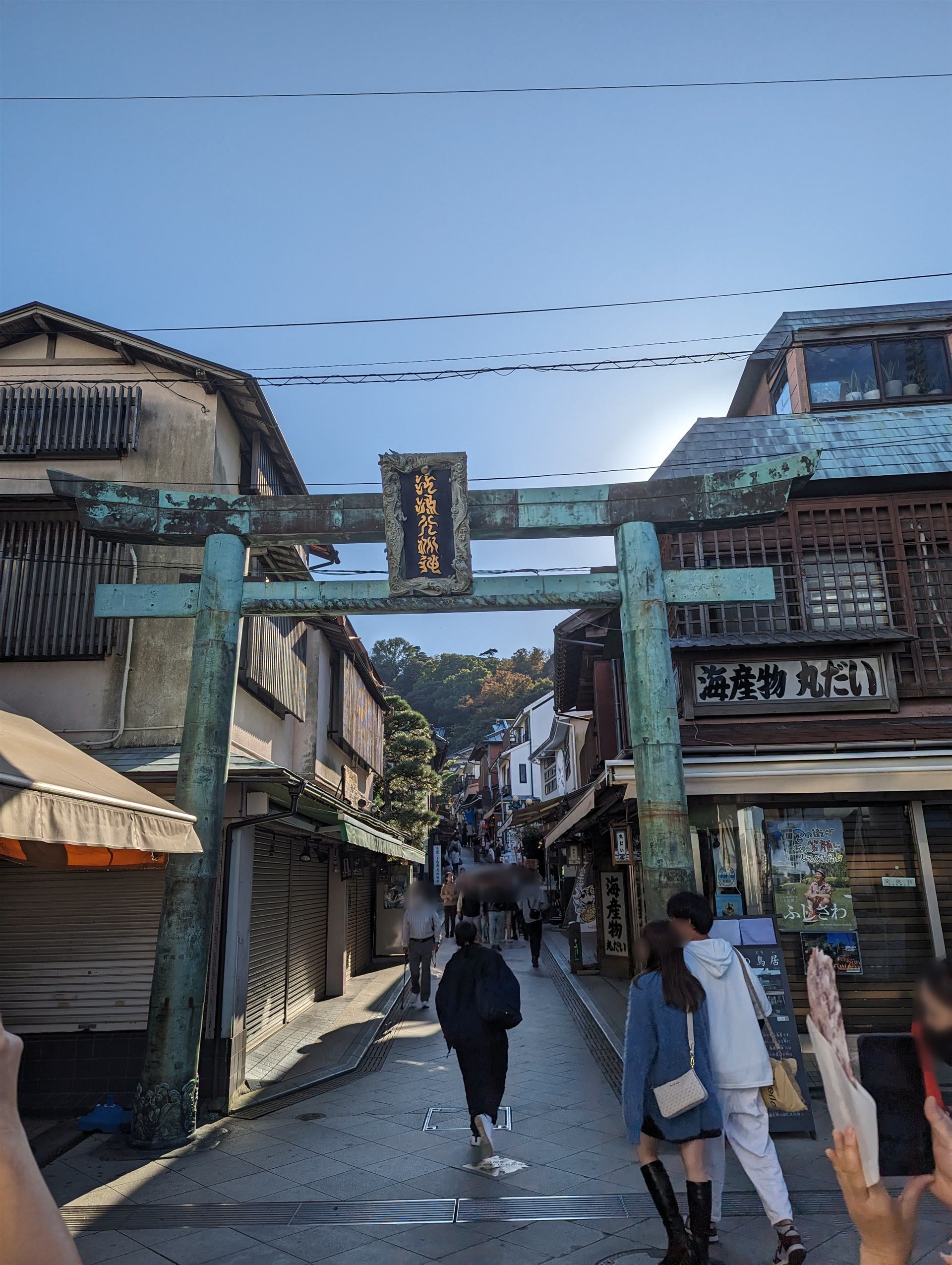
The Bronze Torii. Nakamise Street begins just past it.
Beyond the torii is Enoshima Benzaiten Nakamise Street. It is a shopping street along the approach leading up to Enoshima Shrine, lined with inns, restaurants, and souvenir shops.
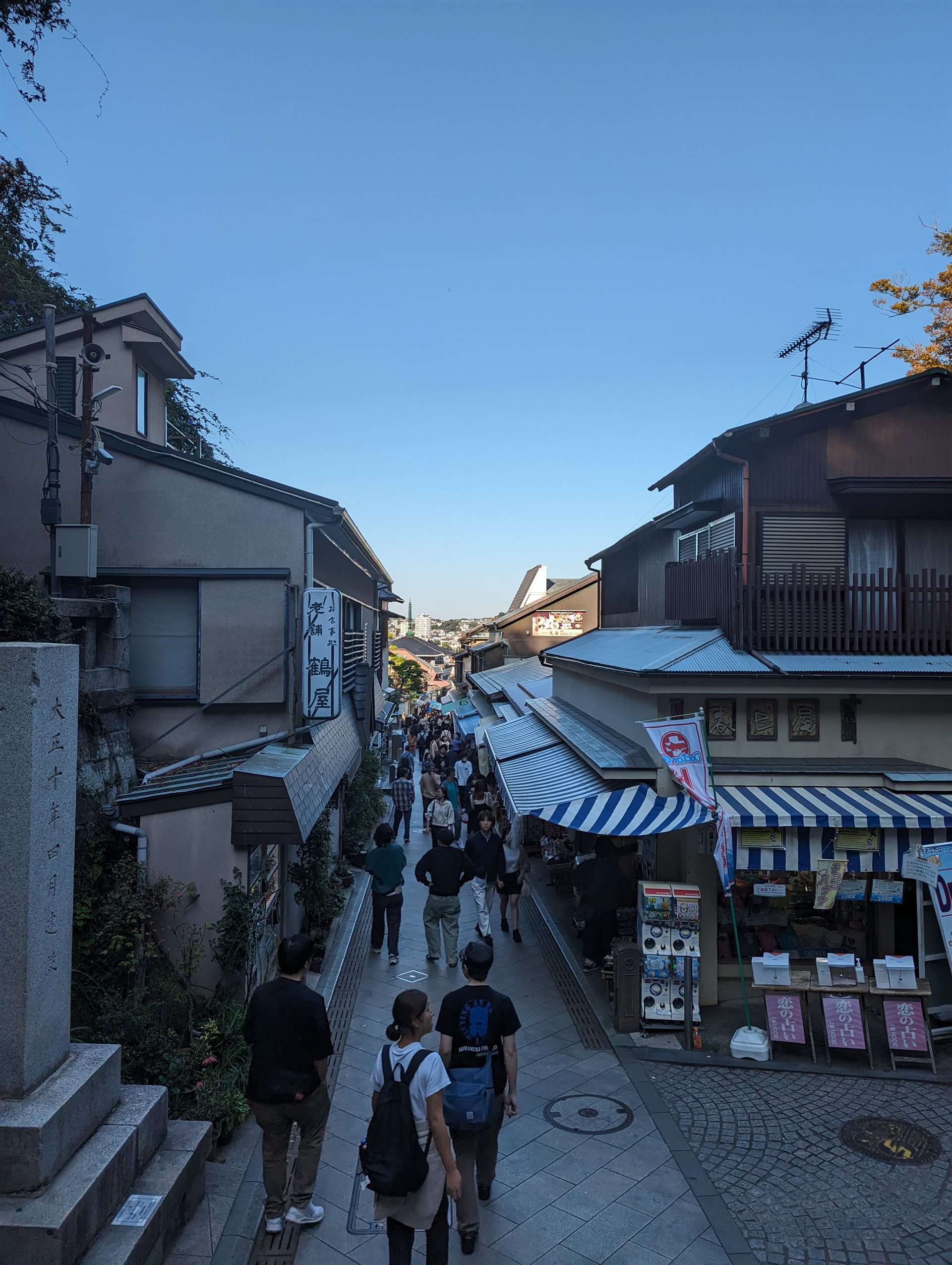
Nakamise Street seen from higher up. A gentle slope continues.
I visited on a weekday, but it was very crowded, and walking was a little difficult.
To the Top: Take the Stairs or Use the Escar
From the end of Nakamise Street, you can choose to climb the stairs or use the paid Enoshima Escar. The Escar, introduced in 1959, was the first outdoor escalator in Japan, and it takes you up a height difference of 46 m in about 4 minutes. It runs upward only, so you take the stairs on the way down.
The table below shows the fees, together with those for the facilities at the top (children are elementary school students; adults are junior high school students and older).
| Facility / ticket | Adults | Children |
|---|---|---|
| Escar (all 3 sections) | 500 yen | 250 yen |
| Enoshima Sea Candle | 800 yen | 400 yen |
| Enoshima Samuel Cocking Garden (9:00–17:00) | Free | Free |
| Enoshima Samuel Cocking Garden (after 17:00, during events) | 500 yen | 250 yen |
| Enoshima Sea Candle set ticket (garden, Sea Candle, and Escar) | 1,100 yen | 550 yen |
The Escar operates from 8:50 to 19:05. The Sea Candle and other facilities are open from 9:00 to 20:00 (last entry 19:30), though hours vary by facility and event.
Note that the official website says the Sunset Terrace is temporarily closed for full renovation work (notice dated June 8, 2026). If you are going for the sunset, please check the latest information before you set out.
From the roads on top of the island, there are also spots where you can look down on Shonan Port (Enoshima Yacht Harbor).
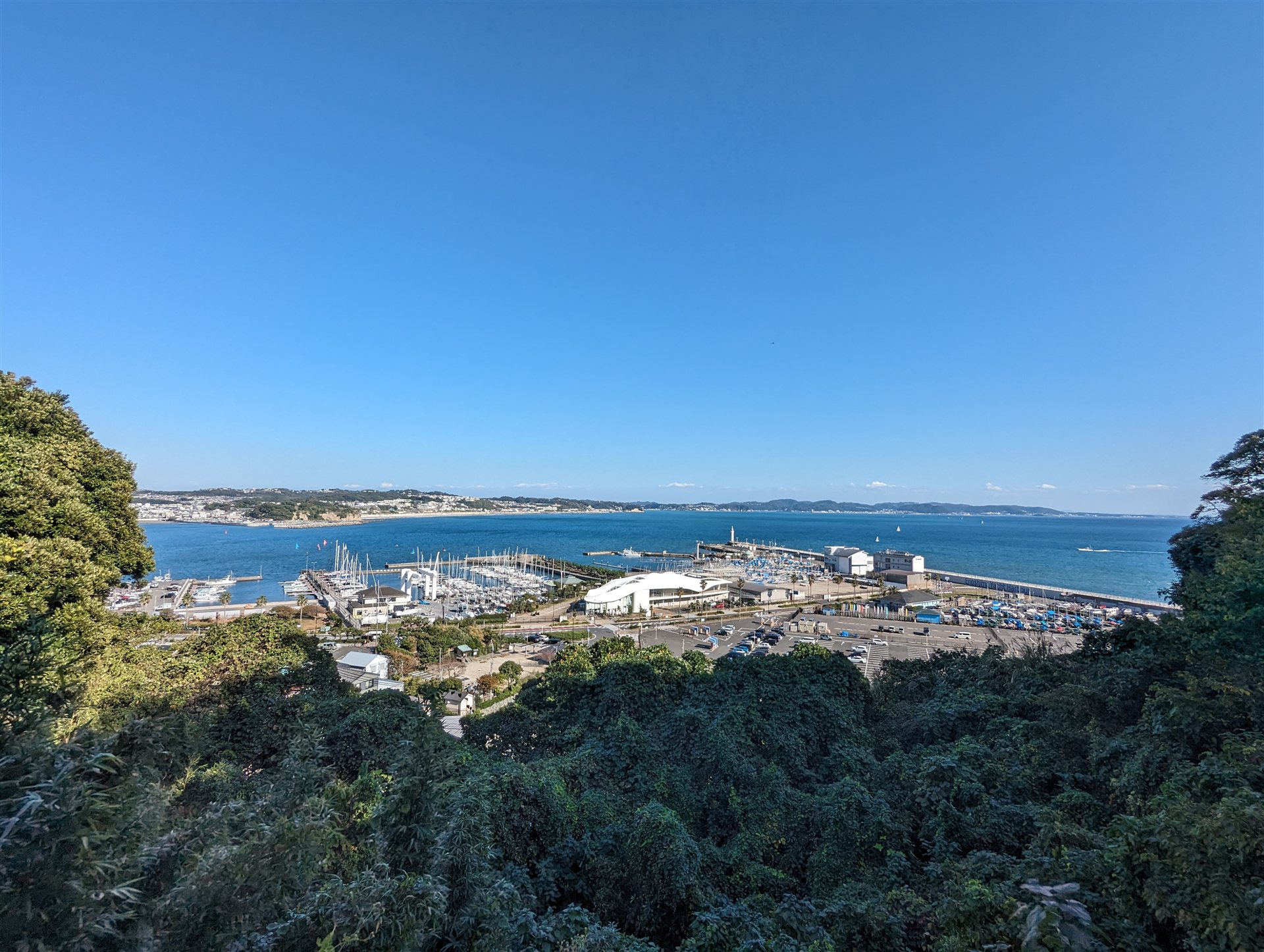
Shonan Port seen from the top of the island. Rows of yachts are lined up.
To the Far End of the Island: Oiwayamichi-dori and the Cliff Views
The road from the top of the island to the Iwaya Caves is called Oiwayamichi-dori. It is a historic shopping street lined with restaurants and souvenir shops.
Along the way there are stairs that go down once and then up again. If you walk back, you will use the same road, so it is best to leave yourself plenty of energy and time.
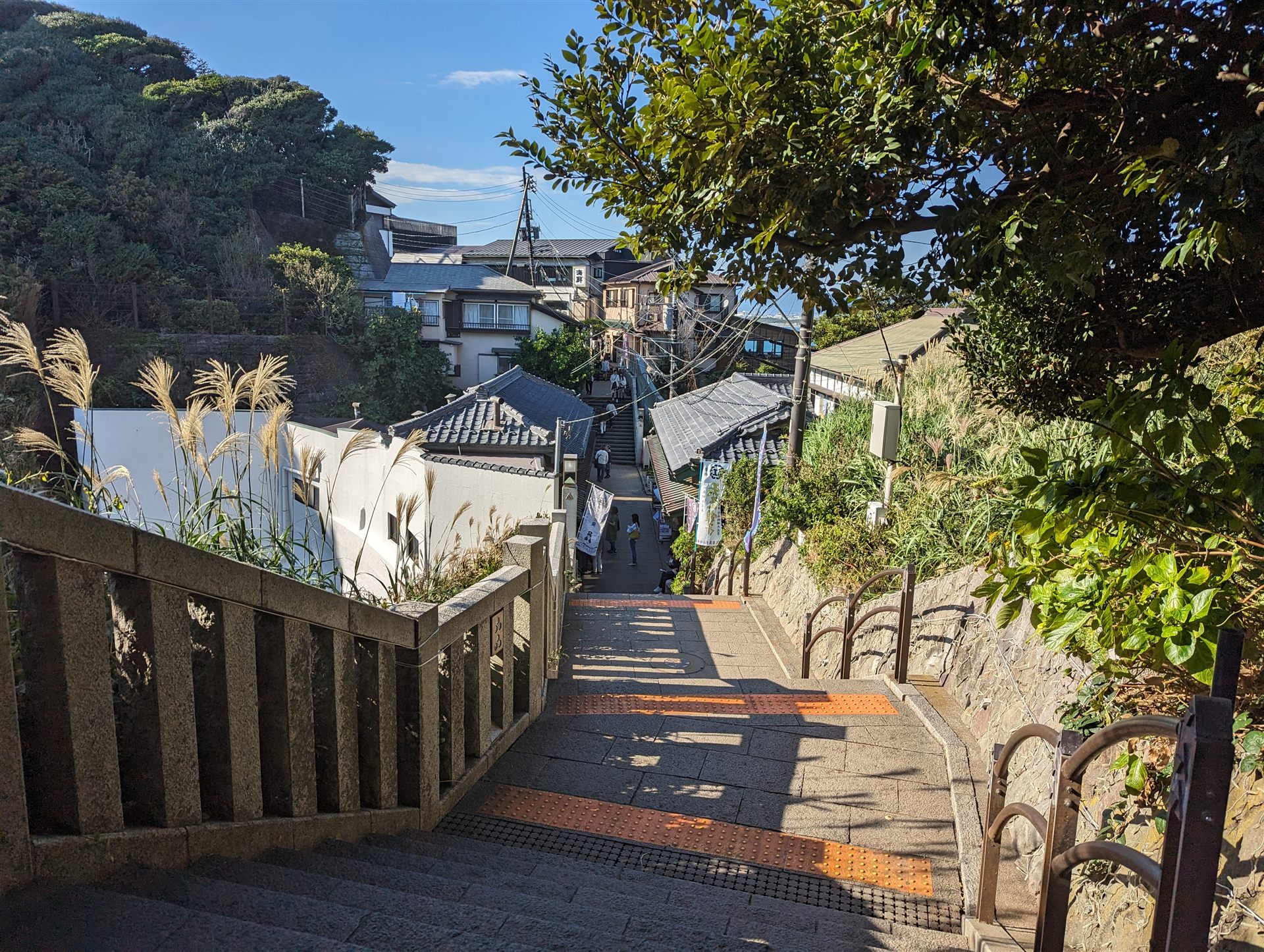
Beyond the stairs, you can see the shopping street and more stone steps continuing on.
Along the way, you can also enjoy views from places where the land drops sharply away to the sea.
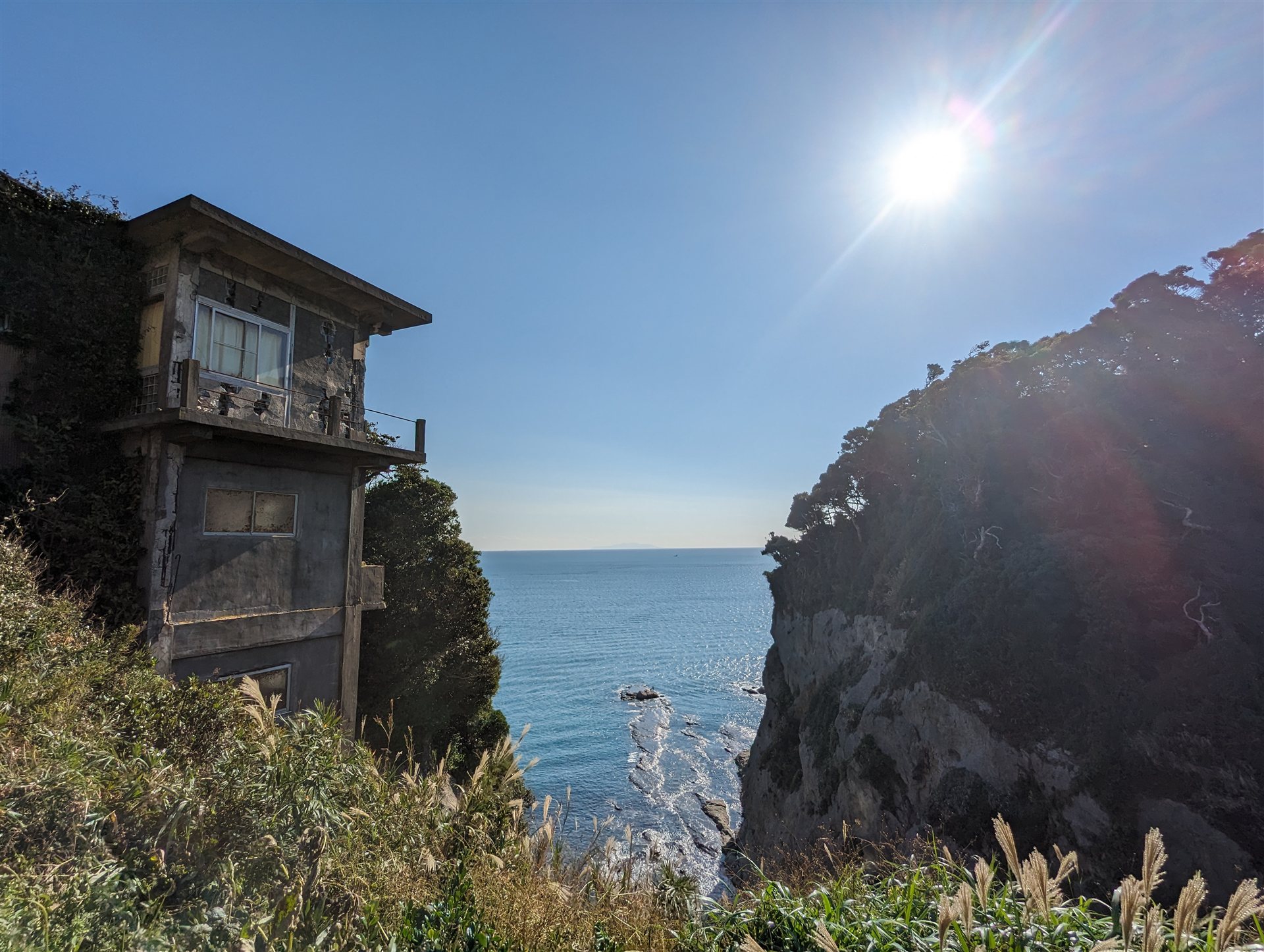
The sea can be seen through a gap in the steep cliffs.
Going further, you come to stairs leading down to the sea. The rocky shores of the Iwaya Caves and Chigogafuchi come into view.
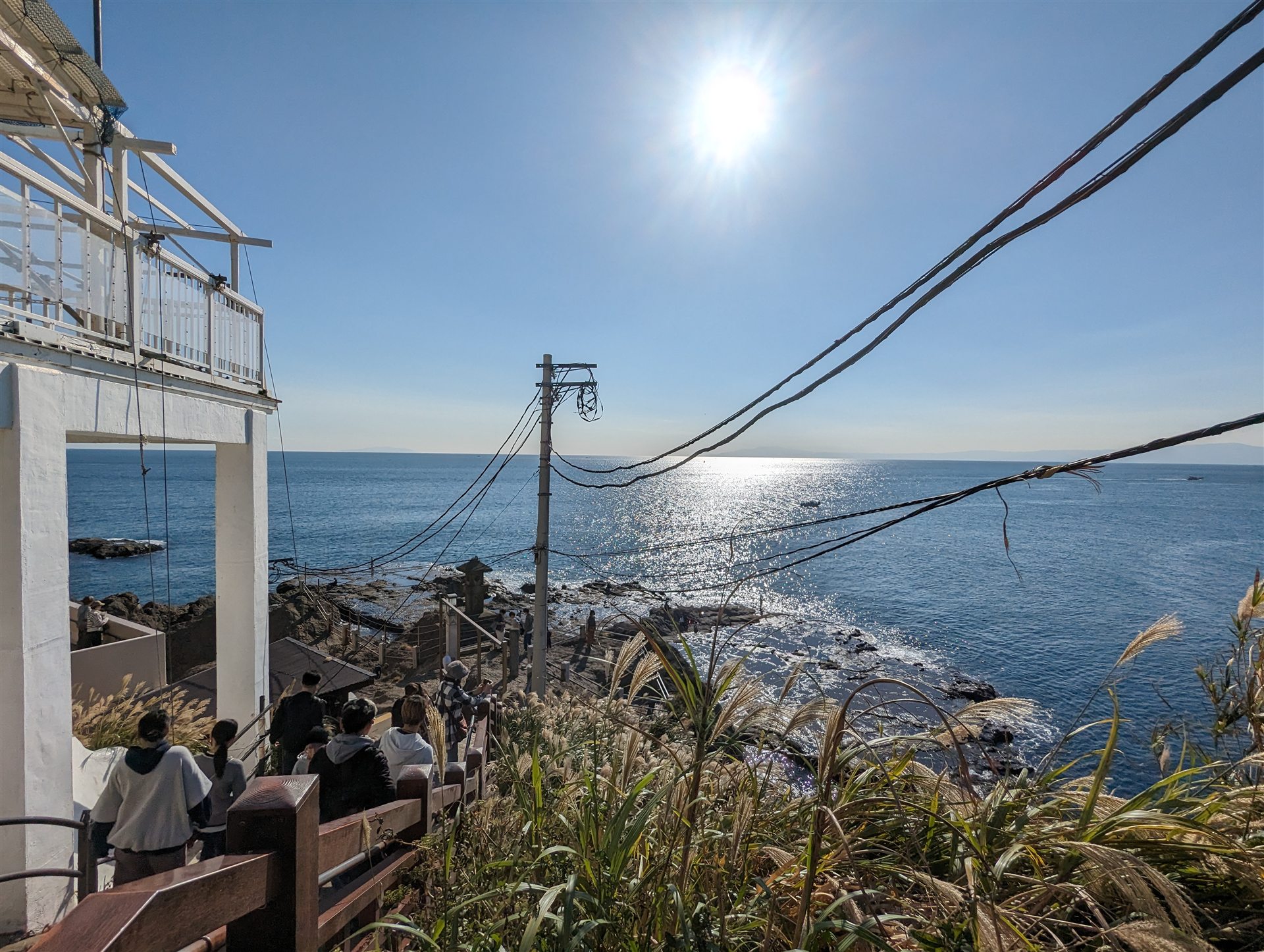
The rocky shore and Sagami Bay seen from the stairs leading down to the sea.
Enoshima Iwaya Caves: Cross Iwaya Bridge to the Entrance
The Enoshima Iwaya Caves are sea caves at the innermost part of the island. Kōbō Daishi and Nichiren are said to have trained here, and the caves are regarded as the birthplace of faith in Enoshima. The caves were closed for a time but reopened in 1993.
The caves are divided into two parts.
- First Cave: 152 m deep. It is said to connect to an ice cave at Mount Fuji
- Second Cave: 56 m deep. It is said to be the site of a dragon god legend
The highlights are the stone statues and rock walls lit by candlelight.
| Item | Details (checked on November 2, 2026) |
|---|---|
| Opening hours | 9:00–17:00 (varies by season) |
| Admission | Junior high school students and older 500 yen, elementary school students 200 yen (20% off for groups of 20 or more) |
| Discounts | Free for the holder and one companion on showing a disability certificate or similar |
| Inquiries | Fujisawa City Tourism Center 0466-22-4141 |
The official page also advises checking the latest information before you go.
The red bridge along the sea is Iwaya Bridge. Its name is written on the main post of the bridge.
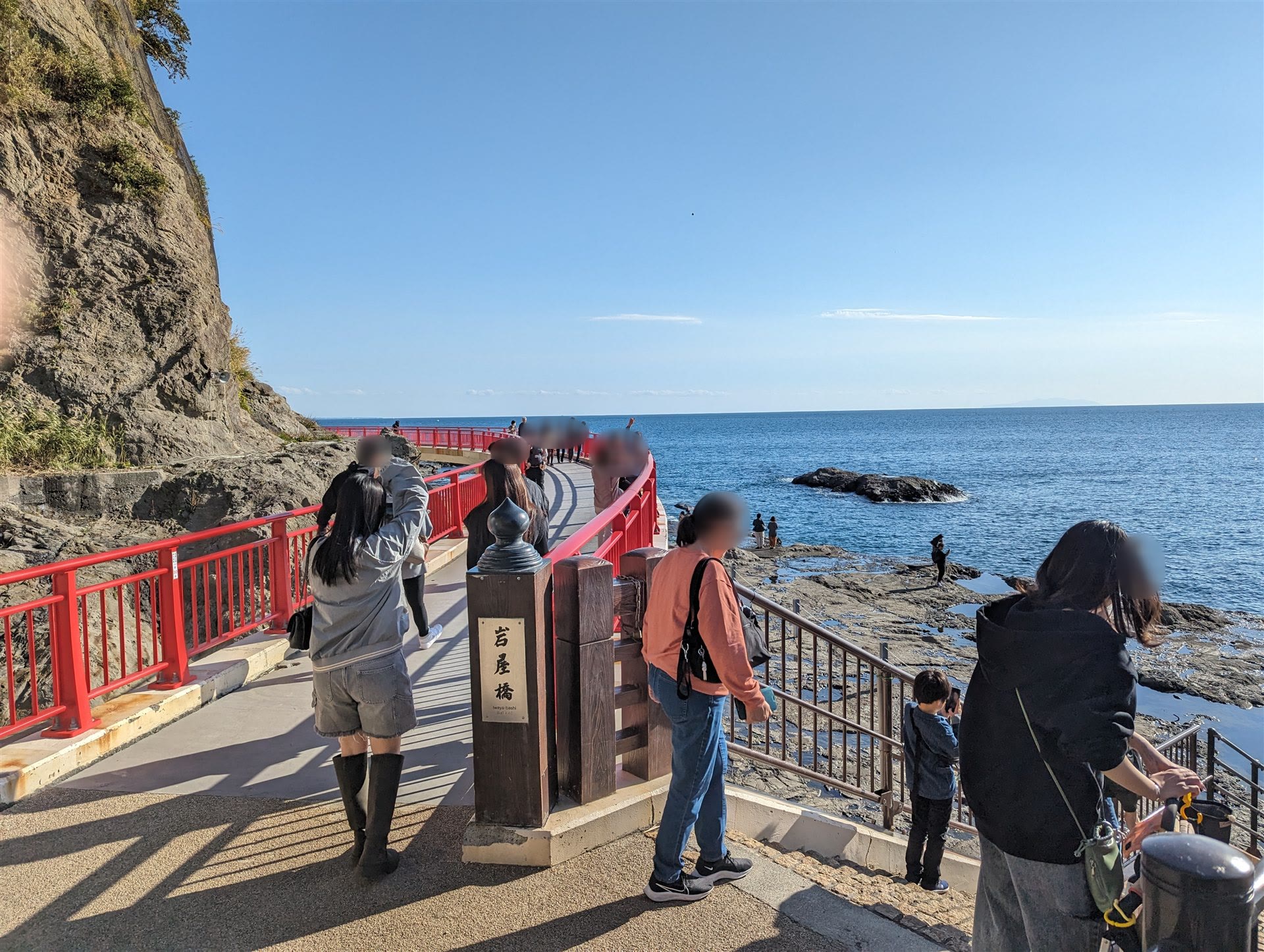
Iwaya Bridge. The red bridge runs along the cliff.
Chigogafuchi: The Rocky Shore Right Next to the Iwaya Caves
Chigogafuchi is a wave-cut platform spreading around the Iwaya Caves at the southwestern tip of the island. It was formed by the uplift of the land, and it is about a 2-minute walk from the Iwaya Caves. Go down the stairs and you are right on the rocks.
The name is said to come from a legend that a young temple page named Shiragiku threw himself into the sea from here. It is also known as a popular spot for rock fishing.
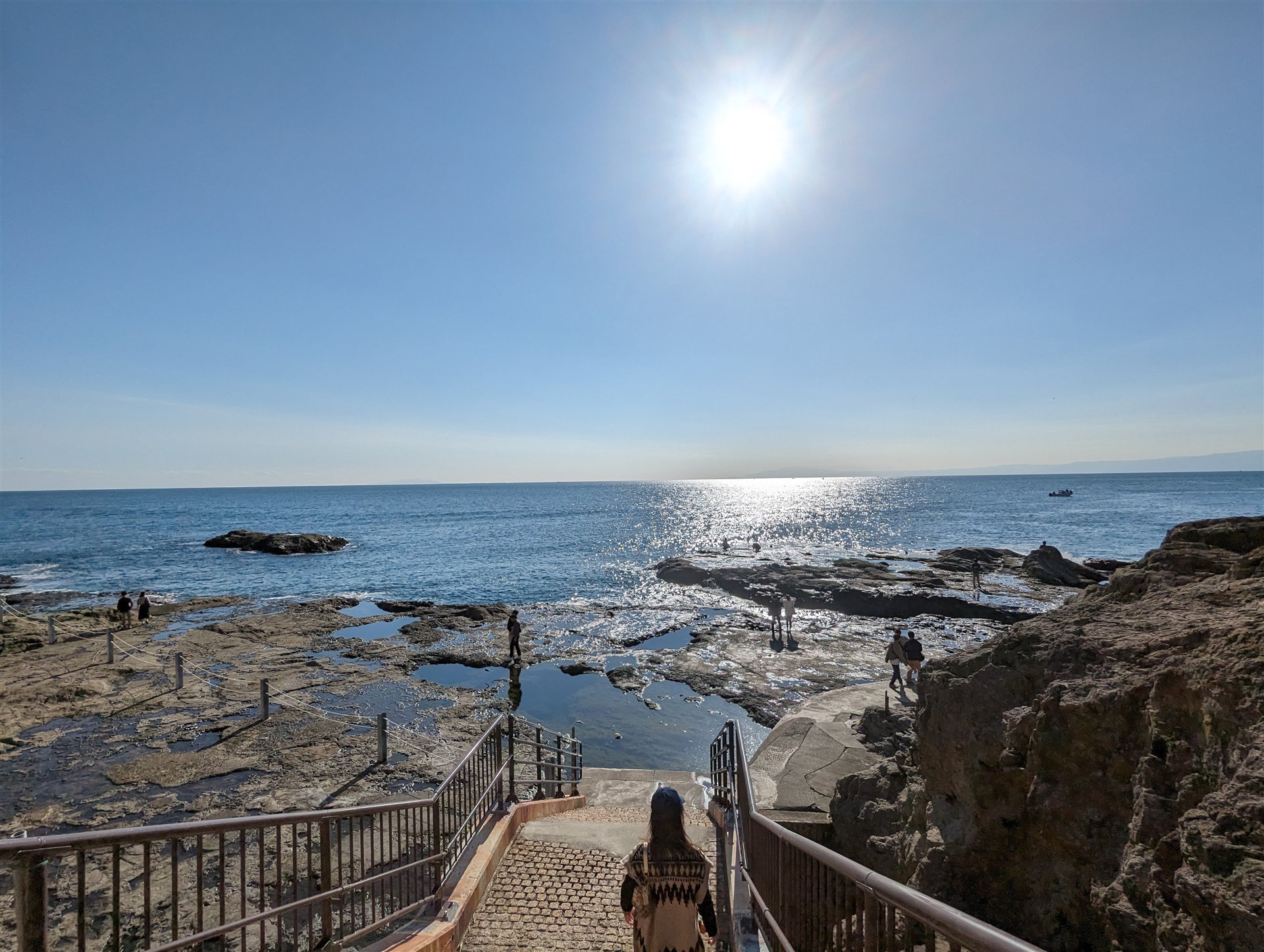
The stairs down to Chigogafuchi. The photo was taken around 13:40 on November 8, and you can see tide pools on the rocks.
Even where the rocks look flat, the surface is uneven, and some places are wet. Wear non-slip shoes, and stay away on days with high waves or bad weather.
Visiting Chigogafuchi at Sunset
Chigogafuchi is known for its beautiful sunsets, with the sun going down beyond Mount Fuji, and it has been selected as one of the Kanagawa 50 Scenic Spots.
If you plan your visit around the sunset, keep the following three points in mind.
- Check the sunset time in advance: It changes greatly with the seasons. It is a good idea to check the time for your day on a site such as the NAOJ Ephemeris Computation Office (Japanese)
- Visit the Iwaya Caves first: The caves are open only until the early evening. Seeing them before you wait for the sunset makes for an easy order
- Plan your way back: There are stairs on the way from the far end of the island to the entrance. Get back to a well-lit area before it gets dark, or bring a light
The next photo shows Enoshima, taken from a beach off the island at around 15:24 on the same day. It was before sunset, and the sunlight stretched across the surface of the sea.
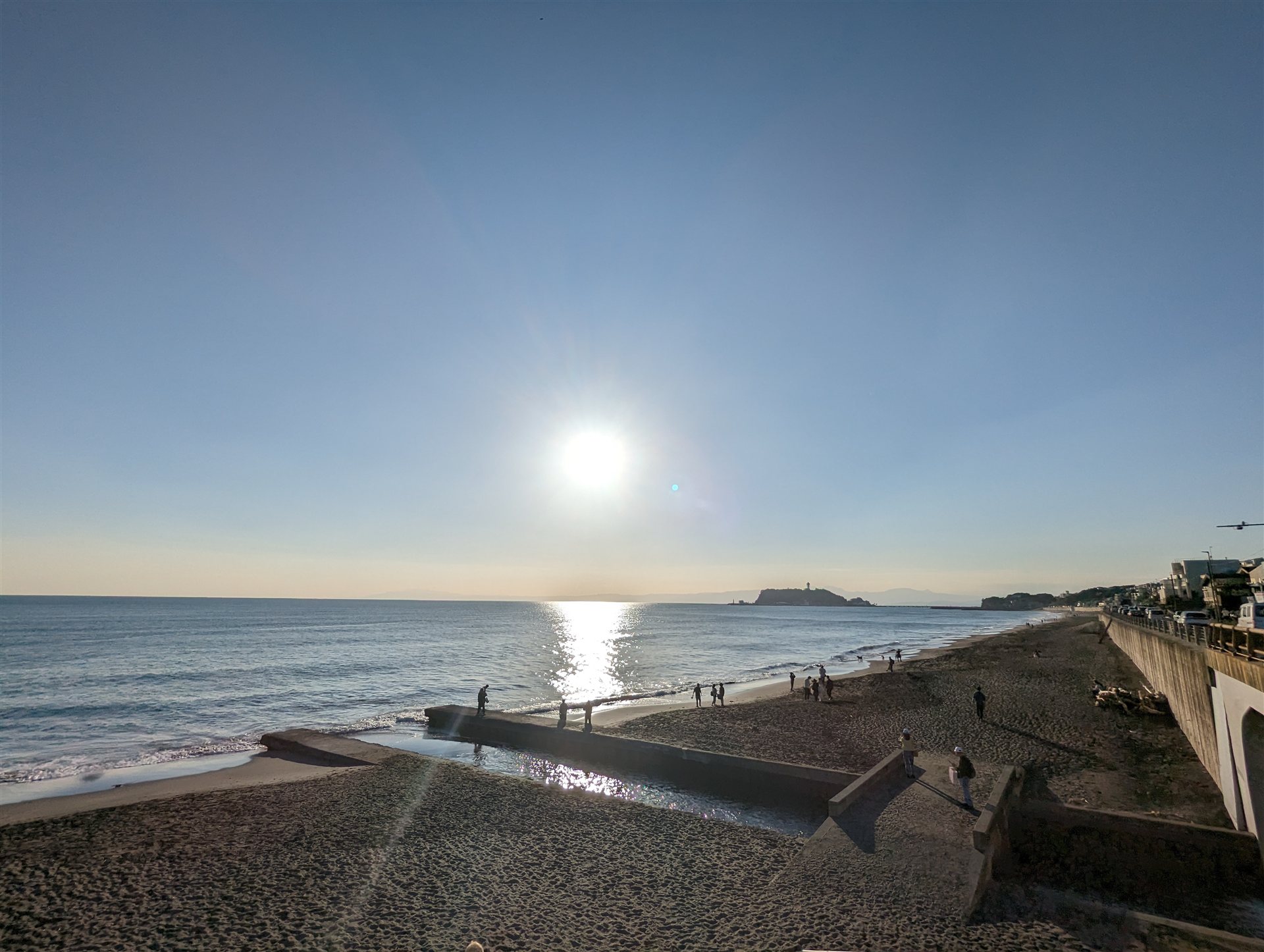
Enoshima seen from the beach near Shichirigahama and Kamakura-Kōkōmae (around 15:24).
For the Way Back, You Can Also Take the Bentenmaru
Besides walking back from the far end of the island to the entrance, you can take the Bentenmaru sightseeing boat. It links Chigogafuchi with a point partway along Enoshima Benten Bridge, offering a sea cruise of about 6 minutes. You can use it both on the way to the Iwaya Caves and on the way back.
Frequently Asked Questions
How much does it cost to enter the Enoshima Iwaya Caves?
It costs 500 yen for junior high school students and older, and 200 yen for elementary school students (checked on November 2, 2026). Opening hours vary by season.
Are the Iwaya Caves and Chigogafuchi separate places?
They are separate places, but very close to each other. On the official model course, it is about a 2-minute walk from the Iwaya Caves to Chigogafuchi.
Can I get to the Iwaya Caves by Escar?
No. The Escar only takes you up toward the top of the island. After going up, you walk to the Iwaya Caves along Oiwayamichi-dori and the stairs.
Is there an Escar for the way back down?
No. The Escar runs upward only, so you take the stairs on the way down.
Summary
On Enoshima, you cross Benten Bridge, pass the Bronze Torii and Nakamise Street, go up by Escar or stairs, and continue along Oiwayamichi-dori to reach the Iwaya Caves and Chigogafuchi.
- The Iwaya Caves and Chigogafuchi are at the very far end of the island, at the bottom of a flight of stairs
- The Escar goes up only. All 3 sections cost 500 yen for adults
- The Iwaya Caves cost 500 yen for junior high school students and older and 200 yen for elementary school students, and opening hours vary by season
- If you are timing your visit for the sunset, check the sunset time and your way back beforehand
For more trips in Kanagawa Prefecture, see our articles on a day trip to Odawara (Japanese) and the Miura Kaigan Sakura Festival (Japanese).
Fees and opening hours may change. Before you go, please check the latest information on the official Fujisawa City tourism website (Japanese) and the official Enoshima Sea Candle website (Japanese).
コメント