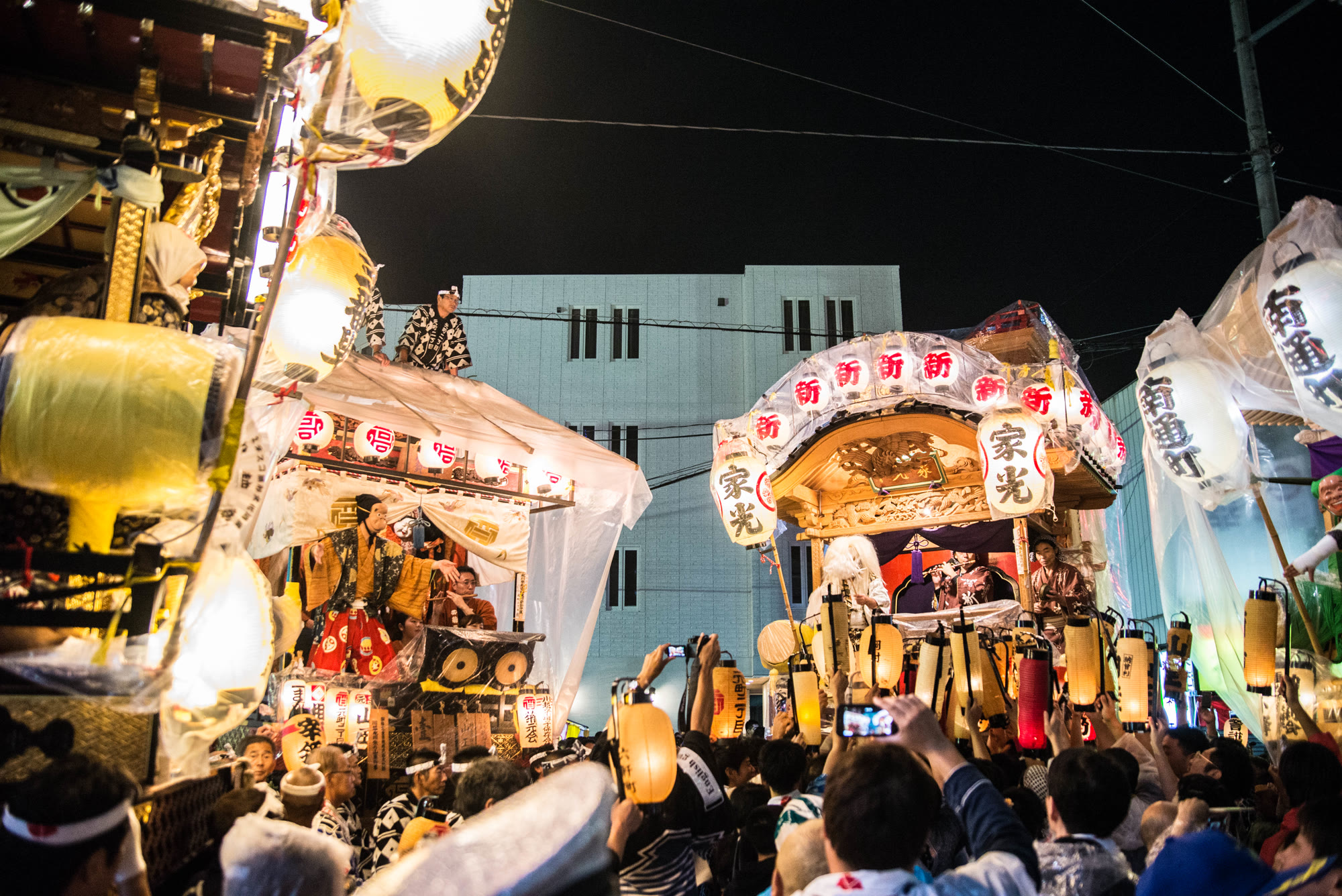
The 2026 Kawagoe Matsuri (Kawagoe Festival) takes place on Saturday, October 17 and Sunday, October 18. Ornate floats descended from Edo’s great “Tenka Matsuri” parade through the old warehouse district of “Little Edo,” and after dark the festival peaks with the hikkawase — floats turning to face each other in a musical showdown. It is one of the biggest autumn festivals in the Tokyo area, and an easy day trip from central Tokyo.
This guide covers the 2026 schedule and main events, highlights, road closures, access from Tokyo, and practical tips to know before you go.
What stayed with me most when I visited was the hikkawase at night. Watching floats face off and battle with their festival music is genuinely thrilling, and the moments when several floats converge on one spot are something I’d urge anyone going to Kawagoe Matsuri not to miss.
- What Is the Kawagoe Matsuri?
- 2026 Dates and Main Events
- Highlights of the Kawagoe Matsuri
- Crowds and How to Get Around
- Road Closures and Parking
- How to Get to Kawagoe Matsuri from Tokyo
- Restrooms, Rest Areas and Families with Children
- Kawagoe Festival Museum: Enjoy the Festival Any Day
- Basic Information
- FAQ
- Summary
What Is the Kawagoe Matsuri?
Kawagoe Matsuri is the collective name for the annual grand festival of Kawagoe Hikawa Shrine in Kawagoe, Saitama Prefecture, together with its sacred procession and float events. It is held every year on the third Sunday of October and the Saturday before it.
Its origins go back to 1648, when Matsudaira Nobutsuna, lord of the Kawagoe domain, donated a portable shrine (mikoshi), lion heads and drums to Hikawa Shrine and encouraged its festival. That gives it a history of more than 370 years.
The float events were designated a National Important Intangible Folk Cultural Property in 2005 as “the Float Events of the Kawagoe Hikawa Festival,” and in 2016 they were inscribed on the UNESCO Intangible Cultural Heritage list as part of “Yama, Hoko, Yatai, float festivals in Japan.”
Kawagoe Matsuri Timeline
| Year | Event |
|---|---|
| 1648 | Domain lord Matsudaira Nobutsuna donates a mikoshi, lion heads and drums to Hikawa Shrine and promotes the festival |
| 1651 | Lavish processions begin parading through the town |
| 1698 | Takazawa-cho brings out the first dancing stage (odori-yatai) |
| 1826 | The festival is recorded in a picture scroll |
| 1844 | The floats of the ten core neighborhoods all adopt the single-pillar style |
| 2005 | “Float Events of the Kawagoe Hikawa Festival” designated a National Important Intangible Folk Cultural Property |
| 2016 | Inscribed on UNESCO’s Intangible Cultural Heritage list as part of “Yama, Hoko, Yatai” |
2026 Dates and Main Events
| Item | Details |
|---|---|
| Dates | Saturday, October 17 – Sunday, October 18, 2026 |
| Venue | Central Kawagoe (around the Kurazukuri warehouse district, Kawagoe Hikawa Shrine and more) |
| Road closures | Both days 10:00–22:00 (no vehicles inside the restricted zone) |
| Admission | Free |
The main events are listed below. Check the official website or the official app “Kawagoe Matsuri Navi” (川越まつりナビ) for exact times and routes.
- Jinkōsai (sacred procession): The core Shinto ritual, in which a mikoshi carrying the deity of Hikawa Shrine parades through town. Usually held on the morning of day one (Saturday).
- Yoiyama (festival eve): As evening falls, lanterns light up on the floats and each neighborhood performs festival music in front of its float.
- Float parade in front of City Hall: Many floats pass in front of Kawagoe City Hall, so you can compare lots of them in one place. Usually around midday on day two (Sunday).
- Hikkawase: Mainly on the evenings of both days, floats meet all over town and face off head-on in a battle of festival music.
Note: In rain, the sacred procession and the City Hall float parade may be cancelled (they were cancelled due to rain in 2023).
Highlights of the Kawagoe Matsuri
1. Magnificent Edo-style floats
Kawagoe’s floats (dashi) evolved from Edo-style floats made up of a two-tier structure topped with a doll. Their signature feature is that the upper tier and the doll can rise up like an elevator.
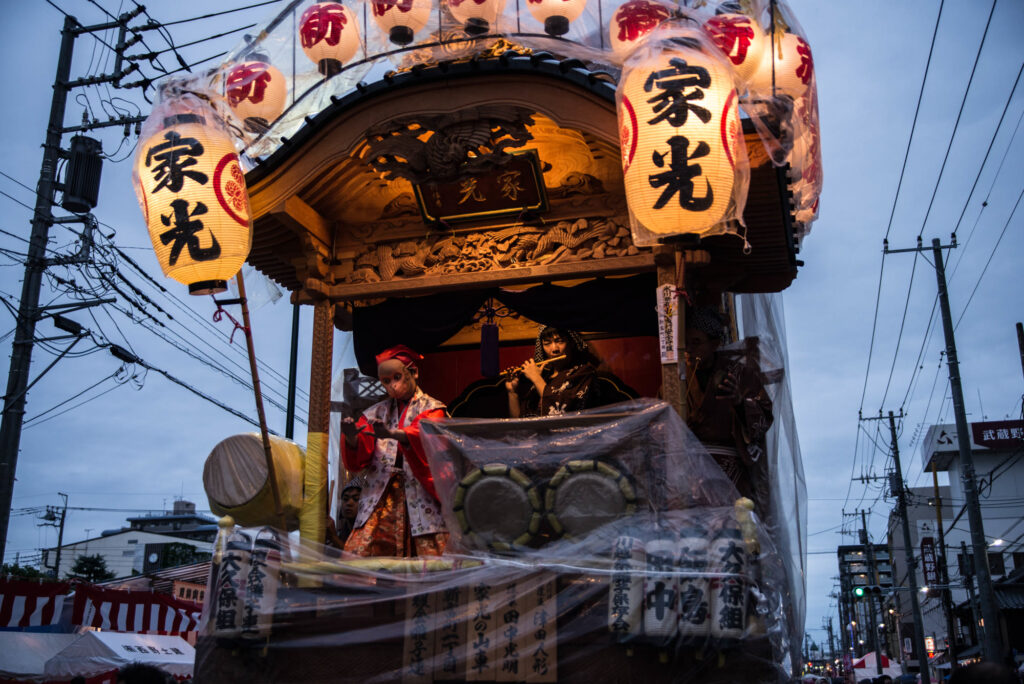
The official website introduces 32 floats, 10 of which are Saitama Prefecture Tangible Folk Cultural Properties. The number of floats taking part varies by year.
Prefecture-designated floats include Naka-cho’s “Ranryō-ō,” Shita-machi’s “Benkei,” Kita-machi’s “Hidesato” and Matsue-cho 2-chome’s “Urashima.”
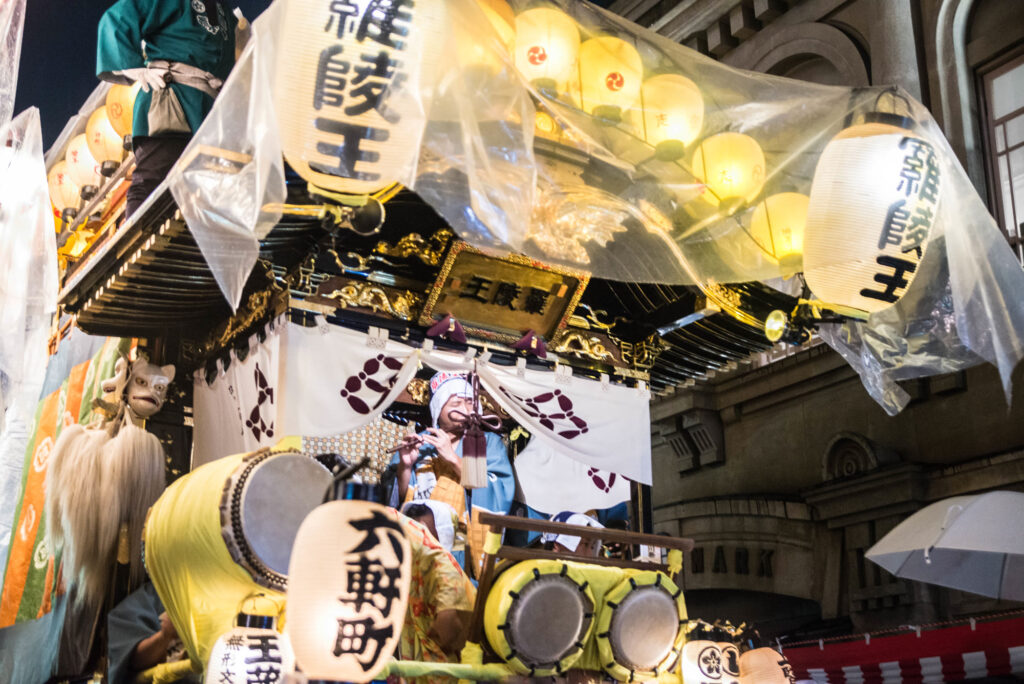
2. The night-time hikkawase
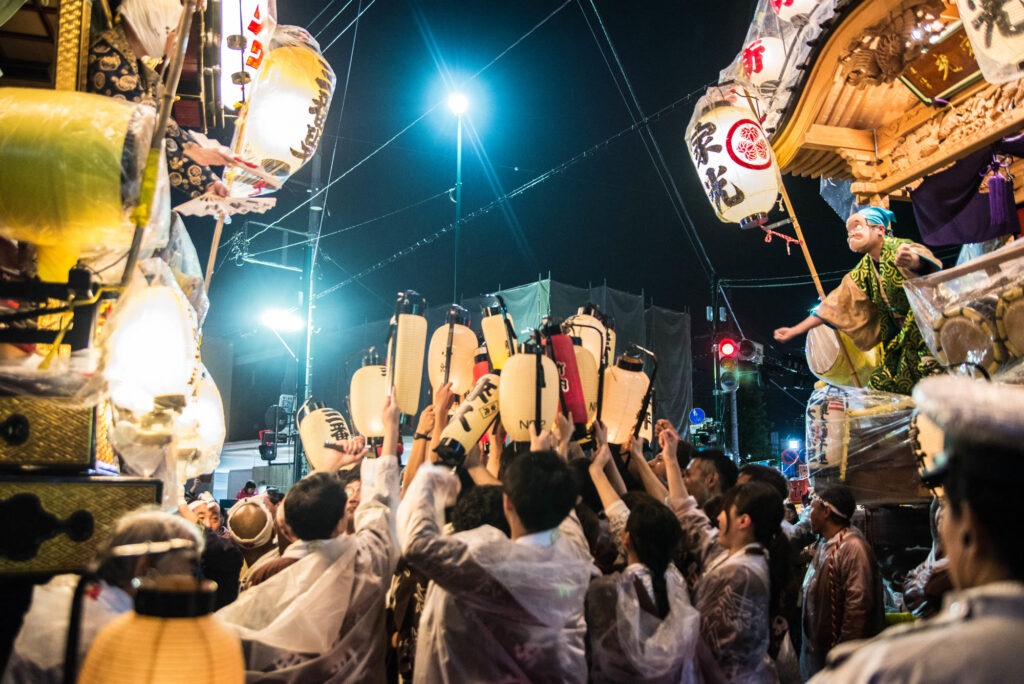
The biggest highlight is the hikkawase. When two floats meet, they turn to face each other and compete with flutes, drums, gongs and dancing. Festival crews raise their lanterns high and roar — it’s an overwhelming sight, and the energy only builds as the night goes on.
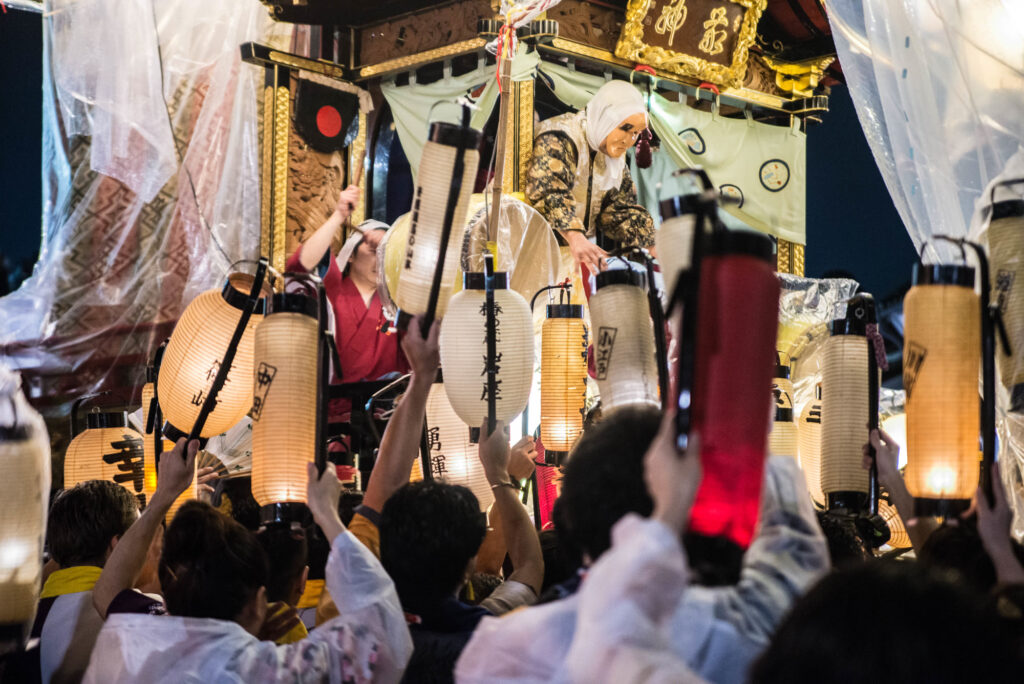
Being there in person, I found the hikkawase truly the main event. It usually involves two floats, but when several floats face inward toward the center at once, it’s spectacular — the one scene I’d most want you to see at Kawagoe Matsuri.
You never know exactly when or where a hikkawase will start, so the best way not to miss one is to pick a float and follow it.
3. Festival music (hayashi) and dance
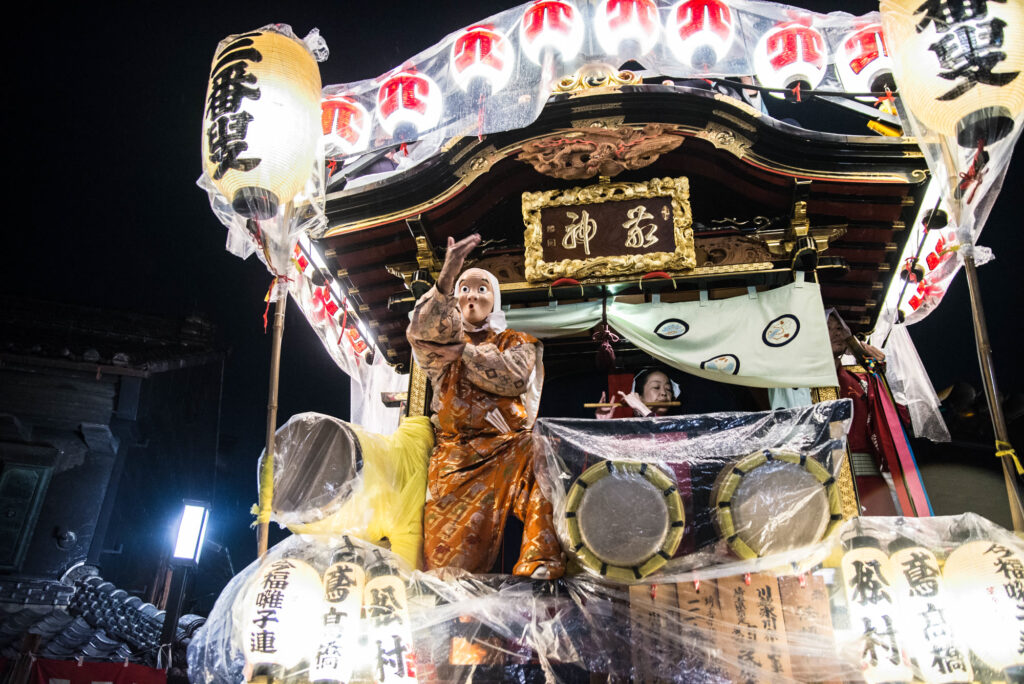
A standard hayashi ensemble has one dancer, one flute, two small drums, one large drum and one gong. There are three schools — Ōkura-ryū, Shiba-Kanasugi-ryū and Tsutsumizaki-ryū — and comparing the different sounds and dances of each neighborhood is part of the fun.
4. Firemen’s ladder stunts
During the evening, traditional tobi steeplejacks perform stunts on top of a tall ladder, adding a touch of old-Edo flair to the festival.
Photography tip
If you’re taking photos, try shooting a hikkawase from the side at a low angle while the floats face each other. Looking up at the lanterns from below gives a far more immersive shot.
Crowds and How to Get Around
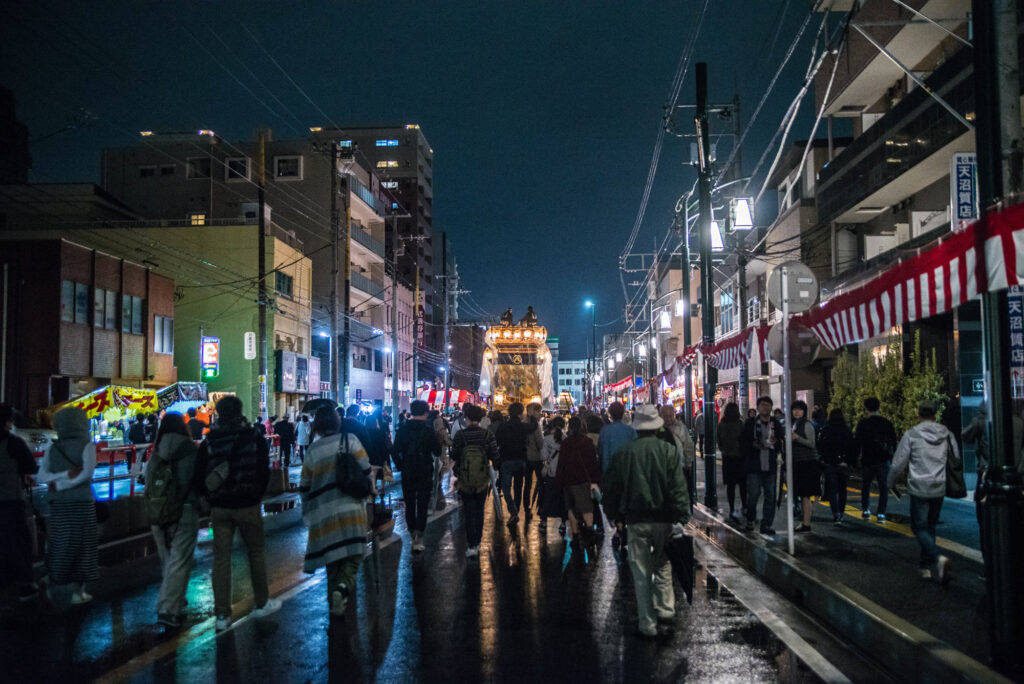
The festival draws huge crowds over two days. It is busiest from evening into the night during the hikkawase, and during the daytime on day two.
- To see the floats up close, walk around early in the day when it is relatively quiet.
- For hikkawase, head to spots where floats cross paths, such as Ichibangai (the warehouse street), Fudanotsuji and the Naka-cho intersection. The “Kawagoe Matsuri Navi” app shows where each float is in real time.
- Visitors are asked to keep moving and keep to the left inside the venue.
When I went, the crowds grew as the night went on. Hikkawase at intersections in particular draw lots of onlookers. Still, it was never a crush — as long as I paid attention to those around me, I could watch comfortably.
Road Closures and Parking
On both days, large-scale road closures are in place in central Kawagoe from 10:00 to 22:00, and no vehicles are allowed inside the restricted zone. Bicycles must be walked in restricted sections. See the venue map on the official website for the exact area.
Temporary parking is set up on school grounds and similar sites (8:30–22:00, locked at 23:00), but it may be unavailable depending on ground conditions. Surrounding roads also get congested, so public transportation is strongly recommended.
Tobu Bus, Seibu Bus and the Koedo loop bus all run on altered routes during the festival.
How to Get to Kawagoe Matsuri from Tokyo
By train
| From | Line | Arrive at | Approx. time |
|---|---|---|---|
| Ikebukuro | Tobu Tojo Line (Express) | Kawagoe Station | About 30 min |
| Seibu-Shinjuku | Seibu Shinjuku Line (Limited Express “Koedo”) | Hon-Kawagoe Station | About 45 min |
| Seibu-Shinjuku | Seibu Shinjuku Line (Express) | Hon-Kawagoe Station | About 60 min |
| Omiya | JR Kawagoe Line | Kawagoe Station | About 20 min |
| Yokohama | Tokyu Toyoko Line through to Tobu Tojo Line (F Liner) | Kawagoe Station | About 75 min |
Note: Times are estimates from the Kawagoe City official website.
From the station to the festival
- Hon-Kawagoe Station (Seibu Shinjuku Line): About a 10-minute walk to the warehouse district (Ichibangai). This is the closest station to the heart of the festival.
- Kawagoe Station (JR Kawagoe Line / Tobu Tojo Line): Farther from the venue than Hon-Kawagoe, so walking takes longer. Tobu buses normally run toward “Ichibangai,” but routes change on festival days, so be careful.
By car
The nearest exit is Kawagoe IC on the Kan-Etsu Expressway. However, with road closures and heavy traffic on festival days, driving is not recommended.
Restrooms, Rest Areas and Families with Children
Restrooms, smoking areas and first-aid tents are marked on the official venue map and in the “Kawagoe Matsuri Navi” app.
Baby stations (“Akachan no Eki”) for nursing and diaper changing are set up at places such as the Kawagoe Festival Museum, Motomachi Rest Area, Yamabuki Kaikan, the Former Yamazaki Family Villa management building and Koedo Kurari (based on the 2025 festival; hours vary by facility).
Also keep the following in mind:
- Drones and other small unmanned aircraft are prohibited by law in principle
- No smoking while walking (designated smoking areas only)
- Please be considerate of small children, strollers and wheelchair users
Kawagoe Festival Museum: Enjoy the Festival Any Day
To get a taste of Kawagoe Matsuri on other days of the year, visit the Kawagoe Festival Museum (Kawagoe Matsuri Kaikan). Two real floats are on display, and films of the festival are screened.
| Item | Details |
|---|---|
| Address | 2-1-10 Motomachi, Kawagoe, Saitama |
| Hours | Apr–Sep 9:30–18:30 (last entry 18:00) / Oct–Mar 9:30–17:30 (last entry 17:00) |
| Closed | 2nd and 4th Wednesdays (next day if a holiday), New Year holidays (Dec 29 – Jan 1) |
| Admission | Adults 300 yen, elementary and junior high students 100 yen |
| Access | 1 min walk from the “Fudanotsuji” Tobu Bus stop |
Note: Check the Kawagoe City official website (Japanese) for the latest information.
Basic Information
| Item | Details |
|---|---|
| Name | Kawagoe Matsuri (Float Events of the Kawagoe Hikawa Festival) |
| Dates | Saturday, October 17 – Sunday, October 18, 2026 |
| Venue | Central Kawagoe, Saitama (around Kawagoe Hikawa Shrine and the warehouse district) |
| Admission | Free |
| Road closures | Both days 10:00–22:00 |
| Nearest stations | Hon-Kawagoe Station (Seibu Shinjuku Line); Kawagoe Station (JR Kawagoe Line / Tobu Tojo Line) |
| Official website | Kawagoe Matsuri official website |
Note: Check the official website for the latest information.
FAQ
Q. When is Kawagoe Matsuri 2026?
Saturday, October 17 and Sunday, October 18, 2026. It is held every year on the third Sunday of October and the day before.
Q. What time can I see the hikkawase?
Mainly in the evening on both days — it is liveliest once the lanterns are lit. You can track the floats in the official “Kawagoe Matsuri Navi” app.
Q. What happens if it rains?
In rain, the sacred procession and the City Hall float parade may be cancelled. Check the official website on the day.
Q. Can I drive there?
Central Kawagoe is closed to traffic from 10:00 to 22:00 on both days and nearby roads are congested, so public transportation is recommended. Temporary parking may be unavailable depending on ground conditions.
Q. What is the nearest station?
Hon-Kawagoe Station on the Seibu Shinjuku Line is closest to the center, about a 10-minute walk from Ichibangai. Kawagoe Station (Tobu Tojo Line / JR Kawagoe Line) also works.
Q. Can I see the floats outside festival days?
Yes — two real floats are on display year-round at the Kawagoe Festival Museum (except closing days).
Summary
With over 370 years of history and recognition as both a National Important Intangible Folk Cultural Property and UNESCO Intangible Cultural Heritage, Kawagoe Matsuri is one of the great autumn festivals of the Kanto region. In 2026 it takes place on Saturday, October 17 and Sunday, October 18.
By day, enjoy the warehouse streets and gorgeous floats; by night, the electric hikkawase. With road closures in place, come by train and use the official app to track the floats as you explore.
While you’re in Kawagoe, also check out our guide to getting to Kawagoe Castle and 13 must-see spots in Koedo Kawagoe, which covers places worth a stop between festival events such as the Toki no Kane bell tower, Renkei-ji Temple and the summer wind-chime festival at Kawagoe Hikawa Shrine. For more articles on Saitama, see our Saitama guide.
コメント