The Itsukaichi area of Akiruno City, Tokyo, is a place where you can go to see autumn leaves starting from Musashi-Itsukaichi Station, the last stop on the JR Itsukaichi Line. Besides the colors of the mountains and streams of the Akigawa Valley, the grounds of the old temple Kotokuji have two giant ginkgo trees standing just inside the mountain gate.
In this article, I introduce the giant ginkgo trees of Kotokuji Temple and the autumn leaves of the Akigawa Valley with photos taken on November 15, 2020. I also cover the usual best time to visit, how to get there from Musashi-Itsukaichi Station, and the autumn leaves course introduced by Akiruno City. The best time and access information were checked on the pages of Akiruno City and the Akiruno Tourism Association (checked on November 2, 2026).
- Basic Information on the Autumn Leaves of Itsukaichi and the Akigawa Valley (Location, Best Time, Access)
- The Giant Ginkgo Trees of Kotokuji Temple: Two Huge Trees Inside the Mountain Gate
- History and Cultural Properties of Kotokuji Temple
- How to Get to Kotokuji Temple from Musashi-Itsukaichi Station
- Autumn Leaves on the Riverbanks and Streams of the Akigawa River
- The Autumn Leaves Course Introduced by Akiruno City
- How the Colors Progressed in 2025 (A Guide to the Best Time)
- Summary of the Autumn Leaves of Itsukaichi and the Akigawa Valley
Basic Information on the Autumn Leaves of Itsukaichi and the Akigawa Valley (Location, Best Time, Access)
The Akigawa River is said to be the largest tributary of the Tama River. A stretch of about 20 km, running from Akiruno City to Hinohara Village, is called the Akigawa Valley. Akiruno City’s page describes it as a place about an hour west of central Tokyo.
- Location of Kotokuji Temple: 234 Kowada, Akiruno City, Tokyo
- Best time at Kotokuji Temple: Mid-November to late November (according to Akiruno City’s page)
- Starting station: Musashi-Itsukaichi Station on the JR Itsukaichi Line
- Getting to Kotokuji Temple: About 25–30 minutes on foot from the station, or take a bus to “Kamicho” and walk about 15 minutes
- Getting to Ishifune Bridge: Take a bus from the station to “Jurigi” and walk about 6 minutes
- Information: Akiruno Tourism Association (Japanese), the tourist information corner at Musashi-Itsukaichi Station, and the tourist information center next to it
The Giant Ginkgo Trees of Kotokuji Temple: Two Huge Trees Inside the Mountain Gate
Kotokuji is a temple of the Kenchōji branch of the Rinzai school of Zen Buddhism. According to Akiruno City’s page, it is said to have been founded in 1373 (Ōan 6). The city’s autumn page lists the two giant ginkgo trees, standing face to face just inside the mountain gate, as a highlight.
The Mountain Gate and the Giant Ginkgo Trees
The mountain gate of Kotokuji is a thatched gate thought to date from the middle of the Edo period. In the photo below, moss grows on the roof, and a ginkgo branch reaches toward the gate from the right.
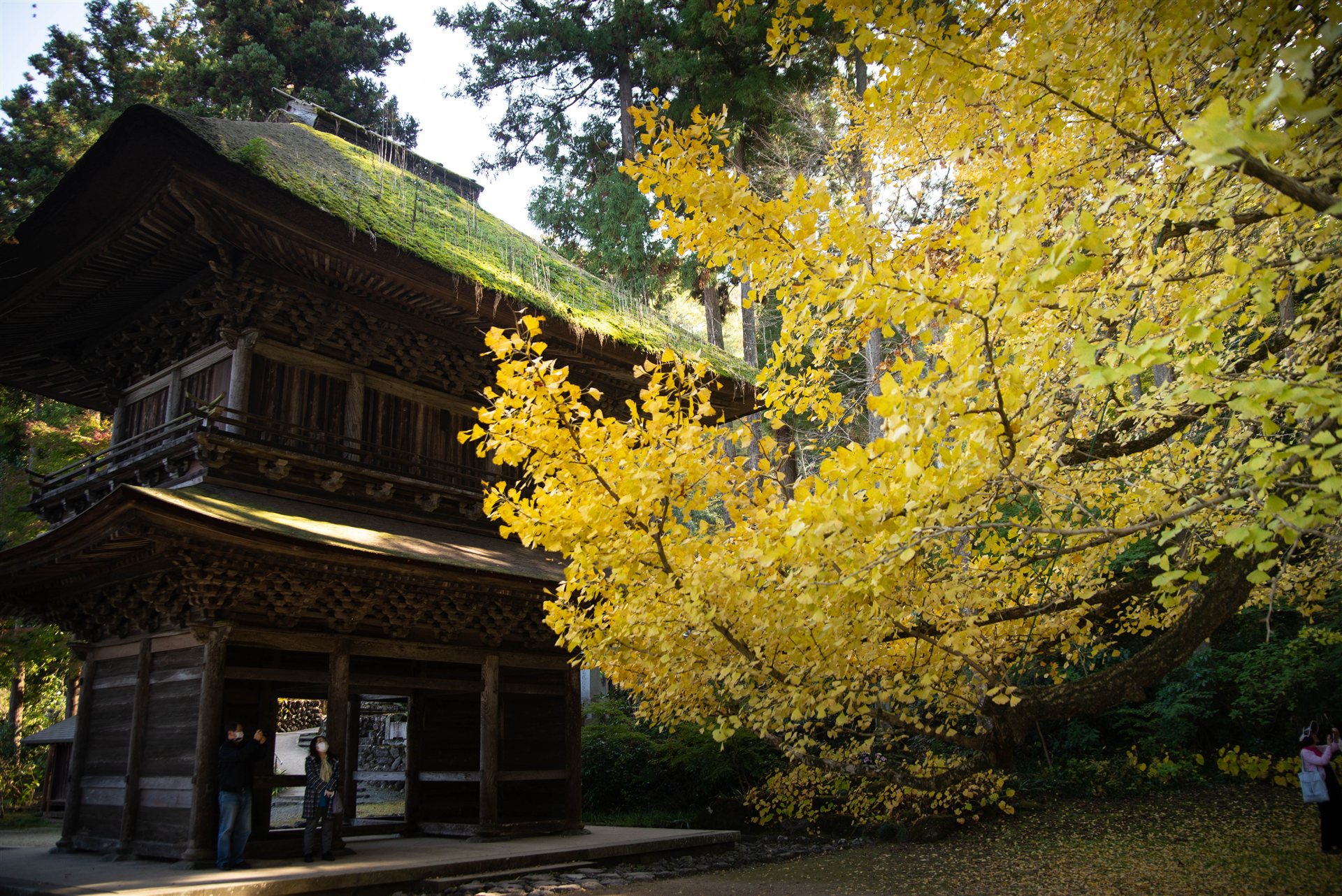
The mountain gate of Kotokuji Temple and the giant ginkgo tree (photo taken on November 15, 2020)
When I actually saw it, it was breathtaking. You can see a scene a little different from a row of ginkgo trees along a street.
The Two Ginkgo Trees Seen from Inside the Mountain Gate
Standing inside the mountain gate, you can see the trunks of the two ginkgo trees side by side through the thick pillars. In the photo, a temple building stands behind them, and the ground is yellow with fallen leaves.
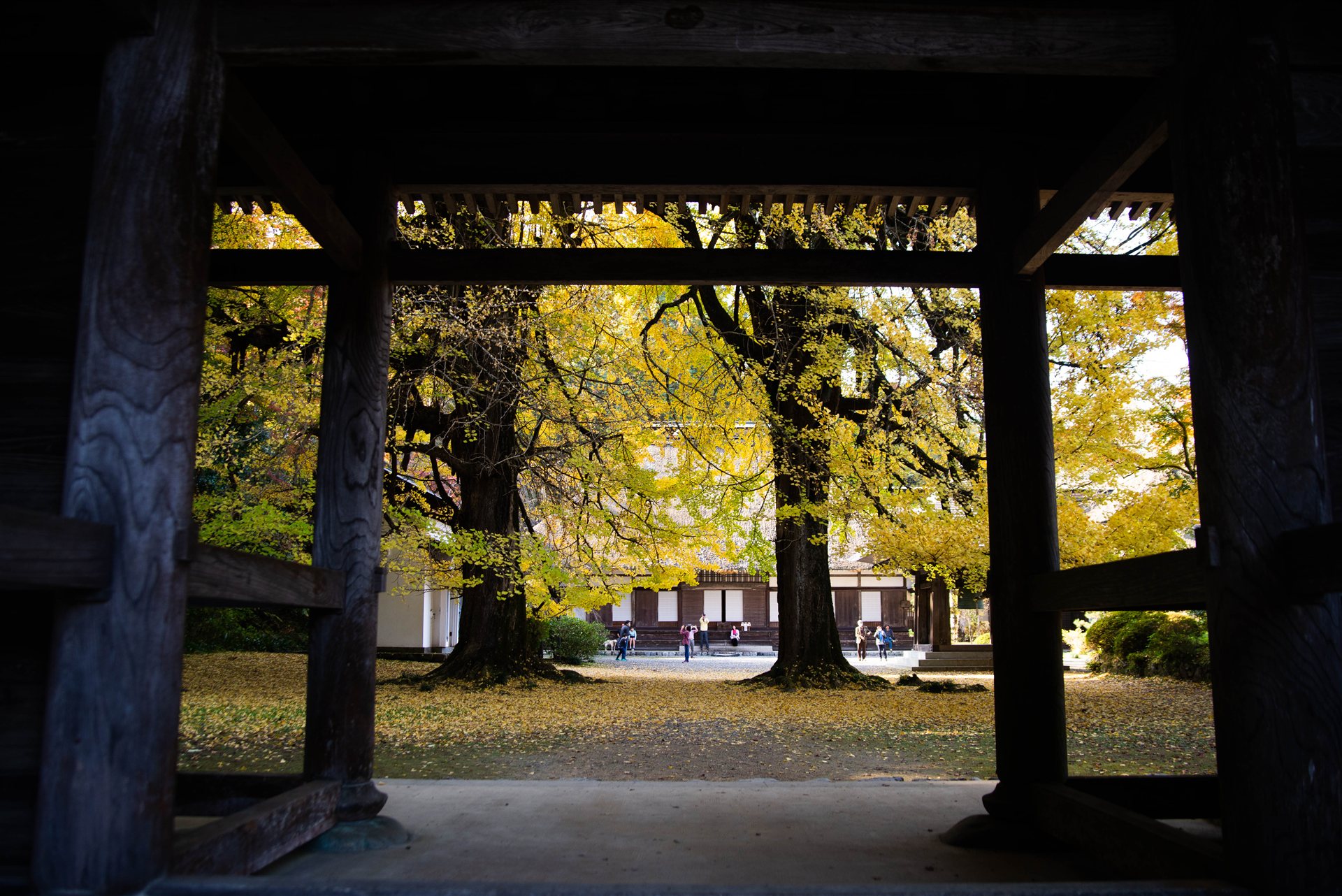
The two giant ginkgo trees seen through the pillars of the mountain gate
Looking Up at the Giant Ginkgo Tree from the Temple Grounds
The next photo was taken looking up at the whole ginkgo tree. As of November 15, the upper part was yellow, while green leaves still remained in the middle. Fallen leaves had already piled up on the ground at its base.
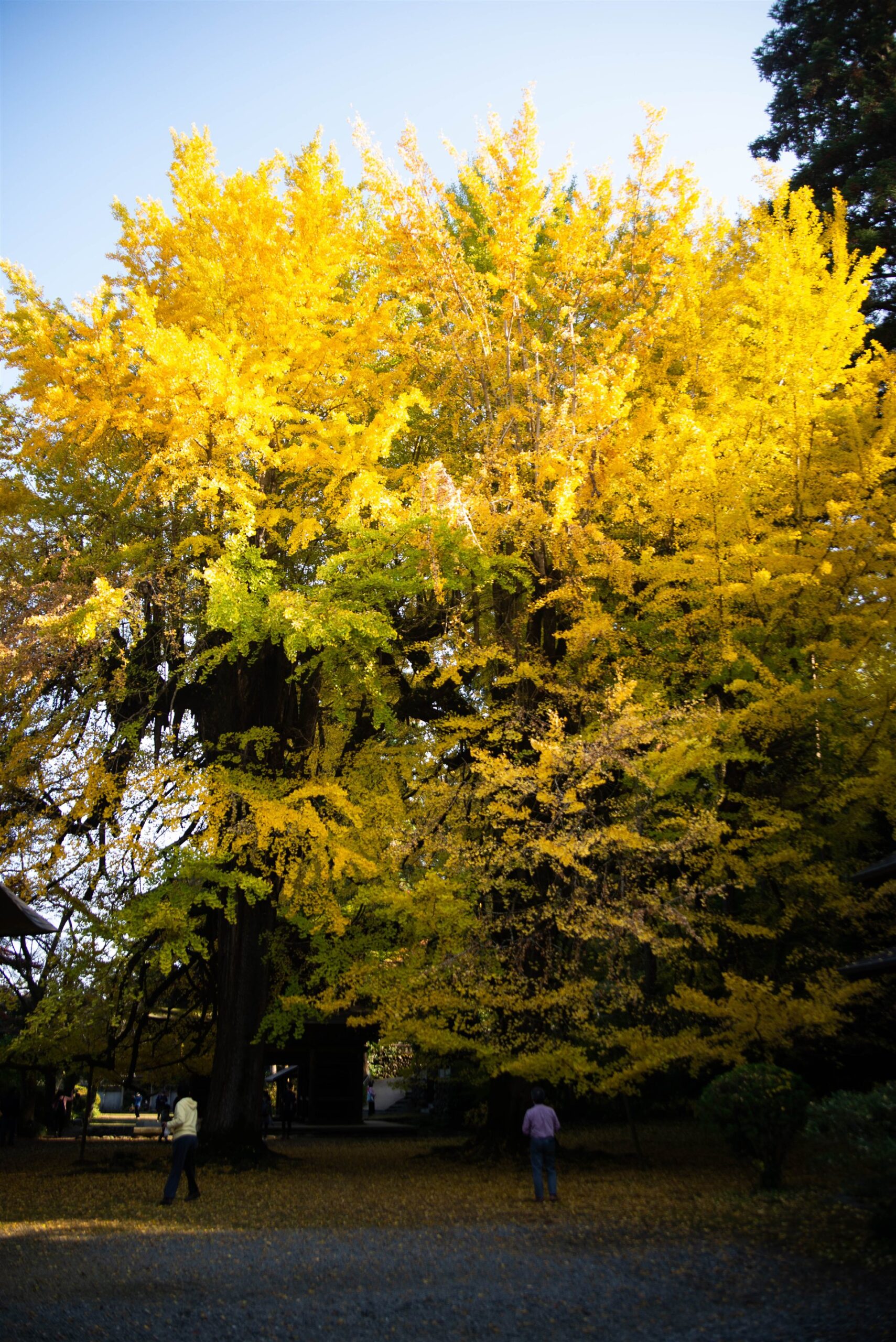
Comparing it with the people below shows how big the tree is
A White-Walled Building and Autumn Leaves in the Temple Grounds
In the temple grounds, you can also see red leaves as well as the yellow of the ginkgo. In the photo below, there is a red shrub beside a small white-walled building, and ginkgo leaves cover the ground in front.
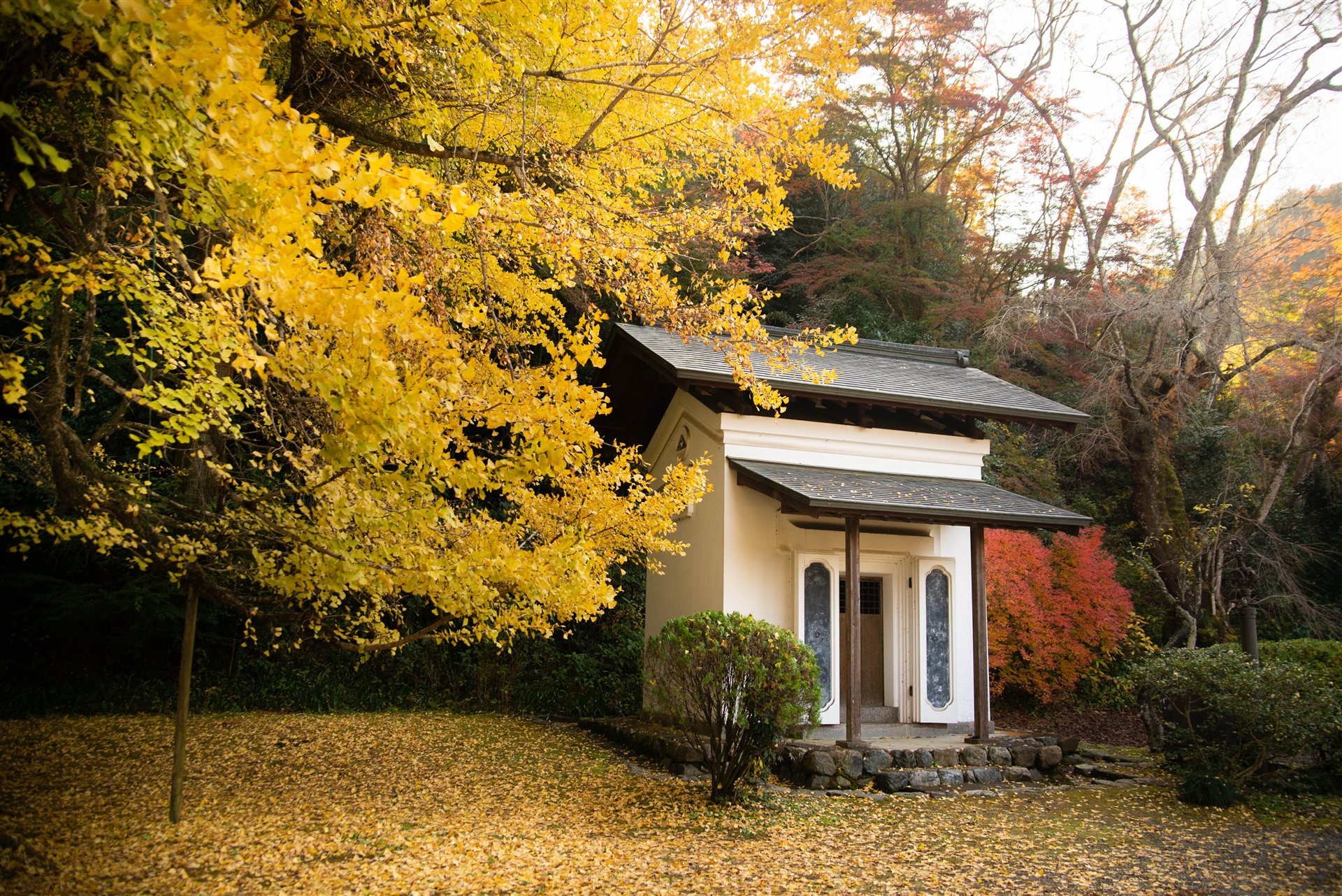
The white-walled building, the ginkgo, and a red shrub
History and Cultural Properties of Kotokuji Temple
According to Akiruno City’s page, Kotokuji is a temple with many cultural properties, and its grounds are a Historic Site designated by the Tokyo Metropolitan Government. The grounds also have a Japanese torreya (kaya) tree and a tarayō holly tree, both designated as Natural Monuments of Tokyo.
It is a temple where you can see not only the ginkgo trees but also the gate and other old trees. Because it is a temple with a long history, please stay quiet in the grounds and do not touch the buildings or trees. The Akiruno Tourism Association also asks visitors to be considerate of local residents and other visitors and to follow good manners when viewing the autumn leaves.
How to Get to Kotokuji Temple from Musashi-Itsukaichi Station
To get to Kotokuji Temple, walk or take a bus from Musashi-Itsukaichi Station.
On Foot
Akiruno City’s pages give two different walking times from the station: about 25 minutes and about 30 minutes. For this reason, this article says “about 25–30 minutes.”
By Bus
From Musashi-Itsukaichi Station, take a bus bound for “Hossawa-no-Taki Iriguchi,” “Fujikura,” “Kazuma,” or “Kami-Yozawa,” and get off at “Kamicho.” It is about a 15-minute walk from the bus stop. This information comes from a page updated in 2021, so please check the timetable and fares with the bus company before you go.
Admission and Parking
Akiruno City’s page did not give the admission fee or visiting hours. As for parking, according to the autumn leaves information on Walkerplus (Japanese), there is free parking for 5 standard cars at the top of the mountain road beside the temple, and space for about 50 standard cars in an open area at the foot of the mountain. It is a 30-minute walk from the open area to the temple. The mountain road is narrow, and cars cannot pass each other (as listed in October 2026; checked on November 4, 2026).
I visited by train, and since it is only a short walk, it is an easy place to reach by train too.
Autumn Leaves on the Riverbanks and Streams of the Akigawa River
Unlike at the temple, the autumn leaves of the Akigawa Valley are seen in combination with the colors of the river, rocks, and mountains. Akiruno City’s page introduces the contrast of the clear blue stream with the autumn leaves as a highlight.
All three of these photos were taken along the Akigawa River.
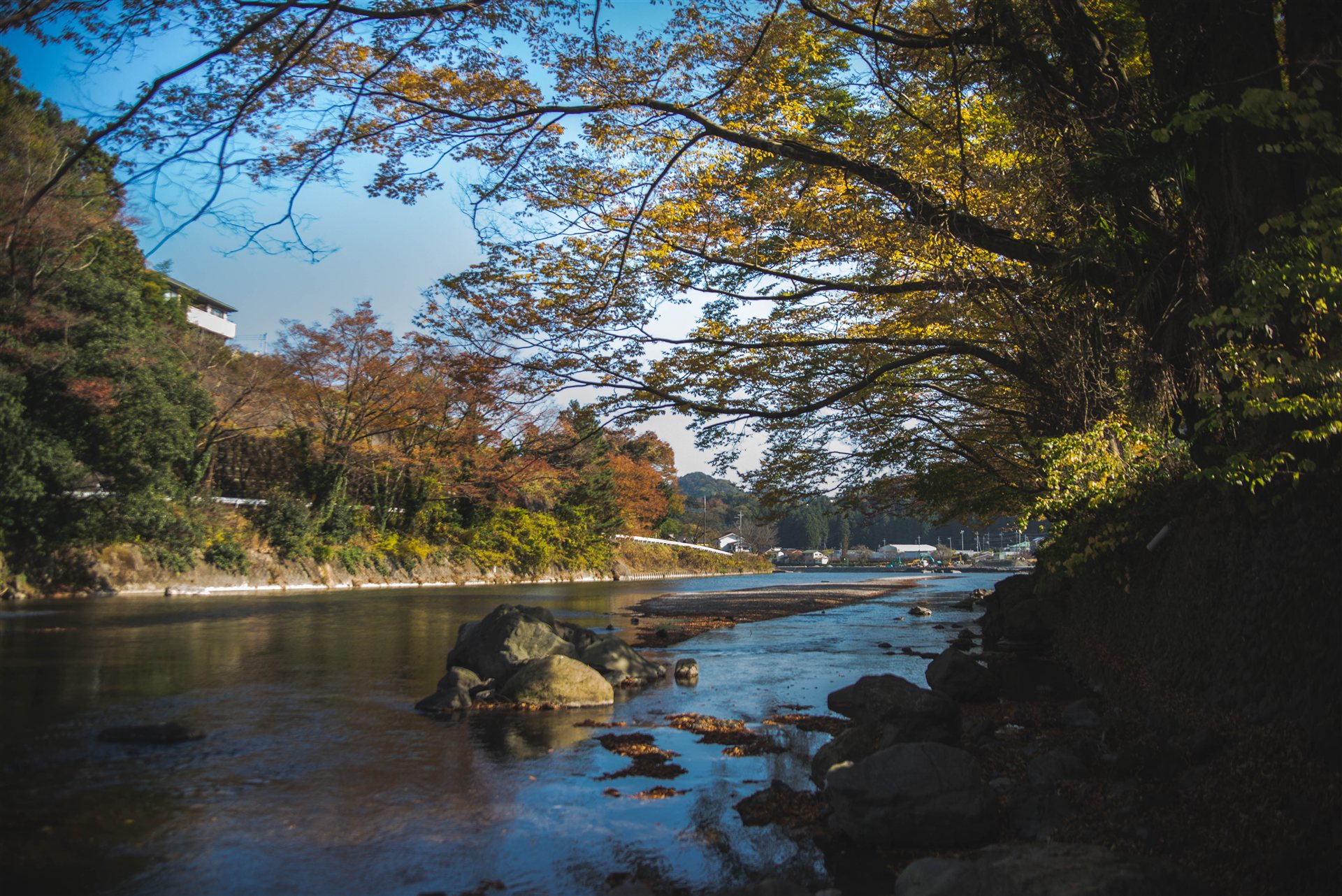
Branches reach out over the water, and the trees on the opposite bank have also changed color
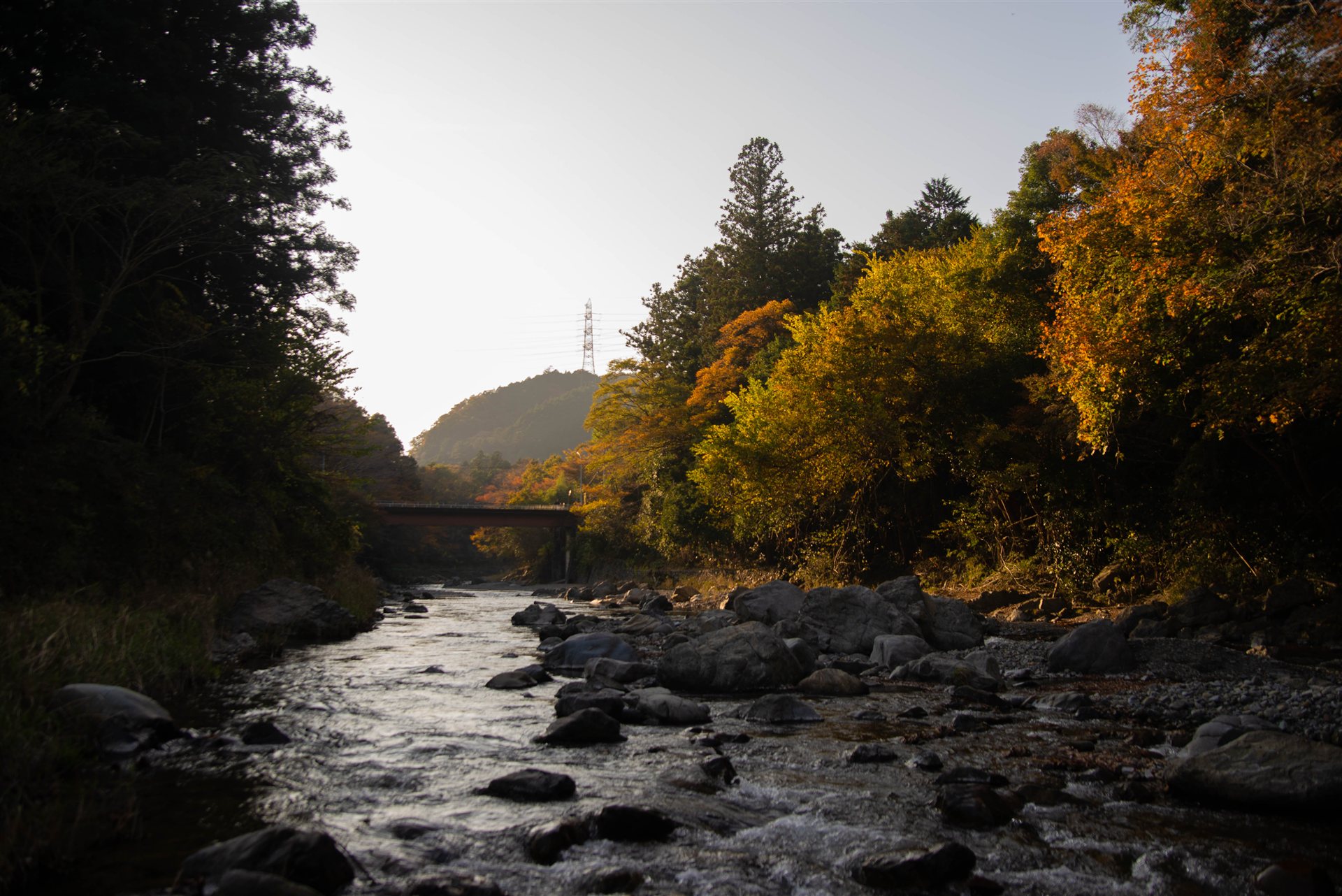
The stream flowing among the rocks. A bridge and a steel tower can be seen in the distance
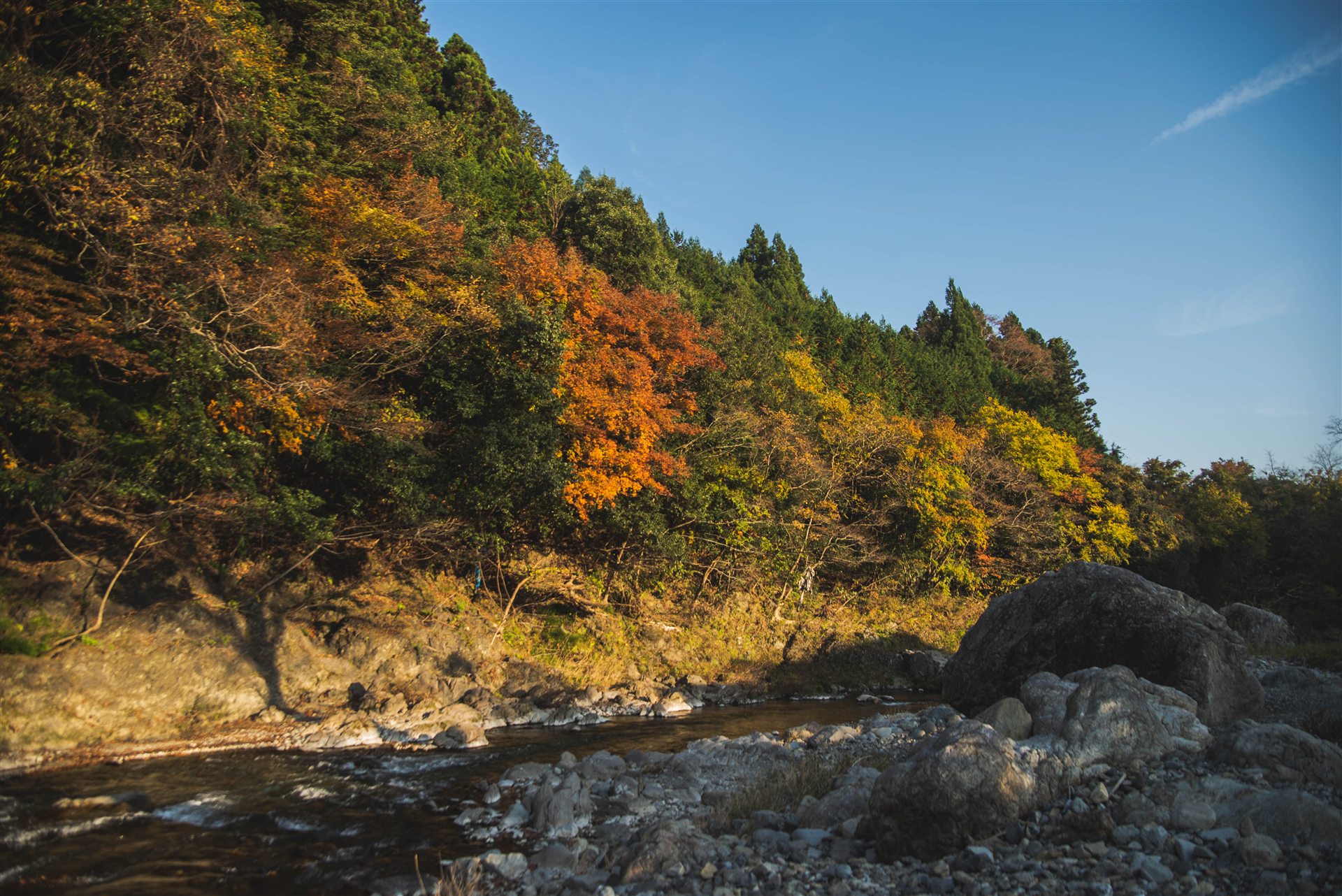
A mountainside where orange and yellow trees mix with the green of the cedars
The Autumn Leaves Course Introduced by Akiruno City
If you want to visit Kotokuji Temple together with the Akigawa Valley, Akiruno City’s Akigawa Valley Autumn Leaves Course (Japanese) is a useful reference. The route is as follows, and the page says it takes about 3 hours.
- Musashi-Itsukaichi Station: You can get pamphlets at the station’s tourist information corner and the tourist information center next to it
- Kotokuji Temple: The two giant ginkgo trees
- Iwase Gorge: The stretch from Kagetsu Bridge to around Sawado Bridge. The highlight is the row of autumn trees along the river seen from Kagetsu Bridge
- Sawado Bridge: The point where the Bonbori and Kariyose Rivers flow into the Akigawa River, at the entrance to the mountain area
- Tokura Shiroyama Terrace: A facility that uses the former Tokura Elementary School. The maples behind the former gymnasium change color
- Akigawa Keikoku Seoto-no-Yu: There is a free footbath
- Aokidaira Bridge: The deepest mountain area on the course. The page says that if you go down to the riverbank, you can see a view of the valley different from the one on the bridge
- Ishifune Bridge: A bridge about 96 m long, from which you can look out over the valley and the autumn leaves
- Akigawa Keikoku Seoto-no-Yu: The goal
The distance is not given, so if you plan to rest or bathe at the facilities, please allow plenty of time.
According to Akiruno City’s page (updated January 17, 2024), Akigawa Keikoku Seoto-no-Yu is open from 10:00 a.m. to 10:00 p.m. (last entry 9:00 p.m.) and is closed on Tuesdays. The page says the hours may differ depending on the season, so please check before you go.
How the Colors Progressed in 2025 (A Guide to the Best Time)
The timing of the autumn leaves changes from year to year. As a guide, here is a summary of the Akiruno Tourism Association’s autumn leaves information for 2025.
- Post on November 8: The ginkgo trees at Kotokuji Temple were almost at their best
- Post on November 13: The ginkgo trees at Kotokuji Temple were at their best. The area around Ishifune Bridge was also at its best
- Post on November 20: The ginkgo trees at Kotokuji Temple were still at their best. Around Kowada Bridge and Kagetsu Bridge, fallen leaves were starting to stand out
The photos in this article were taken on November 15, which would fall in the best period in 2025. As of November 2, 2026, I could not find any posts with this year’s autumn leaves information on the tourism association’s page. Before you go, please check the latest information with the Akiruno Tourism Association (Japanese).
Summary of the Autumn Leaves of Itsukaichi and the Akigawa Valley
- Kotokuji is a temple with two giant ginkgo trees standing inside its thatched mountain gate
- According to the city’s page, the best time at Kotokuji Temple is mid-November to late November
- Kotokuji Temple can be reached from Musashi-Itsukaichi Station in about 25–30 minutes on foot, or by bus and a walk
- If you also want to explore the Akigawa Valley, the city’s autumn leaves course (about 3 hours) is a useful reference
Other articles on the Tama area of Tokyo include Hachioji roundup (Japanese) and the hydrangeas of Takahata Fudō (Japanese). For autumn leaves in other places, see also the highlights of Nikko Toshogu Shrine and the autumn leaves of Chichibu Muse Park (Japanese).
References (checked on November 2, 2026)
- Akiruno City: “31. Kotokuji Temple” (Japanese)
- Akiruno City: “The Four Seasons of Akiruno: Autumn” (Japanese)
- Akiruno City: “Akigawa Valley Autumn Leaves Course” (Japanese)
- Akiruno City: “The Appeal of the Akigawa Valley” (Japanese)
- Akiruno City: “Around Ishifune Bridge” (Japanese)
- Akiruno Tourism Association, Akigawa Valley Autumn Leaves Information 2025 (Japanese): November 8, November 13, November 20
- Map and access for the autumn leaves of Kōshinzan Kotokuji | Walkerplus (Japanese) (checked on November 4, 2026)
コメント