The Senbon Torii at Fushimi Inari Taisha is the scene many people picture as the most “Kyoto-like” view in Kyoto. Many of you have probably seen this tunnel of vermilion torii gates, standing one after another with no gaps, on TV or in photos.
In this article, together with photos from my walk around Fushimi Inari Taisha in November 2022, I have put together the history of Fushimi Inari Taisha, why the Senbon Torii came to be, the highlights of the Rōmon gate and the small torii on the mountain, and how to get there.
The shrine information was checked on the official Fushimi Inari Taisha website and on Cultural Heritage Online (Bunka Isan Online) by Japan’s Agency for Cultural Affairs (checked on October 29, 2026). The photos were taken in November 2022, so some things may look different today.
- What Is Fushimi Inari Taisha? The Head Shrine of All “Oinari-san” Shrines in Japan
- The Rōmon Gate | A Large Vermilion Gate and Fox Statues
- The History of the Senbon Torii | Why Are There So Many Torii Gates?
- The Otsuka Stones and Small Torii on the Mountain
- Cats I Met on the Shrine Grounds
- The Approach in the Evening
- How to Get to Fushimi Inari Taisha
- Things to Know Before You Visit
- Frequently Asked Questions
- Summary
What Is Fushimi Inari Taisha? The Head Shrine of All “Oinari-san” Shrines in Japan
Fushimi Inari Taisha is a Shinto shrine in Fushimi Ward, Kyoto City. It is the head shrine of the Inari shrines, said to number about 30,000 across Japan, and people affectionately call it “Oinari-san.”
According to the official website, the deity came to dwell on Mount Inari on the first Day of the Horse (Hatsuuma) in the 2nd month of 711 (Wadō 4), in the Nara period. Mount Inari, which rises behind the shrine, is regarded as “the origin of Inari faith,” and the Senbon Torii also line the approach leading up this mountain.
With a history of more than 1,300 years, the shrine still has old buildings on its grounds. According to Cultural Heritage Online, in addition to the Rōmon gate, the Okumiya, the Gonden, the Gehaiden, the Byakkosha, the north and south corridors, and other buildings are designated as Important Cultural Properties of Japan.
The Rōmon Gate | A Large Vermilion Gate and Fox Statues
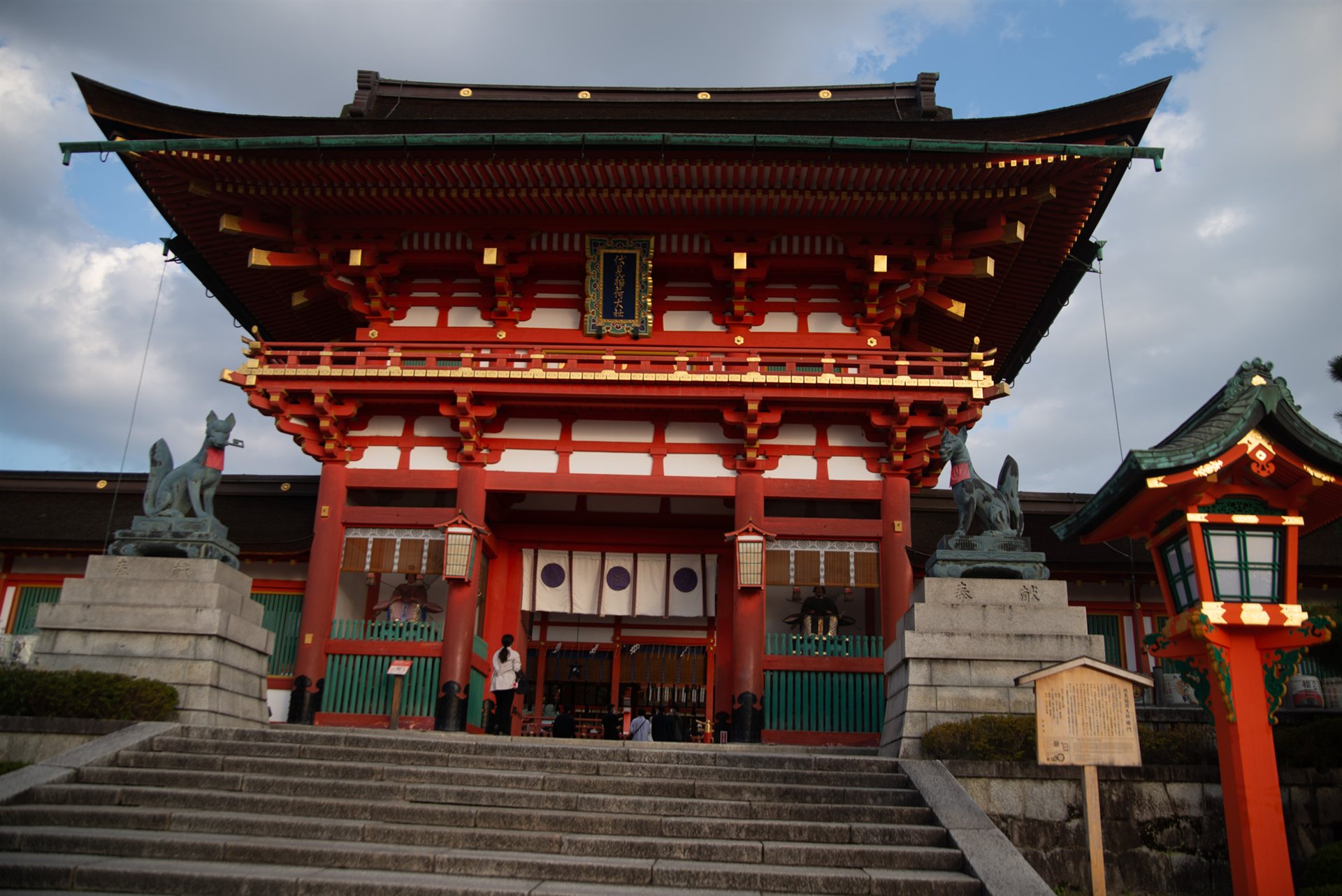
The Rōmon gate of Fushimi Inari Taisha stands at the top of a flight of stone steps. Fox statues are placed on its left and right.
As you walk along the main approach, the first thing you see is the large vermilion Rōmon gate. According to Cultural Heritage Online, the present gate was rebuilt in 1589 (Tenshō 17). It is a two-story gate (a sangen ikko rōmon, three bays wide with one passage), topped with a hip-and-gable (irimoya) roof covered in cypress bark (hiwadabuki). It is an Important Cultural Property of Japan.
This gate is also said to have been donated by Toyotomi Hideyoshi.
On the left and right of the gate stand fox statues instead of the usual guardian lion-dogs (komainu). The official website explains that the messengers (kenzoku) of the Inari deity are foxes. However, these are not the foxes that live in the fields and mountains; like the deity itself, the messengers are said to be invisible beings. This is why you see fox statues all over the grounds.
The History of the Senbon Torii | Why Are There So Many Torii Gates?
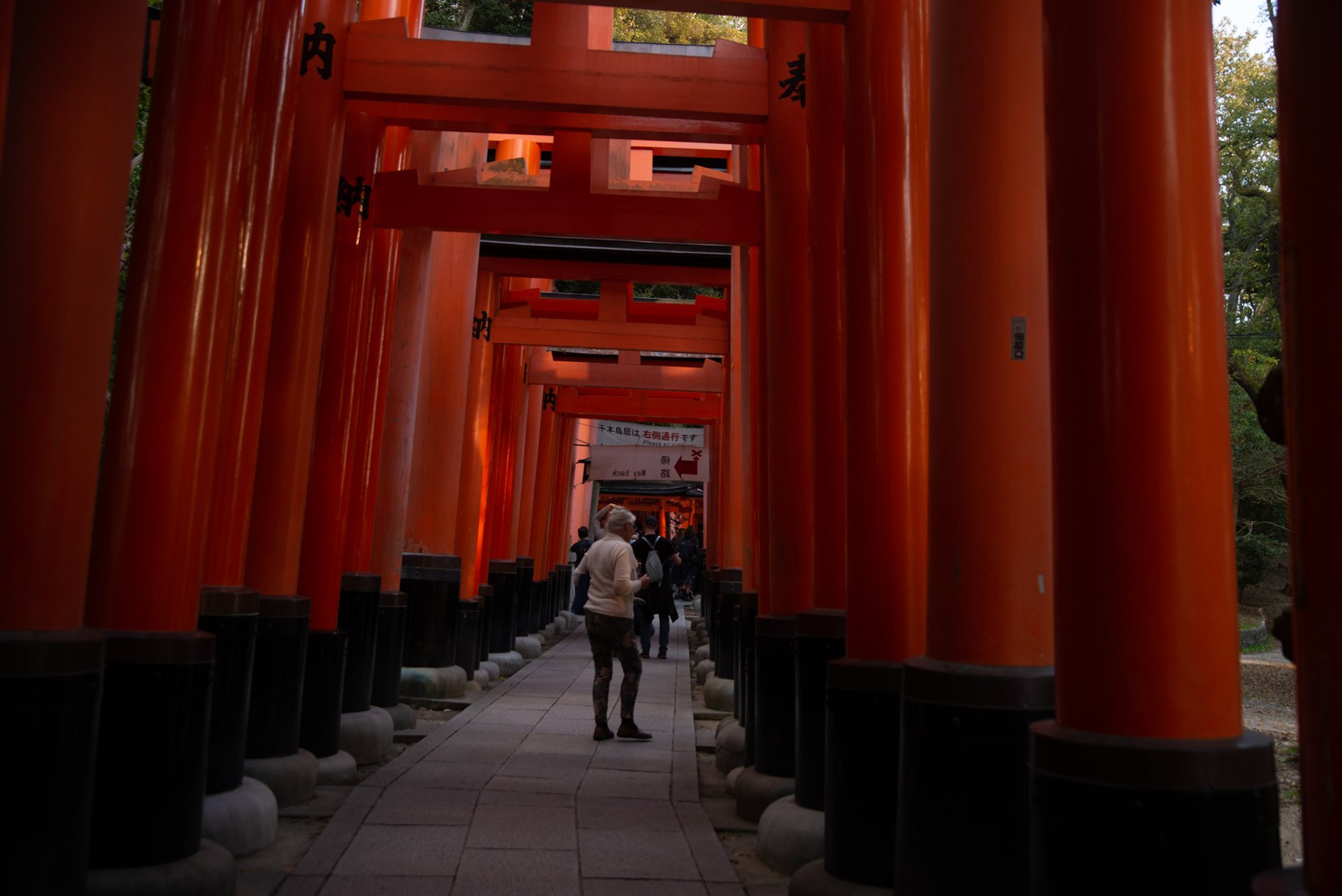
Near the entrance to the Senbon Torii. Further in, signs were hanging that read “Please keep to the right in the Senbon Torii” and “Way back” (November 2022).
When you enter the approach that leads from behind the main hall toward Mount Inari, the Senbon Torii begin, with vermilion torii gates standing one after another with no gaps.
The official website explains why so many torii stand here as follows. People offer torii as a sign of gratitude, in the hope that a wish will “pass through,” or in thanks that it has “passed through.” This custom spread from the Edo period onward, and the result is what you see today.
They are called “Senbon” (a thousand), but according to the official website, today about 10,000 torii line the approaches all over the mountain. The Senbon Torii is the section near the entrance where the torii stand especially close together.
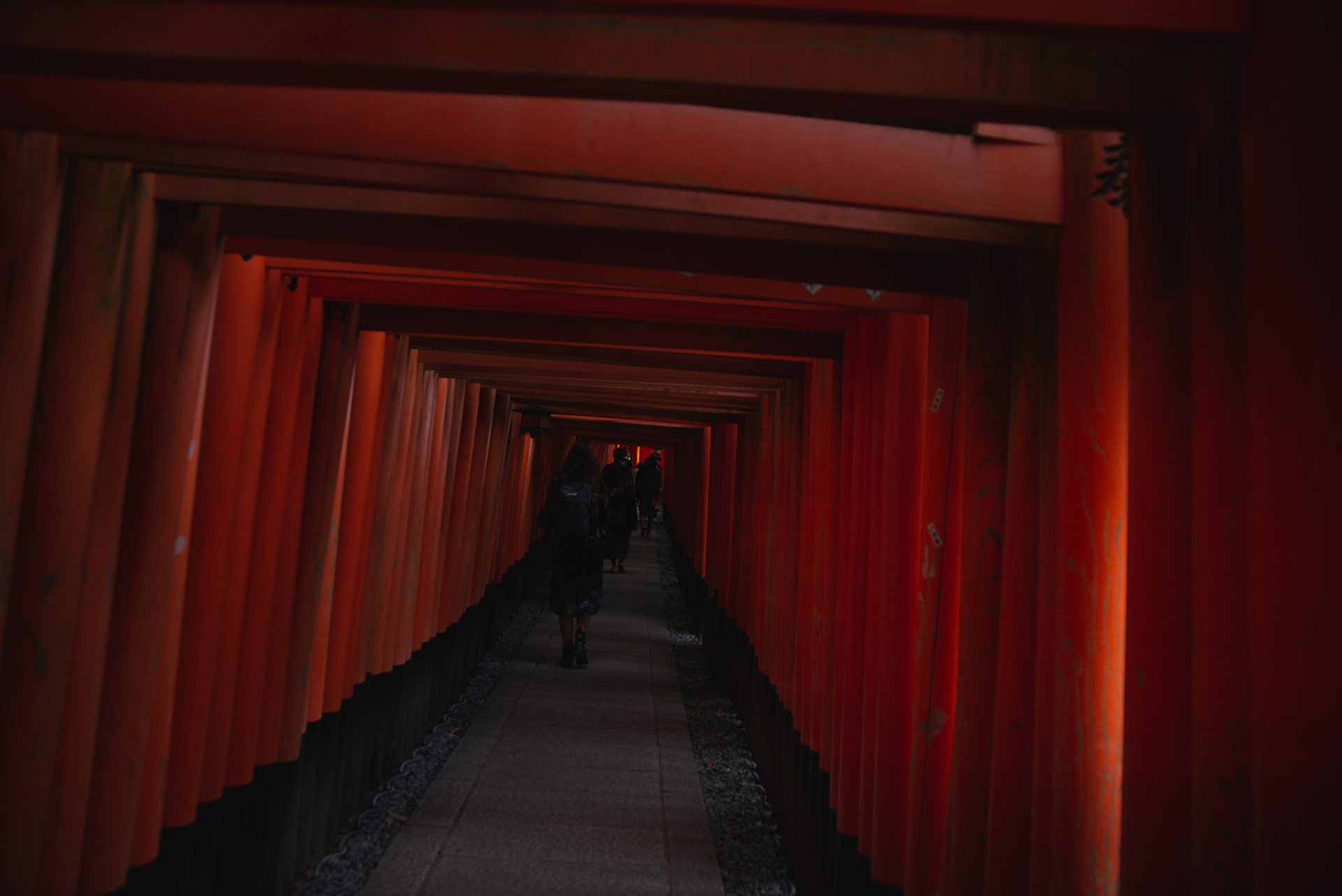
The torii overlap one another and form something like a vermilion tunnel.
When I visited, there were signs asking visitors to keep to the right inside the Senbon Torii. The path is narrow, so if you stop to take photos, be careful of people coming from behind.
When I visited, it was evening, a time when there were few tourists. If you are aiming for a good time to go, I feel that the evening makes it easier to enjoy the view. However, this is only how it was when I visited, so I don’t know what it is like now.
The Writing on the Torii | “Hōnō” (Dedicated) and the Names of the Donors
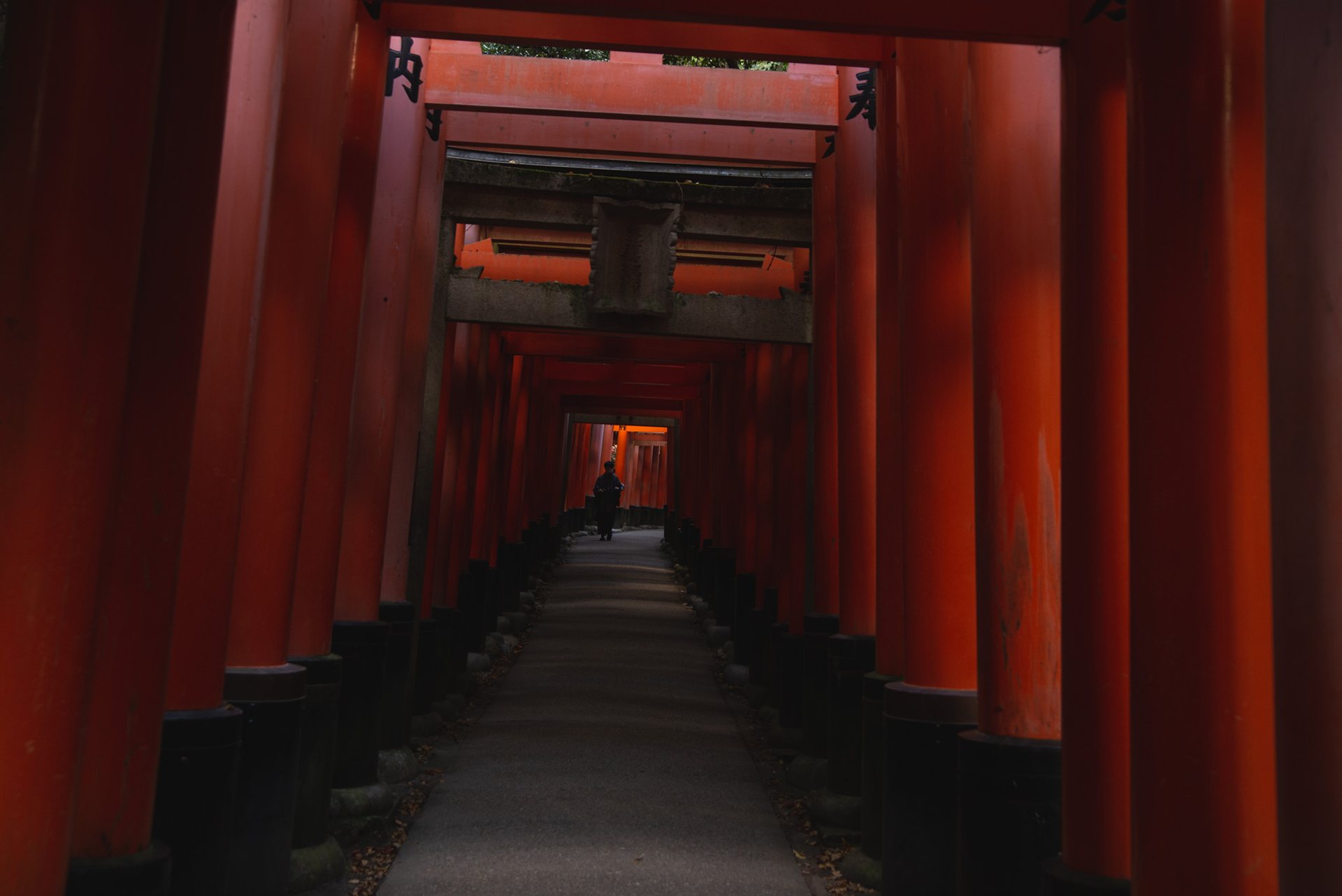
In some places, a moss-covered stone torii stands among the vermilion ones.
If you look closely at the pillars of the torii, you will see the characters for “Hōnō” (dedicated) written in black. In some places, moss-covered stone torii are mixed in among the rows of vermilion wooden ones, showing that each was dedicated in a different era and in a different form.
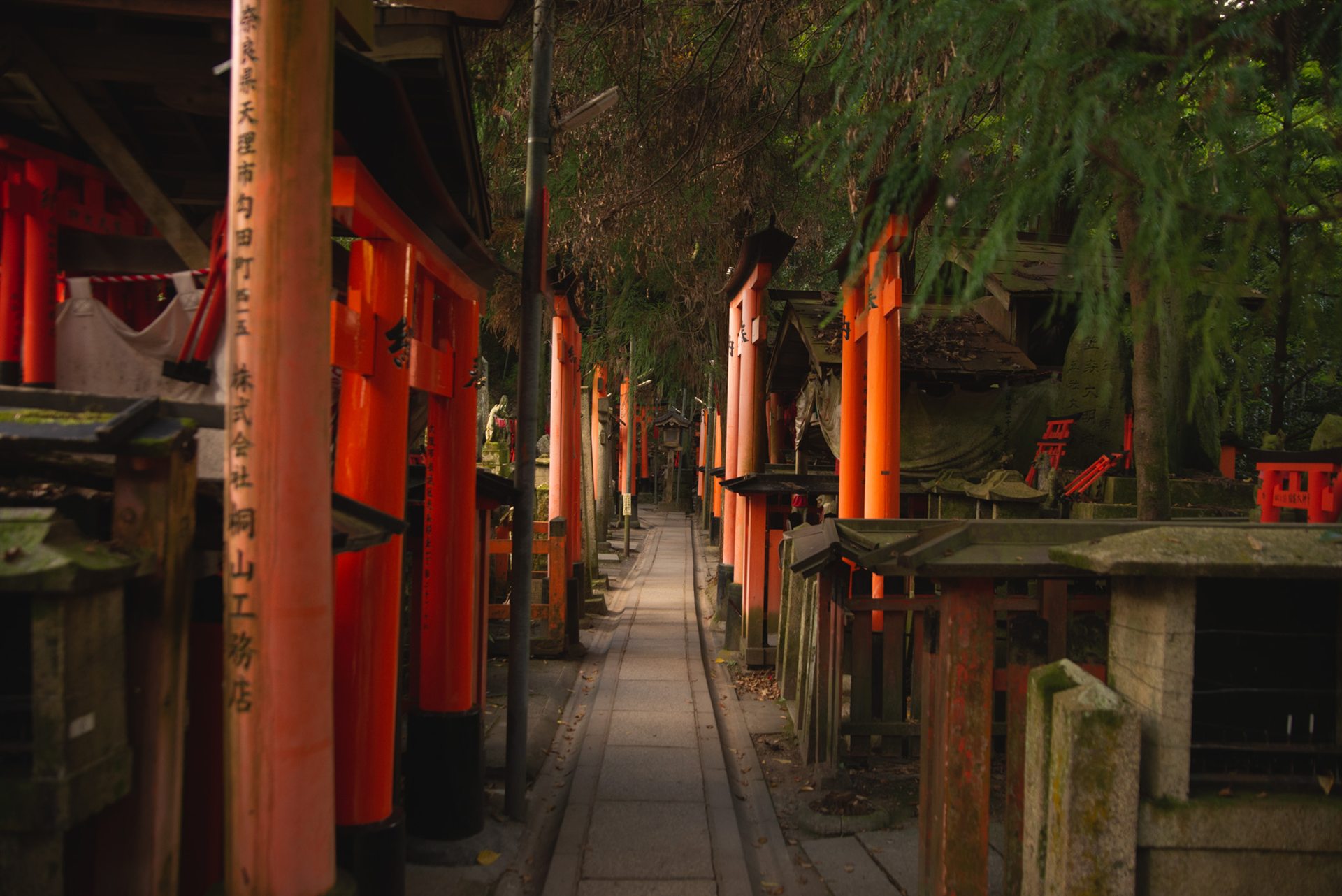
The names and addresses of the companies and people who dedicated the torii are written on the pillars.
As you walk along the approaches on Mount Inari, you start to see the names and addresses of the companies and people who dedicated the torii written on the pillars. The writing on the pillars shows that torii are dedicated by people from outside Kyoto as well.
The shrine still accepts torii dedications today. According to the official website, applications are taken at the shrine office (Management Section), and the teahouses on Mount Inari also pass them on. The offering fees (hatsuhoryō) for each size of torii are listed on the official website, so if you are interested, please check there.
The Otsuka Stones and Small Torii on the Mountain
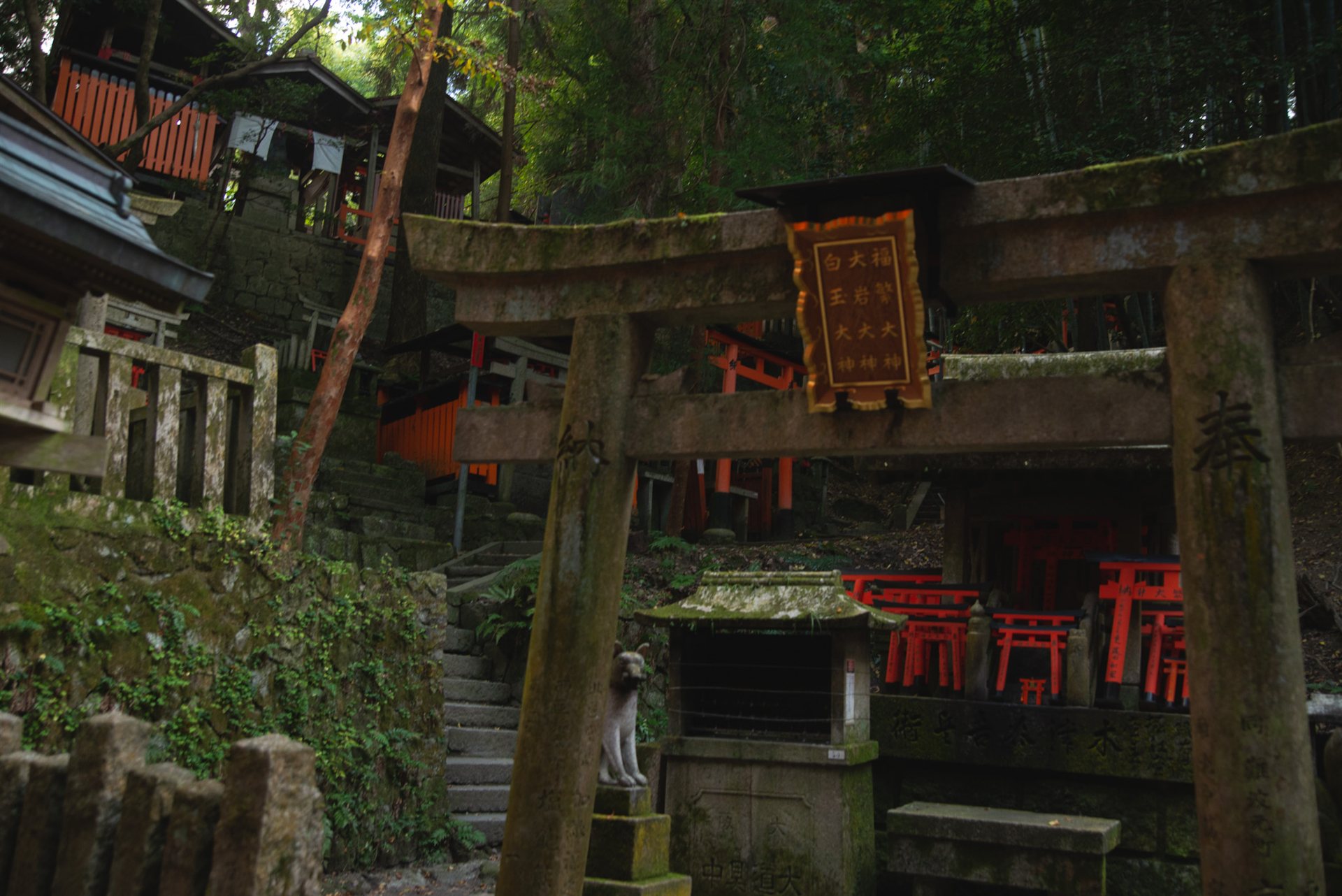
The plaque on the stone torii bears the names “福繁大神,” “大岩大神,” and “白王大神.” Many small vermilion torii have been offered further in.
Once you pass through the Senbon Torii and enter Mount Inari, the atmosphere changes a little. On the tree-covered slopes, many stones carved with the names of deities and small shrines line the stone steps. These stones are called “otsuka.” The FAQ on the official website explains that otsuka are stones “on which people who worship the Inari deity under other names have carved those names and dedicated them to the mountain.”
The stone torii in the photo had a plaque with the names of three deities: “福繁大神,” “大岩大神,” and “白王大神.” In front of the small shrines, many tiny vermilion torii, small enough to sit on the palm of your hand, have been offered. Not only the large torii but also these small ones have the names of the people who dedicated them written on them.
Cats I Met on the Shrine Grounds
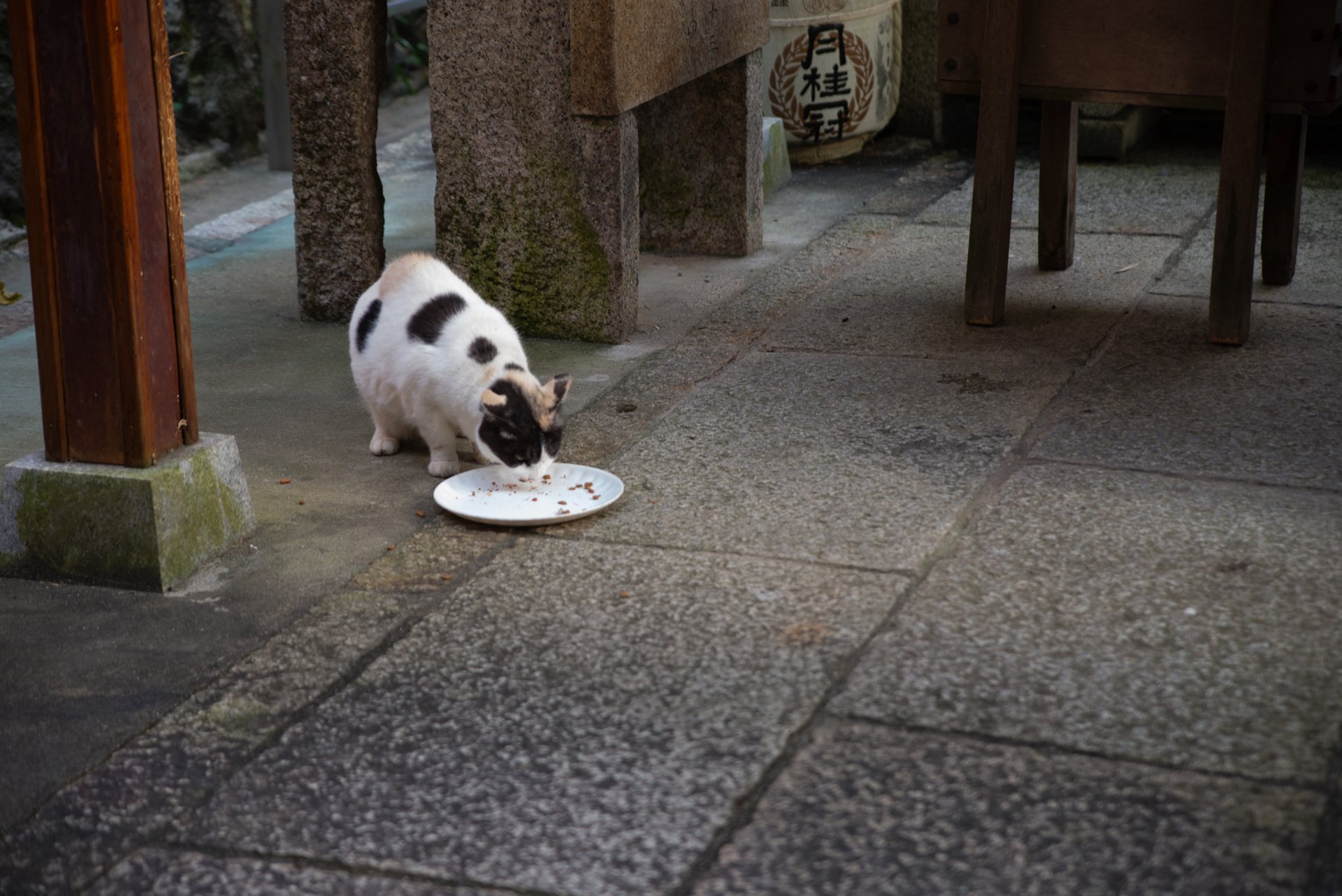
A spotted cat eating food from a dish under a stone lantern.
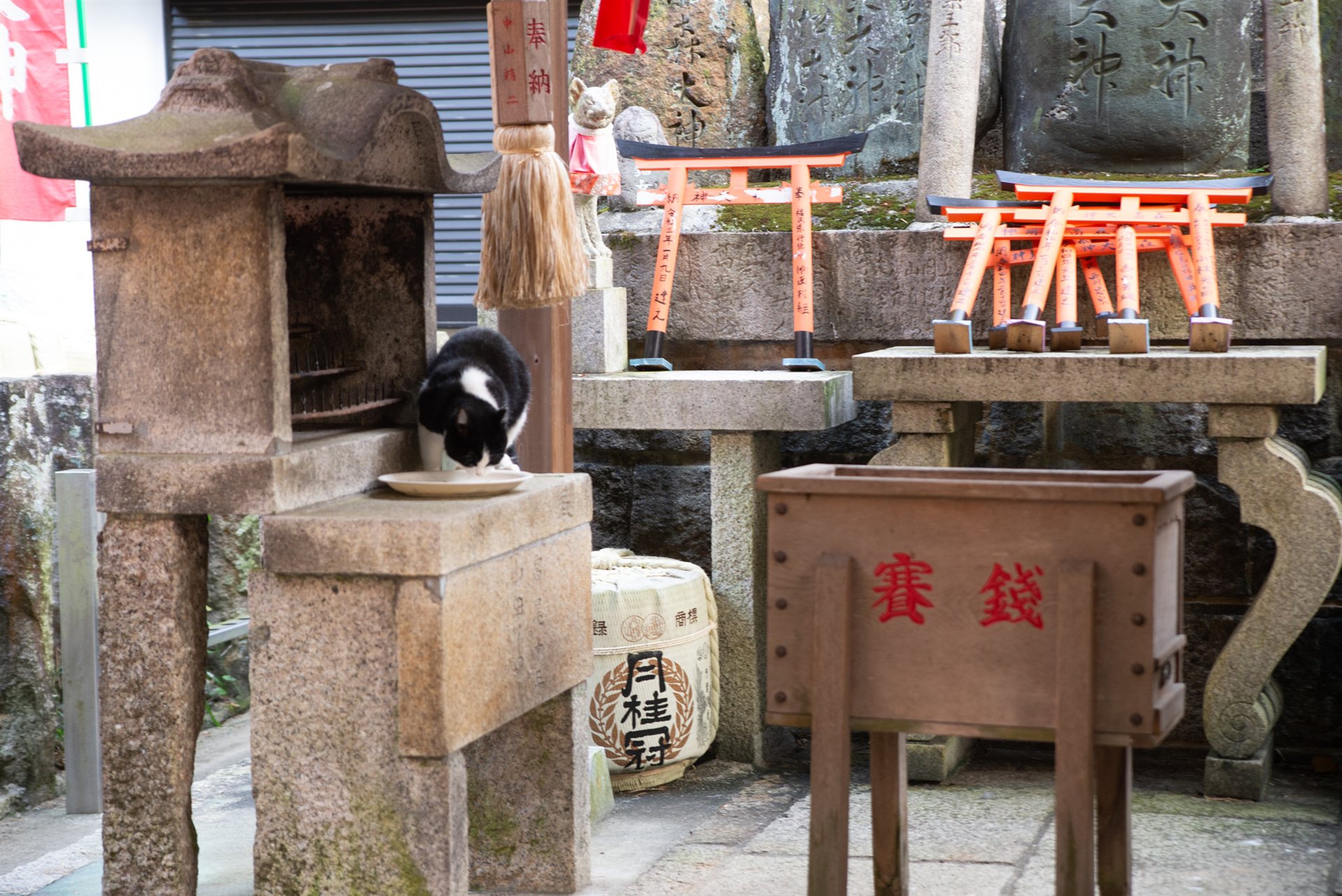
A black-and-white cat was in front of a small shrine with offerings of Gekkeikan sake barrels, an offertory box, and small torii.
While walking on Mount Inari, I came across cats near the small shrines. In front of a shrine lined with Gekkeikan sake barrels, an offertory box, and small torii, they were eating food from a dish. I also wrote about the cats of Fushimi Inari Taisha in my November 2022 travelogue, Kansai Trip Day 1: Kyoto (Japanese).
The small shrines are places of worship, so if you see a cat, it is best to quietly watch over it.
You can meet many cats within the shrine. Some cats are friendly with people, while others are not comfortable around people.
The Approach in the Evening
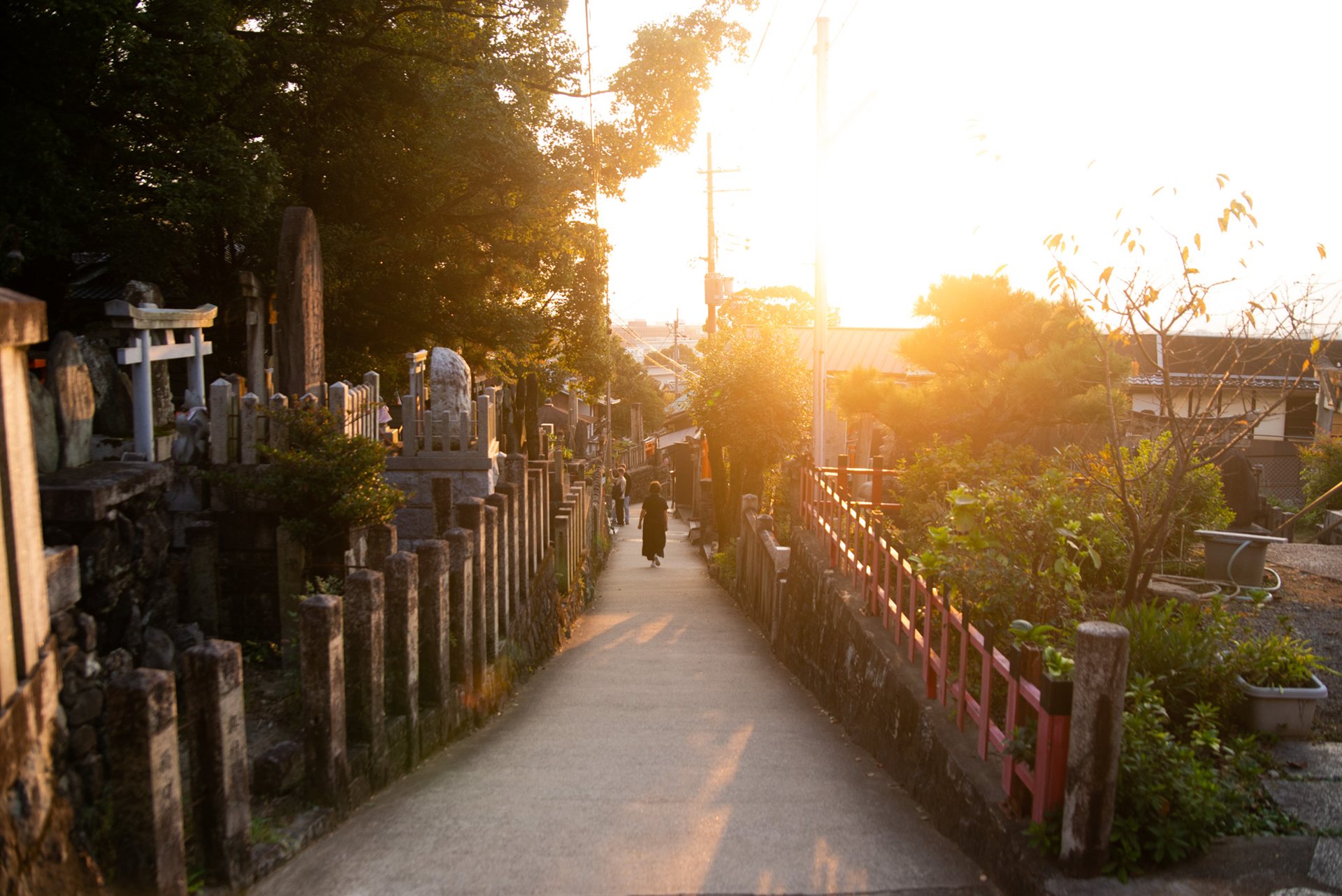
On the way back. The approach lined with stone fences was dyed orange by the setting sun.
The way back from Mount Inari was a downhill approach lined with stone fences and small shrines. I visited in the evening, and the setting sun was shining in through the trees.
I visited in the evening, and you can see a different kind of scenery then, so I also recommend visiting in the evening.
How to Get to Fushimi Inari Taisha
These are the directions given on the official website (checked on October 29, 2026).
| Transportation | How to get there |
|---|---|
| JR | Get off at Inari Station on the JR Nara Line; the shrine is right outside (5 minutes from Kyoto Station) |
| Keihan | Get off at Fushimi-Inari Station on the Keihan Main Line, then walk 5 minutes east |
| City Bus | Get off at Inari Taisha-mae on Route Minami 5, then walk 7 minutes east |
- Address: 68 Fukakusa Yabunouchi-chō, Fushimi-ku, Kyoto
- By car: The official website notes that the roads around the shrine’s parking lot get very crowded. Parking is for worshippers only. Also, the parking lot on the grounds is closed from December 30 to January 6.
The main approach starts right outside JR Inari Station, so I recommend going by train. It is close to Kyoto Station, which makes it easy to combine with other sights in Kyoto City, such as Kiyomizu-dera. I introduce Kiyomizu-dera in my articles The History and Highlights of Kiyomizu-dera (Japanese) and How to Get to Kiyomizu-dera.
Things to Know Before You Visit
- Visiting hours and fees: These were not listed on the access and FAQ pages of the official website.
- Signs ask you to keep to the right in the Senbon Torii: When I visited in November 2022, there was a sign reading “Please keep to the right in the Senbon Torii.”
- Mount Inari is a mountain trail: Beyond the Senbon Torii is a mountain path with many stone steps. I recommend wearing comfortable walking shoes.
- The small shrines and otsuka stones are places of worship: When taking photos, take care not to disturb people who are praying.
Frequently Asked Questions
Are there really a thousand torii in the Senbon Torii?
According to the official website, there are about 10,000 torii, lining the approaches all over the mountain. The Senbon Torii is the section at the entrance where the torii stand especially close together.
Why does Fushimi Inari Taisha have so many torii?
Because the custom of dedicating torii, in the hope that a wish will “pass through” or in thanks that it has “passed through,” spread from the Edo period onward (according to the official website).
What is the nearest station to Fushimi Inari Taisha?
Inari Station on the JR Nara Line. The approach is right outside the station, and it is 5 minutes from Kyoto Station. From Fushimi-Inari Station on the Keihan Main Line, it is a 5-minute walk east.
Summary
Fushimi Inari Taisha, said to date back to 711 (Wadō 4), is the head shrine of all Inari shrines in Japan. The Senbon Torii is a scene created by torii dedicated from the Edo period onward in thanks for wishes that have “passed through,” and today about 10,000 torii line the approaches on Mount Inari.
Beyond the tunnel of torii, there is much more to see, such as the Rōmon gate rebuilt in 1589 (Tenshō 17), the dedication writing on the pillars, and the otsuka stones and small torii on the mountain. It is right next to JR Inari Station, so be sure to stop by during your sightseeing in Kyoto.
References (checked on October 29, 2026)
- About Fushimi Inari Taisha | Fushimi Inari Taisha official website (Japanese)
- FAQ | Fushimi Inari Taisha official website (Japanese)
- Access | Fushimi Inari Taisha official website (Japanese)
- Torii Dedication Guide | Fushimi Inari Taisha official website (Japanese)
- Cultural Heritage Online: “Fushimi Inari Taisha Rōmon” (Japanese)
コメント