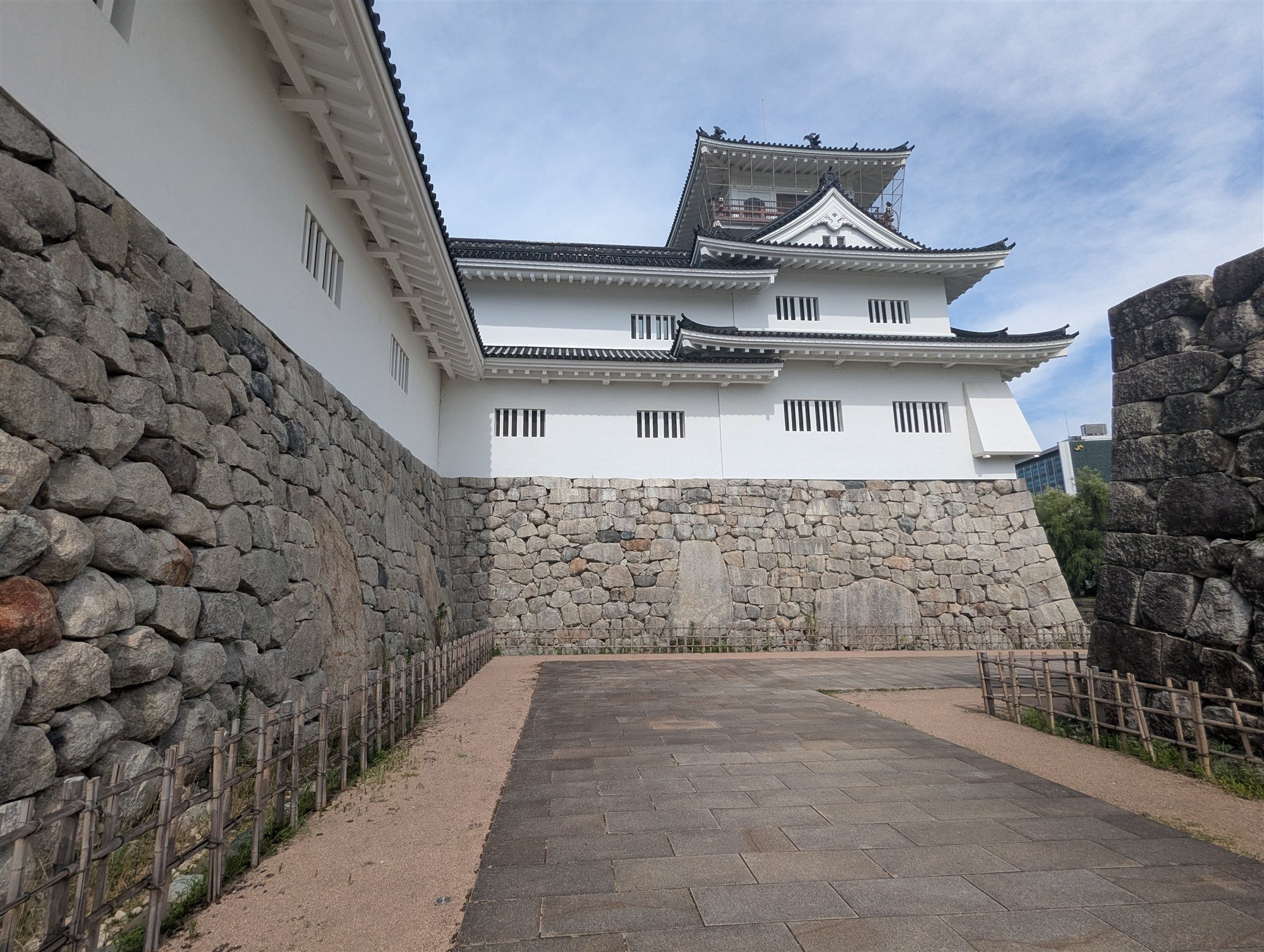
In Toyama Castle Park, within walking distance of Toyama Station, stands a white-walled castle keep. This keep is not a building from the Edo period. It was built in 1954 (Showa 29).
“So what was the original Toyama Castle like?” For readers who wonder about that, this article introduces the history of Toyama Castle. It goes in order, with a timeline, from the castle’s founding in the Sengoku period to the building of today’s keep.
I walked around Toyama Castle Park on July 14, 2025. All the photos in this article were taken on that day.
About the information in this article
- The history is based on the official website of the Toyama Municipal Folk Museum and the museum’s newsletter, “Hakubutsukan Dayori”.
- Opening hours, admission and access were checked on October 11, 2026 (on the official website of the Toyama Municipal Folk Museum).
- Opening hours and admission may change. Please check the latest information on the official website before you go.
- What Is Toyama Castle? Today’s Keep Was Built in 1954
- Timeline of Toyama Castle’s History
- The Sengoku Period: Jinbo Nagamoto Builds the Castle, and Sassa Narimasa
- The Time of Maeda Toshinaga: Developing the Castle and the Great Fire of 1609
- Becoming the Castle of the Toyama Domain: 13 Generations from Maeda Toshitsugu
- From Meiji to Showa: Abolition, the Air Raid, and How Today’s Keep Was Built
- What to See in Toyama Castle Park
- Toyama Municipal Folk Museum (Toyama Castle): Opening Hours, Admission and Access
- Frequently Asked Questions (FAQ)
- Summary
What Is Toyama Castle? Today’s Keep Was Built in 1954
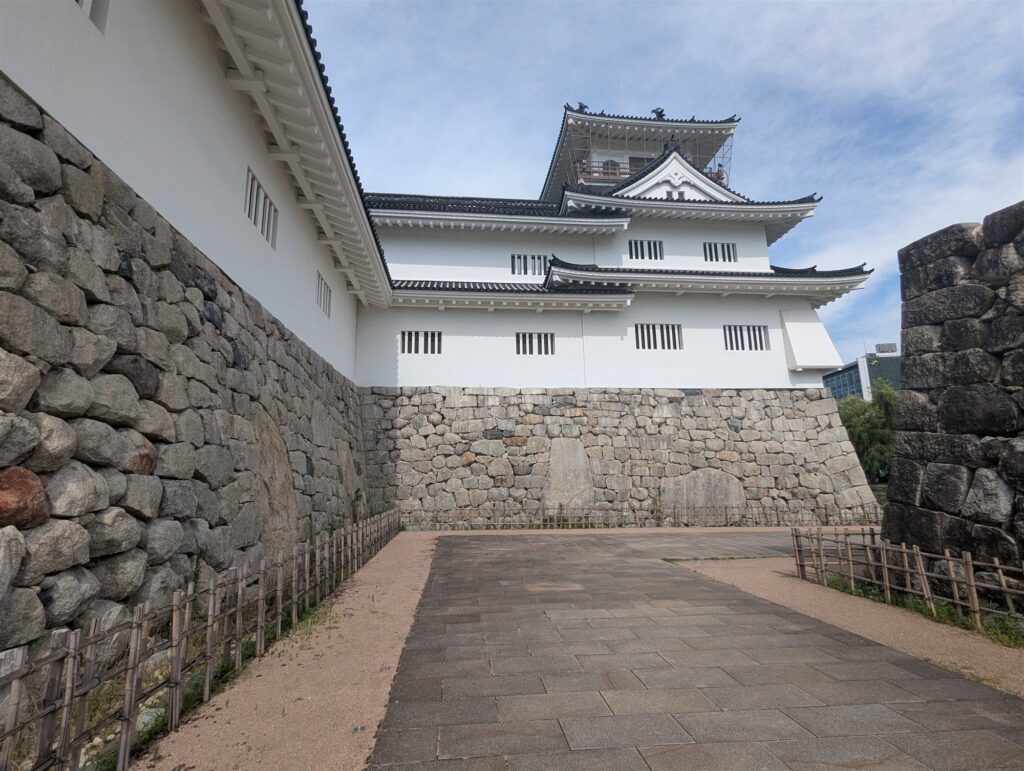
Toyama Castle dates back to the Sengoku period. In the Edo period, the Maeda family of the Toyama Domain lived here. The Japan Castle Foundation also lists it among the “Continued Top 100 Japanese Castles”.
The keep that stands in the park today is the Toyama Municipal Folk Museum. It was built in 1954 (Showa 29) as a memorial building for the Toyama Industrial Grand Exposition.
In fact, Toyama Castle had no keep in the Edo period. The center of the castle was the Honmaru Palace, where the lord governed and also lived. The Honmaru Palace stood around what is now the lawn area of the park.
| Item | Details |
|---|---|
| Location | Honmaru, Toyama City, Toyama Prefecture (Toyama Castle Park) |
| Founded | 1543 (Tenbun 12), by Jinbo Nagamoto |
| Lords in the Edo period | The Maeda family of the Toyama Domain (13 generations) |
| Today’s keep | The Toyama Municipal Folk Museum, built in 1954 (Showa 29) |
| Cultural property | The museum building is a Registered Tangible Cultural Property of Japan (registered in 2004) |
Timeline of Toyama Castle’s History
| Year | Event |
|---|---|
| 1543 (Tenbun 12) | Jinbo Nagamoto builds Toyama Castle |
| Around 1582 (Tensho 10) | Becomes the castle of Sassa Narimasa, a retainer of Oda Nobunaga |
| 1585 (Tensho 13) | Narimasa surrenders to Toyotomi Hideyoshi, and Toyama Castle is torn down |
| 1597 (Keicho 2) | Maeda Toshinaga moves from Moriyama Castle to Toyama Castle (and to Kanazawa Castle the following year) |
| 1605 (Keicho 10) | Toshinaga retires and moves from Kanazawa Castle to Toyama Castle |
| 1609 (Keicho 14) | A great fire burns down most of Toyama Castle and the castle town. Toshinaga moves to Uozu Castle, then Takaoka Castle |
| 1615 (Genna 1) | The castle is abandoned for a time under the One Castle per Province rule |
| 1639 (Kan’ei 16) | 100,000 koku is split off from the Kaga Domain, and the Toyama Domain is created |
| 1640 (Kan’ei 17) | The first lord, Maeda Toshitsugu, enters Toyama Castle |
| 1661 (Kanbun 1) | With the shogunate’s permission, Toshitsugu begins developing the castle and the castle town |
| 1714 (Shotoku 4) | The Honmaru Palace burns down in a fire |
| 1849 (Kaei 2) | Chitose Goten, the retirement residence of the 10th lord Maeda Toshiyasu, is built |
| 1873 (Meiji 6) | Toyama Castle is abolished |
| 1945 (Showa 20) | The Toyama air raid |
| 1954 (Showa 29) | The Toyama Industrial Grand Exposition. A building in the shape of a keep is built, and it opens as the Folk Museum in November |
| 2004 (Heisei 16) | The museum building becomes a Registered Tangible Cultural Property of Japan |
| 2005 (Heisei 17) | After earthquake-resistance work, it reopens as a museum introducing the history of Toyama Castle |
From here, let’s look at each period in a little more detail.
The Sengoku Period: Jinbo Nagamoto Builds the Castle, and Sassa Narimasa
Built by Jinbo Nagamoto in 1543
Toyama Castle was built in 1543 (Tenbun 12) by Jinbo Nagamoto. The Jinbo clan was a powerful family in Etchu (today’s Toyama Prefecture) at the time.
After that, Toyama Castle became a battleground again and again. The exhibits in the Folk Museum also introduce the struggles involving the Ikko-ikki uprisings and Sengoku warlords such as Uesugi Kenshin and Takeda Shingen.
Sassa Narimasa Enters the Castle and Surrenders to Hideyoshi
To help the Jinbo clan, who were suffering under attacks from the Uesugi clan of Echigo, Oda Nobunaga sent his retainer Sassa Narimasa to Etchu. Narimasa ruled Toyama from around 1580 to 1585 (Tensho 8 to 13) and made Toyama Castle his home.
When Nobunaga died in the Honnoji Incident in 1582 (Tensho 10), Narimasa came into conflict with Toyotomi Hideyoshi.
A famous story from this time is the “Sarasara-goe”. It is a legend that in the winter of 1584 (Tensho 12), Narimasa crossed the snowy Zara Pass in order to meet Tokugawa Ieyasu.
However, in 1585 (Tensho 13), Narimasa surrendered to Hideyoshi, who had invaded Etchu. Toyama Castle was torn down at this time. Two years later, Narimasa was transferred to Higo (today’s Kumamoto Prefecture).
The Time of Maeda Toshinaga: Developing the Castle and the Great Fire of 1609
After Narimasa, Toyama Castle came into the hands of the Maeda family. Toshinaga, the eldest son of Maeda Toshiie, moved from Moriyama Castle (in today’s Takaoka City) to Toyama Castle in 1597 (Keicho 2). The following year he became head of the Maeda family and moved to Kanazawa Castle.
In 1605 (Keicho 10), Toshinaga handed the family headship to his younger brother Toshitsune, retired, and entered Toyama Castle once again. It was Toshinaga who developed Toyama Castle as a castle of the Edo period.
However, in March 1609 (Keicho 14), a fire that started in the castle town burned down most of Toyama Castle and the surrounding town. Toshinaga moved to Uozu Castle, and in September of the same year he moved to the newly built Takaoka Castle.
Toyama Castle was abandoned for a time under the One Castle per Province rule of 1615 (Genna 1).
The Folk Museum’s “Hakubutsukan Dayori” says that if the fire of 1609 had not happened, Toshinaga might have started building a new castle and town in Toyama.
Becoming the Castle of the Toyama Domain: 13 Generations from Maeda Toshitsugu
The Toyama Domain Is Created in 1639
Toyama Castle was used as a castle again after the Toyama Domain was created.
In 1639 (Kan’ei 16), when Maeda Toshitsune of the Kaga Domain retired, 100,000 koku was given to his second son, Toshitsugu. This was the beginning of the Toyama Domain.
At First It Was a “Borrowed Castle”
Interestingly, Toshitsugu was not the owner of Toyama Castle at first.
At this time, the area around Toyama Castle was still the territory of the Kaga Domain. So Toshitsugu decided to build a new castle at a place called Hyakuzuka.
However, the castle at Hyakuzuka was not completed for a long time. In October 1640 (Kan’ei 17), Toshitsugu borrowed Toyama Castle from the Kaga Domain and moved in.
In the end, Toshitsugu gave up on the castle at Hyakuzuka. In 1660 (Manji 3), he received permission to exchange land with the Kaga Domain and made Toyama Castle officially his own.
In 1661 (Kanbun 1), with the shogunate’s permission, he began developing the castle and the castle town. About 20 years after the domain was created, Toyama Castle finally became the castle of the Toyama Domain in both name and reality.
After that, Toyama Castle was the home of 13 generations of the Toyama Maeda family until the Meiji period.
The Size of Toyama Castle and the Honmaru Palace
In the Edo period, Toyama Castle was made up of the Honmaru, Ninomaru, Sannomaru, Nishi-demaru and Higashi-demaru. Today’s castle park covers only the Honmaru and the Nishi-demaru. The original castle was much larger than the park is now.
The Honmaru Palace, the center of the castle, burned down in a fire in 1714 (Shotoku 4). Permission to rebuild it was given in 1832 (Tenpo 3), and the palace built at that time remained until the Meiji period.
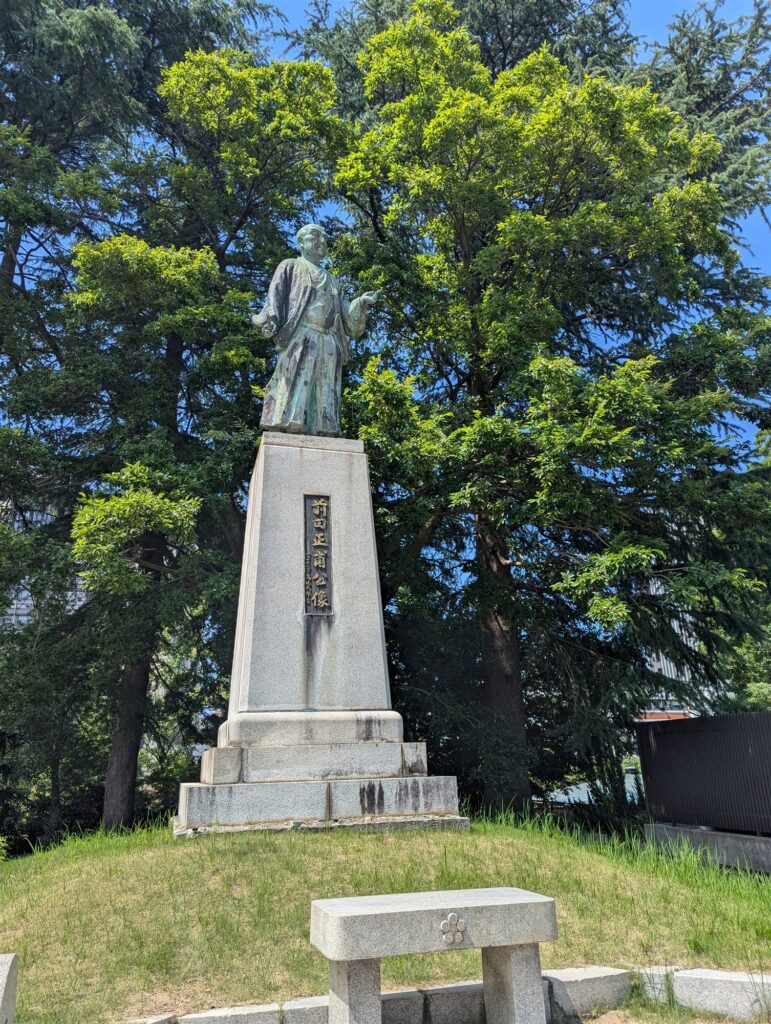
In the park stands a bronze statue of the 2nd lord, Maeda Masatoshi. Masatoshi is said to be the lord who spread Toyama’s medicine peddling (Toyama baiyaku).
From Meiji to Showa: Abolition, the Air Raid, and How Today’s Keep Was Built
The Castle Site Survived Because the Prefectural Office Was There
The Toyama Domain disappeared with the abolition of the domains in 1871 (Meiji 4), and Toyama Castle was abolished in 1873 (Meiji 6). The castle land was sold off little by little, and the moats were filled in.
Even so, the Honmaru area survived because the prefectural office was placed there. The Honmaru Palace was used as the prefectural office. From 1883 (Meiji 16) until it burned down in a fire in 1930 (Showa 5), the castle site was the grounds of the prefectural office the whole time.
After that, the castle site was designated a scenic district under city planning in 1933 (Showa 8), and it came to be protected.
In 1954, a Keep Is Built to Commemorate the Exposition
In 1945 (Showa 20), the city of Toyama was heavily damaged in an air raid.
To mark the end of the war-damage reconstruction project, the Toyama Industrial Grand Exposition was held in 1954 (Showa 29). Today’s keep was built as its memorial building.
- A reinforced concrete building in the shape of a castle, with three tiers and four floors
- The stone walls it stands on were not originally for a keep. They are where the Kurogane Gomon (Iron Gate) of the Honmaru used to be
- During the exposition, it was used as an exhibition hall called the “Palace of Beauty”
- In November of the same year, after the exposition ended, it opened as the Folk Museum
In 2004 (Heisei 16), it became a Registered Tangible Cultural Property of Japan as a building that represents the period of war-damage reconstruction.
“Hakubutsukan Dayori” includes the line that today’s Toyama Castle was built in 1954 by the citizens of Toyama. Today’s keep is a “symbol of recovery” built by the people of postwar Toyama.
What to See in Toyama Castle Park
The Keep (Toyama Municipal Folk Museum)
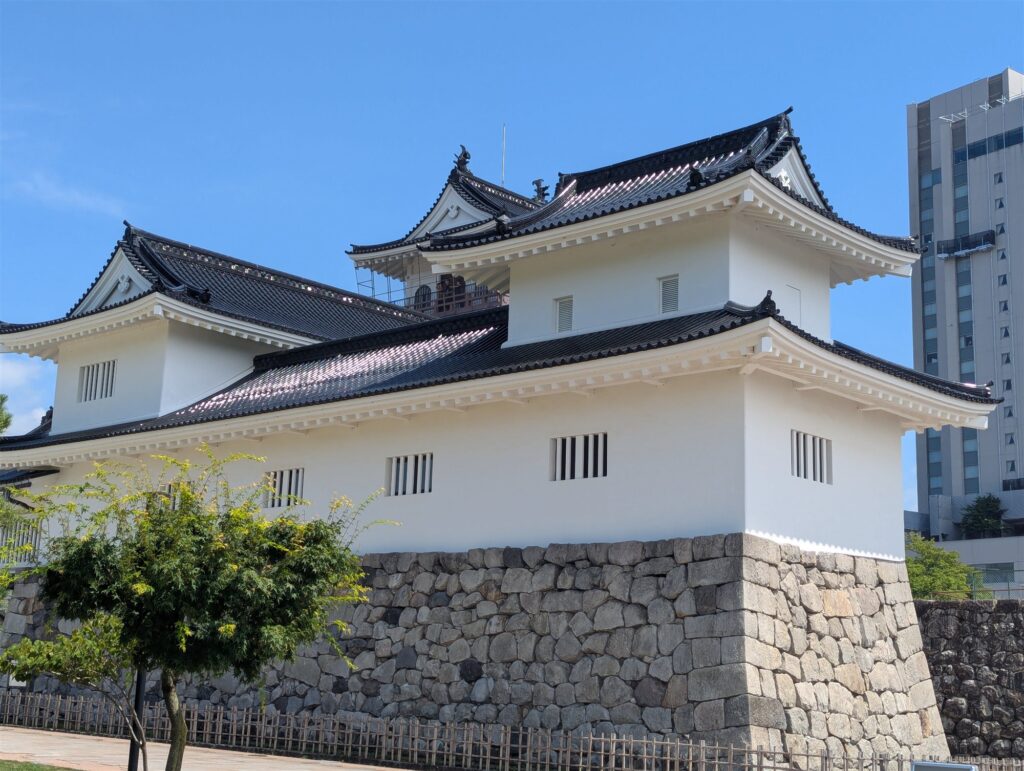
It is a building with white walls and black roof tiles. Inside, under the theme “The Story of Toyama Castle”, the more than 400 years of Toyama Castle’s history are introduced. The 4th floor is the keep’s observation deck.
Stone Walls and Moat
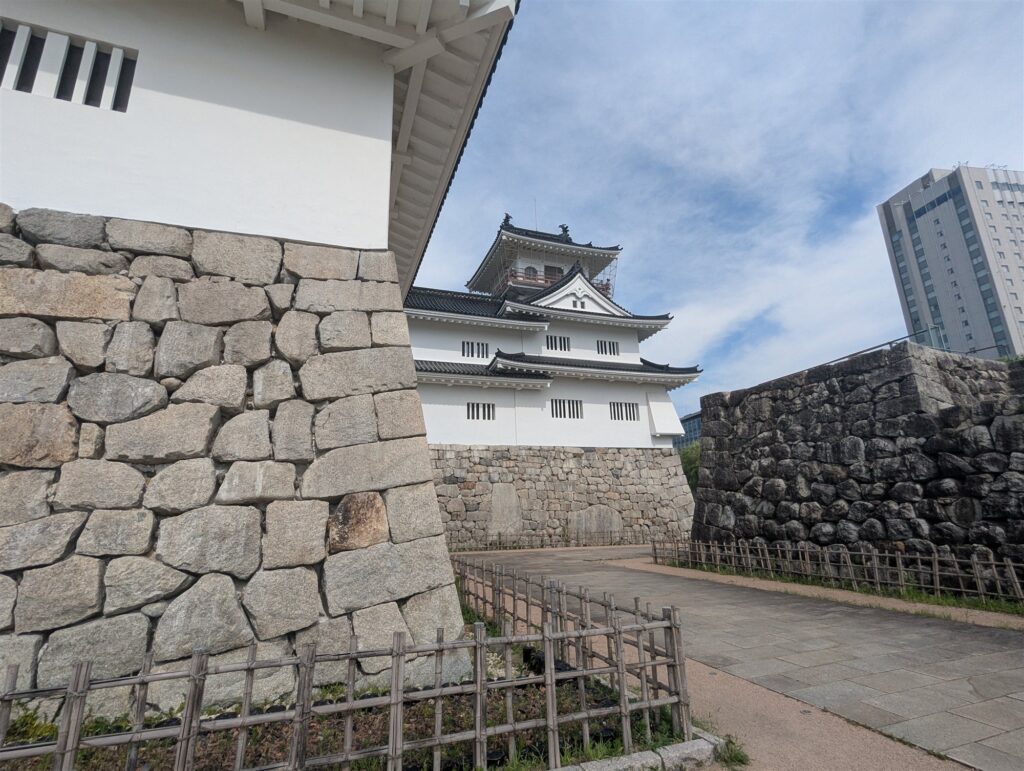
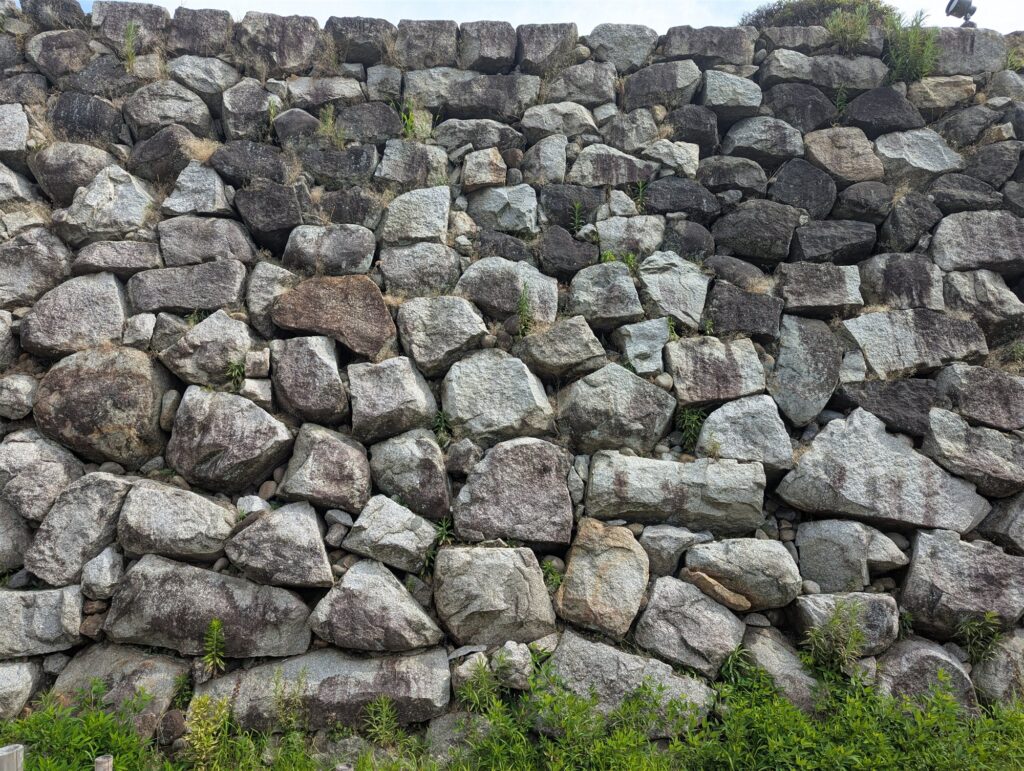
The stone walls and the moat are remains of the Edo-period Toyama Castle that survive in the park. The stone walls under the keep are where the Kurogane Gomon, the gate into the Honmaru, used to be.
In the stone wall facing the path, some especially large stones are set. As you walk, look out for the differences in the size of the stones too.
In the Edo period, moats surrounded the Honmaru, the Ninomaru and the Sannomaru. Today a moat remains on the south side of the museum.
Chitose Gomon Gate
The Chitose Gomon is the only building of Toyama Castle that remains. It was the main gate of Chitose Goten, the retirement residence of the 10th lord, Maeda Toshiyasu.
It was moved to a private home at the beginning of the Meiji period, but from 2006 to 2008 (Heisei 18 to 20) it was moved to the east side of the castle park. It is a Designated Cultural Property of Toyama City.
Sato Memorial Art Museum
The park is also home to the Sato Memorial Art Museum, Toyama. You can see tea rooms and a shoin-style room there.
Toyama Municipal Folk Museum (Toyama Castle): Opening Hours, Admission and Access
| Item | Details |
|---|---|
| Name | Toyama Municipal Folk Museum (Toyama Castle) |
| Address | 1-62 Honmaru, Toyama City, Toyama Prefecture 930-0081 |
| Phone | 076-432-7911 |
| Opening hours | 9:00–17:00 (last entry 16:30) |
| Closed | Year-end and New Year holidays (December 28 – January 4). Also closed temporarily for exhibit changes and other reasons |
| Admission | Adults 210 yen; free for high school students and younger |
| Parking | No dedicated parking lot. Use the Castle Park Underground Parking Lot (paid) |
* This information was checked on the official website on October 11, 2026.
Admission Changes During Special Exhibitions
Admission changes while a special exhibition is being held. In 2026, the special exhibition period is from October 10 to December 6.
| Item | Details |
|---|---|
| Period | Saturday, October 10 – Sunday, December 6, 2026 |
| Admission | Adults 500 yen; free for high school students and younger (the permanent exhibition is included) |
| Closed during the period | Tuesday, October 27 – Friday, October 30 |
Access from Toyama Station
| How to get there | Time |
|---|---|
| Walk from the South Exit of Toyama Station | 10 minutes on foot |
| Take the city tram loop line and get off at “Kokusai Kaigijo-mae” | 2 minutes on foot from the tram stop |
| Take a Toyama Chitetsu bus and get off at “Joshi Koen-mae” | 2 minutes on foot from the bus stop |
| By car (from Toyama IC on the Hokuriku Expressway) | About 15 minutes |
The Castle Park Underground Parking Lot costs 330 yen for the first hour. After that, 110 yen is added every 30 minutes.
Things to Know Before You Go
- The observation deck (4th floor) can be reached only by stairs. The elevator goes only as far as the exhibition room on the 2nd floor
- Closed over the year-end and New Year holidays. The museum is closed from December 28 to January 4
- There are temporary closures. The museum sometimes closes for exhibit changes or maintenance. Please check the closure calendar on the official website
Official: Toyama Municipal Folk Museum (Japanese)
Frequently Asked Questions (FAQ)
Q. Who built Toyama Castle?
A. Jinbo Nagamoto built it in 1543 (Tenbun 12). After that, Sassa Narimasa and Maeda Toshinaga were its lords, and in the Edo period it was the castle of the Maeda family of the Toyama Domain.
Q. Is the keep of Toyama Castle original?
A. Today’s keep was built in 1954 (Showa 29) to commemorate the Toyama Industrial Grand Exposition. Toyama Castle had no keep in the Edo period. However, the building is a Registered Tangible Cultural Property of Japan as architecture that represents the period of war-damage reconstruction.
Q. Is there anything left from the Edo period?
A. The stone walls and the moat remain. As for buildings, the Chitose Gomon, which was the main gate of the 10th lord’s retirement residence, has been moved to the east side of the castle park.
Q. Who was the first lord of the Toyama Domain?
A. Maeda Toshitsugu. He was given 100,000 koku from the Kaga Domain in 1639 (Kan’ei 16) and entered Toyama Castle in 1640 (Kan’ei 17).
Q. How much is admission to Toyama Castle?
A. Admission to the Toyama Municipal Folk Museum is 210 yen for adults. It is free for high school students and younger. During the special exhibition period (October 10 – December 6 in 2026), it is 500 yen for adults (checked on the official website on October 11, 2026).
Q. Can I walk there from Toyama Station?
A. Yes. It is a 10-minute walk from the South Exit of Toyama Station. If you take the city tram loop line, get off at “Kokusai Kaigijo-mae” and walk 2 minutes.
Summary
Toyama Castle was built in the Sengoku period and changed hands many times.
- Jinbo Nagamoto built it in 1543 (Tenbun 12), and it became the castle of Sassa Narimasa
- Maeda Toshinaga developed the castle, but it burned down in the great fire of 1609 (Keicho 14)
- The Toyama Domain was created in 1639 (Kan’ei 16), and it became the castle of 13 generations from Maeda Toshitsugu
- Toyama Castle had no keep in the Edo period, and the center of the castle was the Honmaru Palace
- Today’s keep is the Toyama Municipal Folk Museum, built in 1954 (Showa 29)
- Traces of the Edo-period Toyama Castle remain in the stone walls, the moat and the Chitose Gomon
Once you know the history, the stone walls and the moat look different as you walk. It is within walking distance of Toyama Station, so do stop by at the start of your trip to Toyama.
If you want to go a little further from Toyama, Johana in Nanto City is also recommended. My article on the true tears pilgrimage in Johana explains how to walk around.
For a meal after walking around Toyama Castle, the restaurant known as the original Toyama Black ramen shop is also recommended. My article on Nishicho Taiki Honten covers how to eat it and how to get there.
References and official information checked (checked on October 11, 2026)
- Toyama Municipal Folk Museum official website (Japanese)
- Overview of the Toyama Municipal Folk Museum (Japanese)
- Visitor Information | Toyama Municipal Folk Museum (Japanese)
- Access | Toyama Municipal Folk Museum (Japanese)
- Hakubutsukan Dayori No. 3 (buildings of the Toyama Industrial Grand Exposition) (Japanese)
- Hakubutsukan Dayori No. 5 (the size of Toyama Castle) (Japanese)
- Hakubutsukan Dayori No. 12 (Sassa Narimasa) (Japanese)
- Hakubutsukan Dayori No. 17 (remains of Toyama Castle) (Japanese)
- Hakubutsukan Dayori No. 25 (Maeda Toshinaga and Etchu) (Japanese)
- Hakubutsukan Dayori No. 38 (the dismantled castle and the castle site that remained) (Japanese)
- Hakubutsukan Dayori No. 44 (the founding of the Toyama Domain and Toyama Castle) (Japanese)
- Cultural Properties of Toyama City No. 1 (Chitose Gomon) | Toyama City Board of Education (Japanese)
コメント