Kyoto has an “emperor’s residence” and a “shogun’s castle” close enough to visit on foot. They are the Kyoto Imperial Palace (Kyoto Gosho) and Nijo Castle.
The Kyoto Imperial Palace is where successive emperors lived until the early Meiji period. Nijo Castle was built by Tokugawa Ieyasu as his base in Kyoto, and it is also where Tokugawa Yoshinobu later announced the return of political power to the Emperor (Taisei Hōkan). In Edo-period Kyoto, these two places were the faces of the Imperial Court and of the shogunate.
In this article, I introduce the history and highlights of the Kyoto Imperial Palace and Nijo Castle with photos from when I walked both sites on the same day in November 2022. Opening days, fees, and access were checked on the official websites on October 30, 2026.
- Kyoto Imperial Palace vs. Nijo Castle | The Emperor’s Palace and the Shogun’s Castle
- History of the Kyoto Imperial Palace | Home of the Emperors from 1331 to the Meiji Period
- Highlights of the Kyoto Imperial Palace
- The Shishinden Seen through the Jōmeimon Gate
- Shishinden | The Main Hall Where Enthronement Ceremonies Were Held
- Nikkamon and Gekkamon Gates
- The Okurumayose and the Shin-Mikurumayose (Carriage Porches)
- Shodaibu-no-ma | Waiting Rooms Divided by Rank
- Sugido-e (Paintings on Cedar Doors)
- Oike-niwa | The Pond Garden and Autumn Leaves inside the Palace
- History of Nijo Castle | From Ieyasu’s Construction to the Return of Power to the Emperor
- Highlights of Nijo Castle
- Tips for Visiting the Kyoto Imperial Palace and Nijo Castle in One Day
- Basic Information on the Kyoto Imperial Palace and Nijo Castle
- Frequently Asked Questions
- Summary | Tracing the History of the Imperial Court and the Shogunate at the Kyoto Imperial Palace and Nijo Castle
Kyoto Imperial Palace vs. Nijo Castle | The Emperor’s Palace and the Shogun’s Castle
First, here is a quick summary of how the two places differ.
| Kyoto Imperial Palace | Nijo Castle | |
|---|---|---|
| What it is | Residence of the emperor (dairi) | The Tokugawa shoguns’ castle in Kyoto |
| Year it settled at its present site / was completed | Settled at its present site in 1331 (Genkō 1) | Completed in 1603 (Keichō 8) |
| Current buildings | Built in 1855 (Ansei 2) | Edo-period buildings such as Ninomaru Palace remain |
| Managed by | Imperial Household Agency | Kyoto City (Former Imperial Villa Nijo-jo Castle) |
| Admission | Free | Paid (see “Basic Information” below) |
The Kyoto Imperial Palace is not a “castle built for defense” but a palace for ceremonies and daily life. Its gates are vermilion or plain wood, and wide gardens of white sand spread out around the buildings. Nijo Castle, on the other hand, is a samurai castle surrounded by stone walls, moats, and heavy gates. When you walk both on the same day, you can clearly see how differently the buildings are designed.
History of the Kyoto Imperial Palace | Home of the Emperors from 1331 to the Meiji Period
In the Heian period, the dairi (the emperor’s residence) stood west of today’s Kyoto Imperial Palace. It was lost many times to fires and other disasters, and the emperors began to use mansions in the city as temporary palaces (sato-dairi). One of these settled at its present site in 1331 (Genkō 1), and this was the beginning of the Kyoto Imperial Palace.
Fires and rebuilding were repeated after that, and the current buildings were constructed in 1855 (Ansei 2). The palace was the residence of successive emperors until 1869 (Meiji 2), and after the imperial residence moved to Tokyo, there was a period when it fell into disrepair.
In 1915 (Taishō 4), the enthronement ceremony of Emperor Taishō was held in the Shishinden of the Kyoto Imperial Palace.
Today it is managed by the Imperial Household Agency, and you can walk inside with no reservation and free of charge (checked on October 30, 2026).
Highlights of the Kyoto Imperial Palace
The Shishinden Seen through the Jōmeimon Gate
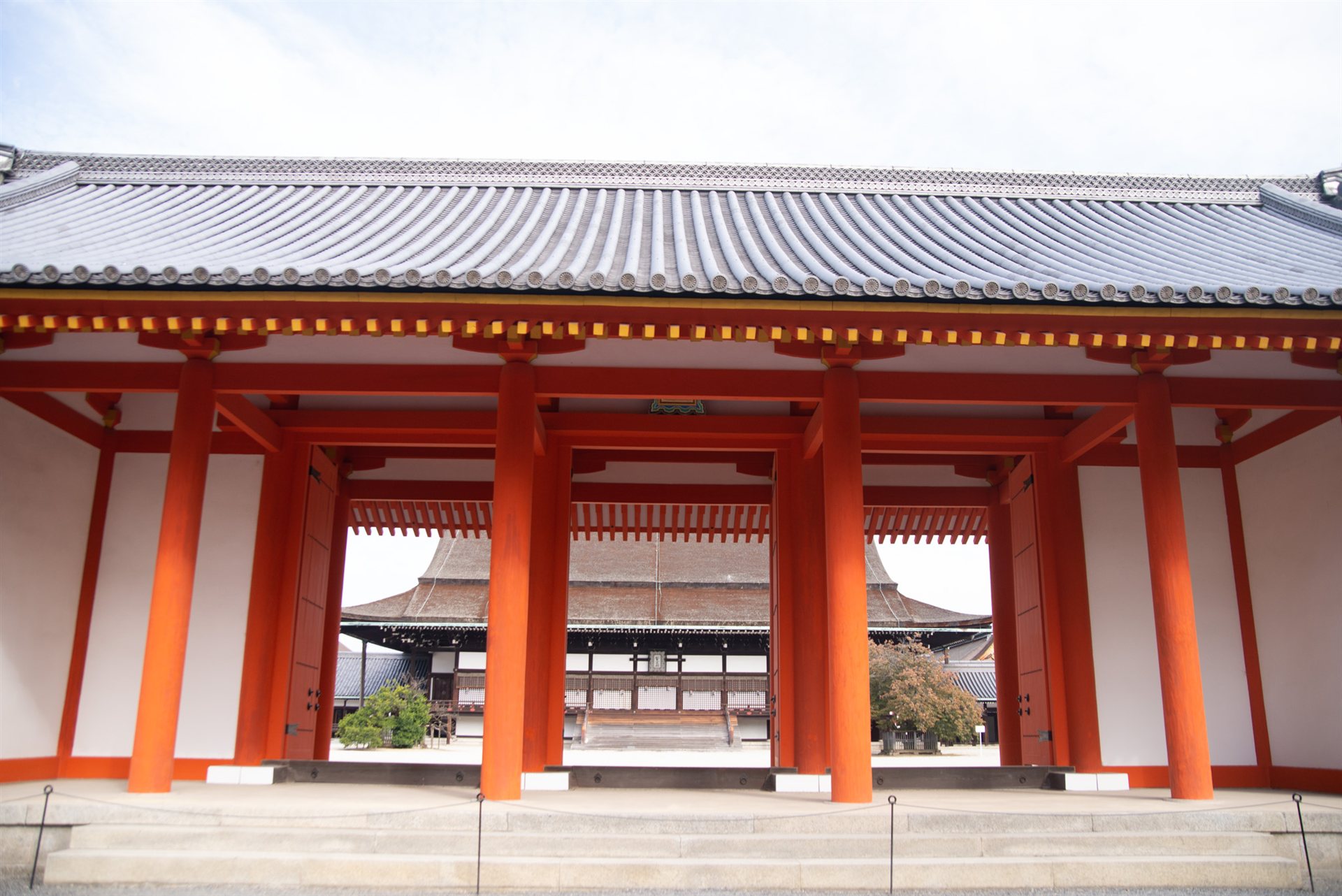
The Shishinden can be seen at the back, through the pillars of the vermilion gate.
In front of the Shishinden (on its south side) stands a gate with vermilion pillars and white walls. From the visitor route, you can look at the Shishinden through the pillars of this gate. The pillars act like a picture frame, giving a straight view of the front steps and the great roof.
Shishinden | The Main Hall Where Enthronement Ceremonies Were Held
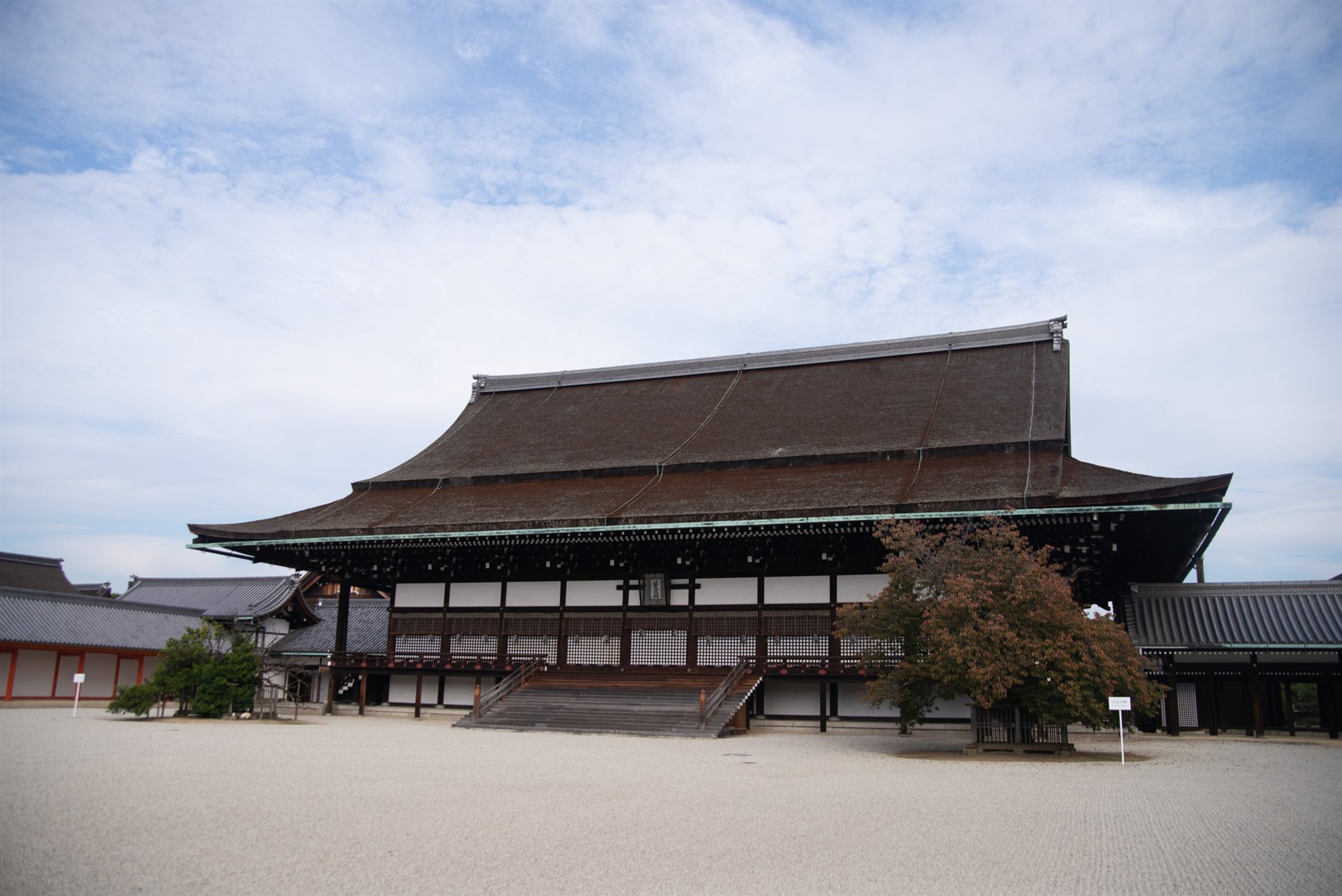
The Shishinden stands beyond the white-sand garden. Its large roof of cypress bark catches the eye.
The Shishinden is the highest-ranking building in the Kyoto Imperial Palace, the main hall where important ceremonies such as enthronements were held. The white-sand garden in front of it is called the Nantei (South Garden) and was used as a ceremonial space.
I was looking at the building from a distance, but it is a very large building, and I could feel its history.
Nikkamon and Gekkamon Gates
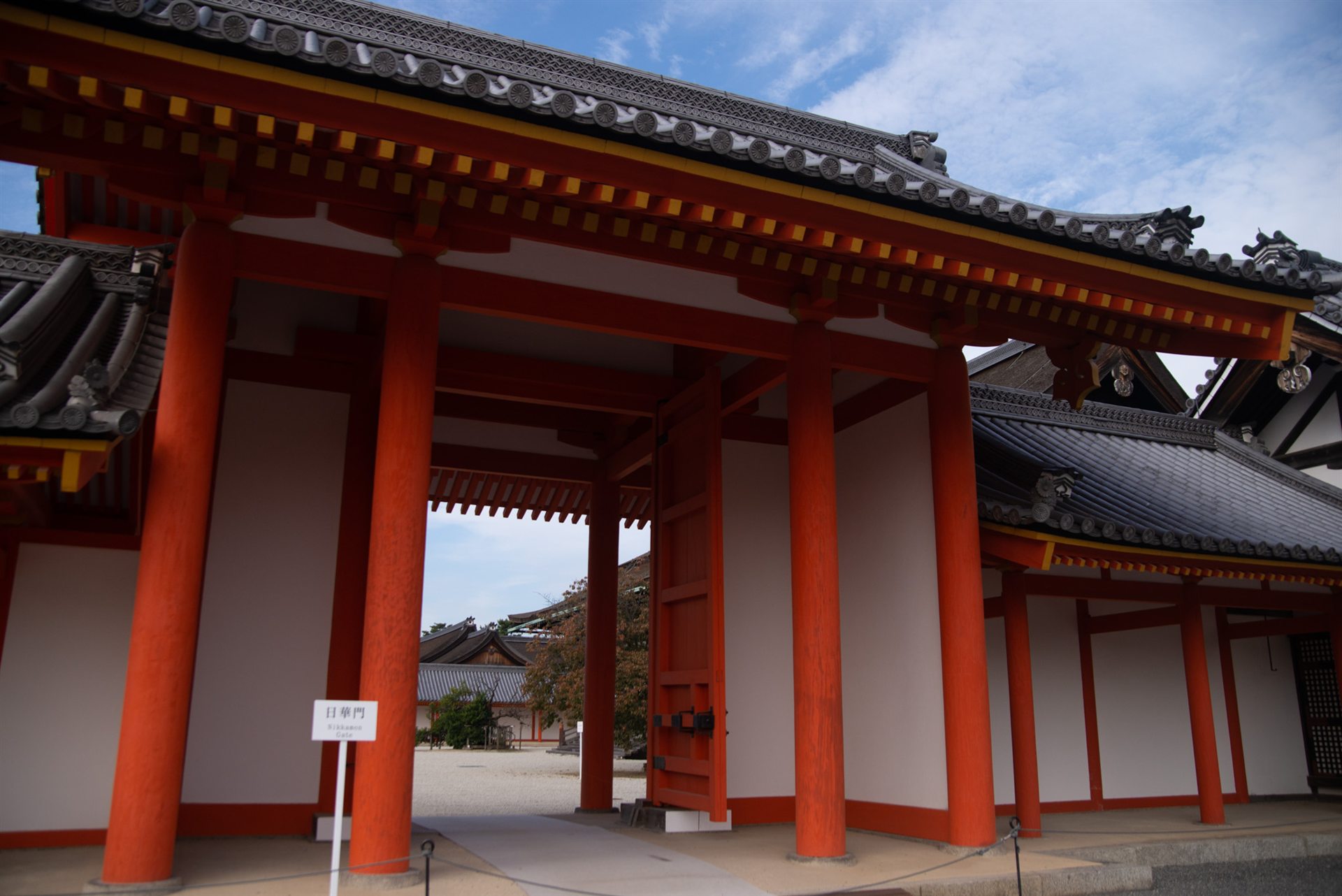
The “Nikkamon” sign. This gate stands on the east side of the garden in front of the Shishinden.
The garden in front of the Shishinden is enclosed all around by roofed corridors. On its east side is the Nikkamon Gate, and on its west side is the Gekkamon Gate. The white walls and gray tiles stand out beautifully against the vermilion pillars. The layers of garden and buildings seen beyond the gates are also a view typical of the Kyoto Imperial Palace.
The Okurumayose and the Shin-Mikurumayose (Carriage Porches)
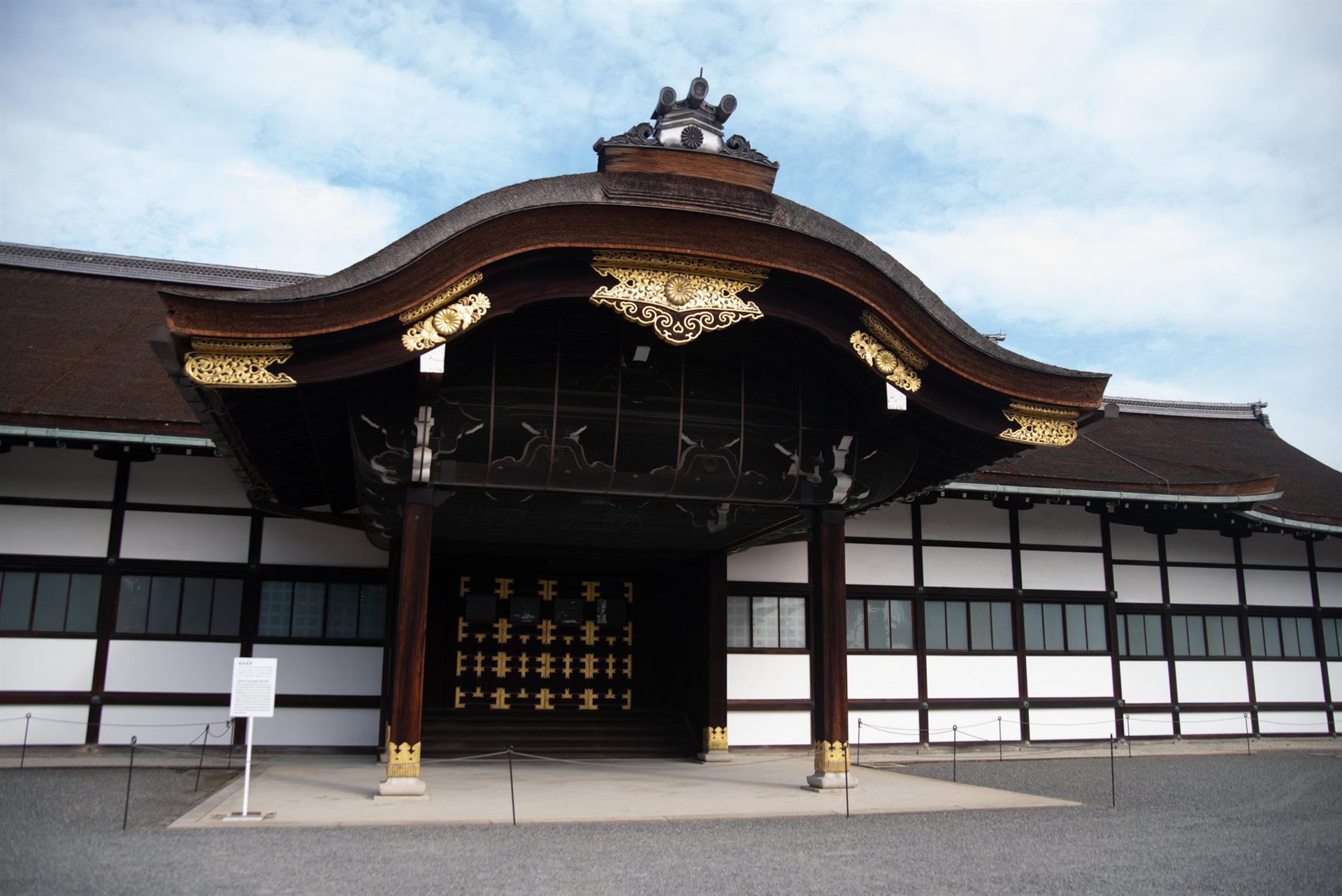
An entrance with a large karahafu (curved gable) roof, decorated with golden chrysanthemum ornaments.
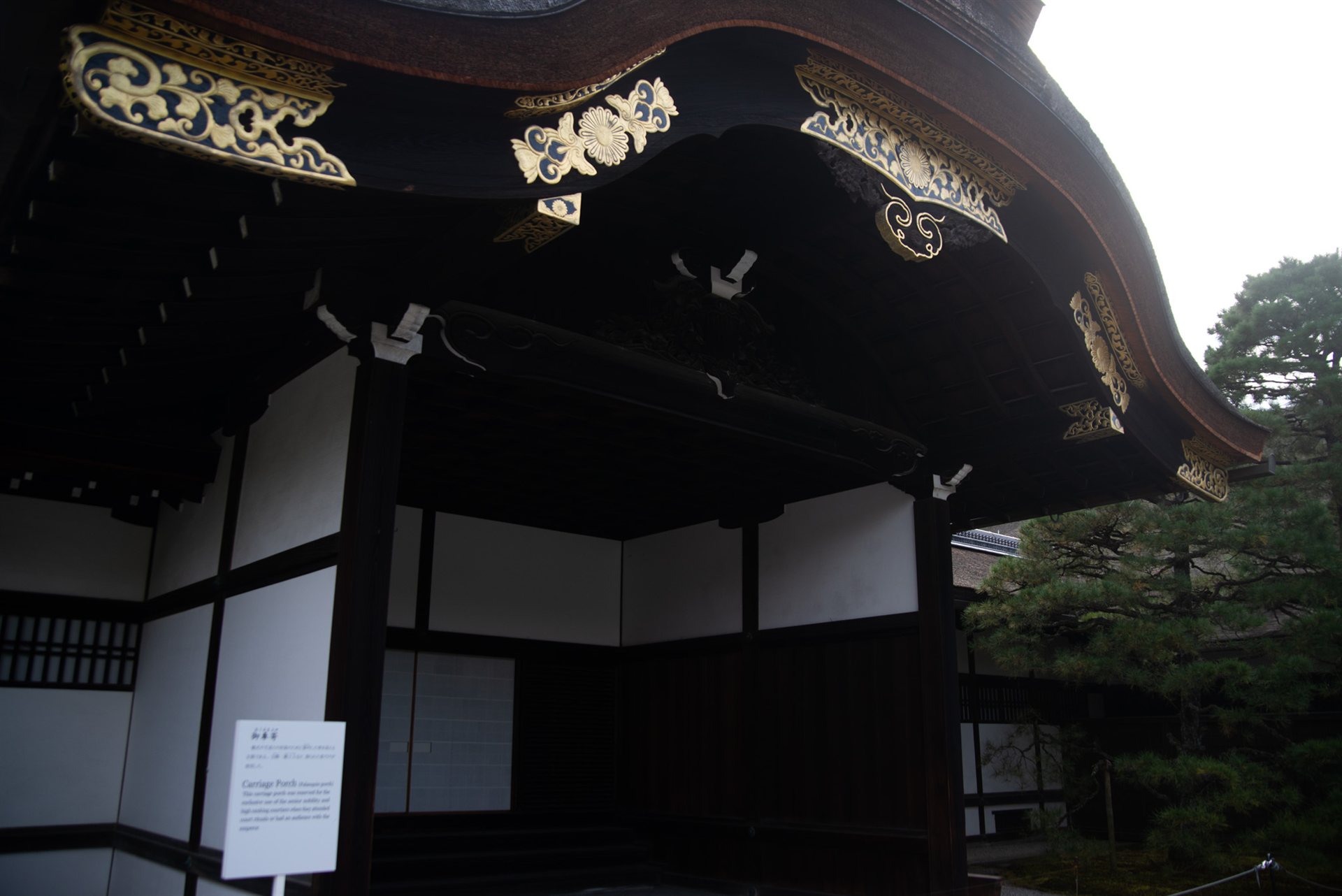
The Okurumayose. The gold ornaments under the roof contrast with the white walls.
The Kyoto Imperial Palace has several entrances to its buildings. According to the information board, the Okurumayose (Carriage Porch) was the entrance for welcoming people who came to the palace for ceremonies or audiences with the emperor, and only a limited group, such as high-ranking court nobles (kugyō and tenjōbito), used it.
Both entrances have rows of gold ornaments under wave-like curved roofs (karahafu). Looking up from close by, you can see how finely detailed the ornaments are.
Shodaibu-no-ma | Waiting Rooms Divided by Rank
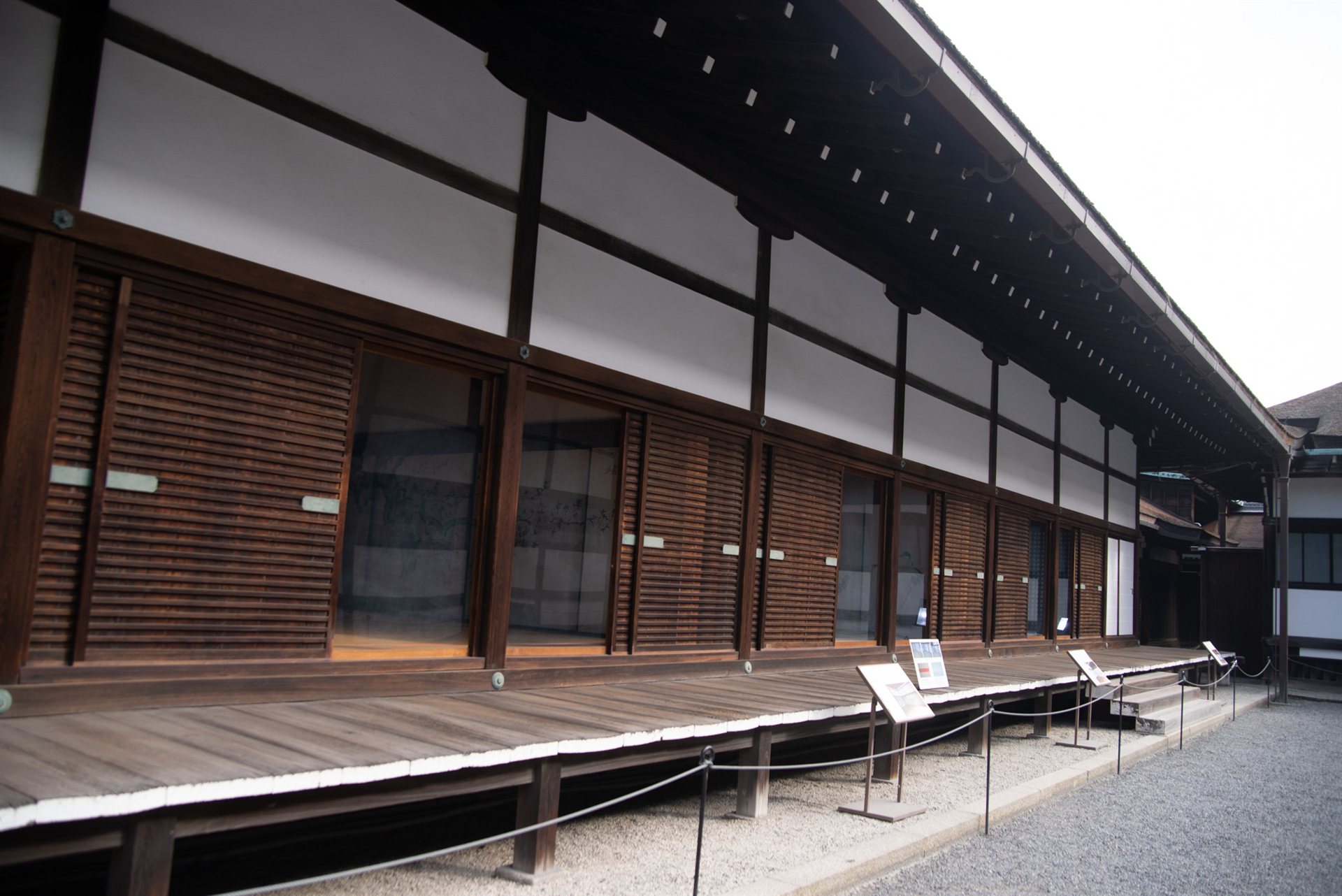
The Shodaibu-no-ma. Information boards stand along the veranda.
The Shodaibu-no-ma is a set of waiting rooms where visitors to the palace waited their turn. According to the information board, the rooms were called, from the highest rank, the “Tiger Room,” the “Crane Room,” and the “Cherry Blossom Room,” after the paintings on their sliding doors, and the room a person used was decided by their rank. You can look into the rooms from outside and see part of the sliding-door paintings.
Sugido-e (Paintings on Cedar Doors)
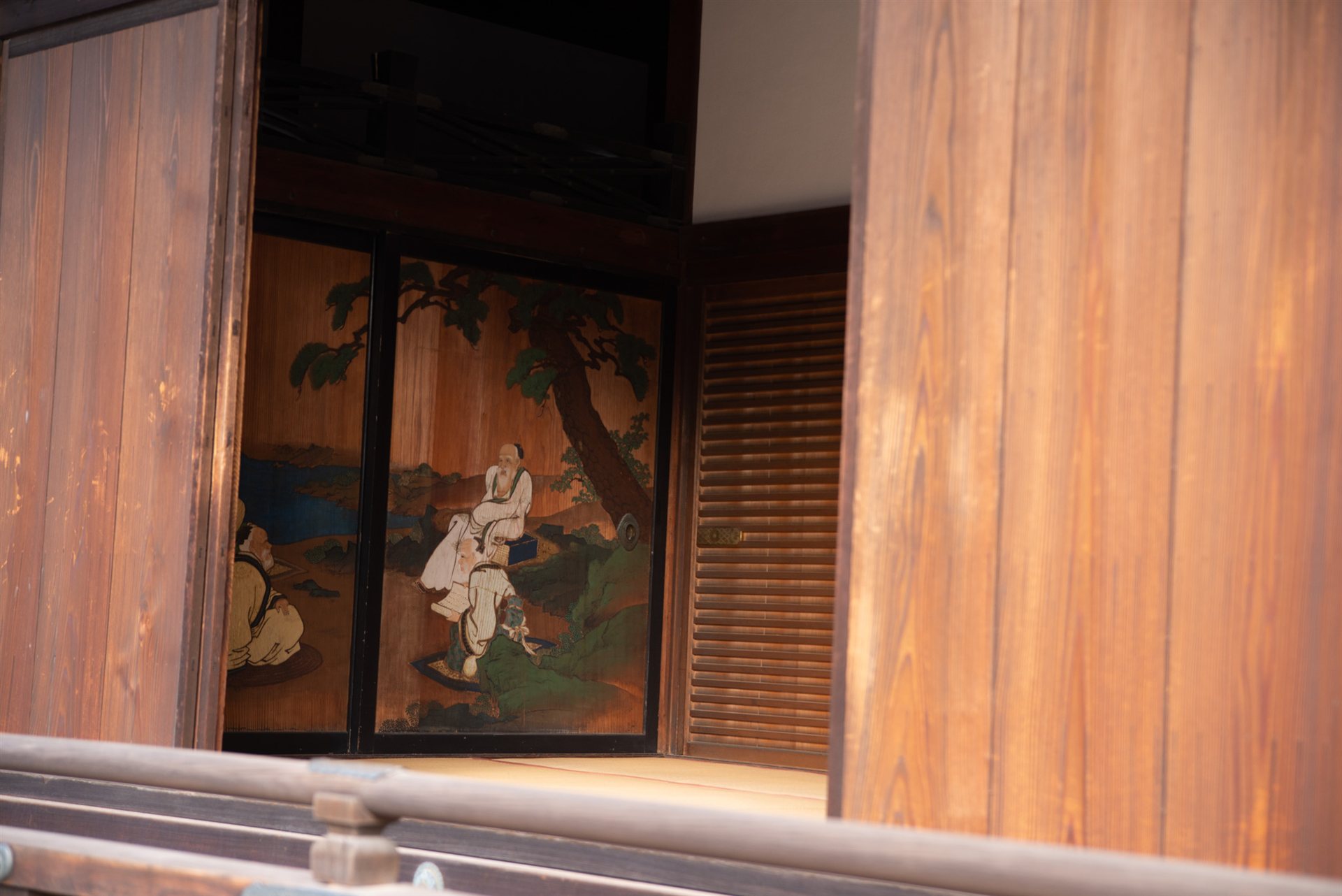
A sugido-e seen beyond an open door. A figure is painted under a pine tree.
Where the doors of the buildings are open, you may be able to see paintings on cedar board doors (sugido-e). On the cedar door in the photo, a pine tree and a figure are painted over the wood grain.
Oike-niwa | The Pond Garden and Autumn Leaves inside the Palace
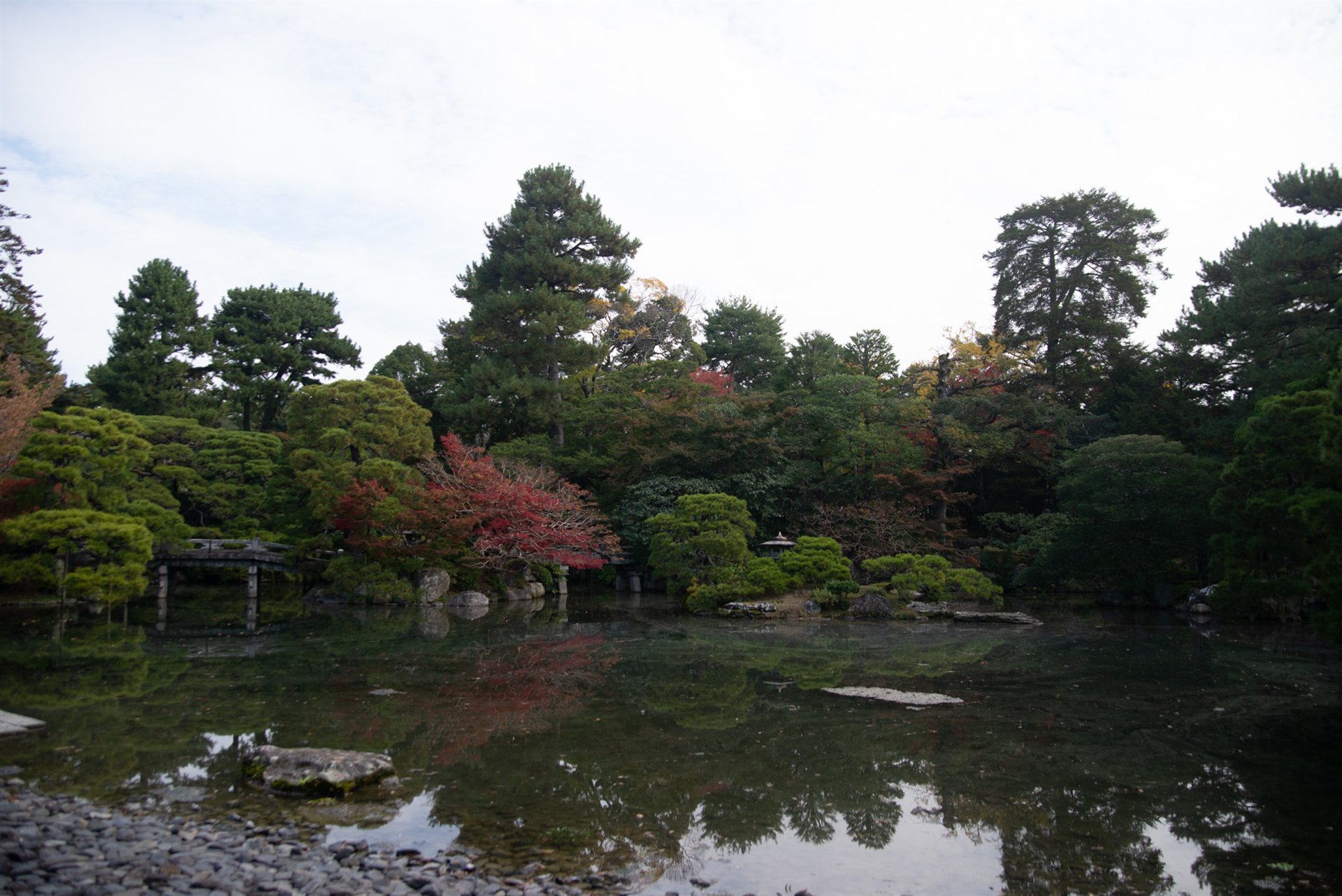
The Oike-niwa. Red maples and pines are reflected on the surface of the pond.
In the latter part of the visitor route is the Oike-niwa (Pond Garden), a garden centered on a pond. The near side is a suhama, a “beach” paved with flat stones, and at the back are a stone bridge, a stone lantern, pines, and maples. In my photo taken in November, the red maples and green pines were reflected on the water.
History of Nijo Castle | From Ieyasu’s Construction to the Return of Power to the Emperor
Construction of Nijo Castle began in 1601 (Keichō 6), when Tokugawa Ieyasu ordered the daimyo of western Japan to build it, and it was completed in 1603 (Keichō 8). This is the area that is now the Ninomaru (second enclosure).
Here are the main events, based on the timeline on the official website.
- 1611 (Keichō 16): Ieyasu meets Toyotomi Hideyori at Nijo Castle
- 1624 (Kan’ei 1): The second shogun, Hidetada, begins work to expand the castle (the Great Kan’ei Renovation)
- 1626 (Kan’ei 3): Invited by Hidetada and Iemitsu, Emperor Go-Mizunoo visits Nijo Castle (a five-day stay)
- 1750 (Kan’en 3): The five-story keep burns down after a lightning strike
- 1867 (Keiō 3), 14th day of the 10th month: The 15th shogun, Tokugawa Yoshinobu, offers to return political power to the Emperor (Taisei Hōkan)
- 1884 (Meiji 17): Becomes a detached palace of the imperial family, the “Nijō Rikyū” (Nijo Imperial Villa)
- 1939 (Shōwa 14): Granted to Kyoto City, and opened to the public from the following year, 1940
- 1994 (Heisei 6): Registered as a UNESCO World Cultural Heritage site
Nijo Castle was the stage for both the beginning (Ieyasu’s arrival) and the end (the return of power) of Tokugawa rule. It also has deep ties with the emperors and the imperial family, including Emperor Go-Mizunoo’s visit, its time as the Nijo Imperial Villa from the Meiji period, and the banquet for the Taishō enthronement ceremonies in 1915 (Taishō 4). Seeing it together with the Kyoto Imperial Palace shows you how the relationship of the Imperial Court and the shogunate changed over time.
Highlights of Nijo Castle
Higashi Ōte-mon Gate and Honmaru Yagura-mon Gate | Gates That Show the Castle’s Defenses
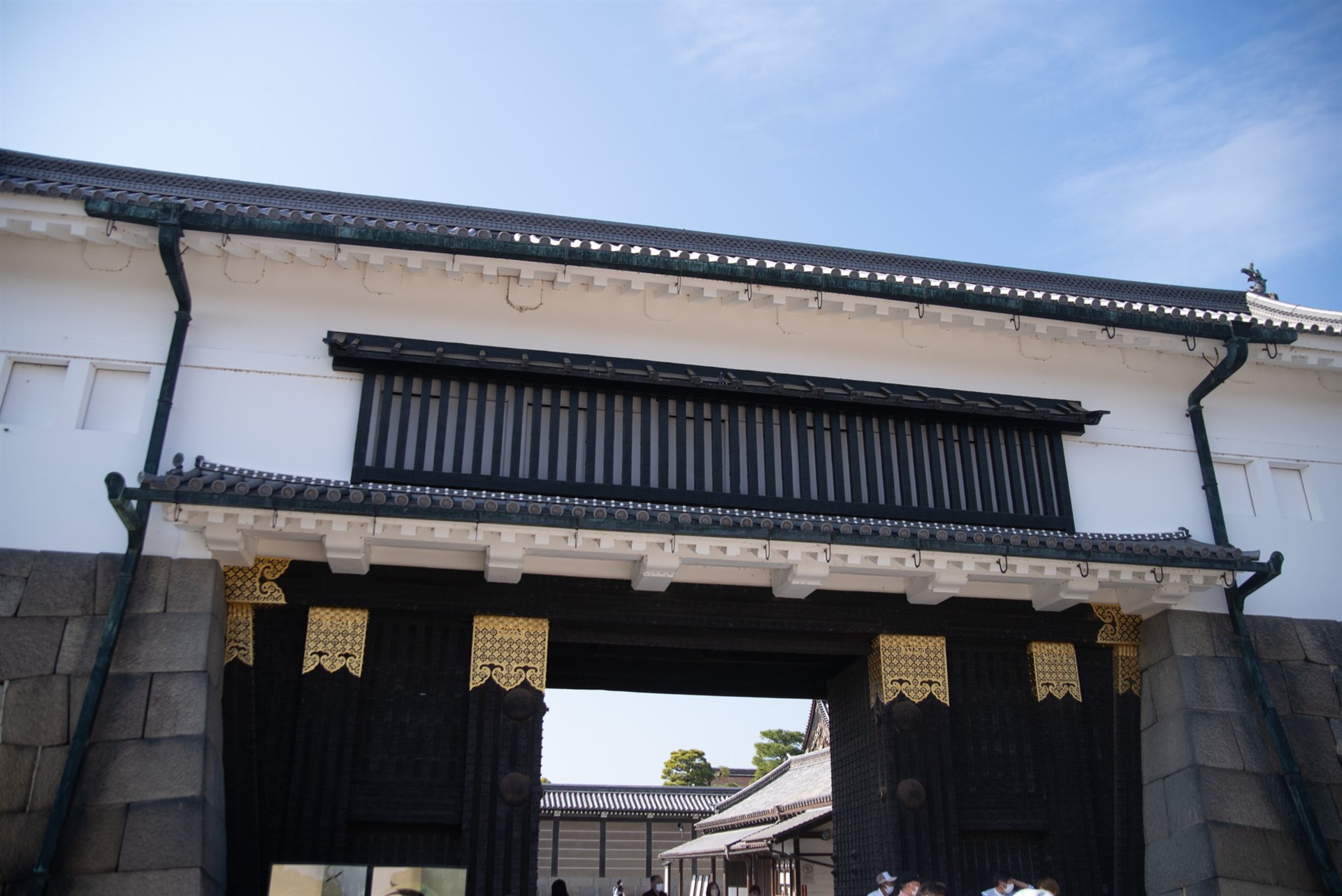
The Higashi Ōte-mon (East Main Gate), the main gate of Nijo Castle. A white-walled turret sits on top of the black doors.
The entrance to Nijo Castle is the Higashi Ōte-mon Gate, facing Horikawa-dori Street. It is a yagura-mon, a gate topped with a turret (yagura), and its black pillars carry gold metal fittings. Compared with the vermilion gates of the Imperial Palace, it is much heavier and clearly built with defense in mind.
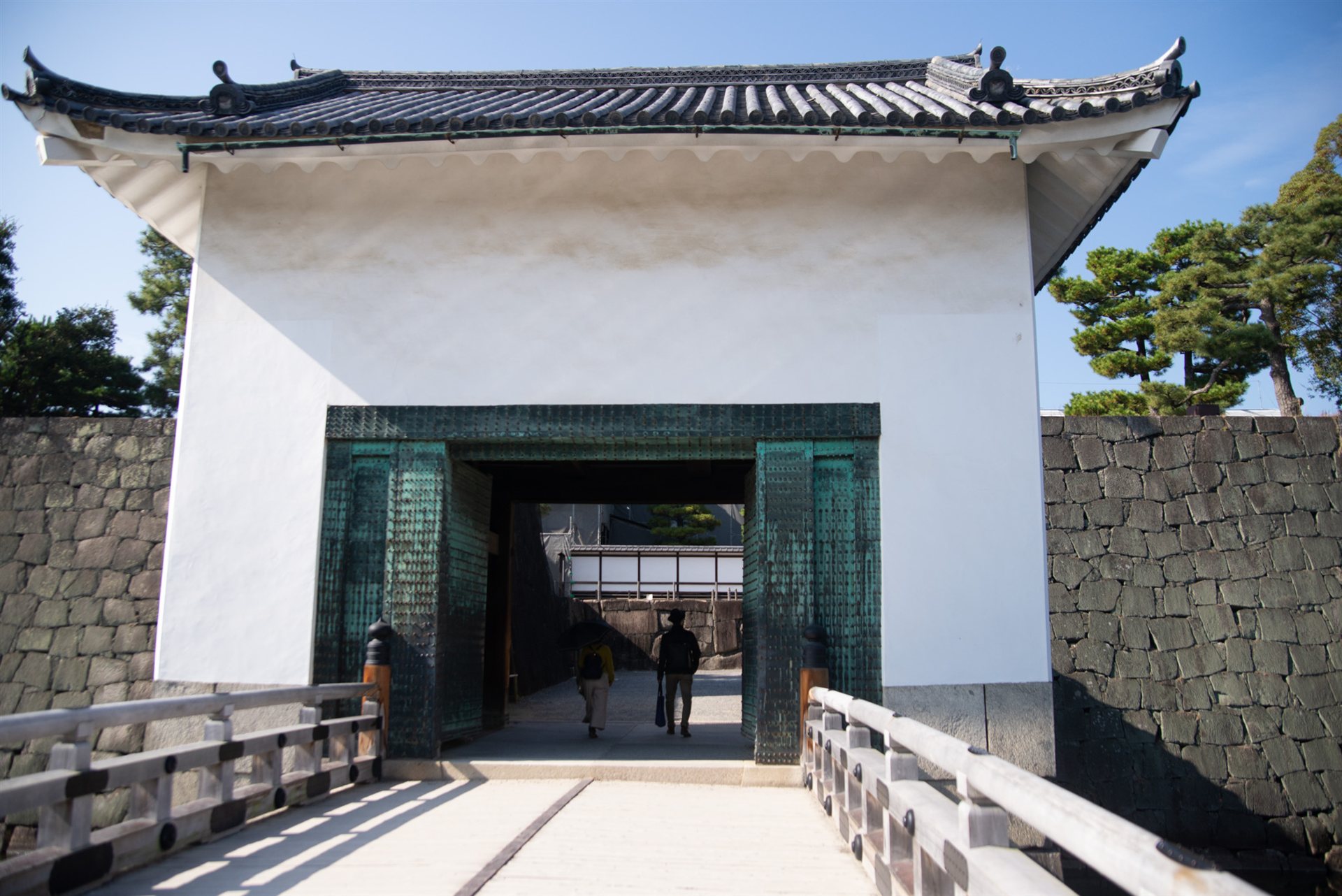
The gate beyond the bridge over the moat. The area around the doors is covered with green, weathered copper plates.
Inside the castle, there is a further area surrounded by moats and stone walls. At the gate beyond the bridge, the area around the doors is covered with copper plates, and stone walls of large stacked stones continue on both sides.
Ninomaru Palace
Ninomaru Palace is the representative building of Nijo Castle, and it is also known as the place where the return of power to the Emperor was announced. Inside the palace, you can walk in order through rooms lined with wall and sliding-door paintings (shōhekiga). To see Ninomaru Palace, you need a viewing ticket in addition to the castle admission ticket (see “Basic Information” below). Note that photography is not allowed inside Ninomaru Palace (checked on the official website on October 31, 2026).
Ginkgo Trees in Autumn
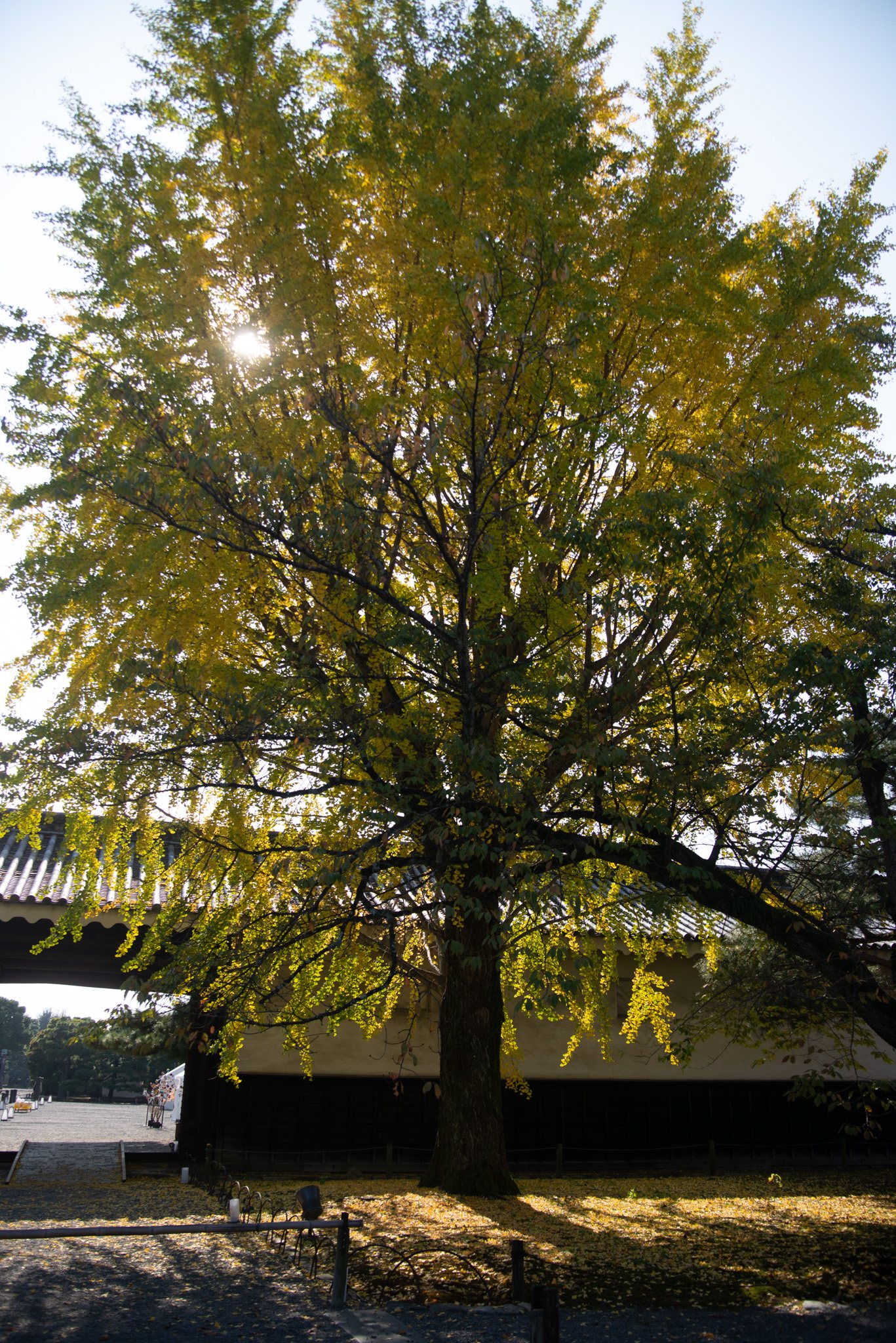
A large ginkgo tree inside the castle. In my photo taken in November, the leaves were beginning to turn yellow.
There are also large ginkgo trees inside Nijo Castle. The photo was taken in November and shows leaves beginning to turn yellow, set against white walls and tiled roofs.
Tips for Visiting the Kyoto Imperial Palace and Nijo Castle in One Day
The Kyoto Imperial Palace and Nijo Castle are connected by subway.
- Kyoto Imperial Palace: 5 minutes on foot from Imadegawa Station on the Karasuma Subway Line (according to the Imperial Household Agency)
- Nijo Castle: Change to the Tozai Line at Karasuma Oike Station on the Karasuma Subway Line, then 5 minutes on foot from Nijojo-mae Station (according to the Kyoto City Tourism Association)
Take the Karasuma Line from Imadegawa Station to Karasuma Oike Station and change to the Tozai Line, and you can visit the two sites one after the other.
Keep in mind that the Kyoto Imperial Palace is closed on Mondays (or the following day if Monday is a national holiday). Also, visitors enter the Kyoto Imperial Palace through the Seishomon Gate, and there is a bag check at the entrance. According to the Imperial Household Agency, a visit takes about 50 minutes.
Basic Information on the Kyoto Imperial Palace and Nijo Castle
(Checked on the official websites on October 30, 2026)
Kyoto Imperial Palace
| Admission | Free (you can visit without a reservation) |
| Opening hours | Vary by season |
| Closed | Mondays (the next day if Monday is a national holiday), the New Year holidays (December 28–January 4), and days when events or other matters prevent visits |
| Entrance | Seishomon Gate (bag check at entry) |
| Time needed | About 50 minutes |
| Guided tours by staff | Japanese 9:30, 10:30, 13:30, 14:30; English and Chinese 10:00, 14:00 |
| Access | 5 minutes on foot from Imadegawa Station on the Karasuma Subway Line, 7 minutes on foot from the Karasuma Imadegawa city bus stop |
| Official website | Kyoto Imperial Palace (Imperial Household Agency) |
Nijo Castle (Former Imperial Villa Nijo-jo Castle)
| Opening hours | 8:45–16:00 (the castle closes at 17:00) |
| Ninomaru Palace ticket hours | 8:45–16:10 |
| Closed | December 29–31 |
| Ninomaru Palace closed to visitors | Every Tuesday in January, July, August, and December (if Tuesday is a holiday, the palace is open and closed the next day instead), December 26–28, January 1–3 |
| Castle admission | Adults 800 yen, junior high and high school students 400 yen, elementary school students 300 yen |
| Castle admission + Ninomaru Palace | Adults 1,300 yen (adults 500 yen if you buy only the Ninomaru Palace ticket after entering the castle) |
| Access | 5 minutes on foot from Nijojo-mae Station on the Tozai Subway Line |
| Official website | Former Imperial Villa Nijo-jo Castle |
Fees and hours may change. Please check the latest information on the official websites before you go.
Frequently Asked Questions
Do I need a reservation for the Kyoto Imperial Palace?
No reservation is needed. You enter through the Seishomon Gate and can visit free of charge (checked on October 30, 2026). However, it is closed on Mondays (or the following day if Monday is a national holiday) and during the New Year holidays.
Should I visit Nijo Castle or the Kyoto Imperial Palace first?
You can visit them in either order. The Kyoto Imperial Palace is closed on Mondays, and Ninomaru Palace at Nijo Castle is closed to visitors on Tuesdays in January, July, August, and December, so it is a good idea to decide the order based on the day you go.
Does Nijo Castle’s admission include Ninomaru Palace?
No, it does not. If you also want to see Ninomaru Palace, buy the set ticket for castle admission and Ninomaru Palace (adults 1,300 yen), or buy a Ninomaru Palace ticket (adults 500 yen) separately after entering the castle.
Summary | Tracing the History of the Imperial Court and the Shogunate at the Kyoto Imperial Palace and Nijo Castle
- The Kyoto Imperial Palace was home to the emperors from 1331 until 1869 (Meiji 2). The current buildings were constructed in 1855, and you can walk around the Shishinden, the Okurumayose, the Nikkamon Gate, the Oike-niwa, and more for free
- Nijo Castle was completed by Ieyasu in 1603, and it is where Yoshinobu offered to return political power to the Emperor in 1867. Highlights include the Higashi Ōte-mon Gate, the stone walls, and Ninomaru Palace
- The two sites are connected by subway, so you can visit them one after the other in a day. Watch out for the Kyoto Imperial Palace’s Monday closures
This blog has other articles about Kyoto, too. In Kansai Travelogue Day 1: Kyoto (Japanese), I visit Kiyomizu-dera, Yasaka Shrine, Fushimi Inari Taisha, and more in one day, along with the Kyoto Imperial Palace and Nijo Castle. For the history of Kiyomizu-dera, see our article on the history and highlights of Kiyomizu-dera (Japanese), and for how to get there, see the Complete Access Guide to Kiyomizu-dera.
References (checked on October 30, 2026)
- Kyoto Imperial Palace: Visitor Information (Imperial Household Agency) (Japanese)
- Kyoto Imperial Palace: History of the Dairi (Imperial Household Agency) (Japanese)
- Former Imperial Villa Nijo-jo Castle: History (Japanese)
- Former Imperial Villa Nijo-jo Castle: Opening Hours and Closing Days (Japanese)
- Former Imperial Villa Nijo-jo Castle: Admission Fees (Japanese)
コメント