Byodo-in’s Phoenix Hall in Uji City, Kyoto Prefecture, is known as the building shown on the Japanese 10-yen coin. In this article, I introduce the history and highlights of the Phoenix Hall of Byodo-in, together with photos I took in November 2022.
I explain why Fujiwara no Yorimichi built an Amida hall in Uji, and what to look for in the garden and the National Treasures. I also cover admission fees, the interior tour of the Phoenix Hall, access, and how to visit nearby Uji Bridge and Ujigami Shrine.
The photos are from November 2022. Information such as fees and hours was checked on November 4, 2026, on the official Byodo-in website and other sources.
- History of Byodo-in’s Phoenix Hall: The Amida Hall Fujiwara no Yorimichi Built in Uji
- Highlights of Byodo-in’s Phoenix Hall
- Byodo-in Admission Fees and Opening Hours (Checked on November 4, 2026)
- Access to Byodo-in (Checked on November 4, 2026)
- Also Visit Uji Bridge, Tonoshima Island, and Ujigami Shrine
- Frequently Asked Questions About Byodo-in’s Phoenix Hall
- Summary
History of Byodo-in’s Phoenix Hall: The Amida Hall Fujiwara no Yorimichi Built in Uji
From a Villa to a Temple (1052)
Byodo-in began as a villa on the west bank of the Uji River. According to the Kyoto Prefecture website, it was originally the villa of Minamoto no Shigenobu, and Fujiwara no Michinaga received it from his wife.
Michinaga’s son, Fujiwara no Yorimichi, converted the villa into a temple in 1052 (Eishō 7). The official Byodo-in website also notes that this year was believed to be the first year of Mappō, the “Age of the Decline of the Dharma.”
Completion of the Phoenix Hall (1053)
The following year, 1053 (Tengi 1), the Amida hall was completed. This is today’s Phoenix Hall. Inside the hall, a seated statue of Amida Nyorai made by the Buddhist sculptor Jōchō was enshrined.
The name “Phoenix Hall” (Hōōdō) came into use around the beginning of the Edo period. The hall did not have this name when it was first built.
Surviving Wars to Become a World Heritage Site
In later years, Byodo-in also became a stage for war. The main events are as follows.
- 1180: Minamoto no Yorimasa was defeated at Uji and took his own life at Byodo-in. The spot is called “Ōgi-no-shiba” (the Fan-shaped Lawn), and Yorimasa’s grave is also in the temple grounds.
- 1336: During fighting involving Kusunoki Masashige and the Ashikaga side, the surrounding area was set on fire, and most buildings burned except for a few.
- 1994: It was registered as a World Heritage Site as one of the “Historic Monuments of Ancient Kyoto.”
- 2012–2014: The major Heisei-era restoration of the Phoenix Hall was carried out.
The official website describes the Phoenix Hall as “the only surviving structure that recalls the age of the Fujiwara regents.” Although much was lost, an Amida hall from the Heian period still stands today.
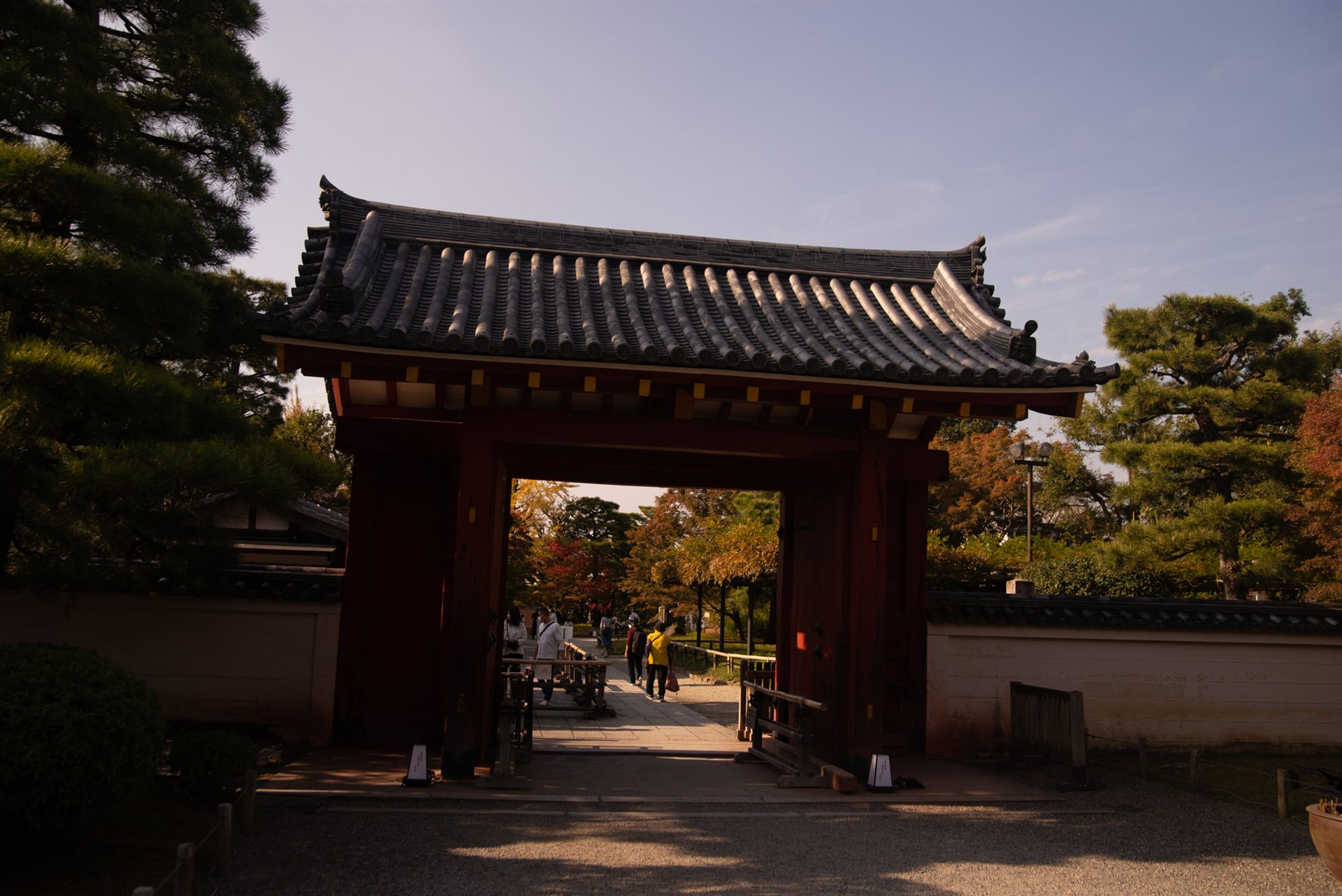
A vermilion gate in the temple grounds, with autumn leaves visible behind it (taken in November 2022).
Highlights of Byodo-in’s Phoenix Hall
The Phoenix Hall and Aji Pond
The Phoenix Hall is a National Treasure and stands on an island in a pond. The building faces east, and the official website explains that this represents the Pure Land of Paradise in the west.
Seen from the front, wing-like corridors extend to the left and right of the central building. On the roof sits a pair of golden phoenixes.
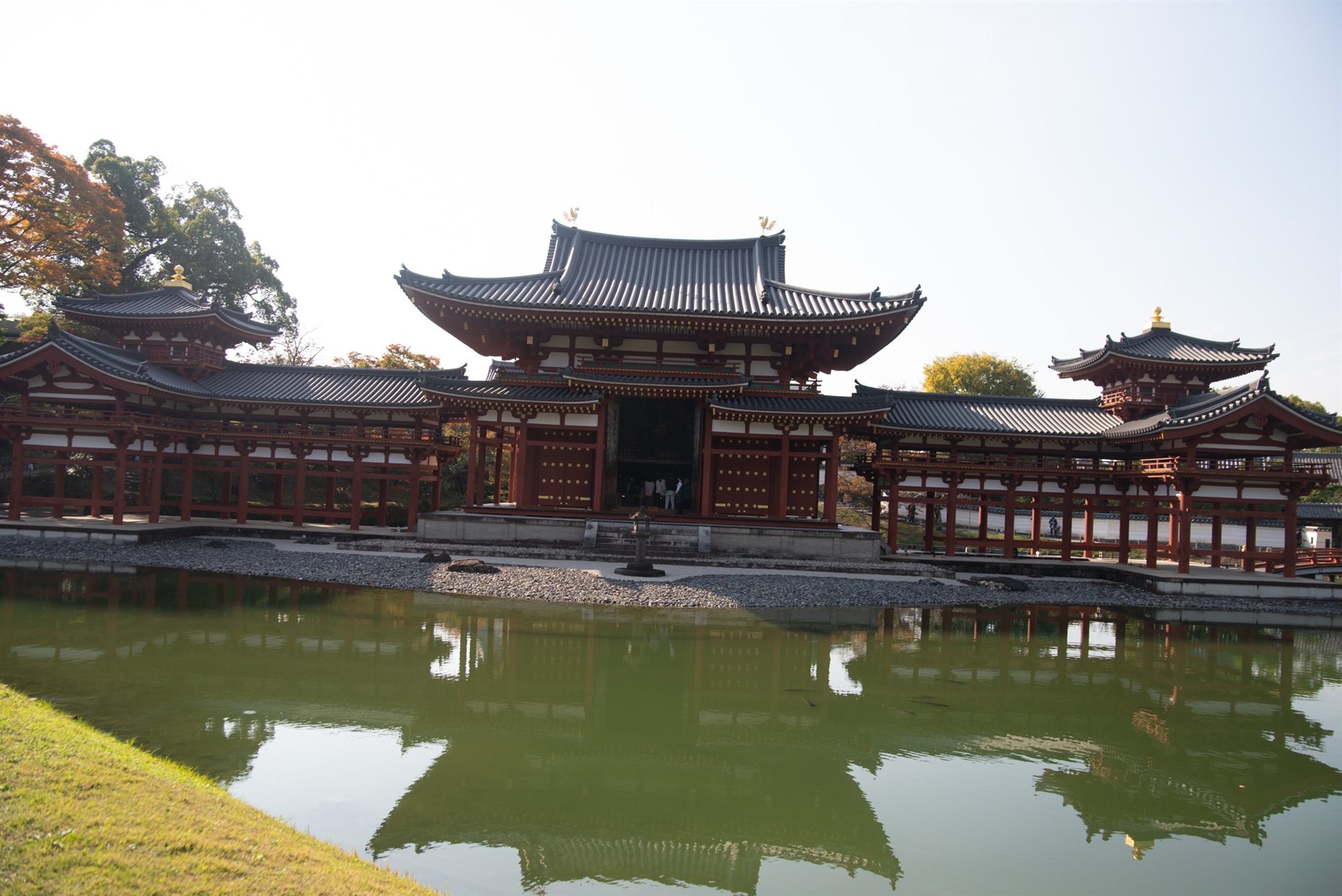
The front of the Phoenix Hall seen across Aji Pond. Phoenixes sit on both ends of the roof (taken in November 2022).
The design on the front of the 10-yen coin is also this Phoenix Hall of Byodo-in. The Ministry of Finance’s list of coins describes the front of the 10-yen bronze coin as “the Phoenix Hall of Byodo-in and arabesque patterns.” Also, according to the official website, the 10,000-yen note issued in 2004 shows a phoenix (the statue on the south side).
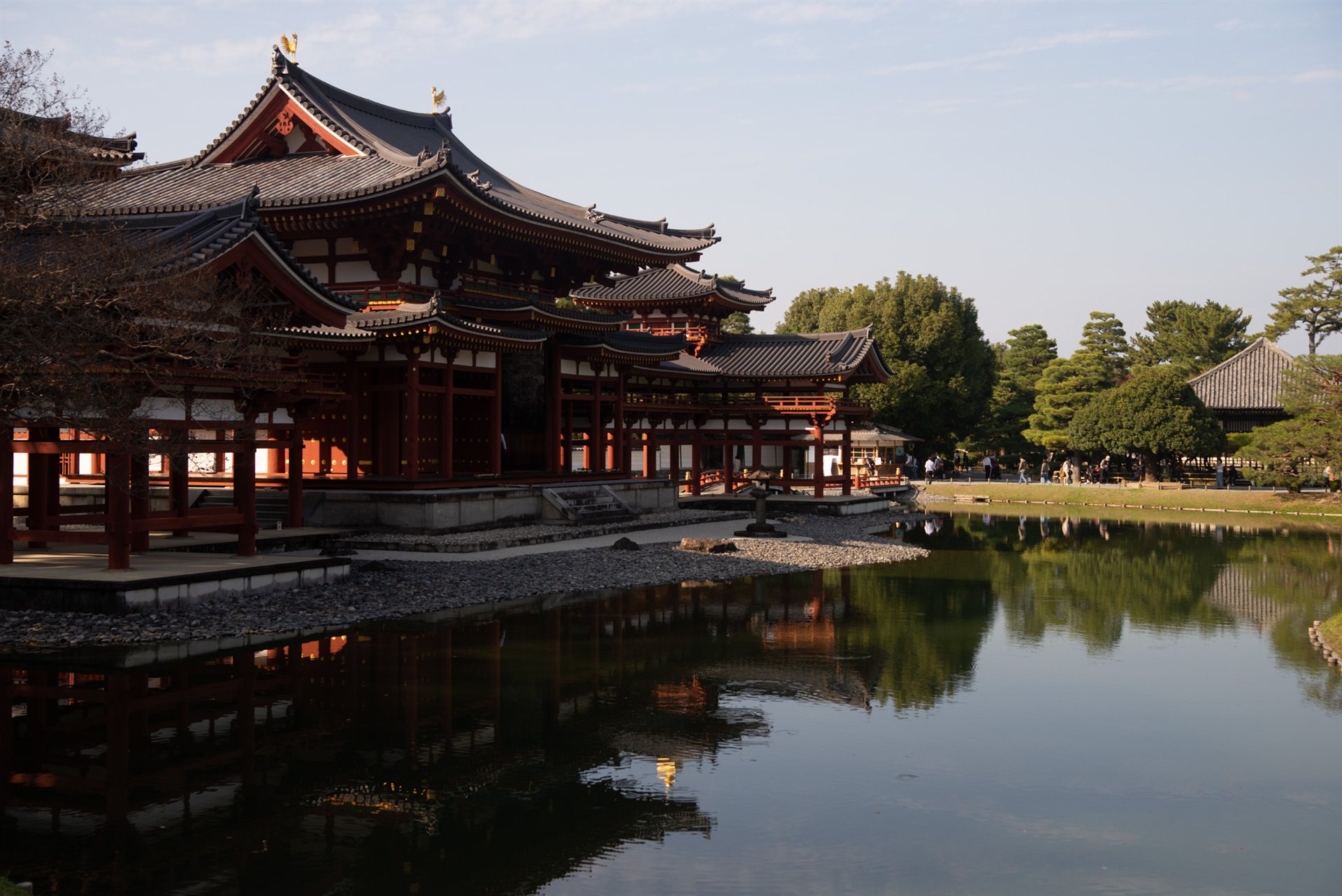
Seen at an angle, the layered roofs and the wing corridors at the back are easy to make out (taken in November 2022).
A Garden Representing the Pure Land of Paradise
The garden around the Phoenix Hall is designated a National Historic Site and a Place of Scenic Beauty. The official website describes it as the oldest Pure Land garden, completed in the Heian period.
Be sure to look at the suhama, the pebble beach laid along the water’s edge of the pond. Excavations that began in 1990 showed that the Heian-period suhama was paved with fist-sized stones, and that the water’s edge traced a gentle curve.
This garden is not complete within the pond alone. According to the official website, the Phoenix Hall, Aji Pond, the Uji River, and the mountains on the far bank come together to create the scene of the Pure Land of Paradise that the nobles of the time wished for.
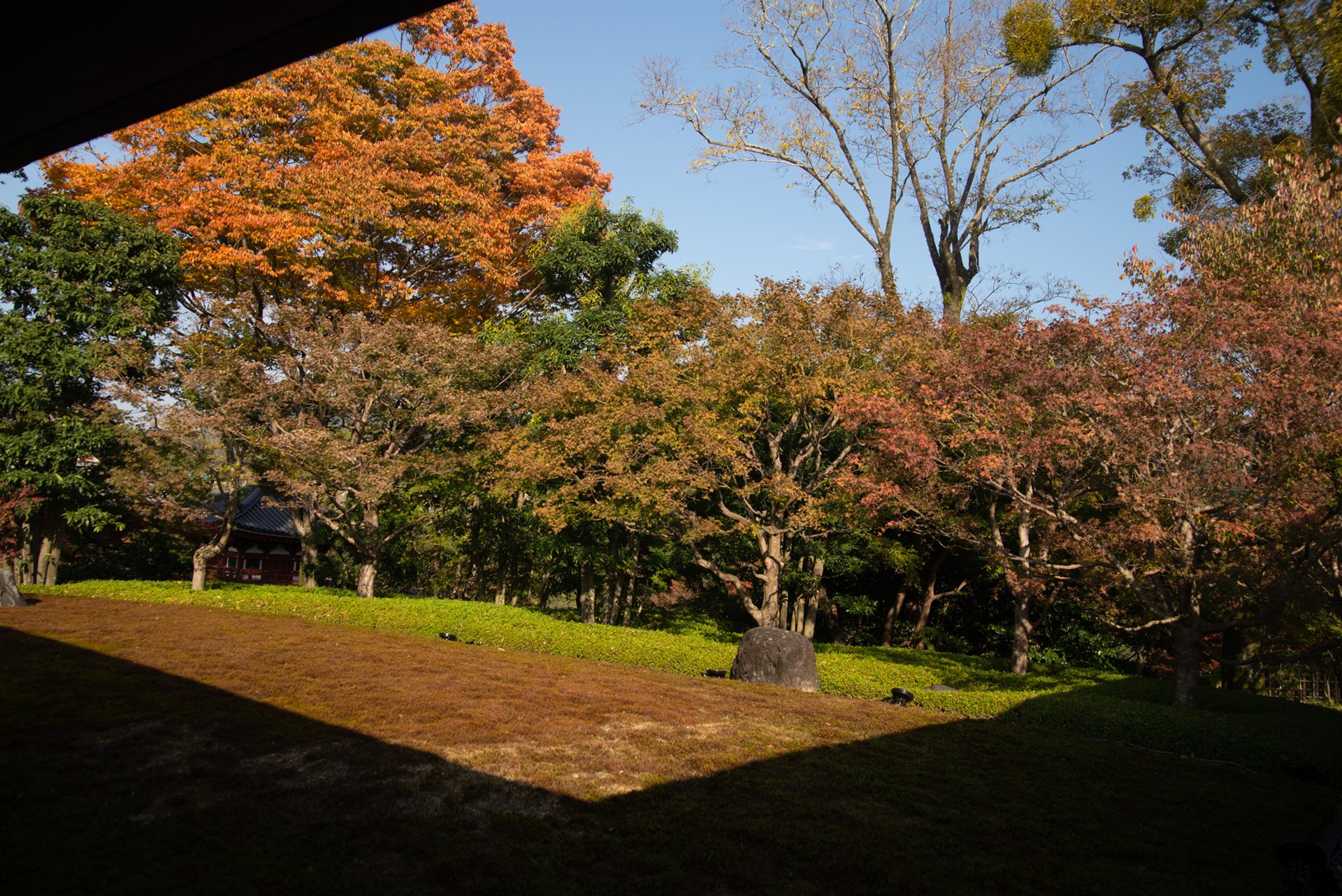
Trees in autumn colors and the garden (taken in November 2022).
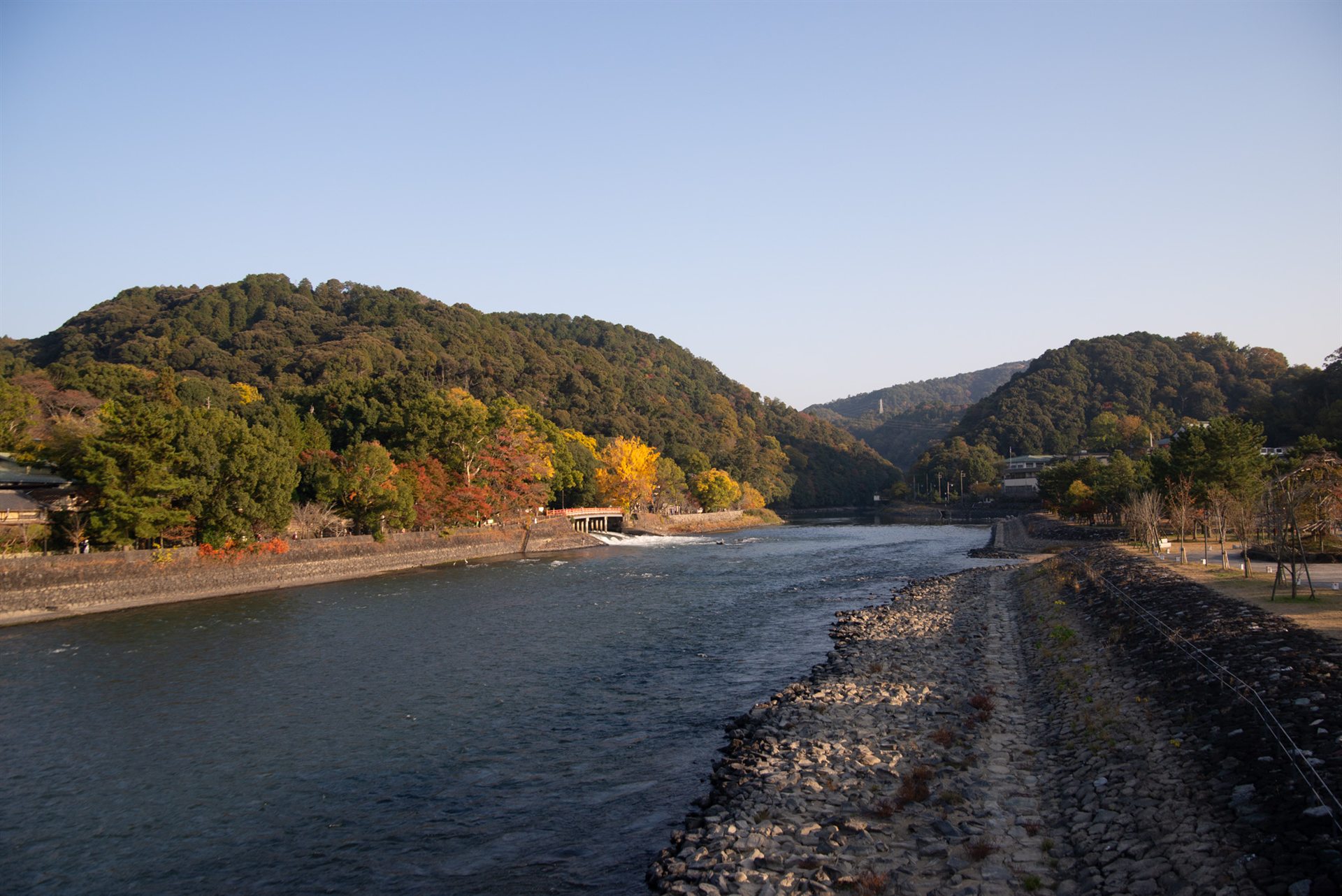
The Uji River, which flows near Byodo-in, and the mountains (taken in November 2022).
National Treasures at the Museum Hoshokan
If you want to learn about the Buddhist statues inside the hall or the phoenixes on the roof, stop by the Byodo-in Museum Hoshokan. This museum opened in 2001, and most of the building is underground so that it blends in with the scenery of the Phoenix Hall and the garden. Entry is included in the garden admission fee.
According to the official website, the main exhibits are as follows.
- Unchū Kuyō Bosatsu, Bodhisattvas on Clouds (National Treasure): These statues hung on the upper walls of the central hall of the Phoenix Hall, and there are 52 in all. They are known for their poses of playing musical instruments and dancing. The Hoshokan holds 26 of them.
- Phoenixes (National Treasure): The pair that was placed on both ends of the roof. The ones on the roof today are the second generation, and the originals can be seen here.
- Temple bell (National Treasure): A Heian-period bell, regarded as one of the “Three Famous Bells of Japan.” It once hung in the bell tower by the pond and is now kept in the Hoshokan.
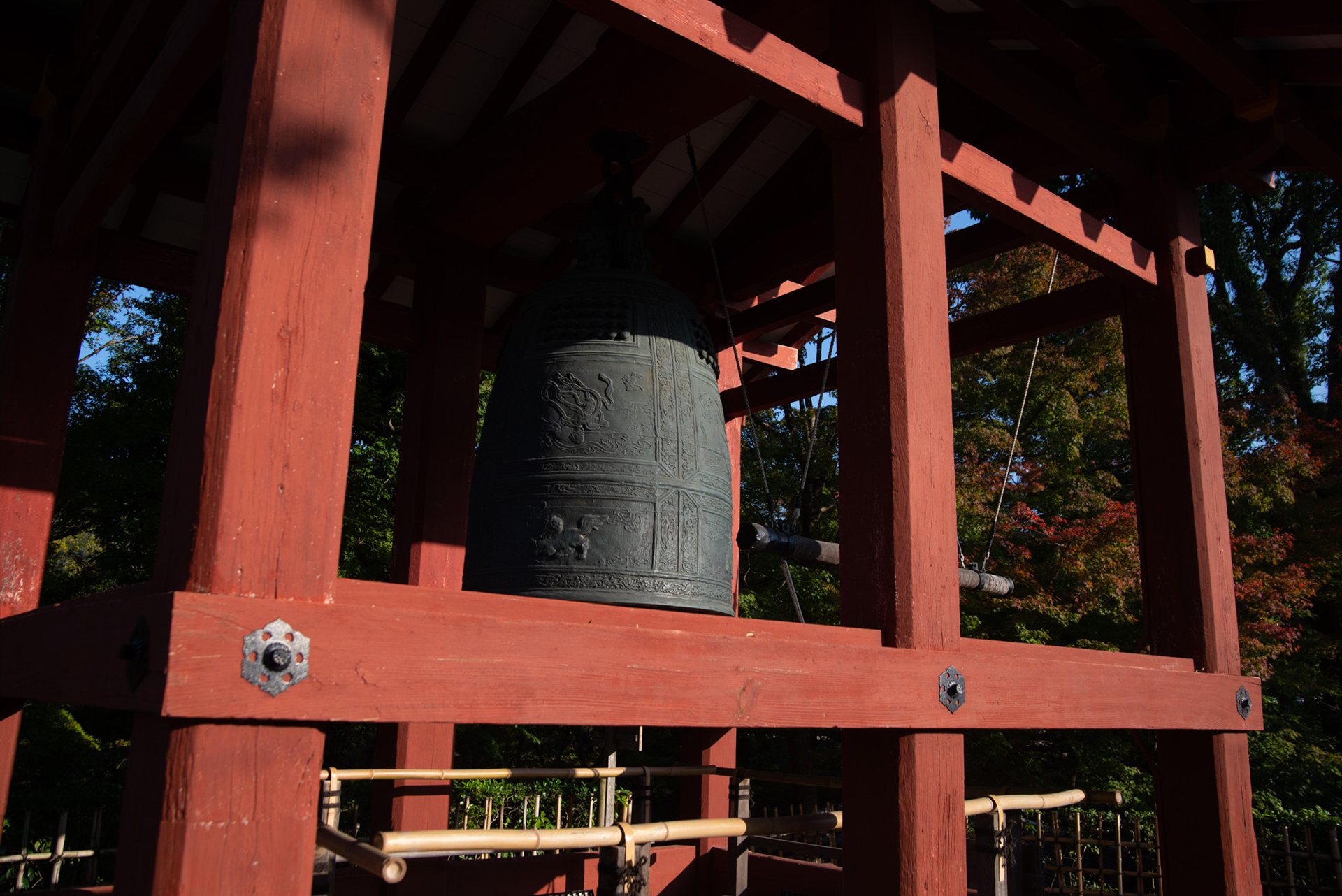
The bell tower with vermilion pillars and the temple bell (taken in November 2022).
Note that photography is not allowed inside the museum.
Byodo-in Admission Fees and Opening Hours (Checked on November 4, 2026)
The fees and hours below are a summary of the official visitor guide (Japanese). Please check the latest information before you go.
| Item | Details |
|---|---|
| Admission (garden + Hoshokan) | Adults 700 yen, junior high and high school students 400 yen, elementary school students 300 yen |
| Groups (25 people or more) | Adults 600 yen, junior high and high school students 300 yen, elementary school students 200 yen |
| Garden | 8:45–17:30 (last entry 17:15) |
| Museum Hoshokan | 9:00–17:00 (last entry 16:45) |
| Phoenix Hall interior tour | 9:30–16:10, a donation of 300 yen per person, 35 people per tour |
| Tea room Sabō Tōka | 10:00–16:30 (last order 16:00), closed on Mondays and Wednesdays (open on national holidays) |
| Shuin office (temple seal stamps) | 9:10–17:00 (last entry 16:45) |
Holders of a disability certificate and one caregiver can enter at half price.
The official model courses are a 50-minute course covering the main gate, the front of the Phoenix Hall, and the Hoshokan, and a 90-minute course that also includes the interior tour, Jōdo-in, the grave of Minamoto no Yorimasa, Ōgi-no-shiba, and more.
Sign Up for the Interior Tour First
Sign-up for the Phoenix Hall interior tour is done inside the garden. It opens at 9:10 on a first-come, first-served basis and closes once all spots are filled. Tours run every 20 minutes, and you gather 5 minutes before your tour starts.
From October 16, 2026, the capacity changed from 50 to 35 people per tour. The official website says that waiting times will be longer than before in busy seasons such as spring and autumn. If you want to join the interior tour, it is a good idea to sign up first.
Things to Know for Autumn 2026
- Special night viewing: Suspended after spring 2026, with no plans to hold it in autumn 2026. When it will resume has not been decided.
- Regular maintenance of the Phoenix Hall: Scheduled for November 10 and 11, 2026. There will be no scaffolding or enclosures, but workers may appear in your photos. The schedule may change due to weather or other reasons.
- Door painting room of the Hoshokan: Closed all day on weekdays from November 2 to 27, 2026, for repair work. It is open on Saturdays, Sundays, and November 23.
- Kannon-dō Hall: Closed to the public for repairs.
- Special exhibition “Mononofu to Uji (Warriors and Uji) [Part 3]”: Held at the Hoshokan until December 13, 2026.
Rules for Photography, Eating, and Drinking
Photography is allowed everywhere except inside the Phoenix Hall, inside the Hoshokan, and at the shuin office, and only for personal enjoyment. Large photography equipment, occupying a spot for a long time, stepping past ropes or other barriers, live streaming on the internet, and drones are prohibited.
Eating and drinking in the temple grounds, and bringing in food and drinks, are also not allowed. You may bring sealable drinks for staying hydrated, such as plastic bottles and water bottles.
Access to Byodo-in (Checked on November 4, 2026)
The address is 116 Uji-Renge, Uji City, Kyoto Prefecture (京都府宇治市宇治蓮華116) (phone: 0774-21-2861).
- Uji Station on the JR Nara Line: About 10 minutes on foot (according to the Kyoto Prefecture website)
- Uji Station on the Keihan Uji Line: About 10 minutes on foot (according to the Kyoto Prefecture website)
- From the west end of Uji Bridge: 5 minutes on foot (according to the Uji City website)
According to the Uji City website, it takes about 16 minutes from Kyoto Station to JR Uji Station by rapid train on the JR Nara Line.
Byodo-in has no parking lot of its own. The official website suggests using the coin parking lots in the area or the privately run parking lot in front of the South Gate. Uji City asks visitors to use public transportation, as the roads become very crowded in the autumn tourist season and at other busy times.
Also Visit Uji Bridge, Tonoshima Island, and Ujigami Shrine
After Byodo-in, you can also walk around the Uji River.
Uji Bridge is said to have first been built in 646 (Taika 2). According to the Uji City website, the current bridge was built in 1996.
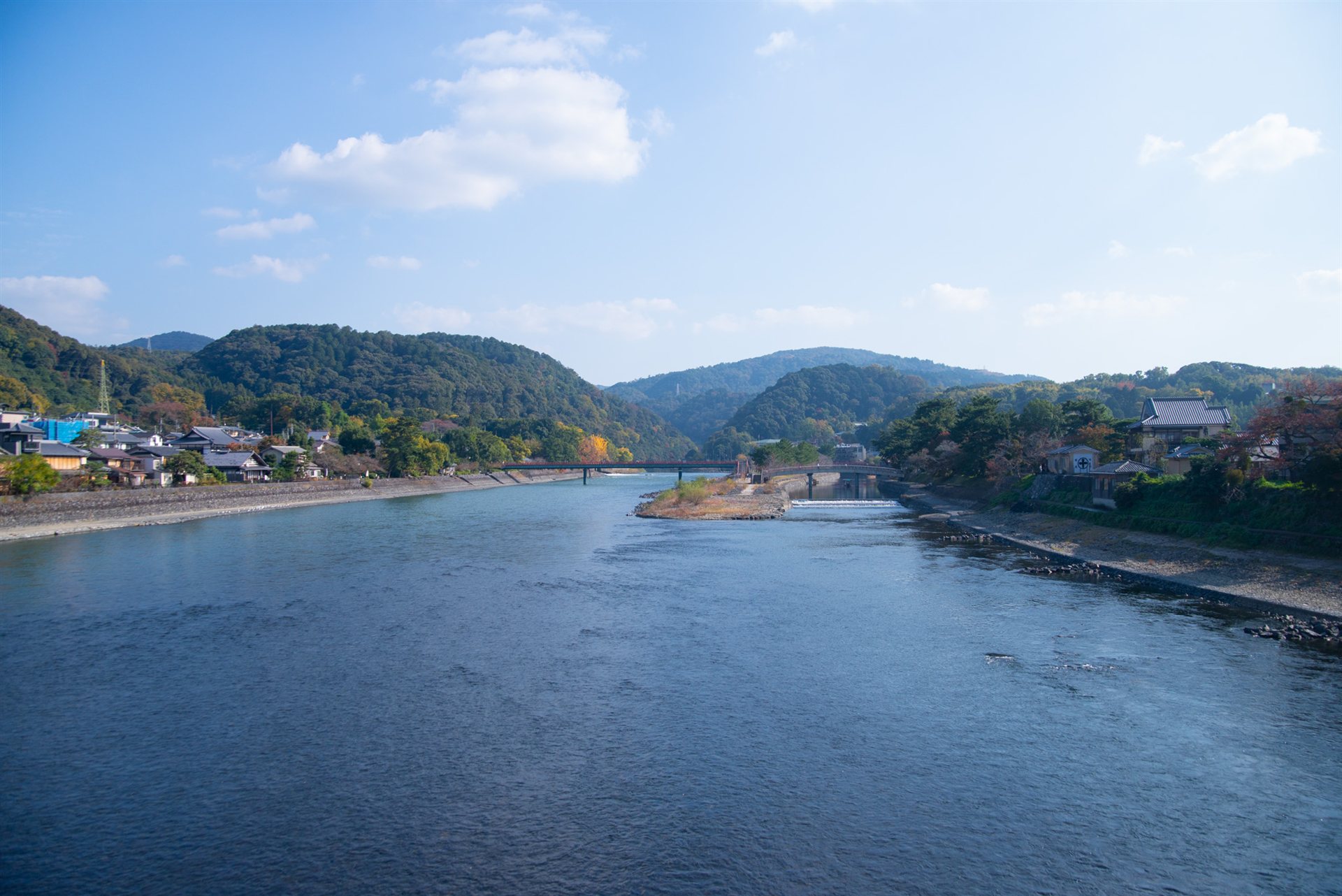
The upper part of the Uji River. You can see the island in the river and a red bridge in the distance (taken in November 2022).
Tonoshima Island and Tachibanajima Island, sandbars in the Uji River, are part of Uji Park. On Tonoshima stands a 15-meter-tall thirteen-story stone pagoda.
According to the Kyoto Prefecture website, the pagoda was built in 1286 by Eison, a monk of Saidai-ji Temple, to console the spirits of fish and to pray for the safety of Uji Bridge. It is an Important Cultural Property and is said to be the largest stone pagoda in Japan. The current pagoda had fallen over and was dug up and restored at the end of the Meiji period.
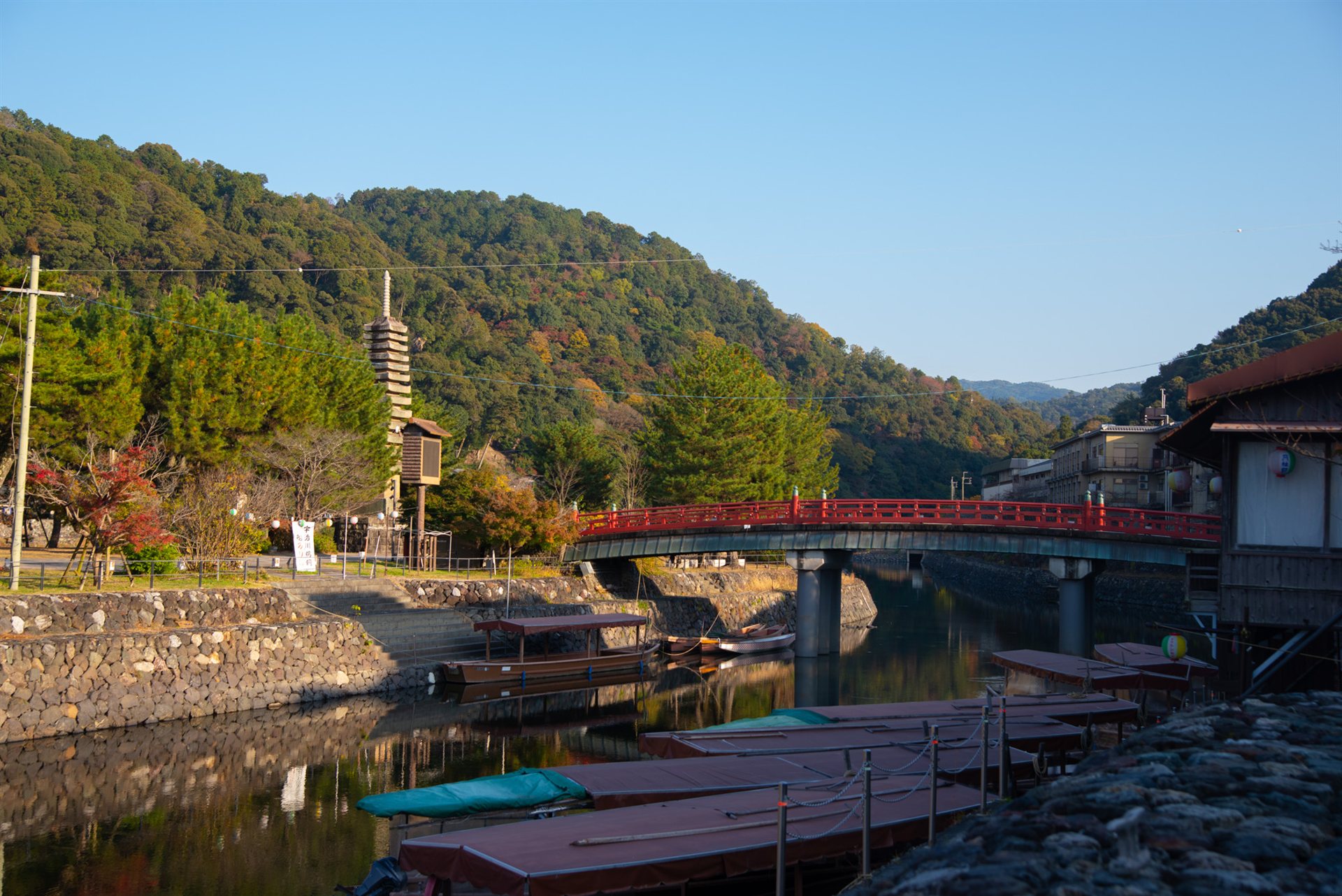
The thirteen-story stone pagoda on Tonoshima Island and a vermilion bridge. Boats are lined up in the foreground (taken in November 2022).
On the east side of the river is Ujigami Shrine, a World Heritage Site like Byodo-in. The Uji City website introduces its main hall as the oldest existing shrine building, built around the end of the Heian period. It is a 10-minute walk from the east end of Uji Bridge.
According to its official website, the gate is open from 5:00 to 16:00, and admission is free. It closes earlier than Byodo-in, so be careful if you plan to visit in the late afternoon.
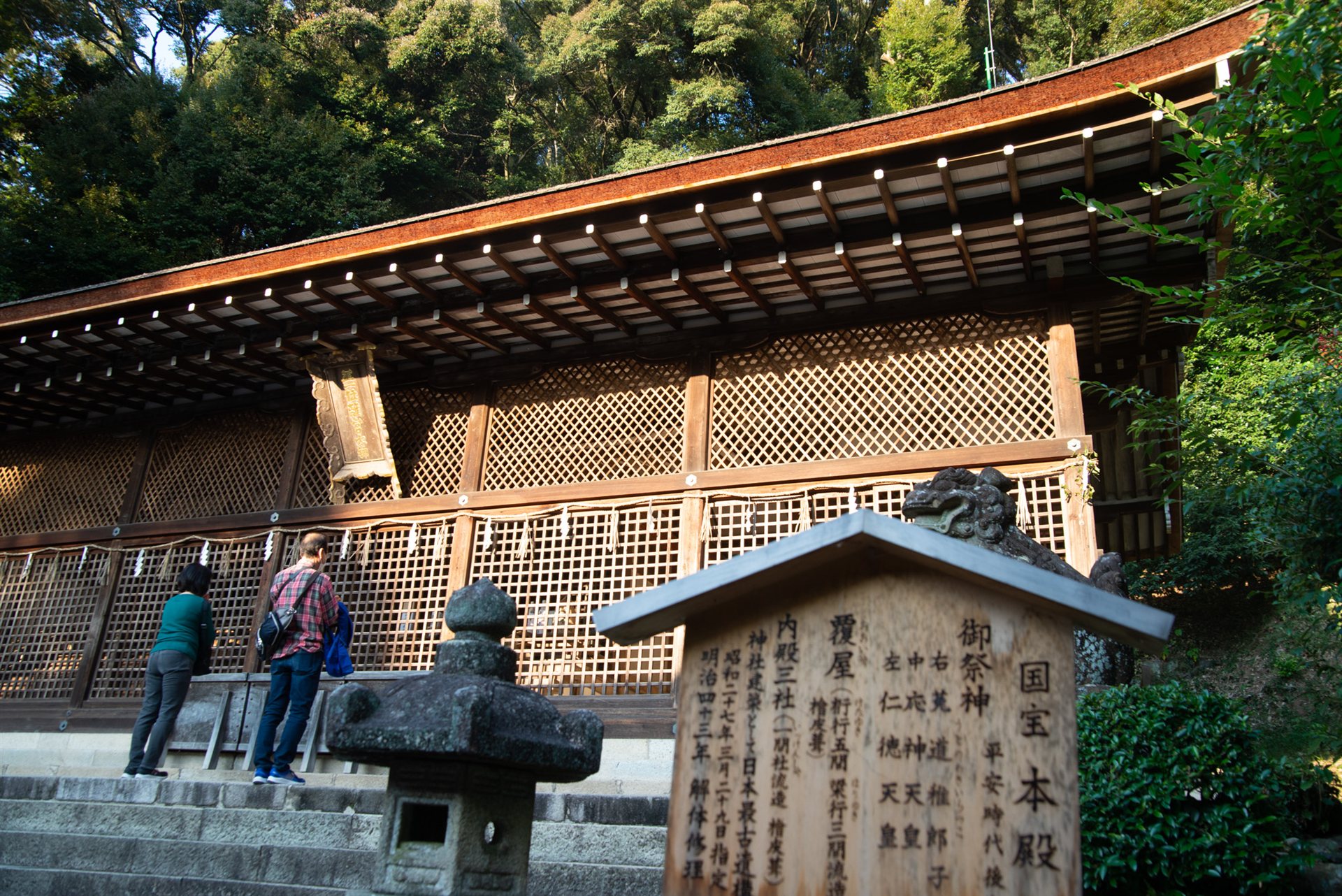
The main hall of Ujigami Shrine. The sign reads “National Treasure” (taken in November 2022).
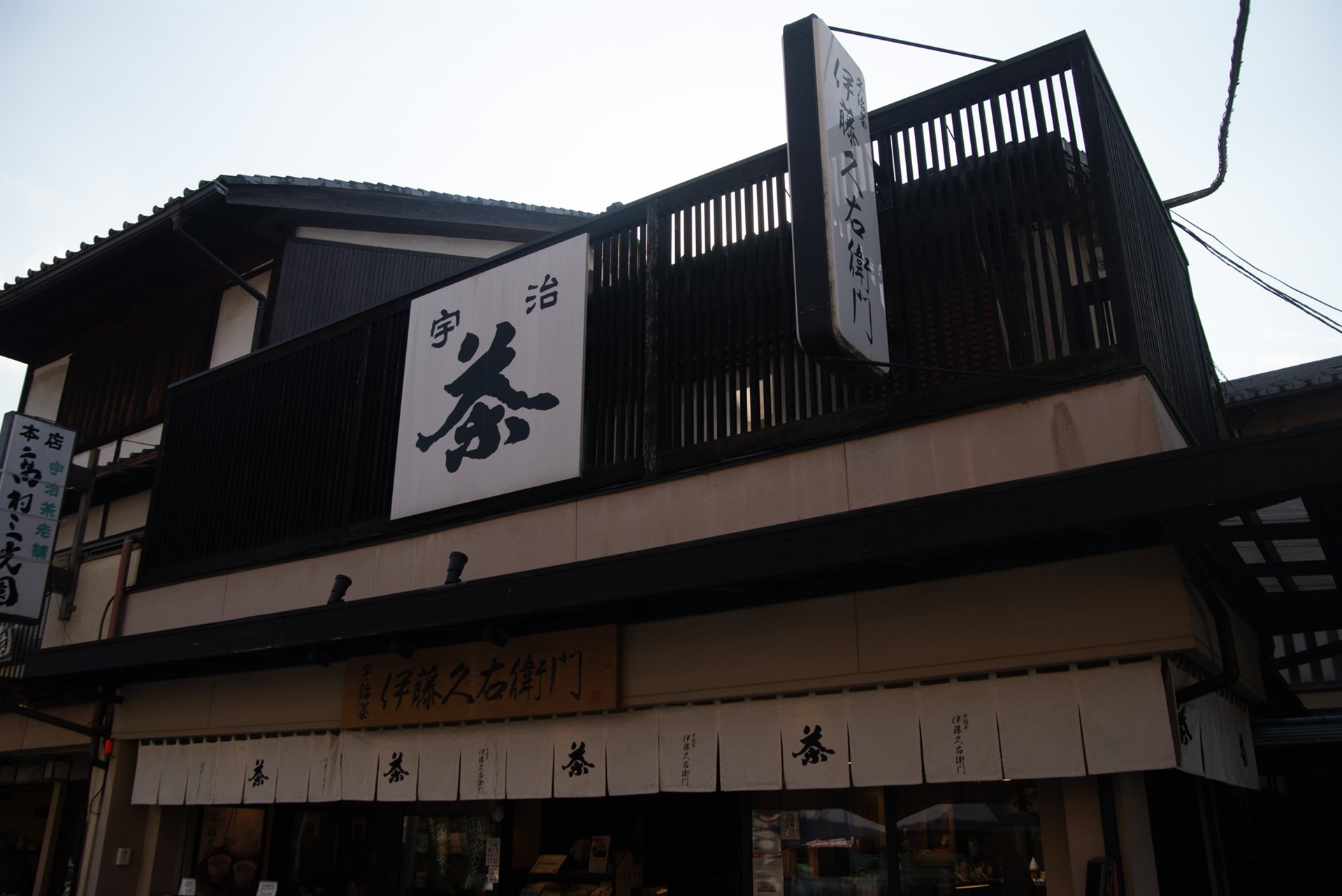
A tea shop with an Uji tea sign (taken in November 2022).
Uji is also known as the setting of “Sound! Euphonium.” Uji Bridge and the places around it are introduced in our “Sound! Euphonium” Pilgrimage Guide. For the flow of my trip around the Kansai region, please also see Kansai Travel Diary, Day 2 (Japanese).
Frequently Asked Questions About Byodo-in’s Phoenix Hall
How much is admission to Byodo-in’s Phoenix Hall?
Admission to the garden and the Hoshokan together is 700 yen for adults, 400 yen for junior high and high school students, and 300 yen for elementary school students. The interior tour of the Phoenix Hall requires a separate donation of 300 yen per person (checked on November 4, 2026).
Can I reserve the interior tour?
According to the official guide, sign-up is on a first-come, first-served basis on the day and takes place inside the garden. Each tour is limited to 35 people, and sign-up closes once the tours are full.
How much time do I need?
The official model courses are 50 minutes for the basic course and 90 minutes for the course that includes the interior tour and more. The waiting time for the interior tour gets longer depending on the season.
Is there night viewing at Byodo-in?
An announcement in September 2026 said that the special night viewing has been suspended. There are no plans to hold it in autumn 2026, and when it will resume has not been decided.
Summary
Byodo-in’s Phoenix Hall is an Amida hall built by Fujiwara no Yorimichi in 1053, and it is also known as the design on the 10-yen coin. After seeing the Phoenix Hall, Aji Pond, and the suhama garden, visit the Hoshokan to see the original phoenixes and the Bodhisattvas on Clouds. This makes it easier to understand how the building came to be.
The capacity of the interior tour changed to 35 people in October 2026, so sign up first once you enter. If you have time, also take a walk to Uji Bridge, Tonoshima Island, and Ujigami Shrine.
For the latest information, please check the official Byodo-in website (Japanese).
References (checked on November 4, 2026)
- Byodo-in official website: Visitor Guide (Japanese)
- Byodo-in official website: Phoenix Hall Interior Tour (Japanese)
- Byodo-in official website: History (Japanese)
- Kyoto Prefecture: World Heritage, Byodo-in (Japanese)
- Uji City: Guide to Public Transportation (Japanese)
- Ujigami Shrine official website: Visitor Information (Japanese)
コメント