Near Hikone Castle, two streets with different themes sit side by side: Yume-Kyobashi Castle Road, modeled on a castle town of the Edo period, and Yonbancho Square, themed on Taisho Roman (the romantic style of the Taisho era).
This article covers the highlights and history of the two streets, access from JR Hikone Station, and parking. I also introduce Ryotanji and Seiryoji, two temples at the foot of Mt. Sawayama.
The photos were taken on February 11, 2024. The shops and buildings may look different today. Information such as prices and hours was checked on November 4, 2026.
Yume-Kyobashi Castle Road, Lined with White Walls and Black Lattices
Yume-Kyobashi Castle Road starts right near Kyobashi, the bridge over the moat of Hikone Castle. The address is Honmachi, Hikone City, and the street is about 350 meters long. Its name comes from this Kyobashi bridge.
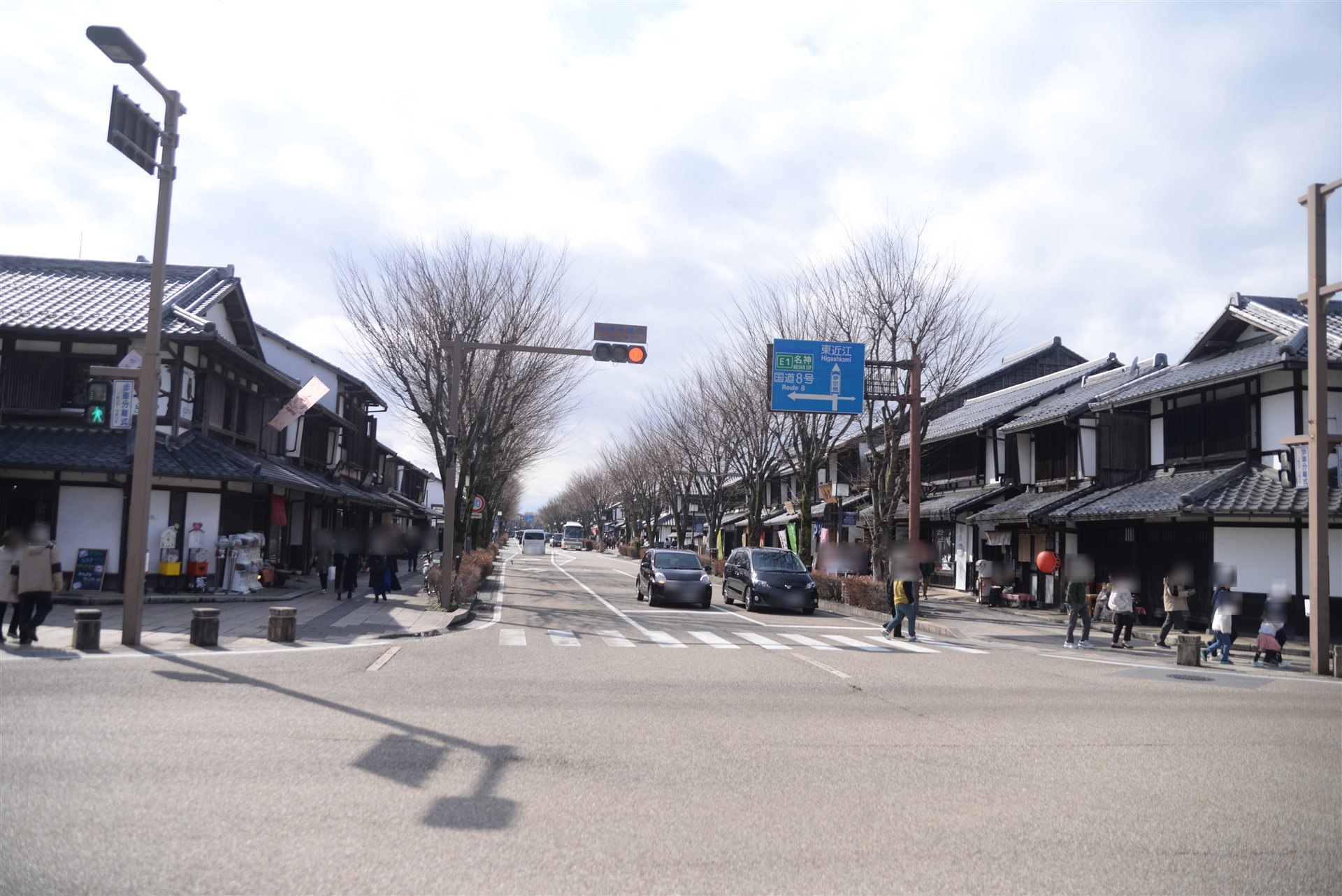
The street seen from the intersection. Townhouse-style buildings line both sides (taken in February 2024).
The Rules of the Streetscape: Gabled Roofs, White Walls, Black Lattices
What makes this street special is that the buildings share the same look. The Hikone Tourism Association describes it as a streetscape unified in a white-walled, black-latticed townhouse style, modeled on a castle town of the Edo period.
According to the street’s official website, the following are used:
- White walls
- Black lattices made with bengara (red iron oxide) mixed with soot
- Smoked roof tiles (ibushi-gawara)
- Gabled roofs with matching slopes
This is not a street where Edo-period buildings have survived as they were. It is a streetscape built around the image of an old castle town, and the street’s catchphrase is “OLD NEW TOWN.” When the road was widened, the power lines were buried underground, so you won’t see any overhead wires in the photos.
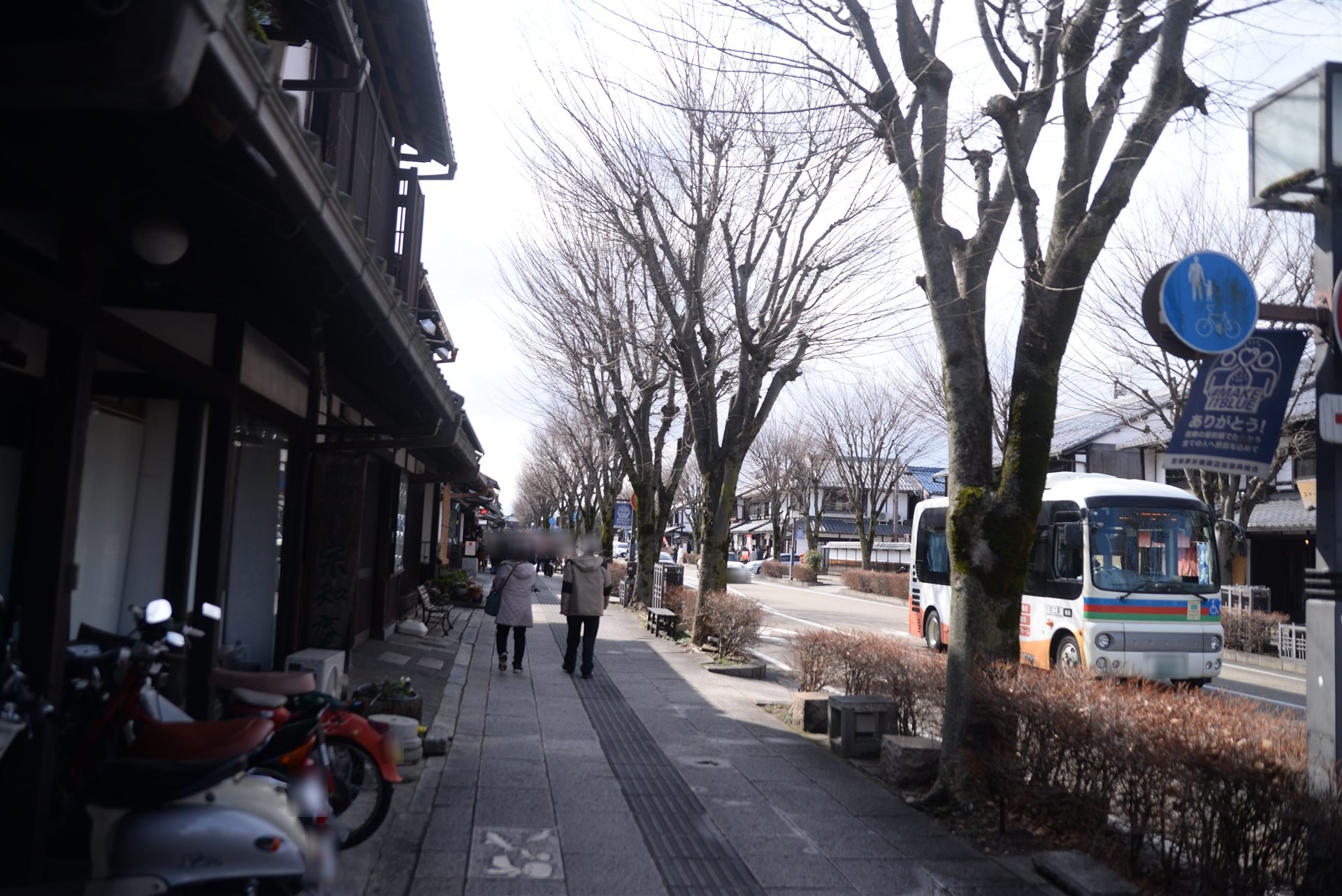
A row of trees runs along the sidewalk. In February, when I took the photo, the leaves had fallen.
Shops Selling Japanese Sweets and Local Specialties
The street is lined with shops selling Japanese and Western sweets, shops with local specialties, and places to eat. Shops change from time to time, so if there is a shop you want to visit, check the shop list on the street’s official website.
The street’s official website also tells the story of the beckoning cat (maneki-neko). It says that the beckoning cat is said to have begun when Ii Naotaka, the second lord of the Hikone Domain, was beckoned by a cat at Gotokuji Temple in Setagaya on his way back from falconry.
There were a great many people, and the street felt lively. The shop selling croquettes had lots of customers, so it took a little while to buy some.
Yonbancho Square, Themed on Taisho Roman
Right next to Yume-Kyobashi Castle Road is Yonbancho Square. The address is Honmachi 1-chome, Hikone City, and its theme is Taisho Roman.
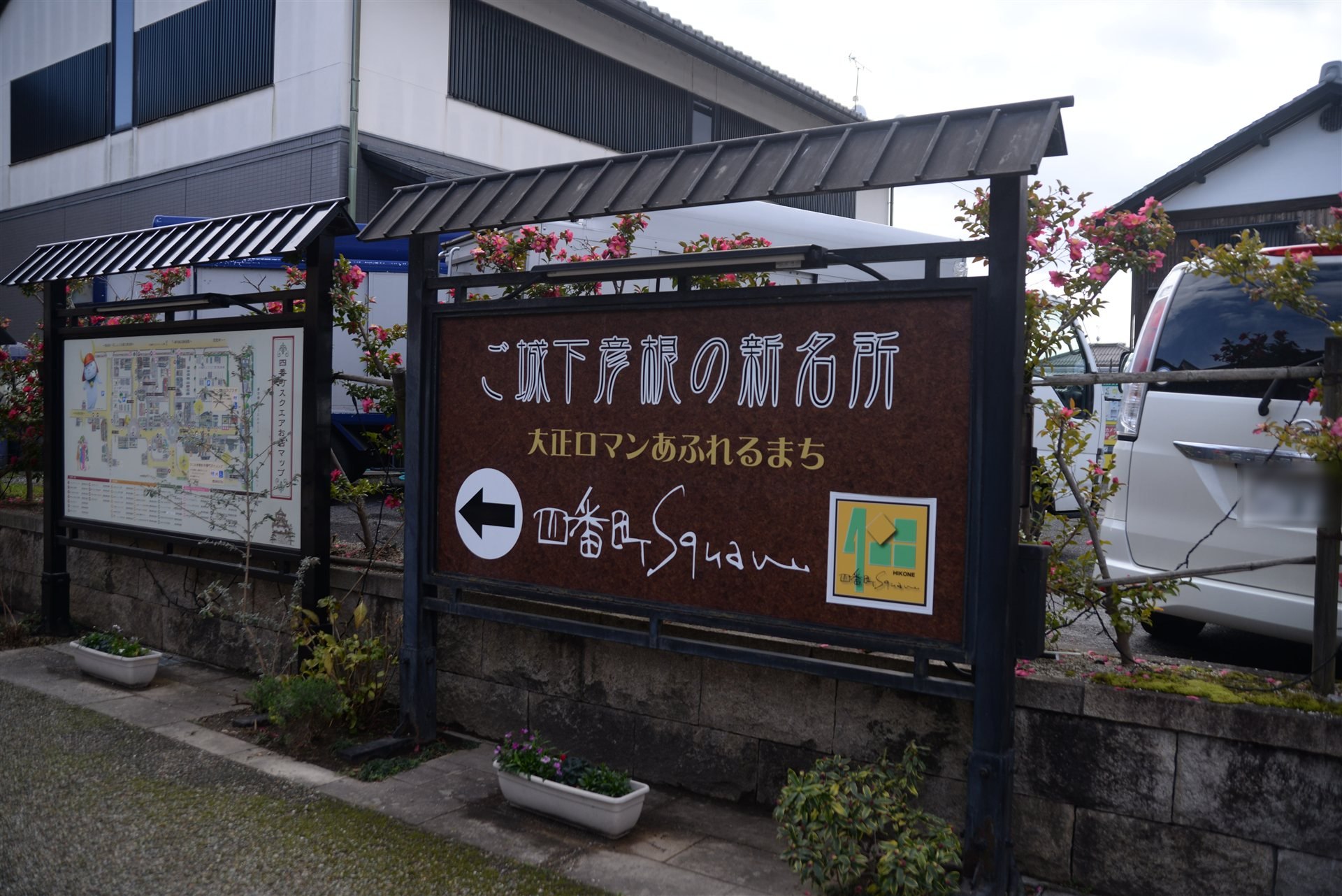
The Yonbancho Square sign. On the left is a map of the shops.
From a Market Shopping Street Known as “Hikone’s Kitchen”
Yonbancho Square began as a market shopping street that thrived as “Hikone’s Kitchen.” This shopping street was reborn as a new town.
Hikone City’s website describes how the area was revived:
- 1996 (Heisei 8): Young shop owners formed the “Geki no Kai” group
- 1998 (Heisei 10): The national government created the “Town Center Revitalization Land Readjustment Project” program
- Project name: Hikone City Honmachi Land Readjustment Project (planned area: 1.3 hectares)
According to the official website, the new town was completed in 2005 (Heisei 17).
Pseudo-Western Buildings and Gas Lamps
The shared design theme is “Taisho Roman.” According to Hikone City’s website, it combines pseudo-Western-style architecture of the Meiji and Taisho eras with modern architecture.
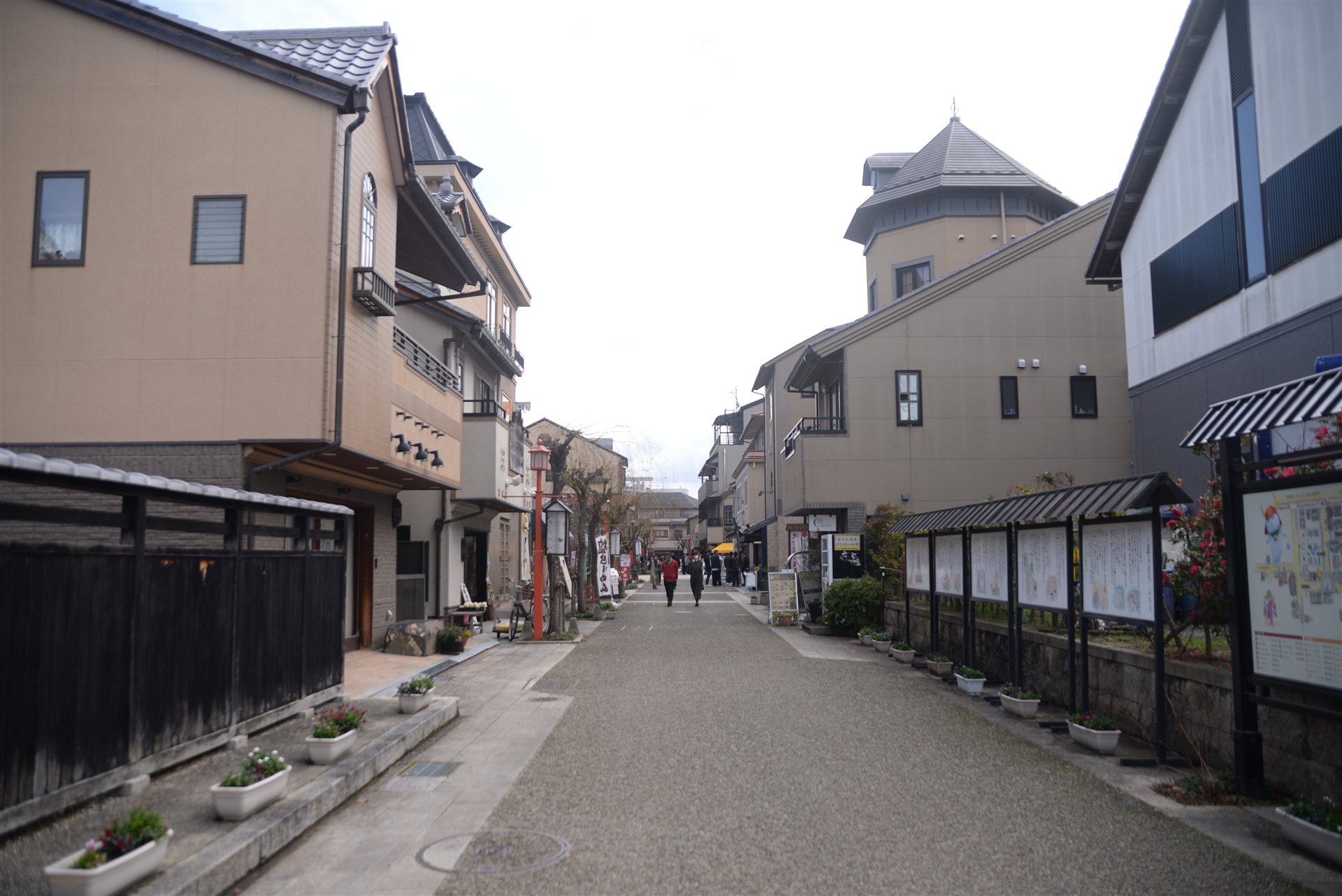
In the back you can see a building with a tower-like roof. In the front right is a map of the shops.
The plaza has gas lamps, and ambient sounds play along the street. Shiga Prefecture’s tourism website introduces this as a sound-based town project, in which “brain-friendly sounds” are played from the studio at Hikone Machinaka Plaza and from speakers around the town.
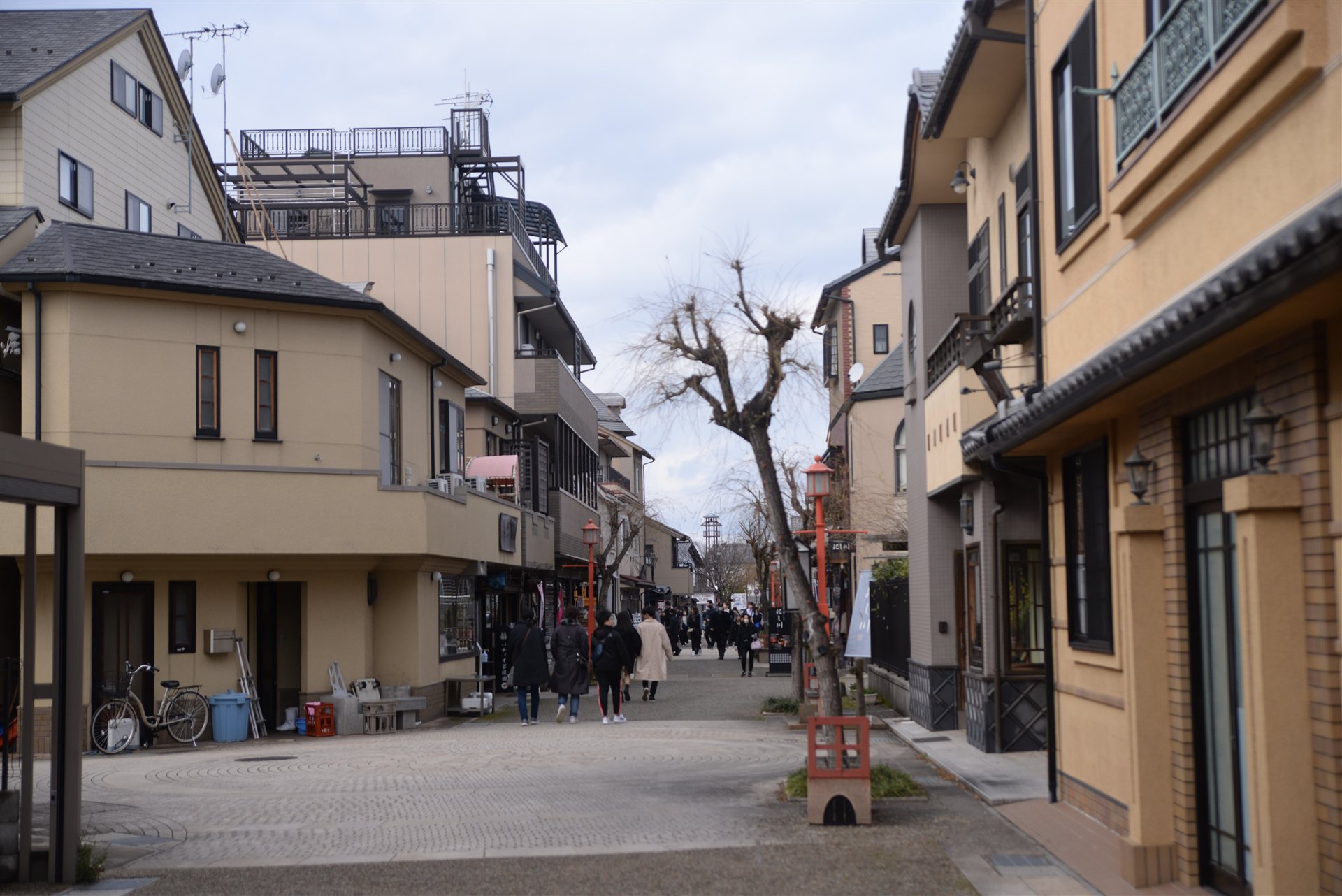
Circular-patterned paving and red street lamps. The street continues into the distance.
Opening hours vary by shop.
A Side Trip to the Temples at the Foot of Mt. Sawayama
At the foot of Mt. Sawayama, a little way from the castle town, there are temples connected with the Ii family. I took photos there right after the ones of the town, so I introduce them here as well.
Ryotanji Temple
Ryotanji is the family temple of the Ii family and belongs to the Myoshinji school of Rinzai Zen. According to tradition, the temple was founded by Gyoki in Iinoya in Totomi Province during the Nara period, and when Ii Naomasa became lord of Sawayama Castle, the monk Koten moved it to the foot of Mt. Sawayama. The sliding-door paintings in the abbot’s quarters are by Morikawa Kyoriku and are designated cultural properties of the city. The garden uses Mt. Sawayama as borrowed scenery.
- Address: 1104 Furusawa-cho, Hikone City
- Access: 25 minutes on foot from JR Hikone Station
- Visiting hours: 9:00–16:00
- Admission: Adults 400 yen, elementary and junior high school students 150 yen
- Contact: 0749-22-2777
(From Shiga Prefecture’s tourism information. Checked on November 4, 2026)
Seiryoji Temple
South of Ryotanji, at the foot of Mt. Sawayama, is Seiryoji. It is a Soto Zen temple and is introduced as the site of the grave of Ii Naomasa, the founder of the Hikone Domain.
Photos Taken at the Foot of Mt. Sawayama
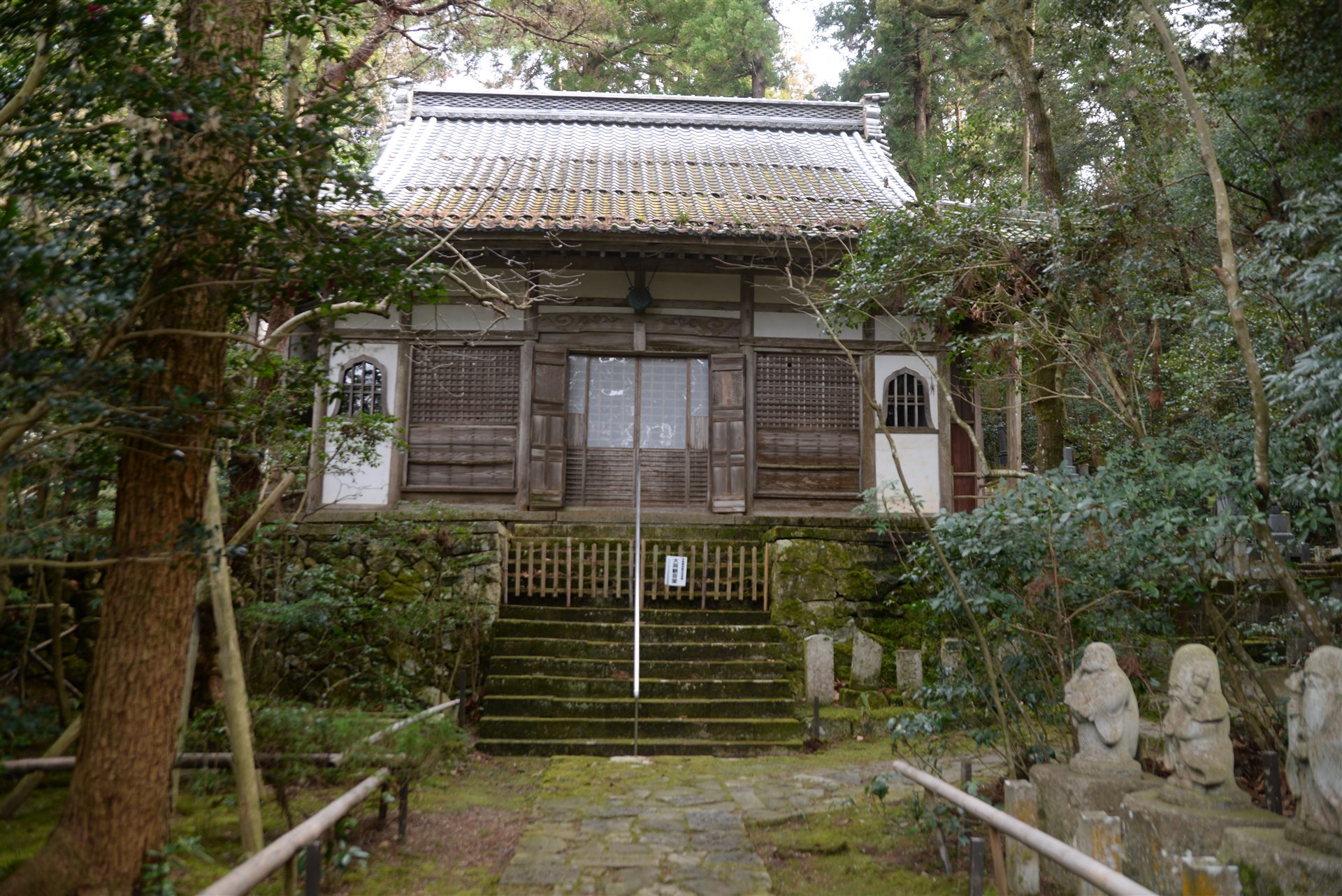
A hall at the top of mossy stone steps. Stone statues are lined up on the right.
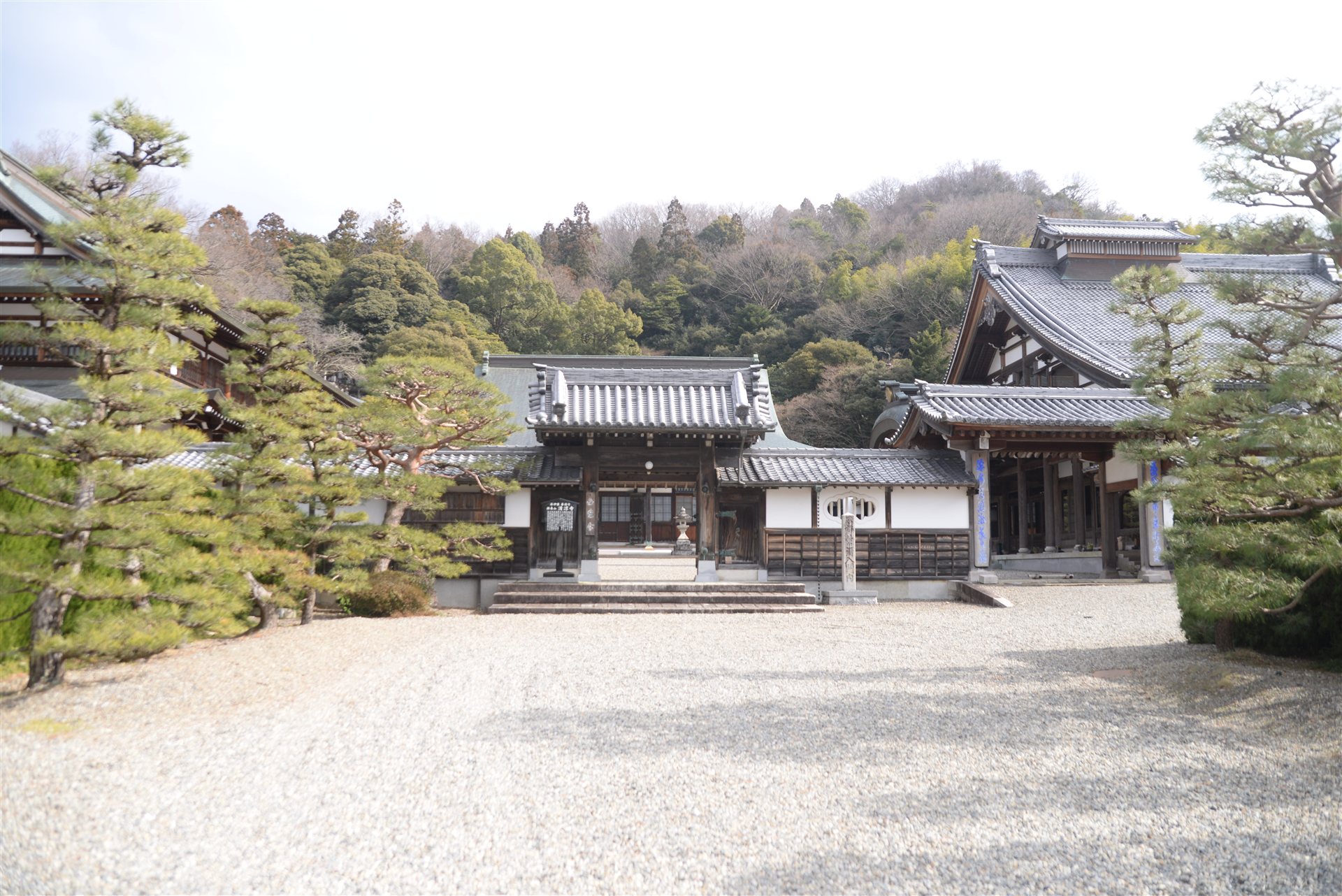
A gate stands at the back of the gravel garden, with pine trees in front.
I was the only visitor there, but every building had a sense of history, and there was a great deal to see. I recommend this place for anyone who wants to sightsee at a relaxed pace.
Access to Yume-Kyobashi Castle Road and Yonbancho Square
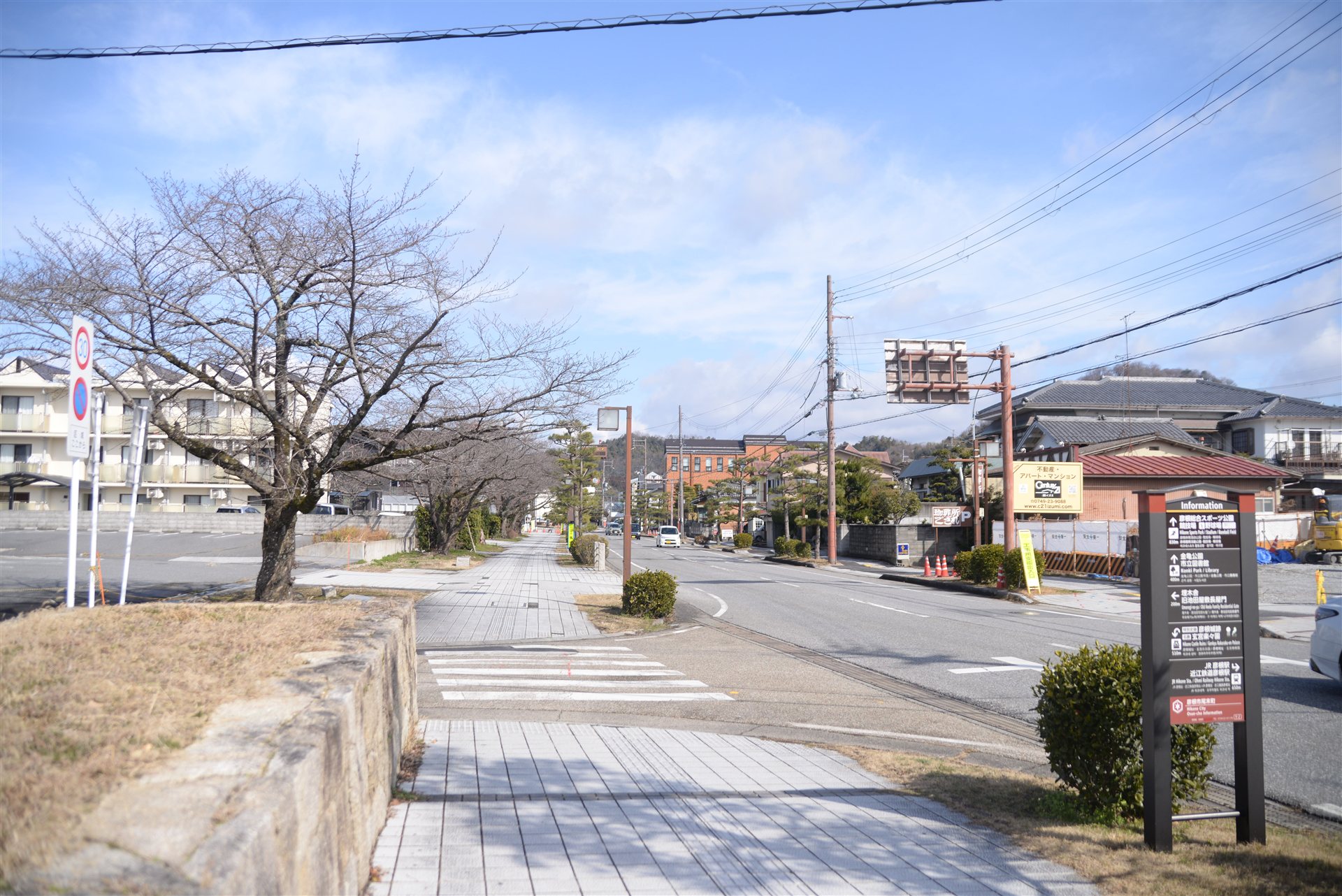
A guide sign in Osue-cho, Hikone City, showing the directions to the main places in town.
By Train: Walk from JR Hikone Station
The nearest station is JR Hikone Station. Walking times differ slightly depending on the source.
- To Yume-Kyobashi Castle Road: about 20 minutes on foot (guide supervised by the Hikone Tourism Association)
- To Yonbancho Square: 18 minutes on foot (Shiga Prefecture tourism information)
- To Hikone Castle: about 15 minutes on foot (Hikone Tourism Association)
According to the Hikone Tourism Association, train times to Hikone are as follows:
- From Osaka: about 80 minutes by JR Special Rapid Service
- From Nagoya: about 30 minutes by Shinkansen to Maibara
- From Tokyo: about 2 hours 10 minutes by Shinkansen to Maibara
If you are coming from Tokyo or Nagoya, change at Maibara to the JR Tokaido Line (Biwako Line).
By Bus: Hikone Junkan Line
The Hikone Junkan Line (loop line) local bus leaves from Stop 1 at JR Hikone Station and takes you to the Kyobashiguchi bus stop.
By Car: Kyobashiguchi Parking Lot
This parking lot near the streets is listed by the Hikone Tourism Association.
- Capacity: 160 standard cars, 10 large vehicles
- Hours: 24 hours for standard cars, 8:30–17:00 for large vehicles (open every day)
- Standard car rates: 400 yen for up to 1 hour. Up to 4 hours, 100 yen is added for every 30 minutes. Over 4 hours and up to 24 hours: 1,000 yen
- Large vehicles 2,000 yen, motorcycles 300 yen per day
Yonbancho Square also has a parking lot for 38 standard cars (Shiga Prefecture tourism information). I could not confirm the rates, so please check on site.
Frequently Asked Questions
What kind of places are Yume-Kyobashi Castle Road and Yonbancho Square?
Yume-Kyobashi Castle Road is a streetscape modeled on a castle town of the Edo period, and Yonbancho Square is a town themed on Taisho Roman. Both are in Honmachi, Hikone City, right next to each other.
Are the two streets close to Hikone Castle?
Yes. Yume-Kyobashi Castle Road is right near Kyobashi, the bridge over the moat of Hikone Castle. The official Hikone Castle website says the castle is open every day of the year. For admission fees and opening hours, please check with the Hikone Castle Management Center (0749-22-2742) or the official website.
Where can I get tourist information?
The Hikone Tourism Association lists the following information desks:
- Hikone City Tourist Information Center (inside JR Hikone Station): 0749-22-2954, 10:00–17:00 (until 16:00 from December to February)
- Hikone Tourist Center (Osue-cho): 0749-23-0033, 10:00–17:00 (until 16:00 from December to February)
- Hikone Tourism Association (Honmachi, inside Hikone Machinaka Plaza): 0749-23-0001, 9:00–17:30
Summary
In the castle town of Hikone, you can walk from Yume-Kyobashi Castle Road, modeled on the Edo period, straight on to Yonbancho Square with its Taisho Roman theme. Both are streets newly built around the image of a bygone era.
If you have time, you can also head to the foot of Mt. Sawayama, home to Ryotanji and Seiryoji, temples connected with the Ii family. In the town of Toyosato, about 13 minutes from Hikone on the Ohmi Railway, you will also find the Former Toyosato Elementary School Buildings, known as a pilgrimage site for “K-ON!” For details, see our article on the Former Toyosato Elementary School Buildings.
Official information can be found on the websites of Yume-Kyobashi Castle Road (Japanese), Yonbancho Square (Japanese), and the Hikone Tourism Association (Japanese). Please check the latest information before you go. (Checked on November 4, 2026)
コメント