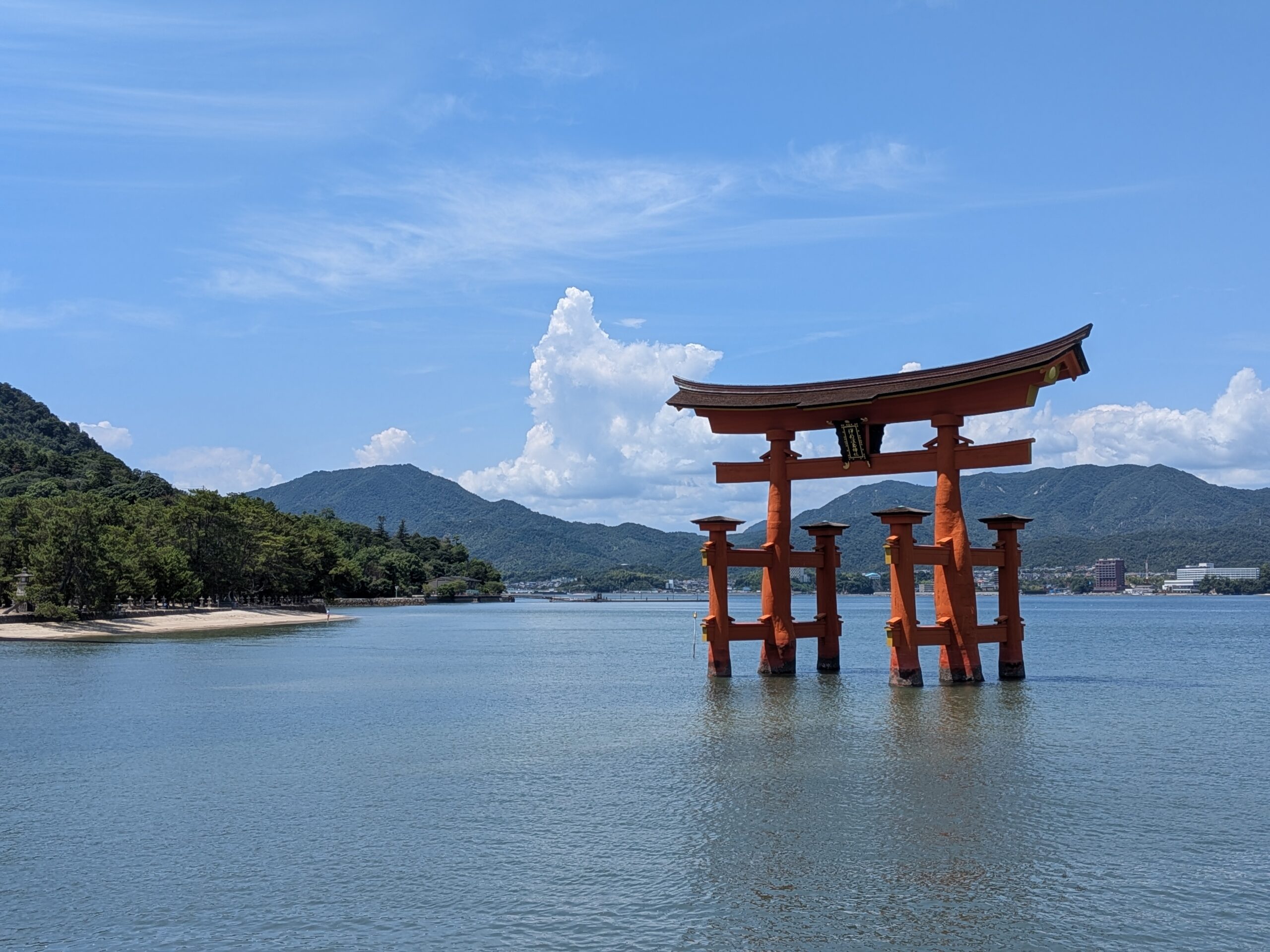
Famous for its vermilion torii gate rising out of the sea, Itsukushima Shrine is the symbol of Miyajima (“Shrine Island”), one of Japan’s Three Scenic Views, and the head shrine of roughly 500 Itsukushima shrines across the country.
Why does the shrine sit over the water, and who built it into the form we see today? This guide traces its history from its founding legend through Taira no Kiyomori’s rebuilding, the Sengoku-era reconstruction, and its UNESCO World Heritage listing.
- Key Facts
- Founded in 593 CE
- Taira no Kiyomori’s Reconstruction (Late Heian Period)
- Repeated Fires and Mori Motonari’s Reconstruction
- The Great Torii Gate Today
- Buildings Added During the Edo Period and After
- UNESCO World Heritage Status (1996)
- The “Reiwa Restoration” (2019–2022)
- Itsukushima Shrine Timeline
- FAQ
- Conclusion
Key Facts
- According to shrine tradition, it was founded in 593 CE, by the local chieftain Saeki no Kuraudo
- Its present sea-floating form was created by the Heian-era warlord Taira no Kiyomori
- The current main hall was rebuilt by Mori Motonari in 1571
- The shrine was inscribed as a UNESCO World Heritage Site in 1996
Founded in 593 CE
Shrine tradition dates the founding of Itsukushima Shrine to 593 CE, the first year of Empress Suiko’s reign. Saeki no Kuraudo, a local chieftain who governed the area, is said to have received a divine oracle from the three Munakata goddesses (Ichikishimahime, Tagorihime, and Tagitsuhime) and built the shrine in their honor, becoming its first head priest.
The three goddesses are worshipped as deities of the sea, transportation, wealth, and the arts.
Why Is the Shrine Built Over the Water?
Itsukushima Island (Miyajima) itself was long worshipped as a sacred, god-inhabited place, centered on the island’s holiest peak, Mount Misen. Because altering the island’s land was considered inappropriate, the shrine buildings were constructed jutting out from the shoreline over the sea rather than on solid ground.
Taira no Kiyomori’s Reconstruction (Late Heian Period)
The shrine’s present appearance — an elaborate shinden-zukuri palace complex floating on the water — was created by the late-Heian warlord Taira no Kiyomori.
Kiyomori was appointed governor of Aki Province in 1146, then governor of Harima Province in 1153, and is recorded as having visited the shrine in 1160. His devotion to Itsukushima only deepened from there.
Around 1168, after taking Buddhist vows, Kiyomori worked with the shrine’s head priest at the time, Saeki no Kagehiro, to rebuild the shrine into its current form. The bold design — a torii gate standing in the sea and shrine halls built along the shore — reflected both Miyajima’s importance as a hub of Seto Inland Sea trade and Kiyomori’s ambitions to expand trade with Song-dynasty China.
Kiyomori and the rest of the Taira clan became devoted patrons of the shrine, and it was during this era that the “Heike Nokyo” — a set of illuminated sutra scrolls dedicated by the Taira clan, now a National Treasure — was donated to the shrine.
Repeated Fires and Mori Motonari’s Reconstruction
After Kiyomori’s rebuilding, the shrine buildings were damaged by fire on multiple occasions over the following centuries.
Following the Battle of Miyajima (1555), fought on the island between Mori Motonari and Sue Harukata, Motonari rebuilt the shrine in 1571, faithfully preserving the architectural style of the original construction. This is the main hall that stands today, now a National Treasure.
The Great Torii Gate Today
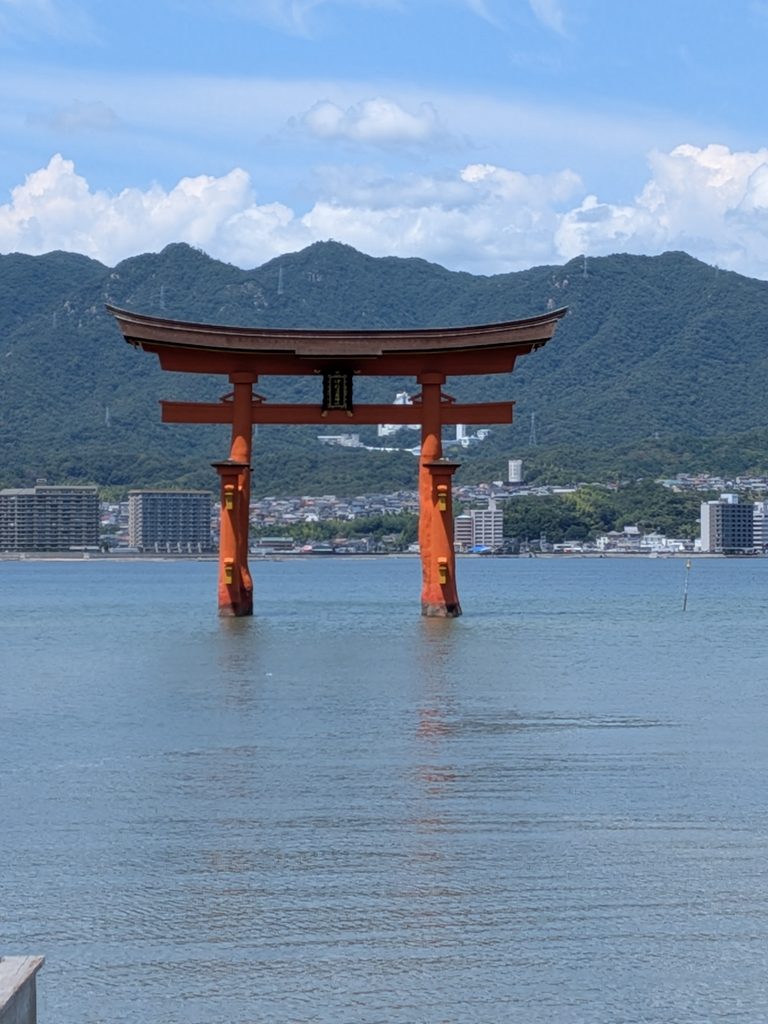
The gate took on its current six-pillar, ryobu-style design in 1547, when it was rebuilt by Ouchi Yoshitaka, who then ruled Suo and Nagato provinces. The torii standing today dates to 1875, and recent research has established that it is the ninth incarnation since Kiyomori’s era.
Buildings Added During the Edo Period and After
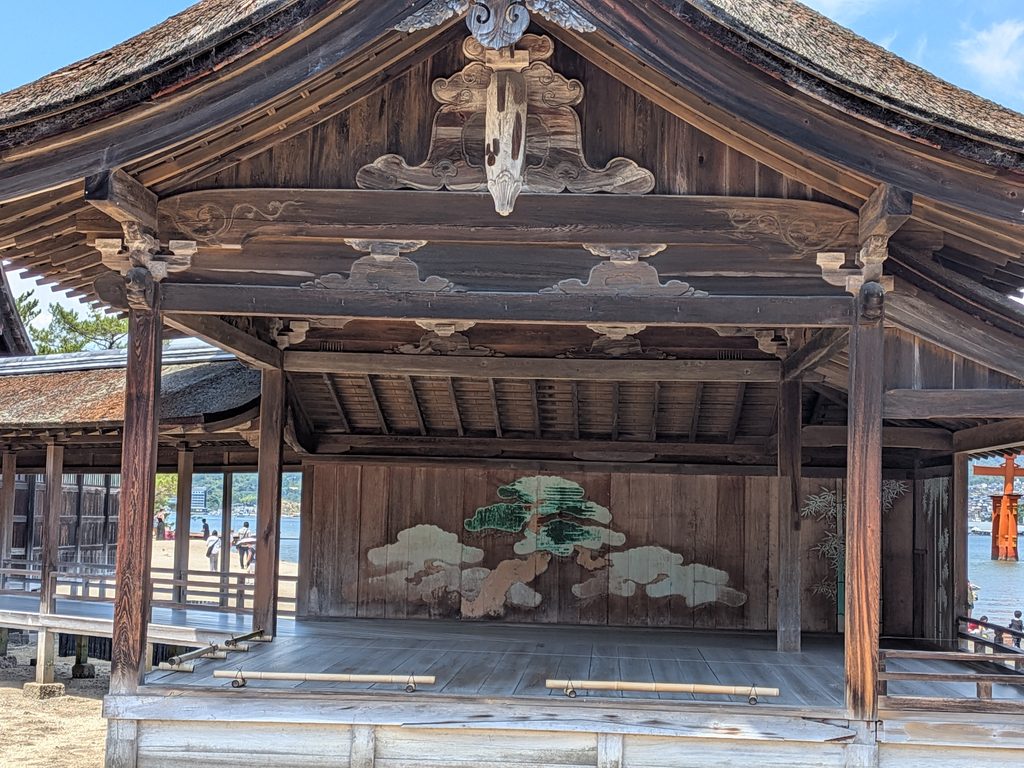
Beyond Kiyomori and Motonari’s work, further structures were added to the shrine complex over the centuries:
- Noh stage: Built in 1605 by Fukushima Masanori, lord of Aki-Hiroshima; later rebuilt by lord Asano Tsunanaga
- Tenjinsha (Tenjin Shrine): Founded in 1556 by Mori Takamoto
- Five-story pagoda: Built in 1407, blending Japanese and Chinese architectural styles
Many of these buildings are today designated National Treasures or Important Cultural Properties.
UNESCO World Heritage Status (1996)
Itsukushima Shrine was inscribed as a UNESCO World Heritage Site in 1996. The listed area covers about 14% of the island, including the shrine complex, the surrounding sea, and the primeval forest of Mount Misen behind it.
Today, six buildings — including the main hall, worship hall, and corridors — are National Treasures, and eleven buildings plus three structures, including the Great Torii and the five-story pagoda, are Important Cultural Properties. Coincidentally, Hiroshima’s Atomic Bomb Dome was inscribed as a World Heritage Site the very same year, giving the prefecture two UNESCO sites in a single year.
The “Reiwa Restoration” (2019–2022)
Due to age-related deterioration, the Great Torii underwent major restoration work starting in June 2019. After roughly three and a half years, the so-called “Reiwa Restoration” was completed in December 2022, restoring the gate’s vivid vermilion color.
Itsukushima Shrine Timeline
| Year | Event |
|---|---|
| 593 CE | Founded, according to shrine tradition, by Saeki no Kuraudo |
| 1146 | Taira no Kiyomori appointed governor of Aki Province |
| 1153 | Kiyomori appointed governor of Harima Province |
| 1160 | Kiyomori visits the shrine |
| c. 1168 | Kiyomori rebuilds the shrine into its present sea-floating form |
| 1407 | Five-story pagoda built |
| 1555 | Battle of Miyajima (Mori Motonari vs. Sue Harukata) |
| 1556 | Mori Takamoto founds Tenjinsha |
| 1561 | Mori Motonari rebuilds the Great Torii |
| 1571 | Mori Motonari rebuilds the main hall (still standing) |
| 1605 | Fukushima Masanori builds the Noh stage |
| 1875 | The current Great Torii is built (9th generation) |
| 1996 | Inscribed as a UNESCO World Heritage Site |
| 2019–2022 | “Reiwa Restoration” of the Great Torii |
FAQ
When was Itsukushima Shrine founded?
According to shrine tradition, it was founded in 593 CE by the local chieftain Saeki no Kuraudo.
Who built the shrine into its current form?
The late-Heian warlord Taira no Kiyomori, who rebuilt it around 1168 into a shinden-zukuri complex floating over the sea.
When was the current main hall built?
In 1571, when Mori Motonari rebuilt it faithfully in the shinden-zukuri style Taira no Kiyomori had built, following the Battle of Miyajima.
When did the shrine become a World Heritage Site?
In 1996. Hiroshima’s Atomic Bomb Dome was also inscribed as a World Heritage Site the same year.
Why is the shrine built over the water?
Miyajima itself was worshipped as a sacred, god-inhabited island, so altering its land was considered inappropriate. The shrine was instead built extending out over the sea from the shoreline.
Conclusion
From its legendary founding in 593 CE, through Taira no Kiyomori’s dramatic redesign and Mori Motonari’s Sengoku-era reconstruction, Itsukushima Shrine has carried more than 1,400 years of history into its present form. Since its 1996 UNESCO listing, and through the recent Reiwa Restoration, its beauty continues to be carefully preserved.
When you visit Miyajima, take a moment to reflect on this long history as you approach the shrine.
コメント